

In March 2023, a maintenance crew at Luke Air Force Base left a flashlight inside an F-35A engine inlet. During the subsequent engine run, the flashlight was ingested, causing an estimated $3,933,106 in engine damage. The investigation found two specific failures: an incomplete inlet inspection and no tool-kit inventory before the run.
The FOD prevention checklist existed. The barriers it described didn’t fire.
That gap between form and execution is where foreign object debris incidents actually happen. Not because organizations lack a checklist, but because the checklist doesn’t connect to the moment a tool goes missing, an opening gets sealed, or debris migrates from a construction zone into a live operating area. If you manage an airfield, run an MRO operation, or supply parts into an aerospace OEM, this is the version of the FOD prevention checklist that survives an audit and, more importantly, prevents the incident that triggers one.
What One Misplaced Item Can Cost
Before the checklist, the stakes. Three incidents show three different failure modes. None involved missing paperwork.
Concorde Flight 4590: someone else’s debris
On July 25, 2000, a metal strip lost by a departing DC-10 sat on the runway at Charles de Gaulle. The Concorde hit it on takeoff. The tire blew. Debris ruptured a fuel tank. Fire brought the aircraft down. 113 people died because one operator’s maintenance failure produced a piece of FOD that another operator’s crew could not detect at rotation speed.
KC-46: fixed, then broken again
In 2019, the U.S. Air Force stopped accepting KC-46 tankers after discovering tools and debris inside closed compartments. Boeing added inspections, training, and clean-as-you-go practices. Deliveries resumed March 11. On March 23, the Air Force halted acceptance again. Air Force Secretary Heather Wilson called it a manufacturing-discipline breakdown.
Luke F-35A: the $3.9 million flashlight
The flashlight wasn’t exotic. It was a standard maintenance item nobody accounted for. The investigation traces the failure to specific procedural steps that were skipped, not to an absence of rules. The engine, a $14 million asset, survived with $3.9 million in damage because the flashlight happened to miss certain critical components. Luck is not a control.
The aggregate picture
The FAA’s 2023 cost-benefit analysis estimates the global economic burden of FOD at up to $22.7 billion annually, spanning damage, delays, and associated losses. The runway FOD detection systems market alone is projected at roughly $190 million in 2026, growing toward $345 million by 2034.
Those aggregate numbers don’t tell you whether your facility’s problem is a missing wrench or a construction bolt. Your checklist needs to match your exposure, not a global statistic.

Frameworks That Define Your FOD Program
Not every checklist item is legally mandatory. Confusing advisory guidance with regulatory requirements (or missing a contractual flow-down) creates either false confidence or unnecessary burden. Here is what actually applies and where:
| Framework | Scope | What it means for your checklist |
|---|---|---|
| 14 CFR 139.305 and 139.327 | Binding requirements for covered U.S. airport certificate holders: prompt debris removal, daily and event-triggered inspections, record retention | Build specific inspection triggers (daily, unusual conditions, post-incident) into scheduling; maintain records for 12+ months (inspections) and 24 months (training) |
| FAA AC 150/5210-24A (Feb 2024) | Advisory (not regulatory) guidance for airport FOD programs, equipment, construction controls, and record-keeping | Structure the full prevention-detection-removal-evaluation cycle; retain program records for at least two years |
| IAQG 9146 | Supply-chain FOD program requirements that aerospace customers invoke contractually | Check your purchase orders for flow-down clauses; non-compliance can mean lost contracts |
| AIA NAS412 (revised Aug 2023) | Updated aerospace prevention guidance adding risk assessment, non-standard work content, and traceability | Reassess unusual work, not just routine production tasks |
| NASA MSFC-STD-3598 Rev D | Graded FOD zones (Awareness, Control, Critical) with escalating item controls for sensitive hardware | Match inspection rigor to hardware sensitivity; increase controls near flight-critical components |
These frameworks are complementary. An airport pavement inspection doesn’t verify that a mechanic accounted for every tool inside an aircraft. A manufacturing clean-room standard doesn’t cover a construction vehicle crossing a taxiway. Build your checklist against the frameworks that match your actual operations, and know which controls are contractually mandated versus voluntarily adopted.
The 15-Step FOD Prevention Checklist
This checklist synthesizes controls from FAA, NASA, and NTSB guidance into a sequence that works across airfield, maintenance, and manufacturing settings. Adapt it to your specific procedures, risk classification, and contractual requirements.
For each step, record Pass / Fail / N/A, supporting evidence, the corrective-action owner, and closure verification. Header the form with: site or asset identifier, work order or inspection route, date and shift, area risk classification, applicable procedure, inspector name, and responsible supervisor.
| Step | Action | Pass condition | If not met |
|---|---|---|---|
| 1 | Define responsibility | Area, task, owner, and applicable FOD controls identified before work begins | Resolve ownership before starting |
| 2 | Baseline the area | Work surface, access routes, equipment, and exposed hardware inspected; pre-existing conditions documented | Remove or isolate hazards; document existing damage |
| 3 | Control personal items | Required PPE secured; unauthorized loose personal items excluded from the controlled area | Remove or secure items before entry |
| 4 | Inventory tools | All required tools recorded; missing items visually obvious through shadow boards, foam inserts, or equivalent control | Reconcile discrepancies before the task proceeds |
| 5 | Account for consumables and hardware | Fasteners, rags, wire ties, cut-off material controlled via counted kits or containers | Recover and reconcile unexplained items |
| 6 | Protect openings | Covers, caps, and plugs fitted on all exposed hardware; removal sequence controlled | Protect exposed hardware and inspect for contamination |
| 7 | Secure material in transit | Packaging intact, loads secured, loose items contained during transport | Repack or secure before movement |
| 8 | Control construction and vehicle traffic | Designated routes followed, loads covered, tires inspected before entering aircraft operating areas | Correct the source; increase inspections at crossing points |
| 9 | Clean as you go | Generated debris removed after each operation, before it migrates into hardware or operating areas | Pause the task and restore a clean condition |
| 10 | Inspect at required triggers | Daily, shift-change, unusual-condition, and post-incident inspections completed per applicable procedures | Perform the missed inspection; assess exposure since the last verified check |
| 11 | Match removal to material | Equipment matches the debris type and surface; collection verified | Change methods if debris remains (magnetic sweepers miss non-ferrous material) |
| 12 | Escalate missing items immediately | Lost tools, broken fragments, and unexplained count discrepancies reported as soon as discovered | Hold affected task or operation pending approved resolution |
| 13 | Verify before closing access | Area inspected and items reconciled before panels, cowlings, or compartments are sealed | Investigate; obtain an independent check where appropriate |
| 14 | Complete handoff | Tools reconciled; outstanding conditions communicated to the next responsible person | Keep unresolved discrepancies open and assigned |
| 15 | Close the feedback loop | Location, material, source, action, owner, and closure recorded; data analyzed for patterns | Investigate recurrence; revise controls |
Steps 4 and 12 are where most maintenance incidents originate. The Luke F-35A investigation traces the failure directly to an incomplete tool inventory (step 4) and no escalation of the discrepancy (step 12) before the engine run. Step 13 is where the KC-46 program failed twice: compartments sealed without verified reconciliation, debris hidden until the next acceptance inspection.
NTSB Safety Alert SA-054 specifically recommends inventories before and after maintenance, organized storage that makes missing items visually obvious, clean-as-you-go practices, and a second mechanic’s inspection where appropriate. Those recommendations map to steps 4, 9, 13, and 14 above.
Three Patterns That Break Even Good Checklists
The checklist is necessary. By itself, it is not sufficient. These failure modes survive a complete-looking form.
Signature without execution
The F-35A investigation doesn’t suggest the maintenance team was negligent across the board. Specific steps were skipped under operational pressure, and the checklist signature didn’t force a pause. When tool inventory is recorded but not performed, the barrier is theatrical. The fix: make inventory a hold point. No verified count, no engine run. Period.
Fix, relapse, repeat
Boeing implemented corrective actions after the first KC-46 halt. Additional inspections. Training refreshers. Clean-as-you-go emphasis. Twelve days later, the same failure mode reappeared. Corrective actions that address symptoms (add an inspection layer) without fixing root causes (why are tools ending up in closed compartments in the first place?) produce temporary compliance, not permanent change.
Your debris, someone else’s catastrophe
Concorde reminds us that FOD is a system-level failure. The metal strip came from a different aircraft, a different airline, a different maintenance organization. If your checklist only covers your own workspace, you are trusting that every other operator sharing that runway or ramp has their program working perfectly too. Airport-wide FOD programs exist precisely because that assumption kills people.
The items nobody checks
Most checklists focus on visible objects: tools, bolts, rags, safety wire. Several categories routinely escape visual inspection:
- Non-ferrous debris (aluminum shavings, plastic fragments, composite dust) that magnetic sweepers simply do not collect
- Broken tool fragments where the pieces don’t reconstruct into a whole tool, so the count appears correct
- Chemical residues from cleaning solvents or sealants that compromise surfaces without being visible as “objects”
- Construction dust in hangars undergoing renovation, migrating through temporary barriers into active work areas
NASA’s graded-zone approach addresses this by escalating controls based on hardware sensitivity. In a Critical Zone, item-control and inspection requirements are far more stringent than in an Awareness Area. If your checklist applies the same scrutiny to a parking apron and an engine test cell, it is not calibrated to actual risk.
Closing the Gap: Connected Tool Control
The most consequential development in FOD prevention isn’t a new radar or a faster sweeper. It is connecting tool accountability to task closure so that a discrepancy stops the work, not just generates a report for someone to find later. This integration is especially critical during aircraft turnaround operations, where time pressure can tempt crews to skip verification steps.
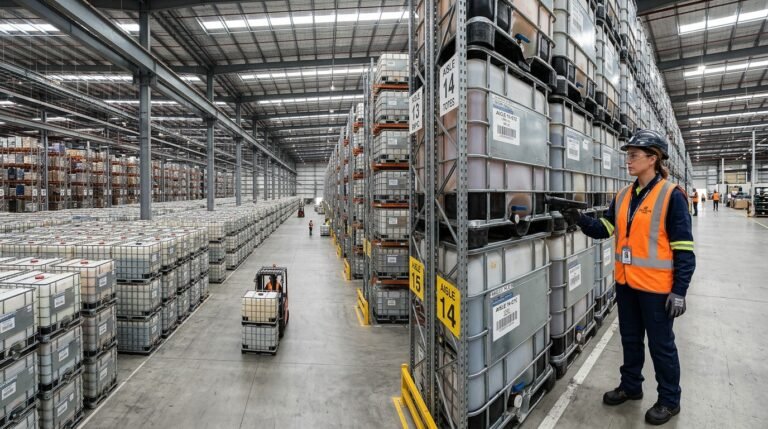
In May 2025, Prince Aviation deployed nine camera-equipped Snap-on Level 5 workstations that record drawer contents, track tool movements by user, monitor calibration status, and integrate with their Quantum Control maintenance software. A missing screwdriver becomes visible before the panel goes back on, not during next week’s audit.
This shifts tool accountability from a periodic count to a continuous state. The checklist step “inventory tools” becomes something the system enforces, not something a technician self-certifies under time pressure.
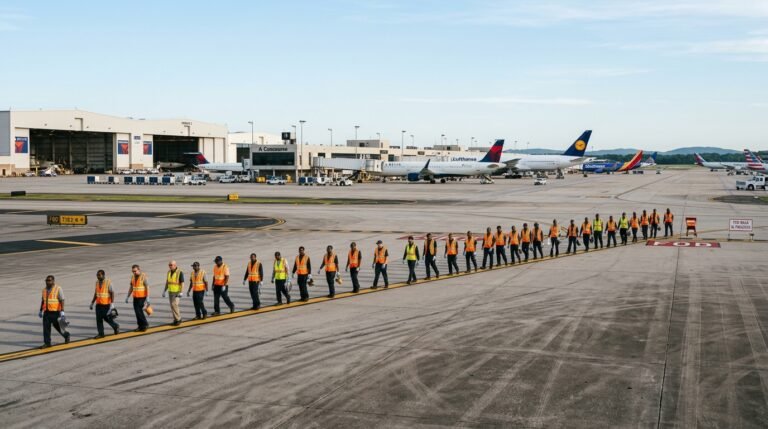
At the airfield level, Charlotte Douglas International Airport runs daily informal inspections alongside organized FOD walks, tracking and weighing collected debris to identify recurring sources. Their March 2026 walk recovered 246 pounds; the May walk recovered nearly 65 pounds. The absolute weight matters less than the trend data and the source analysis that follows.
The same logic applies to ground equipment, engine covers, and maintenance stands. If an asset can be tracked through its full operating cycle (not just checked out and checked back in), the system knows where it is in real time. When something goes missing, the search narrows from “somewhere on the airfield” to a specific location and time window. That is the difference between a 30-minute tool hunt and a $4 million engine repair. Advanced airport telematics enable this level of visibility across ground support equipment and maintenance assets. These systems, including IoT-based asset trackers and DO-160 approved devices for airfreight and aviation environments, start paying for themselves in operational dollars rather than compliance checkboxes.
Detection and Removal: Layers, Not Replacements
Fixed radar systems (Xsight FODetect, Moog Tarsier, Trex FOD Finder) provide continuous or near-continuous monitoring of runway surfaces. They detect and locate objects. They do not remove them. They do not reconcile a mechanic’s missing wrench inside an aircraft. They are a detection layer that triggers a removal response.
AI-based classification is progressing, but a January 2025 research review identifies persistent challenges: limited training datasets, environmental variability, underrepresentation of rare objects, and the accuracy-versus-speed trade-off. A March 2026 report describes initial AI deployments at Indian airports, but without published operational results from identified installations.
The FAA’s drone research tells a similar story. A September 2024 study achieved 96% detection on specified test objects but could not resolve false positives, processing time, low-light performance, or inclement-weather operations. High detection in a controlled test is not the same as operational reliability.
Stack layers according to your demonstrated failure mode. If your problem is tools left inside aircraft, invest in tool accountability systems. If your problem is construction debris reaching the movement area, address source controls and targeted sweeping. If your runway has long intervals between inspections and high traffic, persistent sensing shortens the exposure window. Technology fills a specific gap. It does not replace the chain of prevention, detection, removal, and evaluation that the FAA outlines as the governing cycle.
A FOD prevention checklist that stops at a signature is paperwork. The version that prevents incidents connects every step to a verified condition, an accountable owner, and a system that flags what is missing before it can cause harm. If your operation still relies on manual counts and paper forms for high-value aviation assets, that visibility gap is worth closing. Talk to our team or reach us at info@datanetiot.com.

Frequently Asked Questions
Does FOD stand for debris or damage?
Both usages exist in the industry. “Foreign object debris” refers to the unwanted material. “Foreign object damage” refers to the harm it causes. Your checklist should record every discovery, even when no damage occurs, because debris that was harmless today may cause damage tomorrow if left in place.
How often should FOD inspections happen?
For covered U.S. airports, 14 CFR 139.327 requires daily inspections, additional checks during unusual conditions, and immediate inspection after accidents or incidents. Maintenance and manufacturing environments need task-based checks: before starting work, at shift changes, and before closing access to compartments.
Is FAA advisory circular guidance legally mandatory?
No. AC 150/5210-24A states explicitly that its guidance is advisory, not regulatory. Binding requirements come from applicable regulations (Part 139), approved airport operating procedures, airworthiness directives, and contractual obligations such as IAQG 9146 flow-downs. Know which controls are required for your operation and which are adopted best practices.
What should happen when a tool goes missing?
Report it immediately. Hold the affected task or operation until the item is found or an authorized resolution process is completed. NASA’s standard also requires escalation when broken-tool fragments cannot be fully accounted for. Never assume a missing item is harmless without evidence.
Can a magnetic sweeper handle all FOD types?
No. Magnetic equipment collects ferrous metals only. Aluminum, plastic, composite fragments, fabric, and other nonmetallic debris require mechanical sweeping, vacuum collection, friction mats, or manual pickup. Match your removal methods to the debris your operation actually generates.
Will AI detection eventually replace FOD walks and inspections?
Not in the near term. AI detection can reduce intervals between discovery events, but current systems face challenges with environmental variation, false alarms, and rare-object recognition. The FAA’s 2026 guidance treats drones and autonomous vehicles as active research, not validated replacements. The strongest programs layer automated detection on top of human inspection and physical response, not in place of them.





 +1 508 292 2210