

More than 1.2 million hazardous-material shipments move through the U.S. every day. Search for how to track hazmat containers and you’ll find pages of federal code: labeling requirements, segregation tables, manifest procedures. All necessary. None of it tells you where a specific container is right now, what condition the cargo is in, or who has custody at this moment.
A GPS dot on a map doesn’t solve it either. A coordinate proves where the tracker is. It doesn’t prove what’s inside the container, whether the product temperature is within limits, or whether anyone has formally accepted responsibility. The 2023 East Palestine derailment made this painfully visible: location data existed, but critical cargo information never reached the people making emergency decisions.
Here’s the framework I use when working with chemical fleet operators and industrial supply chains: how to build a hazmat tracking program that connects identity, position, condition, and custody into something that actually protects your operations.
Tracking a Hazmat Container Means Four Things at Once
Most tracking conversations start and end with “where is it?” That’s one layer out of four. For hazmat containers, you need all of them working together before the data is operationally useful.
| Layer | What it answers | Example |
|---|---|---|
| Identity | Which specific container? | BIC number, drum serial, cylinder barcode |
| Location | Where is it right now? | GNSS coordinates, yard zone, port terminal |
| Condition | Is the cargo still safe? | Temperature, pressure, fill level, shock, door status |
| Custody | Who holds responsibility? | Signed manifest, scan event, digital handoff record |
The most common mistake I see in hazmat tracking programs isn’t choosing the wrong hardware. It’s skipping identity. Companies mount trackers on containers without a clean asset register connecting each unit to its cargo, manifest, and responsible party. Then they wonder why the dashboard shows coordinates but can’t answer the question that matters during an incident: what’s inside?
A critical distinction here: the BIC container identification number (owner prefix, equipment category, serial, check digit) identifies the physical container. The UN or NA identification number identifies the hazardous substance inside it. Your system must connect both. When either is missing or mismatched, your tracking data has a hole right where it matters most.
When any one of these four layers is absent, you have partial information. And partial information about hazardous materials is where expensive problems start.
What Each Tracking Technology Actually Proves
Different technologies produce different kinds of evidence. Before comparing vendors, understand the evidence you need. A scan proves an identification event at a reader. A location report concerns the tracker. A signed manifest concerns a documented transaction. Each is useful. None replaces the others.
| Technology | Best role | What it proves | Main limitation |
|---|---|---|---|
| Barcode / Data Matrix scanning | Controlled handoff confirmation | This asset was here at this time | No event unless someone scans |
| Passive UHF RFID | Automated portal identification | Asset passed through a reader zone | Requires reader infrastructure and engineered read zones |
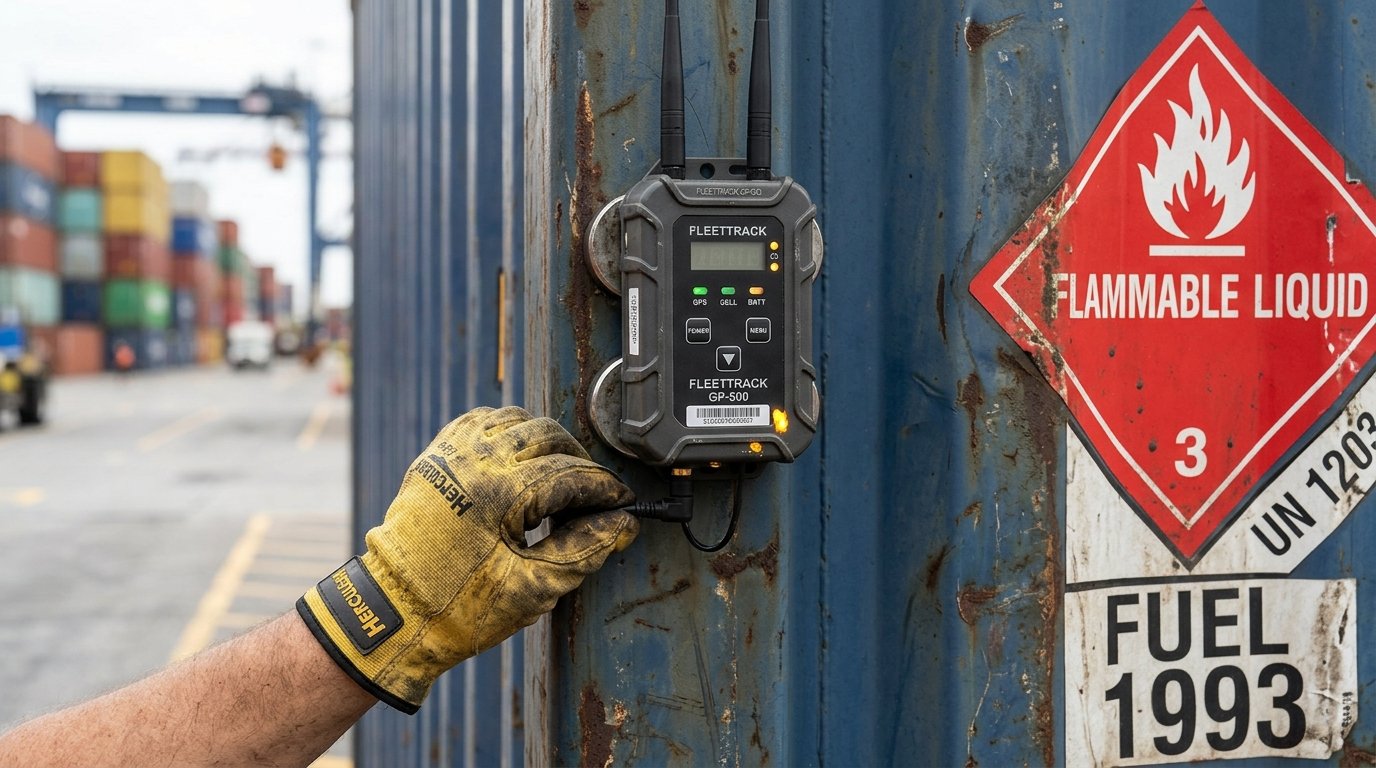
| GNSS + cellular tracker | Independent location reporting | The tracker was at these coordinates | Metal walls, stacking, and coverage gaps degrade performance |
| RFID + local network (LoRa, Wi-Fi) | Yard/warehouse identity with measurements | Asset identified with associated weight, movement, or event | Requires engineered gateways and event logic |
| Cellular + satellite backup | Remote or ocean movements | Extended communication reach | Device-specific; not all models include satellite |
| Electronic manifest or custody platform | Legal transfer documentation | Acceptance, signatures, exceptions | Does not establish continuous physical location |
One reality that trips up first-time buyers: GPS signals degrade inside steel containers. Metal walls, stacked configurations, indoor storage, and dense port yards all affect reception. Antenna placement, mounting orientation, and reporting frequency (which trades directly against battery life) are engineering decisions, not afterthoughts. Test with real containers under actual operating conditions before committing to a fleet rollout.
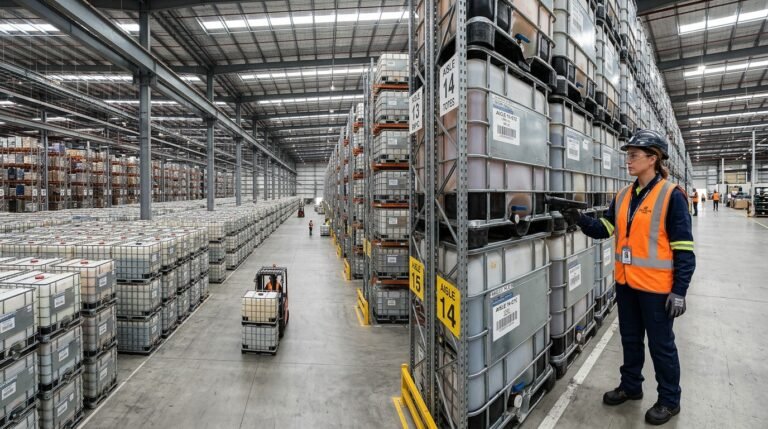
Not every container needs GPS either. Taiwanese energy company CPC tracks chemical catalyst drums with UHF RFID tags, cameras, 51 five-ton scales, and LoRa backhaul reaching 600 meters where Ethernet was unavailable. Their crowded metallic environment required shielding to prevent stray reads. What CPC needed was evidence of which drum moved, what it weighed, and whether the movement matched an authorized order. GPS on every drum would have been expensive overkill. Similar principles apply when choosing how to track a pallet carrying hazmat drums—match the technology to the actual movement pattern and decision requirements.
Certification Comes Before Connectivity
This is where hazmat tracking parts ways from standard freight tracking. You cannot mount just any device on a container carrying flammable, corrosive, or toxic materials.
OSHA requires electrical equipment in hazardous locations to be suitable for the specific location classification and the combustible properties present. That means ATEX or IECEx ratings, correct zone classification, appropriate gas or dust groups, and verified temperature markings. Getting this wrong isn’t an audit finding. It’s an ignition source.
I’ve seen companies spend months evaluating tracking platforms and zero time checking whether the devices they’re considering can legally be mounted on their containers. The market reflects the complexity. Products like the SAVVY SenseGateway-ExR carry vendor-stated ATEX/IECEx Zone 0 and Zone 20 approvals for tank and rail monitoring. The Nexxiot Globehopper 3 lists ATEX category 2 for Zone 1/21, but its own user manual restricts performing installation work inside a hazardous area. The distinction between “the device is certified” and “you can install it wherever you want” is not trivial. Read the full documentation.
For air transport, IATA’s 2026 guidance provides a conditional exception for active trackers: lithium-ion batteries under 20 Wh, lithium-metal content under 1 g, plus additional electromagnetic and packaging requirements. Conditional, with caveats. Not blanket approval for any battery-powered device on a cargo aircraft.
The practical sequence: involve your EHS team and the device manufacturer’s technical support before finalizing hardware. Certification comes before connectivity. Every time.
Five Steps to a Working Hazmat Tracking Program
This sequence comes from real deployments, not theoretical frameworks. Each step builds on the one before.
1. Map the asset to the cargo before dispatch. Verify the container ID against the shipment reference and manifest. Associate the tracking device. Record baseline status using explicit lifecycle states: filled, dispatched, received, empty, cleaning, inspection, available. Define who can authorize each state change. Skip this, and you’ll have devices reporting coordinates with no context about what they’re attached to or what’s inside.
2. Engineer the installation for the hazard. Determine whether the mounting location is classified. Confirm the device approvals match the zone, gas/dust group, and temperature range. Follow the manufacturer’s approved mounting instructions. Hazardous-area suitability is a separate requirement from IP ratings or drop test results.
3. Choose condition sensors based on the decision they enable. Temperature, pressure, fill level, shock, and door status answer different questions. Chemical Express monitors product temperature remotely across 2,800 tank containers using Ex-rated sensors, eliminating the need for physical inspection at every stop. HOYER uses temperature, pressure, and filling-level data across its smart tank fleet. The key in both cases: product-specific alarm limits set by qualified personnel, not generic thresholds. A surface temperature reading doesn’t represent the entire cargo. And a tracker is not a leak detector.
4. Design the system around missing data. Test with loaded steel containers in stacked yards, inside warehouses, across border crossings, and during expected communication outages. Build stale-data warnings into the platform. Define the fallback when connectivity drops. A gap in reporting is not the same as “nothing happened.” It might be the moment that mattered most.
5. Assign response ownership to every alert. Connect the tracking platform to your inventory, transport, and EHS systems. The GS1 EPCIS standard (version 2.0) provides an interoperable framework for “what, when, where, why, and how” events, including sensor data. For each alert type, define an owner, escalation path, acknowledgment requirement, and closure evidence. Without that structure, alerts become noise, and the entire tracking investment delivers dashboards instead of decisions.
What the Field Teaches About Data Quality
Two recent cases illustrate why a tracking program’s value is only as strong as the data flowing through it.
The NTSB investigation into the February 2023 Norfolk Southern derailment in East Palestine, Ohio, found that the deputy fire chief learned some cargo information by telephone but never received a physical or electronic consist copy. Relevant expertise and dissenting views about the vent-and-burn decision were not communicated completely to incident command. Three years later, the lesson remains the same: accurate cargo identification and qualified technical information must reach the people making emergency decisions, in a format they can act on, under pressure. A fleet portal accessible only to your logistics team is not an emergency-response plan.
On the data side, an August 2026 EPA inspector-general evaluation found approximately 144,000 invalid generator IDs out of 356,000 unique IDs submitted through e-Manifest during 2022 to 2024. About 800 manifests showed volumes exceeding 1,000 tons, with four approaching 1 million tons. A complete electronic audit trail is not automatically an accurate one. Validate master data, units, and feasible quantities at the point of entry. If your tracking platform ingests garbage identifiers, it will produce garbage visibility.
Regulatory Shifts Shaping Hazmat Tracking in 2026
Several changes this year directly affect how tracking programs should be built and maintained.
A DOT rule effective September 3, 2026 now permits carriers and facility operators to provide emergency-response information electronically. The responsibility for reliable availability stays with the carrier. Loss of cellular coverage, power, or device function does not excuse compliance. If your tracking system doubles as your emergency-response information channel, it needs robust offline capability and a tested fallback.
EPA’s March 2026 proposal would phase out paper hazardous-waste manifests 24 months after a final rule is published, with estimated annual savings of $28.5 million. That final rule hasn’t been published yet. Plan for full electronic manifest operations, but don’t treat the paper sunset as a done deal.
IMDG amendment 42-24 entered into force January 1, 2026, bringing mandatory lost-container reporting that requires position and number lost. If your containers travel by sea, your tracking system needs to support these reporting obligations.
On the standards front, DCSA announced Track and Trace 3.0.0 in September 2026, adding IoT and reefer events: geolocation, geofence crossings, door status, temperatures, power status, and alarms. Access is currently limited to members and DCSA+ partners, with public release planned for the second half of 2027. Interoperability is still a migration in progress.
The pattern across all of these changes: regulators are making digital tracking more central to compliance, while holding operators accountable for data quality and system availability. Building your tracking program around that reality is more productive than waiting for a universal standard to arrive.

Frequently Asked Questions
Can I use a regular GPS tracker on a hazmat container?
Not without verifying the hazardous-area classification first. OSHA requires electrical equipment to be suitable for the specific location and the combustible properties present. Check whether your mounting location is classified, confirm the device carries the correct ATEX/IECEx rating for that zone and gas/dust group, and follow the manufacturer’s approved installation instructions.
Does EPA’s e-Manifest show real-time container location?
No. The e-Manifest system documents shipment transactions: signatures, receipt confirmations, and exceptions. It does not provide GPS tracking. If you need physical location visibility, connect a separate asset-tracking system and reconcile its data with your manifest records.
What’s the difference between a container ID and a UN number?
The BIC container identification number identifies the physical container itself (owner prefix, serial number, check digit). The UN or NA identification number identifies the hazardous substance the container carries. A tracking system should connect both: which container holds which cargo, at which location, under whose custody.
Can the public look up what a hazardous railcar contains?
Not openly. AskRail provides near-real-time railcar information, but full lookup access is restricted to qualified, registered users such as emergency responders. The data reflects last-known information and may be delayed or incomplete. It is not a public live-tracking map.
What happens if I never receive a signed receipt for my hazardous waste shipment?
Under EPA requirements effective January 2025, large-quantity generators must inquire after 45 days. Both large- and small-quantity generators must submit an exception report after 60 days if the required signed receipt has not been returned. A tracker showing arrival at the facility provides useful context but does not replace the formal manifest receipt.
How long must I retain hazmat shipping and tracking records?
Under 49 CFR 172.201, hazardous-waste shipping papers require three years of retention after initial carrier acceptance. Other hazardous-material papers require two years. Telemetry logs, sensor data, incident records, and custody documents should follow a separate retention schedule based on your operational and regulatory needs.
If your hazmat containers are visible during transit but disappear during dwell, return, cleaning, or reuse, that’s the gap asset tracking closes. Our guide on how to track returnable containers covers the full lifecycle visibility challenge in detail. We work with chemical logistics operators and industrial supply chains to design tracking programs that cover the full container lifecycle. Browse our asset tracking devices, explore solutions for ocean equipment tracking, or reach out directly to discuss your specific requirements.






 +1 508 292 2210