

If you manage a fleet of intermediate bulk containers, you already know the math doesn’t add up. Stainless steel totes cost between $3,500 and $5,000 each. Caged poly versions run around $1,000. And yet, every quarter, someone approves a purchase order for replacements because nobody can confirm where the existing ones went.
The question of how to track IBC totes usually starts there: with a procurement request that shouldn’t exist. But the answer isn’t just “put a GPS on it.” That’s one layer. A useful one, sometimes. But if your tracking system can’t tell you who has the tote, what was in it last, whether it’s been cleaned, and when its next DOT inspection is due, you’re building on sand.
I’ve spent 15+ years deploying asset tracking across industries where containers circulate far from home (airlines, chemical logistics, port operations). The pattern repeats: companies confuse shipment tracking with asset tracking, overspend on hardware, underspend on process, and end up with expensive blinking dots on a map that don’t actually reduce losses. Here’s how to do it differently.
Shipment Tracking vs. Asset Tracking: The Distinction That Saves the Budget
Most logistics software tracks shipments. It tells you a delivery left point A, arrived at point B, and a manifest was signed. Job done. The system moves on to the next shipment.
But your IBC didn’t disappear after delivery. It’s sitting on a customer’s yard. Maybe empty, maybe half full, maybe forgotten behind a warehouse. And your manifest-based system has no opinion about it because, as far as it’s concerned, the shipment was completed.
This is the core gap. Shipment tracking ends at delivery. Asset tracking follows the container through its entire cycle: fill, dispatch, delivery, dwell, empty notification, collection, return, cleaning, inspection, and release for refill. Every stage that gets skipped becomes a place where totes vanish from your books.
Colonial Chemical Solutions learned this the hard way. Their legacy system couldn’t manage a growing, multi-location tote fleet. Tote-related paperwork consumed 90 minutes daily, and the result was still unreliable. After switching to lifecycle-based tracking with smartphone scanning, they eliminated the paper, reassigned an office worker, and reduced new-tote purchases within six months.
The fix wasn’t a fancier tracker. It was redefining what “tracked” means.
Four Layers of IBC Visibility (and When Each One Pays Off)
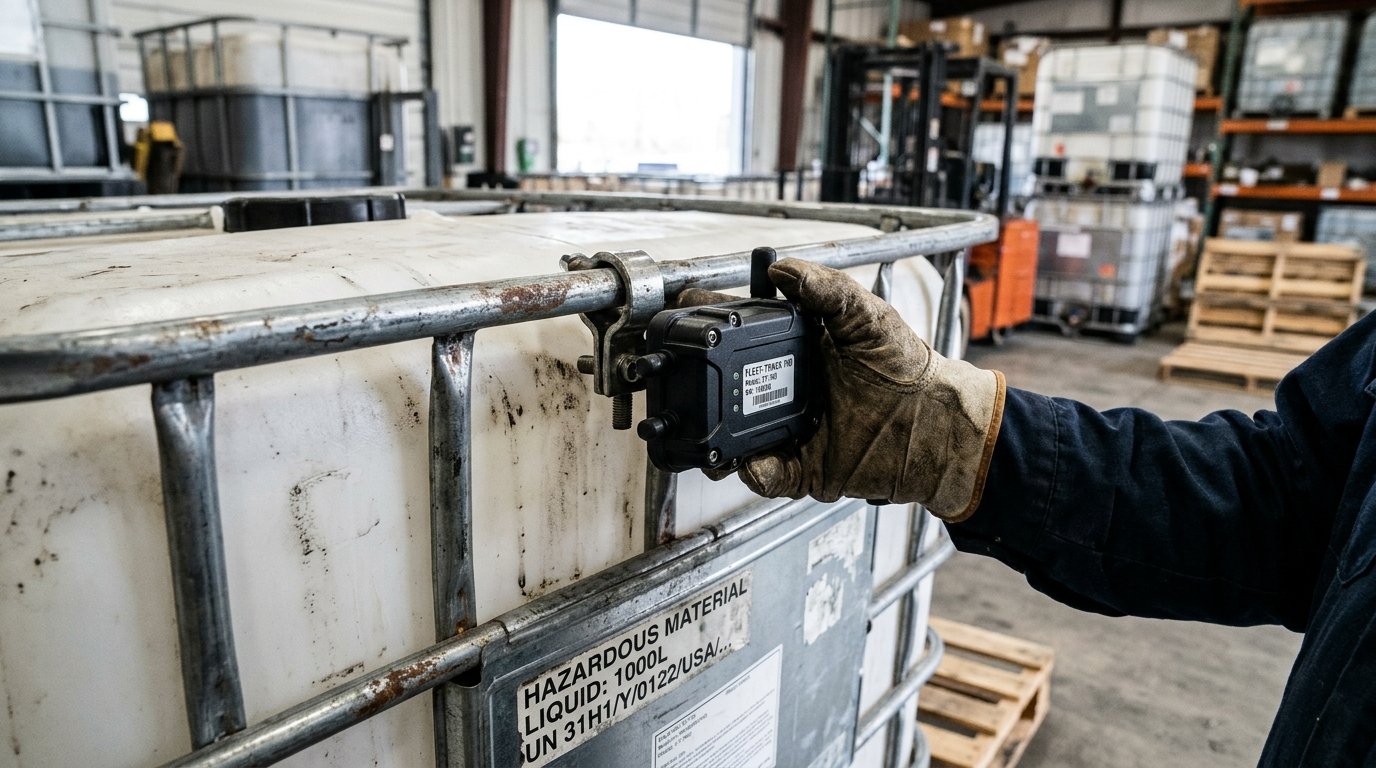
Not every tote needs the same level of surveillance. The technology you choose should match the operational decision it enables, not the other way around. Here’s how the options stack up in practice:
| Layer | How it works | What it proves | Where it fits |
|---|---|---|---|
| Barcode / QR scan | Operator scans the tote at each event; system records identity, time, GPS of the scan | Custody handoff, contents, service history | Smaller fleets, documented customer handoffs, budget-conscious starts |
| UHF RFID with fixed readers | Tags on totes are read automatically as they pass reader portals | Presence at a facility boundary, automated gate-in/gate-out | High-volume filling lines, dispatch docks, return receiving |
| BLE beacons with gateways | Low-energy devices detected by local network infrastructure | Indoor/yard presence, zone-level location | Chemical plants and warehouses where indoor visibility matters |
| Cellular GPS/GNSS trackers | Battery-powered device reports position via cellular network | Remote location between handoffs, geofence alerts, dwell time | High-value totes at customer sites, dispersed fleets, long-cycle assets |
These layers aren’t competing alternatives. They’re complementary. A well-designed system might use permanent QR labels on every tote (layer one), RFID readers at filling and dispatch (layer two), and cellular trackers only on the stainless steel units worth $5,000 each that tend to sit at customer sites for months (layer four).
Similar multi-layer approaches apply when you track trailers and mobile assets across logistics networks.
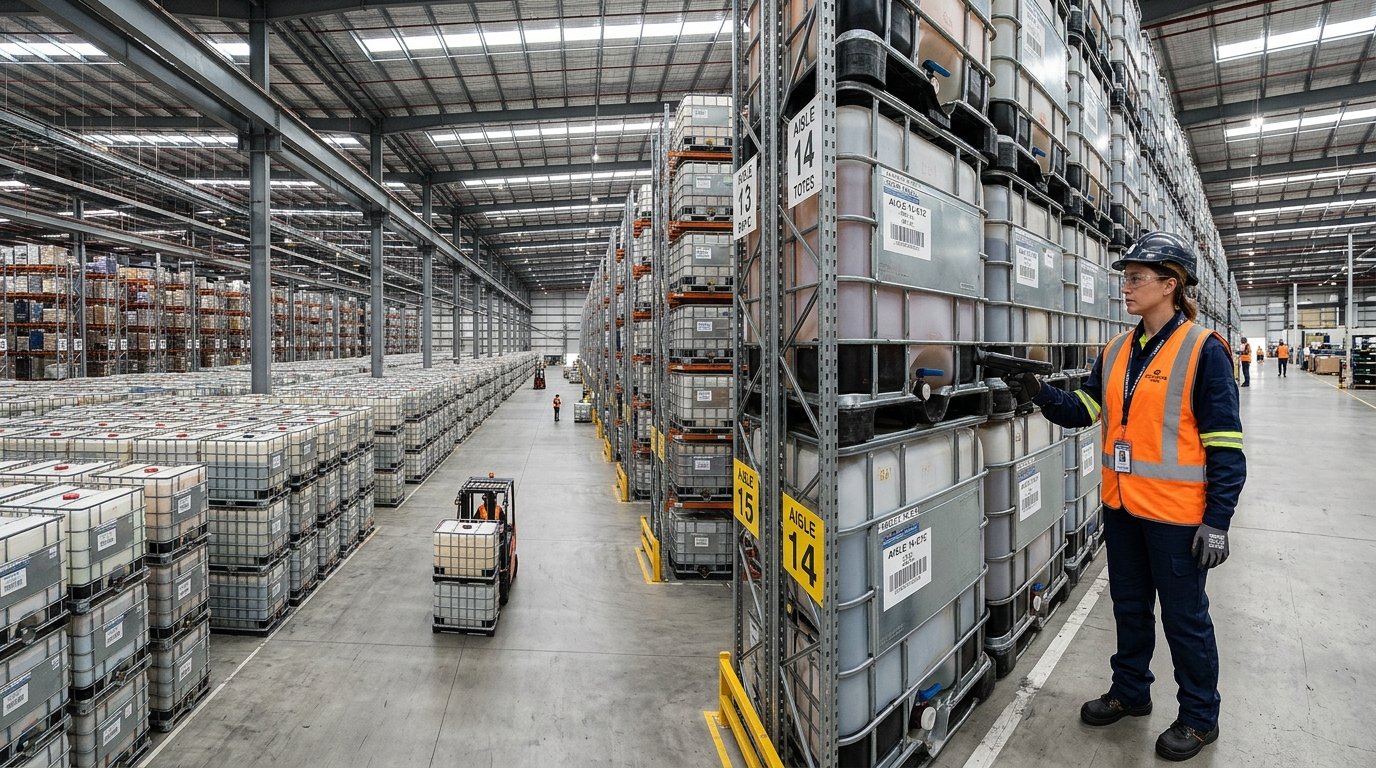
Industrial Chemicals Group ran a fleet exceeding 3,000 IBCs across six UK manufacturing sites. Manual stock checks were ineffective. Their RFID implementation achieved automatic reads from up to 3 meters, improving records and reducing administration. But the key insight: they didn’t need to know the tote’s position in real time. They needed to know it passed through the right gates in the right sequence.
When a $2 Label Beats a $50 Tracker
The tracking industry has an obvious incentive to sell you more hardware. I sell hardware too, so let me be honest about when you don’t need it.
If your IBCs circulate between your own facilities and a small set of known customers on predictable routes, reliable scan-based tracking with enforced process discipline will solve 80% of your visibility problem. The remaining 20% is customer dwell time, and a well-structured return policy with automated overdue alerts handles much of that without a single GPS ping.
Where powered trackers earn their keep:
- High-value stainless totes ($3,500+) with long customer dwell cycles
- Fleets dispersed across geographies where you can’t install reader infrastructure
- Containers that move through third-party logistics where you have zero process control
- Hazmat containers where proving chain of custody has regulatory consequences
A vendor ROI example from Packwise illustrates the economics of a 350-IBC deployment: approximately EUR 54,000 in one-time costs and EUR 54,600 annually. That’s roughly EUR 156 per tote per year in ongoing cost. For a $5,000 stainless tote that would otherwise go missing, the math works. For a $300 poly tote making short runs between two plants, it probably doesn’t.
The honest question isn’t “should we track IBCs?” It’s “which IBCs justify which level of tracking?”
Metal, Liquid, and Wash Cycles: The Physics Nobody Mentions
IBC totes are hostile environments for tracking technology. A plastic tank inside a steel cage, filled with liquid chemicals, stacked three high, and pressure-washed between cycles. Every one of those conditions degrades signal, destroys hardware, or both.
Metal cages and RFID. Metal can disable conventional RFID tags, and liquids reduce performance through absorption and detuning. Specialized on-metal tags and antenna designs exist, but they cost more and require careful placement. If a vendor demos their RFID system on an empty plastic tote in a clean room, that tells you nothing about performance in your stacking yard.
Wash and chemical exposure. Tracker battery life claims assume controlled conditions. Real-world chemical splashes, high-pressure washing at elevated temperatures, and caustic cleaning agents shorten those claims considerably. When evaluating devices, ask for performance data under your specific wash protocol, chemical exposure, and reporting schedule. General claims of “IP67 rated” describe water submersion resistance, not chemical compatibility.
Battery vs. reporting frequency. Every position report costs battery life. A tracker reporting every 15 minutes will drain faster than one reporting daily. More frequent reporting also competes with network coverage in rural or industrial areas where cellular signal is weak and the device burns power searching for a connection.
The practical takeaway: pilot with filled, stacked, real-world totes before committing to a fleet-wide rollout. Test the actual conditions, not the spec sheet.
What to Track Beyond Location
Location gets all the attention. But for chemical IBCs, five other data points matter just as much, sometimes more.
Contents and batch history. East Kansas Chemical needed to track not just where each IBC was, but what product it currently held and what it had held previously. Their implementation combined barcode scanning with a maintenance module so employees could record the product being shipped and maintain a complete content history per container. Without this, you risk cross-contamination, which in chemical logistics can mean regulatory action, not just a quality complaint.
Custody and dwell time. Knowing a tote is “at Customer X” is useful. Knowing it’s been there for 47 days when the agreed return window is 30 is actionable. Automated dwell alerts, tied to customer accounts, convert passive visibility into collection triggers and detention billing.
Cleaning and inspection status. A container’s presence at a wash facility is not proof it was cleaned. A scan at the wash station, linked to the container ID and a cleaning release record, is. For hazmat IBCs under 49 CFR 180.352, testing and inspection intervals of 2.5 years and 5 years apply. Your tracking system should convert those dates into operational holds, not buried spreadsheet entries.
Fill level. Solvay Bernburg’s deployment of connected sensors on hydrogen peroxide containers gave the supplier visibility into customer stock levels. The result: better replenishment planning and prompt container returns. This shifts the model from reactive (“customer called, they’re empty”) to predictive (“customer will need refill in 8 days, schedule collection of the empties”).
Asset identity vs. tracker identity. This is a subtle but important point. If your tracker is mounted in a reusable lid that moves between totes, the tracker’s serial number is not the tote’s serial number. GS1’s Global Returnable Asset Identifier (GRAI) exists specifically for reusable transport assets. Record device reassignments explicitly, or your “tracking data” will eventually describe a sensor’s journey, not a container’s.
A Practical Implementation Sequence
Based on what I’ve seen work across industrial asset tracking deployments, here’s the sequence that avoids the most common failures:
1. Audit and label the fleet. Before buying any technology, reconcile your existing serial numbers against physical inventory. You’ll likely discover totes you forgot you owned and serial numbers that don’t match anything in your system. Apply durable, readable labels to every unit. This alone often recovers “lost” assets.
2. Define your lifecycle events. Map every stage: filling, dispatch, delivery confirmation, empty notification, collection request, return receipt, cleaning, inspection, release for refill. Each event needs an owner (who confirms it happened) and a trigger (what happens if it doesn’t).
3. Start with scan-based capture. Smartphones work. Colonial Chemical saved thousands by using existing smartphones instead of purchasing rugged handhelds. The barrier to adoption drops when operators use devices they already carry.
4. Automate the high-volume chokepoints. If your filling line processes hundreds of totes daily, RFID readers at the gate eliminate manual scans at that specific point. Automate where volume justifies infrastructure; scan everywhere else.
5. Add powered trackers selectively. Deploy cellular GPS devices on the containers whose remote visibility changes a real decision: high-value stainless totes, long-dwell customer deployments, hazmat containers requiring chain-of-custody evidence. Our asset tracking device catalog includes options purpose-built for industrial containers in harsh environments, from compact cellular trackers to ruggedized units with multi-year battery life.
6. Integrate with your business systems. A standalone tracking dashboard is a toy. The data needs to flow into your ERP, maintenance scheduling, customer billing, and compliance reporting. GS1’s EPCIS standard provides a framework for structuring event data across systems, covering what happened, when, where, why, and how.
7. Measure what matters. Track these KPIs monthly: average cycle time (fill to refill), customer dwell time, unaccounted assets, scan completeness rate, overdue inspections, and replacement purchases. If replacement purchases aren’t dropping, something upstream is broken.
The Compliance Reality Check
Tracking supports compliance. Tracking does not equal compliance. That distinction matters when regulators show up.
For hazardous materials transport in the U.S., 49 CFR 180.352 sets IBC testing and inspection requirements at defined intervals. Your system should flag approaching deadlines, block dispatch of overdue containers, and maintain auditable records. A GPS coordinate proves the tote was somewhere. It doesn’t prove it was inspected.
For food-contact containers under FSMA Rule 204, traceability requirements demand documented chain of custody. For pesticide containers, EPA requires records identifying the pesticide registration number, repackaging date, and container identifier, retained for three years.
On the sustainability front, the EU’s Packaging and Packaging Waste Regulation applies from August 2026 and sets a 40% transport-packaging reuse target by 2030. The regulation also introduces provisions for reusable-packaging information via QR codes or standardized digital carriers. If you operate in or export to the EU, your IBC tracking data becomes evidence of reuse compliance, not just operational convenience.
None of these regulations mandate live GPS on every tote. All of them demand accurate, auditable lifecycle records. Build the record first. Add location intelligence where it strengthens the evidence.
Three Outcomes That Justify the Investment
When the implementation sequence above is followed, the measurable results tend to cluster around three outcomes:
- Fewer replacement purchases. Colonial Chemical’s case is instructive: faster returns and better visibility meant they stopped buying totes to replace ones that weren’t actually lost. For a fleet of 500 stainless IBCs at $4,000 each, recovering even 5% of “lost” assets avoids $100,000 in unnecessary capital expenditure.
- Shorter cycle times. When you can see that a customer has held 12 empty totes for 60+ days, you can act. Automated dwell alerts and detention billing change customer behavior. Faster returns mean fewer total totes needed to serve the same demand.
- Audit-ready compliance records. Instead of assembling inspection histories from filing cabinets before an audit, the data exists in one place, linked to each asset ID. The time savings compound with every regulatory touchpoint.
If your IBC fleet feels invisible after delivery, that’s exactly the gap that proper asset tracking closes. We’ve helped companies across chemical logistics, aviation, and industrial supply chains build visibility systems that start with process discipline and scale with hardware only where ROI is clear. If that conversation is relevant, reach out at info@datanetiot.com.
Frequently Asked Questions
What is the cheapest way to start tracking IBC totes?
Permanent serialized labels (barcode or QR), smartphone scanning, and a shared asset register. Colonial Chemical deployed this approach using existing smartphones and eliminated 90 minutes of daily paperwork within six months. Software and process costs still apply, but you avoid upfront hardware investment for readers or GPS devices.
Do all IBC totes need GPS trackers?
No. GPS trackers make sense for high-value containers ($3,500+), long-dwell customer deployments, and situations where you need location between custody handoffs. For totes circulating between known facilities on predictable routes, reliable event-based scanning provides the visibility that matters most.
Does RFID work on metal-caged, liquid-filled totes?
It can, but standard tags often fail on metal surfaces, and liquids absorb RF energy. Specialized on-metal tags and tuned antenna designs address these challenges. Always pilot with filled, stacked containers in real conditions rather than relying on vendor demos with empty totes.
How long do IBC tracker batteries last?
It depends on reporting frequency, temperature, chemical exposure, and network conditions. Published claims range from 3 to 10 years, but those assume favorable scenarios. Ask vendors for battery life projections under your specific reporting interval and operating environment before committing.
Can tracking make my IBCs compliant for hazardous chemicals?
Tracking supports compliance by maintaining inspection records, flagging overdue testing, and documenting chain of custody. But it does not replace the required physical inspections, cleaning procedures, or container certifications mandated by 49 CFR 180.352, EPA repackaging rules, or other applicable regulations.
Should I track the container and its contents separately?
Yes. The container is a reusable asset with its own lifecycle (cleaning, inspection, maintenance). The contents change with every fill. Use a permanent asset identifier (like GS1’s GRAI) for the tote and link product/lot information to each fill event. This prevents content history from being overwritten when the tote is cleaned and refilled.







 +1 508 292 2210