
Here’s a number that should keep aviation operations leaders up at night: $725 million in estimated cargo theft losses in 2025 alone, with the average value per theft incident climbing 36% year-over-year to nearly $274,000. That’s according to CargoNet’s latest analysis. Now layer on the AOG Technics parts fraud scandal—thousands of forged engine components circulating through the supply chain—and the theft of 600+ turbofan parts in Spain that triggered an EASA-wide alert. The question isn’t whether tracking high-value aviation assets matters. It’s whether your current approach actually tracks anything after the shipment arrives.
Most organizations confuse shipment tracking with asset tracking. They know where a spare CFM56 engine is while it’s on a truck. The moment it reaches the MRO facility, it vanishes from the visibility map—until someone physically walks over and scans a barcode. That gap between delivery confirmation and operational accountability is where engines get lost, parts get misrouted, and fraud finds room to breathe. Comprehensive aviation asset visibility solutions address this blind spot by maintaining continuous tracking throughout the entire asset lifecycle.

What Counts as a “High-Value Aviation Asset”?
The scope is wider than most people assume. We’re talking about:
- Complete aircraft — commercial airliners, business jets, regional turboprops
- Propulsion components — engines, APUs, engine stands in transit
- Structural assemblies — landing gear, flight control surfaces
- Avionics and LRUs — Line-Replaceable Units worth tens of thousands each
- Flight recorders — FDRs, CVRs
- Ground Support Equipment (GSE) — tugs, power units, air starters, loading bridges
- High-value cargo — pharmaceuticals, spare engines in transit, defense components
Each asset class has a different risk profile, a different movement pattern, and a different tracking requirement. Lumping them all into one solution is how visibility dies.
The Two Meanings of “Tracking” in Aviation
When the industry says “tracking,” it means two fundamentally different things—and conflating them creates blind spots.
1. In-Flight Position Tracking
This is real-time monitoring of an aircraft’s latitude, longitude, and altitude for air traffic control, safety, and search and rescue. Technologies here include ADS-B (ground-based and space-based), SATCOM channels, and radar. The regulatory driver is ICAO’s Global Aeronautical Distress & Safety System (GADSS), born directly from the MH370 disappearance in 2014.
As of January 1, 2025, GADSS requires that newly certified large aircraft (over 27,000 kg) autonomously transmit their position at least once per minute during a distress event—no pilot intervention required. That’s the Autonomous Distress Tracking (ADT) mandate, codified in ICAO Annex 6. EASA has transposed this into EU law. The FAA has taken a different path, leaning on its existing surveillance infrastructure and accepting EASA-approved installations as an alternative compliance method.
2. Inventory, Custody, and Logistics Tracking
This is where the real operational gap lives. Tracking the location, status, and movement of individual parts, engines, and equipment throughout their entire lifecycle—not just during a single shipment leg. This is critical for MRO operations, theft prevention, regulatory compliance, and proving the provenance and chain of custody that separates an airworthy part from a suspect one.
The distinction matters because most solutions on the market are built for meaning #1 or for a single leg of meaning #2. Almost none address the full asset cycle: deployment → transit → dwell at MRO → return → redeployment. That’s the gap asset tracking closes that shipment tracking never will.
Why Shipment Tracking Fails Aviation Operations
Shipment tracking answers one question: “Did the package arrive?” Asset tracking answers a different set of questions entirely:
- Where is every engine stand in our pool right now—not where was it last scanned?
- How long has that APU been dwelling at the third-party MRO facility?
- Which containers have completed a full cycle, and which are stuck?
- Can we prove unbroken chain of custody for this LRU if a regulator asks?
Shipment tracking ends at delivery. Asset tracking follows the asset through every phase of its life, including the return leg that nobody budgets for but everyone bleeds money on.
The Technology Stack: What Actually Works
Space-Based ADS-B for In-Flight Visibility
Space-based ADS-B—pioneered by Aireon’s receivers on the Iridium LEO satellite constellation—has fundamentally changed what’s possible for in-flight tracking. Detection rates of approximately once every two seconds, even over oceans and polar regions. Latency under 400 milliseconds from satellite to ground. Global availability above 99%. This technology validated the principles behind GADSS and has already proven its value: Aireon’s ALERT service has supported over 100 search-and-rescue assistance requests since 2019, narrowing search areas from thousands of square kilometers to as little as 1–2 km².
But space-based ADS-B is surveillance infrastructure—it tells you where the aircraft is in the sky. The moment the aircraft lands, you need a different stack.
Cellular IoT Trackers for Ground-Based Assets
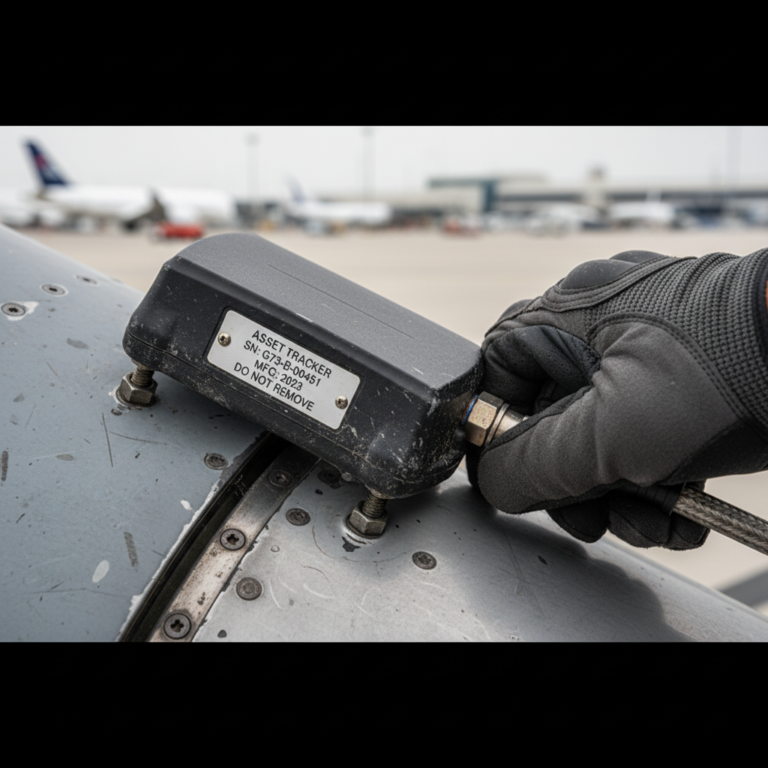
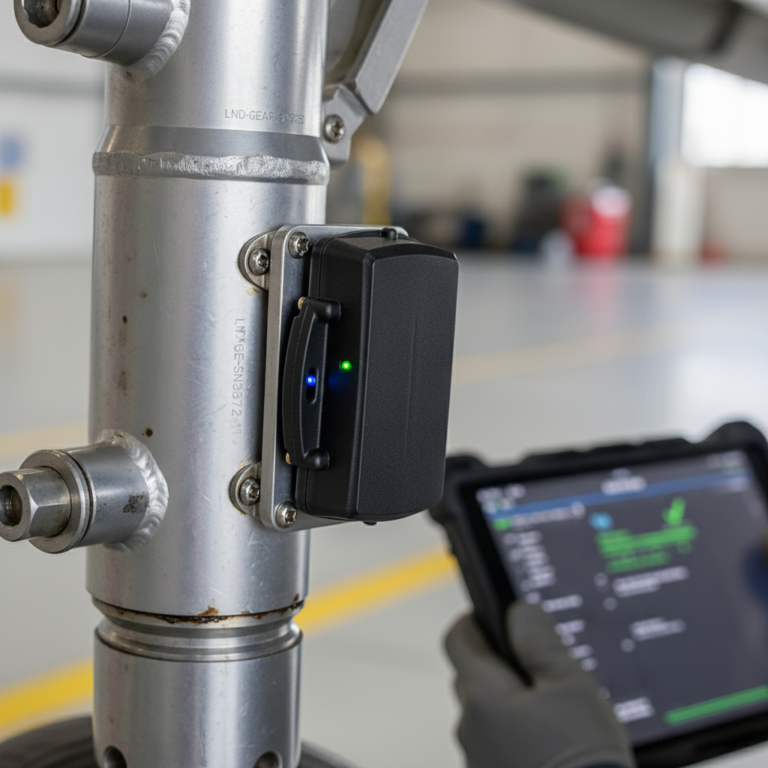
For engines on stands, landing gear in transit, GSE on the ramp, and containers in the MRO supply chain, cellular IoT trackers (LTE-M, NB-IoT, 4G/5G with GNSS) are the workhorse. Outdoor accuracy within 3–5 meters via GNSS. Multi-year battery life on devices using adaptive duty cycles—some exceeding 10 years on standard batteries. Mature API integration (REST, webhooks, SFTP) with MRO/ERP systems like AMOS, TRAX eMRO, or IBM Maximo.
The key advantage is that these devices don’t care about the “shipment” concept. They report position based on schedule and motion, not based on whether a freight forwarder remembered to scan a barcode. The asset stays visible whether it’s on a truck, sitting in a warehouse, or dwelling at a repair station for three weeks longer than planned.
RFID for Warehouse and Parts Inventory
Passive RFID handles high-volume, short-range identification—tool control, parts kitting, warehouse inventory counts. It’s mature, cost-effective, and essential for MRO environments. But RFID doesn’t track. It identifies at the point of scan. If nobody scans, the asset is invisible.
Air-Certified Trackers for Cargo in Flight
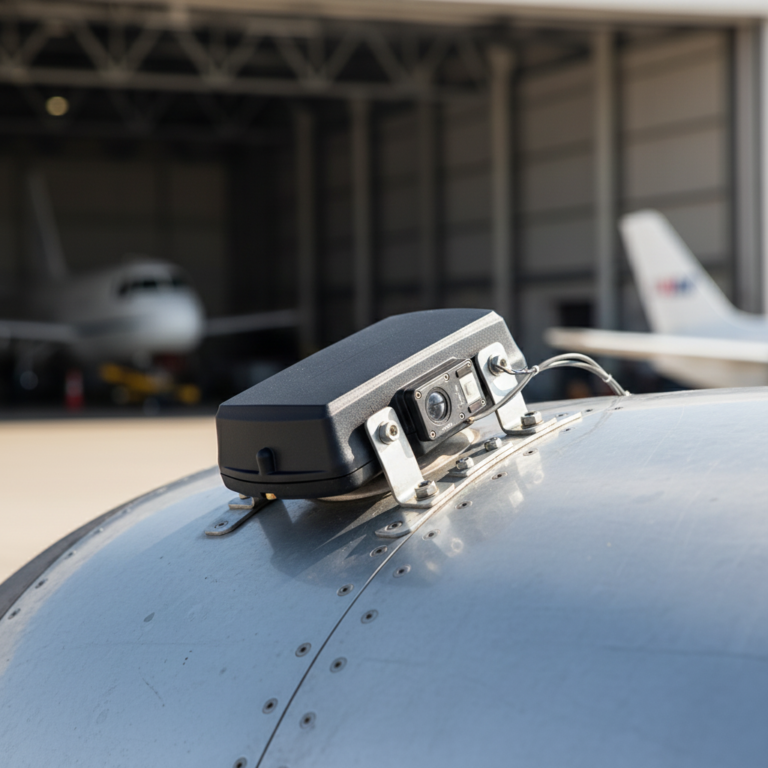
For high-value cargo and assets that need visibility during the flight segment itself, you need hardware certified to DO-160 environmental testing standards. This is the gap most general-purpose IoT trackers can’t cross. Aviation-grade devices designed to survive altitude, vibration, temperature extremes, and electromagnetic interference—while remaining approved to operate inside an aircraft cargo hold—are a small but critical product category.
The Threats That Make Tracking Non-Negotiable
Parts Fraud
The AOG Technics scandal wasn’t an anomaly. A London-based parts broker distributed thousands of CFM56 engine components with forged documentation. Airlines had to ground aircraft for inspections. Network-wide checks to quarantine suspect parts cost the industry millions. In 2026, the company’s founder was convicted and sentenced by the UK Serious Fraud Office.
Then in January 2026, twelve containers holding 600+ turbofan engine parts—declared non-airworthy and bound for destruction—were stolen in Spain when thieves impersonated the contracted mutilation provider. EASA issued an immediate alert. Those parts, if reintroduced to the supply chain, could end up on aircraft.
Asset tracking with unbroken chain-of-custody data is the defense. If you can prove where a part has been—every handoff, every dwell, every facility—you can prove what it isn’t: fraudulent.
GNSS Jamming and Spoofing
Between 2024 and 2026, GNSS jamming and spoofing moved from theoretical risk to operational reality. The FAA cited an IATA report showing a 65% increase in the rate of GNSS signal loss per 1,000 flights in H1 2024 versus H1 2023. Hotspots include the Eastern Mediterranean, Black Sea, Baltic region, and parts of South Asia.
Because standard ADS-B messages are unauthenticated and unencrypted, a spoofed GNSS signal causes the aircraft to broadcast false position data. Ghost aircraft appear on ATC screens. Real aircraft show up in wrong locations. Mitigations include multi-constellation GNSS receivers, inertial reference system integration, and cross-validation with radar and multilateration—but no single fix solves the problem.
For ground logistics, the implication is clear: if you’re relying exclusively on GNSS for asset position, you need a plan for when that signal is degraded or false.
Rising Cargo Theft
The $725 million in 2025 cargo theft losses isn’t evenly distributed. High-value, high-density shipments—like aviation components—are disproportionately targeted. When the average theft is worth $274,000, a single engine stand disappearing represents a catastrophic loss that no insurance claim fully recovers.
The Regulatory Landscape: EASA vs. FAA
Implementation of GADSS standards differs meaningfully between regions:
- EASA has closely transposed ICAO’s GADSS SARPs into EU law (Commission Implementing Regulation 2022/2203), with prescriptive mandates for new aircraft and specific passenger seating capacity thresholds.
- FAA has indicated that its existing surveillance infrastructure—primary/secondary radar, ground-based ADS-B, and space-based ADS-B—already provides sufficient tracking capability. Formal rulemaking is ongoing, but the FAA accepts EASA-approved installations as an alternative compliance path.
For operators flying both sides of the Atlantic, this divergence means dual compliance considerations. And for parts and components moving through international supply chains, it means the tracking standard that governs your asset may change depending on which jurisdiction it’s sitting in.
Five Myths About Aviation Asset Tracking
Myth 1: “We track everything—we use a freight forwarder with GPS.”
Reality: Your freight forwarder tracks the shipment. The moment it’s delivered, their job ends. If that engine sits at an MRO facility for 45 days instead of 15, you won’t know until someone calls to ask where it is.
Myth 2: “RFID solves our tracking problem.”
Reality: RFID solves your identification problem at scan points. Between scans, the asset is invisible. RFID is essential for MRO inventory, but it’s not a tracking solution for assets in motion or dwelling at third-party facilities.
Myth 3: “ADS-B covers everything.”
Reality: ADS-B covers aircraft in flight. It tells you nothing about engines, landing gear, GSE, or parts on the ground. And with GNSS spoofing incidents up 65%, even in-flight ADS-B data needs cross-validation.
Myth 4: “Our ERP system shows where all assets are.”
Reality: Your ERP shows where assets were last recorded—which is wherever someone last entered data. Without live telemetry feeding into that system, you’re looking at a snapshot, not reality.
Myth 5: “Tracking hardware is too expensive to justify.”
Reality: A cellular IoT tracker with multi-year battery life costs a fraction of one day of AOG (Aircraft on Ground) downtime. When a single missing engine stand delays a maintenance event, the cost of not tracking is orders of magnitude higher than the device.
Three Measurable Outcomes of Full-Cycle Asset Tracking
- Cycle time reduction of 20–40% — When you can see where every asset is in real time, you eliminate the search-and-call process that adds days or weeks to every maintenance cycle. Dwell time at third-party facilities becomes visible and manageable.
- Container pool right-sizing — Most aviation operations over-purchase containers and engine stands because they can’t see utilization. Real-time visibility exposes idle assets and lets you reduce your pool size without reducing throughput.
- Audit-ready chain of custody — Every position report, every geofence crossing, every facility entry and exit creates a digital record. When a regulator asks you to prove provenance, you have timestamped, GPS-verified data—not a paper trail that can be forged.
What the Market Looks Like
The global aviation asset management market was valued at $273 billion in 2025, projected to reach $465 billion by 2034 at a 6.08% CAGR, according to Fortune Business Insights. The more specific aviation and airport asset tracking sub-segment, while smaller (~$356 million in 2023), is growing at nearly 15% CAGR—reflecting the urgency operators feel about closing the visibility gap.
That growth is being driven by the convergence of regulatory pressure (GADSS, ADT mandates), economic pressure (theft, fraud, AOG costs), and technology maturation (multi-year battery IoT devices, cloud-native platforms with mature APIs, DO-160-certified airfreight trackers).
Building a Layered Tracking Strategy
No single technology covers every aviation asset tracking need. The effective approach is a layered stack matched to asset class and risk profile:
- In-flight aircraft tracking: ADS-B Out compliance + GADSS/ADT for distress scenarios. Register with SAR services. Develop GNSS-interference contingency procedures.
- High-value components in transit: Cellular IoT trackers (LTE-M/NB-IoT with GNSS) attached to engine stands, landing gear containers, APU shipping frames. Devices must survive harsh logistics environments and report autonomously for months or years.
- Airfreight cargo in flight: DO-160-certified trackers that can operate inside cargo holds during flight without interfering with avionics.
- MRO warehouse and line inventory: Passive RFID for parts kitting and tool control. Active BLE or UWB for real-time location within the facility.
- Integration layer: All telemetry normalized and fed into your MRO/ERP system (AMOS, TRAX, Maximo) via API, creating a single source of truth that connects physical location to maintenance records and chain-of-custody documentation.
The common thread: every layer must persist beyond delivery. If your visibility ends when a freight forwarder marks “delivered,” you’re doing shipment tracking—not asset tracking.
Where We Fit
At Datanet IoT Solutions, we build and deploy the ground-side layers of this stack. Cellular IoT trackers from Digital Matter (Oyster3, Remora2, Hawk) for engine stands, GSE, and reusable containers. The Thingfox T2—DO-160-certified—for air cargo that needs visibility in flight. Environmental monitoring for temperature-sensitive shipments. Full end-to-end integration with your existing MRO and logistics platforms.
We’re not a flight tracking company. We’re the company you call when your container pool feels invisible after delivery—when you need to know where your assets are across their full cycle, not just during one leg.
If that sounds like the gap you’re trying to close, talk to our team — info@datanetiot.com

Frequently Asked Questions
What is GADSS and why does it matter for aviation asset tracking?
GADSS (Global Aeronautical Distress & Safety System) is an ICAO framework created after the MH370 disappearance. It mandates that newly certified large aircraft autonomously transmit their position at least once per minute during distress events. It reshaped the minimum standard for in-flight tracking and drove adoption of technologies like space-based ADS-B.
What’s the difference between shipment tracking and asset tracking in aviation?
Shipment tracking ends at delivery confirmation—it answers “did the package arrive?” Asset tracking follows the item through its full lifecycle: transit, dwell at MRO facilities, return, and redeployment. For high-value aviation components, the return leg and dwell time are where the most operational dollars are lost.
How do MROs track engines and landing gear on the ground?
Effective MRO operations use a hybrid approach: passive RFID for warehouse inventory and parts kitting, and active cellular IoT trackers (LTE-M, NB-IoT with GNSS) on high-value items like engine stands for continuous global visibility. This telemetry integrates with MRO/ERP platforms like AMOS, TRAX, or IBM Maximo via API.
What is DO-160 certification and why does it matter for air cargo trackers?
DO-160 is the environmental testing standard for airborne equipment, covering vibration, temperature, altitude, electromagnetic interference, and more. A DO-160-certified tracker is approved to operate inside aircraft cargo holds during flight—general-purpose IoT trackers are not, making this certification essential for in-flight cargo visibility.
How serious is the threat of GNSS jamming to aviation tracking?
Very serious. The FAA reported a 65% increase in GNSS signal loss per 1,000 flights in H1 2024 versus H1 2023. Since ADS-B depends on GNSS for position data, spoofing can cause aircraft to broadcast false locations. Mitigations include multi-constellation receivers, inertial system integration, and multi-sensor cross-validation.
What is the financial impact of not tracking high-value aviation assets?
Cargo theft losses reached an estimated $725 million in 2025, with average theft values of $274,000. Beyond theft, untracked assets cause excess dwell time, over-purchased container pools, AOG delays, and inability to prove chain of custody—each carrying costs that dwarf the price of a multi-year IoT tracking device.




 +1 508 292 2210