

The global aerospace industry loses an estimated $2 billion annually to counterfeit parts. Forged certificates. Fabricated maintenance histories. Components that pass paper inspection but were never properly tested. Aerospace asset tracking technology was built to prevent exactly this, yet most deployments still lose visibility at the worst possible point. (See also: griffin air tracking.)
In 2023, AOG Technics was exposed for distributing counterfeit jet engine bushings with fabricated documentation to airlines on multiple continents. Aircraft were grounded. Inspections cascaded across carriers. The failure wasn’t exotic. Paper-based traceability broke because paper can be forged.
The technology to verify an asset’s full lifecycle exists today. It goes beyond confirming a shipment arrived. It tracks where a part was made, who maintained it, which aircraft it flew on, and every handoff in between. If your current visibility ends at the warehouse dock, you’re operating in the blind spot. Here’s how aerospace asset tracking actually works in 2025, what it costs, what it returns, and where most operations still get it wrong.
What Aerospace Asset Tracking Actually Covers
“Asset tracking” gets used loosely in sales decks. In aerospace, the scope is specific, and the stakes are higher than in any other industry.
Aerospace asset tracking monitors the location, condition, and lifecycle status of physical assets across the entire aviation ecosystem. That includes:
- Aircraft parts and components, from OEM production through installation, MRO cycles, and retirement
- Tools and ground support equipment, including calibrated tooling, tow tractors, hydraulic rigs, and de-icing vehicles
- Containers and transport packaging such as ULDs, engine stands, and reusable shipping fixtures
- Baggage, now mandated for four-checkpoint tracking under IATA Resolution 753
- Engines and entire aircraft for fleet management, lease transitions, and utilization analysis
Here’s the distinction that most operations still miss: shipment tracking tells you a crate of turbine blades arrived at your MRO facility. Asset tracking follows those same blades through inspection, allocation to a specific engine, installation on tail number N12345, 4,200 flight cycles, removal during a C-check, transfer to an MRO shop in Singapore, recertification, return, and reinstallation.
One system generates a delivery receipt. The other generates a verifiable operational history. That difference separates logistics notification from actual asset intelligence.
The market reflects this shift, driven by broader aerospace industry asset visibility trends. The global asset tracking market reached $24.14 billion in 2024 and is projected to hit $51.59 billion by 2030 at a 14.9% CAGR. The aviation-specific segment, valued at $356.3 million in 2023, is on track for $899.7 million by 2032. That 14.8% growth rate is nearly three times the 5.2% CAGR of the broader aerospace MRO market it serves. The industry isn’t adding tracking incrementally. It’s building the infrastructure ahead of the process changes that tracking will enable.
Understanding the scope is one thing. Knowing which technologies deliver that visibility is another.
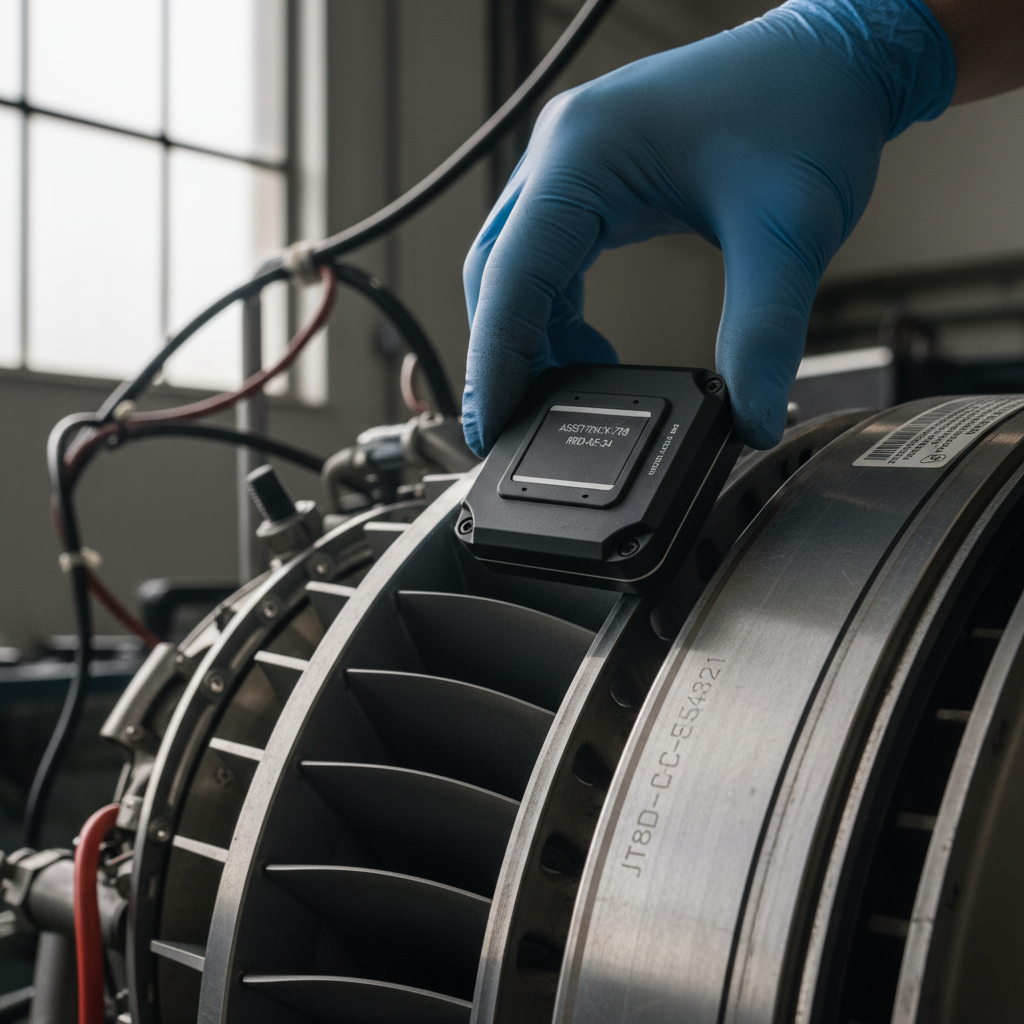
Five Technologies, One Architecture
No single tracking technology covers every aerospace use case. The industry has converged on multi-mode architectures that layer different sensing technologies based on what the operation actually needs.
| Technology | Best Aerospace Use | Accuracy | Key Limitation |
|---|---|---|---|
| Passive RFID | Part identification at receiving and MRO workbench | Item-level (≤10 m range) | Requires reader proximity; no continuous tracking |
| Active RFID | High-value tool and container tracking across tarmacs | 3–5 m | Higher per-tag cost; battery replacement cycles |
| BLE (Bluetooth Low Energy) | Zone-level awareness in hangars and storage areas | 1–5 m | Signal attenuation in metal-dense environments |
| UWB (Ultra-Wideband) | Precision location in engine shops and assembly lines | 10–30 cm | Highest tag cost; battery life of 6–12 months |
| GPS / Satellite | Inter-facility transit, ocean crossings, polar routes | 5–10 m | Battery drain in days to weeks; zero indoor coverage |
Most operational deployments need at least three of these running simultaneously. Passive RFID handles part identification when a component arrives or gets pulled for maintenance. BLE or active RFID provides zone awareness across the hangar floor and tarmac. GPS or satellite covers the gap when assets cross borders, oceans, or move through remote airfields without cellular coverage.
Airbus demonstrated this layered approach starting in 2010, attaching passive EPC Gen 2 tags to roughly 3,000 parts per A350 XWB aircraft. By 2013 they were tagging 160,000 items per year. Their A380 VIP system combined active and passive RFID to collect data every 30 seconds across eight manufacturing sites in four countries, triggering proactive alerts when calibrated tooling was left in the wrong zone.
A practical warning: if a vendor proposes one technology for every scenario, the proposal reflects their product catalog, not your operations. The starting point is always the operational gap (hangar visibility? transit blind spots? part authentication?), with technology selection following from there.
Even the best hardware, though, only tracks location. It doesn’t verify trust. And trust is where aerospace’s biggest vulnerability lives.
Where Paper Trails Collapse
The FAA has linked suspect unapproved parts to over 174 documented incidents. Seventy-three percent of counterfeit part seizures involve forged or altered paper certificates that cleared initial visual inspection. Discovering a counterfeit at installation costs 4.8 times more than catching it at receiving. This is not a low-probability edge case. It’s a measured, recurring failure mode.
The AOG Technics scandal showed exactly how the system breaks. Counterfeit jet engine bushings with fabricated documentation passed receiving checks at multiple airlines. By the time the fraud surfaced, suspect parts were already installed and flying. Paper-based certification (FAA Form 8130-3, EASA Form 1) was designed for an era with shorter supply chains. A single component today can change hands six or seven times between OEM and installation. Each handoff is a potential forgery point.
Two developments in aerospace asset tracking technology are directly addressing this:
At the receiving dock, digital verification is replacing visual certificate inspection. Parts tagged with RFID carry machine-readable records compliant with ATA Spec 2000 Chapter 9-5. Scanning a tagged part cross-references its identity against manufacturer records in seconds rather than minutes. Digital verification at receiving reduces counterfeit installation risk by an estimated 94% and cuts verification time by 68% compared to manual paper checks.
Further upstream, blockchain-based provenance systems create a distributed, tamper-proof ledger recording every handoff in a part’s life. Who manufactured it. Who maintained it. Which aircraft it flew on. Every transfer, verifiable and immutable. These aviation blockchains are private and permissioned (not public like cryptocurrency), with data controlled by its owners. Honeywell, SkyThread, and Block Aero are each building production-grade systems targeting high-value serialized parts.
The U.S. Department of Defense has already formalized this shift, moving from a “Trusted Foundry” model to a Zero Trust approach that treats every part as suspect until digitally verified. Commercial aviation is following. When hundreds of millions of dollars in serviceable parts are scrapped annually because their documentation can’t be verified, the economic argument for digital chain-of-custody writes itself.
The urgency is clear. But urgency alone doesn’t unlock procurement budgets. Concrete returns do.
The ROI That Gets Budget Approval
Abstract arguments about digital transformation don’t survive procurement reviews. Specific outcomes do. Here are four deployments with published results.
Airbus started tagging parts on the A350 XWB with passive RFID in 2010, expanding to seats and life vests across other models until they were tagging 160,000 items per year by 2013. The number that keeps getting cited at industry conferences: inventory count time for life vests and seats dropped from 18 hours to 26 minutes. A 97% reduction. Inspection teams that spent an entire shift counting were freed for actual inspection work.
KLM applied RFID not to parts themselves but to the packaging used to ship them between facilities. Receiving became virtually 100% hands-free, with a 50% reduction in packaging costs. The parts didn’t change. The visibility around them did.
At London Heathrow, implementing asset tracking for ground support equipment produced a 20% reduction in ground handling delays. Misallocated tow tractors and baggage carts are among the most common causes of departure delays. The fix wasn’t more equipment. It was knowing where the existing equipment was.
At the extreme end of scale, the U.S. Air Force’s Integrated Logistics System tracks over 35 million assets valued at $18 billion across 1.7 million warehouse locations worldwide. At that scale, even marginal improvements in utilization translate to billions in avoided procurement.
Across comparable high-stakes industries, RTLS deployments consistently deliver 30-50% reduction in asset loss, up to 90% reduction in search time, and estimated annual savings of $500,000 to $1 million per facility.
The pattern across all of these: the largest gains come not from buying more assets, but from making existing ones visible. Most organizations don’t have a shortage problem. They have a visibility one.
But visibility has a shelf life problem. Most of these gains evaporate if tracking stops at the wrong point in the asset’s life.
Shipment Tracking Stops at Delivery. Asset Tracking Doesn’t.
This is the gap I see most often in the field.
A freight forwarder confirms a crate of turbine blades arrived at your MRO facility. Origin, transit milestones, delivery timestamp, signed receipt. The shipment-tracking job is done. But what happens after the dock door closes? Where are those blades stored? How long before they’re inspected? Which ones get allocated to which engine? When the overhauled engine ships out, do the blades travel with verified documentation, or does someone rebuild the paperwork from work orders after the fact?
Shipment tracking is transactional. It answers one question: did it arrive? Asset tracking is continuous. It answers the questions that drive operations: where is it now, how long has it been sitting, what’s its certification status, and where does it need to go next?
The difference becomes a compliance issue fast. IATA Resolution 753 mandates tracking each checked bag at four points: check-in, loading, transfer, and arrival. FAA Advisory Circular AC 119-2A provides guidance for RFID use on aircraft, parts, and components. ATA Spec 2000 Chapter 9-5 defines the data standards. All of these assume lifecycle visibility, not point-to-point transit confirmation.
In practice, dwell time, utilization rates, and cycle completeness are invisible to shipment-level systems. If your reusable ULDs sit at a partner facility for six weeks when the target cycle is two, shipment tracking won’t flag it. If your container pool feels invisible after delivery, that’s exactly the gap asset tracking closes.
The regulatory trajectory is moving in one direction: more visibility, more digitization, fewer paper-based trust assumptions. The next wave of technology is designed to meet it.
What’s Coming: Digital Twins, Satellite IoT, and Predictive AI
Three developments are reshaping aerospace asset tracking over the next two to five years.
Digital twins are moving from pilot projects to production. In 2026, organizations are deploying digital twins as core business infrastructure to optimize assets, reduce downtime, and drive predictive maintenance. But a digital twin of an aircraft is only as accurate as the tracking data feeding it. Without continuous location, condition, and status updates flowing from physical assets, the twin becomes a static model. Asset tracking is the live data layer that keeps the twin operational and current. Without it, you have a diagram with extra steps.
Satellite IoT is closing the transit blind spot. Low-earth-orbit constellations have reduced connectivity costs to the point where satellite tracking makes economic sense for mid-value assets, not just engines worth millions. For components moving across oceans, polar routes, or through airfields with no cellular coverage, satellite fills the gap between “left origin” and “arrived destination.” MRO networks spanning multiple continents feel this gap most acutely.
AI-driven predictive maintenance depends on tracking data more than most people realize. When you combine movement and location data with sensor telemetry (vibration, temperature, pressure), machine learning models can predict component failures before they happen. The shift from scheduled to condition-based maintenance hinges on having granular, reliable tracking data to correlate each part’s location with its operational stress history. Without spatial context, predictive models are guessing.
All three trends converge on a single insight: asset tracking is becoming the foundational data layer for aerospace operations. Not a standalone system. Not a bolt-on. The layer that everything else, from predictive analytics to regulatory compliance to digital twin accuracy, depends on.
If you’re evaluating tracking architectures for aviation parts, ground support equipment, or airfreight containers, the right approach starts with the operational gap, not the hardware catalog. We design multi-mode tracking solutions matched to aerospace requirements, from DO-160 certified airfreight trackers to ruggedized asset tracking devices for ground operations. Talk to our team if you want to map the right architecture for your operation.

Frequently Asked Questions
What is aerospace asset tracking technology?
Aerospace asset tracking technology uses RFID, BLE, UWB, GPS, and satellite IoT to monitor the location, condition, and lifecycle status of physical assets across the aviation ecosystem. This includes aircraft parts, tools, ground support equipment, baggage, and containers, tracked from manufacturing through operation, maintenance, and retirement.
Which tracking technology is best for aerospace?
No single technology covers all aerospace tracking needs. Most deployments use multi-mode architectures: passive RFID for part identification, BLE for zone awareness in hangars, UWB for precision indoor location, and GPS or satellite for transit between facilities. The right combination depends on the specific operational gap you need to close.
What ROI can MRO operations expect from asset tracking?
Published deployments show 30-50% reduction in asset loss, up to 90% reduction in search time, and annual savings of $500,000 to $1 million per facility. Airbus reduced inventory count time by 97% after deploying RFID across production lines. The largest gains typically come from improving visibility of existing assets rather than purchasing new ones.
How does asset tracking help prevent counterfeit aerospace parts?
RFID-tagged parts carry machine-readable data records that can be instantly cross-referenced against manufacturer databases at the receiving dock. Blockchain-based provenance adds a tamper-proof ledger of every handoff. Together, digital verification at receiving reduces counterfeit installation risk by an estimated 94% compared to visual paper inspection alone.
What regulations require aerospace asset tracking?
Key frameworks include IATA Resolution 753 (baggage tracking at four mandatory checkpoints), FAA Advisory Circular AC 119-2A (RFID use on aircraft and parts), ATA Spec 2000 Chapter 9-5 (RFID data standards for aviation), and the U.S. Department of Defense’s Zero Trust model for defense parts verification.
What is the difference between shipment tracking and asset tracking?
Shipment tracking confirms a package reached its destination, then the job ends. Asset tracking follows the item through its entire operational lifecycle: storage, inspection, installation, maintenance cycles, return, and reuse. In aerospace, this continuous lifecycle visibility is both an operational advantage and increasingly a regulatory requirement.








 +1 508 292 2210

4 Responses