

A single temperature excursion you never detected just cost you a rejected pharma shipment, a contested insurance claim, or 40,000 pounds of spoiled protein. The cargo looked fine on the outside. The data logger, if you had one, was read three days after delivery. By then, the damage was done and the finger-pointing had started.
Cargo condition monitoring exists to close that gap: continuous, in-transit measurement of temperature, humidity, shock, tilt, light exposure, and location, streamed to a cloud platform that alerts you while intervention is still possible. The concept is simple. The execution is where most deployments either deliver real ROI or become expensive shelf decorations.
I have spent 15 years deploying IoT tracking across aviation, maritime, and industrial supply chains. Here is what I have learned about cargo condition monitoring that the product brochures leave out.
What Cargo Condition Monitoring Actually Measures
At its core, cargo condition monitoring is the practice of attaching sensors to shipments (or their containers) and recording environmental variables throughout transit. The “core four” variables are temperature, humidity, shock (measured in g-force), and tilt/orientation. Higher-end deployments add light detection (indicating an unauthorized opening), door state, and atmospheric pressure.
The key distinction from basic shipment tracking: location tells you where your cargo is. Condition monitoring tells you what state it is in. A container can arrive on time and on route while its contents are already destroyed.
Geotab defines cold chain monitoring specifically as using technology to continuously monitor temperature-sensitive products in transit. Cargo condition monitoring is the broader discipline. It covers ambient electronics, aerospace components, fine art, hazmat, and anything where handling quality or environmental exposure determines whether you deliver a product or a liability.
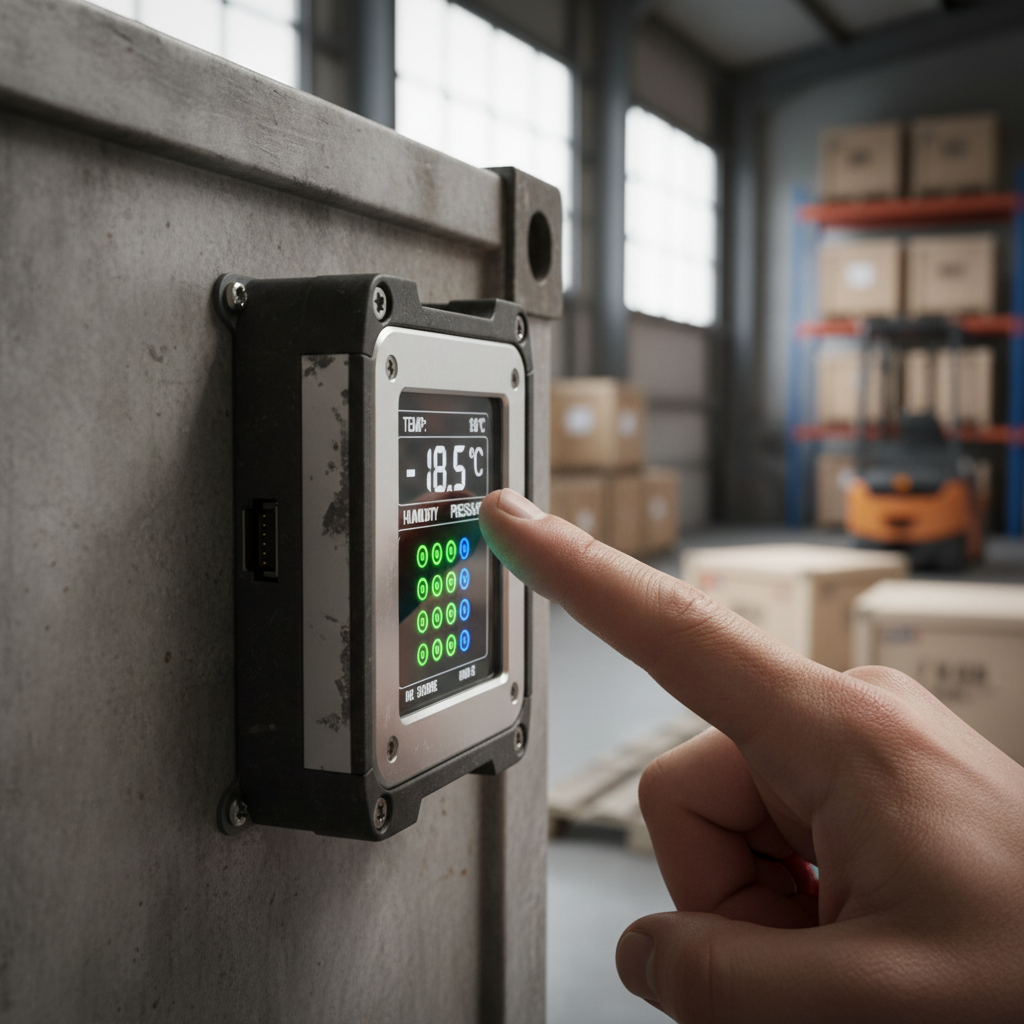
The Economic Pain That Drives Adoption
Numbers first. The pharmaceutical industry alone loses an estimated US$35 billion annually to cold-chain failures, with up to 50% of vaccines globally discarded because storage drifted outside specification. These are not catastrophic events. They are micro-degree deviations of 1-2°C, often undetectable without continuous monitoring.
For food, the FAO attributes 526 million tonnes of annual food loss to insufficient refrigeration, roughly 12% of the global total. A 2024 University of Michigan study pushed that estimate further, suggesting up to 620 million metric tons of food loss annually attributable to poor cold-chain infrastructure.
The cargo monitoring system market reflects this pain. Analysts value it at US$6.78 billion in 2025, projecting US$15 billion by 2035 at an 8.3% CAGR. The narrower cold chain monitoring segment sits at US$8.31 billion with a 12.6% CAGR through 2030.
Yet roughly half the addressable market remains pre-adoption. Industry surveys indicate that 53% of shippers were already using real-time visibility in 2024, with 25% more planning to adopt within 12 months. The dominant driver cited by 80% of respondents: loss prevention and cross-border shipping challenges.
Translation: if you are reading this article, you are likely in that remaining half evaluating whether the investment pencils out. It does. But only if the deployment is architected correctly.
The Four-Layer Tech Stack (and Where Each One Fails)
Every modern cargo condition monitoring system runs on four layers. Understanding where each layer creates value (and where it breaks) is what separates a deployment that pays for itself from one that generates dashboards nobody checks.
Layer 1: Physical sensors
The sensor is the thing touching your cargo. It may be a battery-powered GPS tracker with onboard temperature and accelerometer, a passive USB data logger, or a container-integrated unit wired into a reefer controller. Digital Matter’s product line emphasizes battery-powered GPS trackers with multi-year lifespans for the “set and forget” use case. Pharma-grade loggers from vendors like Controlant offer Saga IoT devices covering ranges from -200°C to +50°C for cryogenic therapies.
Where it fails: battery life under real conditions is always shorter than the spec sheet. Cold temperatures drain lithium cells faster. Vibration accelerates discharge. And the biggest failure mode is not technical at all: it is a human placing the sensor in the wrong position inside the container, where it reads ambient air instead of product core temperature.
Layer 2: Connectivity
Three options dominate. Cellular (LTE-M, NB-IoT) is the workhorse for road and port operations. Satellite (Iridium, others) covers ocean and polar routes where cellular is absent, which is exactly why cargo monitoring at sea demands a different connectivity strategy than land-based shipments. Bluetooth Low Energy (BLE) handles last-mile handoffs, typically bridging through a driver’s phone or a vehicle gateway.
Multi-mode radios are now standard for intermodal shipments. Maersk’s Captain Peter remote container management keeps GPS and condition data active across ocean, rail, truck, and barge. Hapag-Lloyd’s smart-container program uses low-power wide-area networks for similar multi-modal coverage.
Where it fails: dead zones are real. Not just mid-ocean (satellite solves that), but inside steel containers in port stacks, inside aircraft cargo holds (where RF transmission is restricted), and at border crossings where roaming agreements lapse. If your platform cannot gracefully handle store-and-forward (buffer data locally, transmit when signal returns), you get gaps precisely at the moments that matter most.
Layer 3: Cloud platform
The platform ingests readings (typically via MQTT or REST APIs), stores them in a time-series database, renders dashboards, and emits threshold alerts via SMS, email, or webhook. This is where raw sensor readings become actionable intelligence: a temperature curve becomes a compliance record, a shock event becomes an insurance claim document.
Where it fails: alert fatigue. If your platform sends 200 notifications per day because thresholds are too tight or too generic, operators stop reading them within a week. The platform needs configurable logic: alert me only when temperature exceeds X for longer than Y minutes, or when shock exceeds Z g-force while the shipment is tagged as fragile aerospace components.
Layer 4: AI and analytics
This layer is evolving fastest. AI moves monitoring from reactive (“your shipment breached”) to predictive (“your shipment will breach in 6 hours based on current reefer performance and ambient temperature forecast”). Industry analysts now rank AI-driven predictive visibility as the number one trend reshaping transportation intelligence in 2026. CargoAi launched AI Predictive AWB Tracking in February 2026, forecasting air cargo delays before they occur.
Where it fails: prediction requires historical data volume. If you just started monitoring, you do not have 18 months of route-specific baselines. Many vendors sell “AI-powered” platforms that are, in practice, rule engines with a machine-learning label. Ask to see the training dataset size before you buy the prediction story.
What the Vendor Brochures Leave Out
I have deployed condition monitoring across airlines, MRO shops, freight forwarders, and port operators. The technology works. The failures are almost never technological. They are operational.
Failure mode 1: Sensor placement. A temperature sensor attached to the exterior wall of a pallet reads container air, not product temperature. For pharma, this is a compliance gap. For food, it is a false sense of security. Placement protocols, not just hardware selection, determine data quality.
Failure mode 2: Device retrieval. Reusable trackers only deliver ROI if they come back. In a reusable container pool, 15-25% of devices “disappear” per cycle if there is no return logistics plan. This is the exact gap between shipment tracking (job ends at delivery) and asset tracking (follows the device through its full lifecycle, including return and reuse). If your container pool feels invisible after delivery, that is the gap asset tracking closes.
Failure mode 3: Data that nobody acts on. I have seen operations with 6 months of perfect condition data and zero interventions triggered by it. The data flowed into a dashboard that nobody owned. No SOP for what happens when temperature hits +9°C on a 2-8°C shipment. Monitoring without a response protocol is an audit trail, not a loss-prevention tool.
Failure mode 4: Integration silos. Your condition monitoring platform produces alerts. Your ERP processes orders. Your TMS routes shipments. If these systems do not talk to each other, an alert about a failing reefer cannot trigger an automatic reroute to the nearest cold storage. The alert sits in one system while the shipment continues to degrade in another. API-first platforms are non-negotiable for this reason.
The Trust Problem: Spoofing and Data Integrity
Here is a reality check most vendors will not raise in a sales meeting. The same data you rely on for insurance claims and regulatory compliance is now being actively falsified by some carriers.
An AI freight-visibility platform called Chain reported a 300% spike in fraudulent tracking instances across more than one million loads. Carriers spoof GPS pings to mask delays and pad on-time metrics. If your monitoring architecture trusts device-reported location as ground truth without server-side verification, you are exposed.
The cybersecurity dimension is equally real. The 2017 NotPetya ransomware attack cost Merck, FedEx/TNT, and Maersk roughly US$800 million combined. FedEx disclosed a US$300 million quarterly loss at TNT Express. Maersk’s entire booking and container tracking system went dark. Any monitoring architecture built on connected IoT sensors needs tamper-evident logging, zero-trust network design, and redundant offline buffering as baseline requirements.
What to demand from your vendor: motion-pattern anomaly detection (does the GPS track match physically possible movement?), immutable audit logs, and data integrity checks that survive both external attacks and internal falsification.
Where Air Cargo and Aviation Fit In
Air cargo has unique constraints that make airfreight cargo tracking and condition monitoring both harder and more valuable than other modes.
Harder because: RF transmission restrictions inside aircraft cargo holds limit real-time connectivity during flight. Hardware must meet DO-160 environmental standards (vibration, altitude, temperature cycling). Battery chemistry is regulated by IATA Dangerous Goods rules. And cycle times are compressed: a 48-hour pharmaceutical air shipment has zero margin for a missed temperature alert.
More valuable because: air cargo is disproportionately high-value per kilogram. Pharmaceuticals, biologics, aerospace components, electronics. A rejected shipment of monoclonal antibodies flown from Europe to the US represents six figures in product loss, plus regulatory documentation burden.
The solution architecture for airfreight condition monitoring requires DO-160 approved hardware (not just a consumer-grade tracker rebranded for logistics), store-and-forward capability for the in-flight blackout period, and immediate cellular reconnection upon landing. This is where device selection directly determines whether you get usable data or gaps at the critical moments.
For operations running ULDs, ground support equipment, or reusable pharma containers through multiple flight cycles, the monitoring device needs to survive the full asset lifecycle. Not just origin to destination, but return, dwell, maintenance, and redeployment. That is asset tracking applied to condition monitoring: the sensor follows the container, not just the shipment.
Three Outcomes That Justify the Investment
When deployment is done right (correct placement, retrieval logistics, response protocols, system integration), here is what condition monitoring actually delivers:
- Documented proof for insurance claims and carrier disputes. Without continuous condition data, you have a he-said-she-said dispute over when damage occurred. With it, you have timestamped, geolocated evidence showing the exact leg, the exact moment, and the exact environmental excursion. This shifts claims resolution from negotiation to documentation.
- Near-elimination of preventable waste. Iceland’s national pharmaceutical cold chain deployed Controlant IoT monitoring and cut vaccine waste from approximately 30% to 0.3%. A 100x improvement, sustained over more than a decade. The principle scales: if you can detect a deviation within minutes instead of days, you can intervene before the product is lost.
- Insurance premium reduction. This is the angle almost nobody in the SERP talks about. Underwriters price cargo insurance partly on historical loss ratios and partly on risk mitigation measures. Documented, continuous condition monitoring is a demonstrable risk reduction. I have seen clients negotiate 10-20% premium reductions by presenting monitoring data to their underwriters. Over a year of high-value shipments, that reduction alone can exceed the total cost of the monitoring deployment.
Choosing the Right Architecture for Your Operation
There is no universal “best” solution. The right architecture depends on your cargo type, route profile, regulatory environment, and whether you need one-way disposable monitoring or reusable device programs.
| Architecture | Best for | Tradeoff |
|---|---|---|
| Passive single-use USB logger | Clinical trials, one-way pharma, proof-of-compliance | No real-time alerts. Data read on arrival. You learn what happened, not what is happening. |
| Active cellular IoT tracker (reusable) | Multi-leg pharma, food, high-value industrial | Real-time alerts and intervention capability. Higher unit cost, requires retrieval logistics. |
| BLE logger + phone gateway | Last-mile courier, clinical sites | Low cost, leverages existing phones. Dependent on driver compliance to keep phone nearby. |
| Container-integrated + satellite | Ocean reefer, project cargo, intermodal | Full multi-modal coverage. High capex, container retrofit required. |
| DO-160 approved airfreight device | Pharma air cargo, aerospace components, ULDs | Survives flight environment, regulatory compliant. Smaller vendor pool, higher certification cost. |
For airfreight operations requiring DO-160 compliance, we work with the Thingfox T2, which is specifically approved for the airfreight environment. For ground-based asset pools and multi-leg road or port operations, battery-powered GPS trackers from Digital Matter deliver multi-year lifespans with cellular condition reporting.
The hardware choice matters, but the deployment design matters more. Sensor placement protocols, alert thresholds calibrated to your product tolerances, integration with your existing systems, and a retrieval plan for reusable devices. That is the difference between a monitoring program and a box of trackers sitting in a warehouse.
If your operation needs condition monitoring that survives the full asset cycle (not just origin to destination), talk to our team. We deploy end-to-end, from hardware selection through platform integration, with a focus on aviation and industrial supply chains where compliance is non-negotiable and downtime is expensive.

Frequently Asked Questions
What is cargo condition monitoring?
Cargo condition monitoring is the continuous measurement of environmental variables (temperature, humidity, shock, tilt, light, door state) inside or around a shipment during transit. Sensors stream readings to a cloud platform that issues real-time alerts when any value crosses a configured threshold, enabling intervention before product damage becomes irreversible.
How is cargo condition monitoring different from cargo tracking?
Cargo tracking tells you where a shipment is (GPS location, ETA). Condition monitoring tells you what state it is in (temperature, humidity, handling quality). A container can arrive on time while its contents are already compromised. Condition monitoring fills that visibility gap.
What industries use cargo condition monitoring most?
Pharmaceuticals and biologics (regulatory mandate under DSCSA), food and agriculture (perishable loss prevention), ocean container shipping (reefer management), aerospace and defense (shock-sensitive components), and high-value electronics. Pharma is the most heavily regulated; food represents the largest volume opportunity.
How much does a cargo condition monitoring deployment cost?
Reusable cellular trackers typically run US$50-200 per device plus US$5-30/month platform subscription. Single-use passive loggers cost US$5-50 per unit. Managed monitoring services (full-service visibility) price at 1-3% of cargo value per leg depending on mode and risk. ROI typically materializes within the first prevented loss or successful insurance claim.
Can cargo condition monitoring reduce insurance premiums?
Yes. Documented, continuous monitoring is a demonstrable risk mitigation measure. Underwriters factor loss prevention capabilities into premium calculations. Operations with comprehensive monitoring data have negotiated 10-20% reductions on cargo insurance premiums, which over annual shipment volumes can exceed total monitoring costs.
What is the biggest risk with cargo condition monitoring data?
Data integrity. GPS spoofing incidents have spiked 300% according to recent industry reports, with carriers falsifying location to mask delays. Additionally, the NotPetya ransomware attack cost logistics firms US$800 million collectively. Demand tamper-evident logging, server-side anomaly detection, and cyber-resilient architecture from any vendor.






 +1 508 292 2210

4 Responses