

The global fleet management market is projected to reach $67 billion by 2030. North America alone had roughly 19.2 million active fleet-management systems by the end of 2024, headed toward 33.2 million by 2029. The spending is real. The confusion is equally real.
Most organizations shopping for asset management software for transportation are comparing products from three fundamentally different categories without realizing it. A telematics platform is not a maintenance system. A maintenance system is not an enterprise asset manager. And none of them delivers value if the data feeding them is incomplete, delayed, or manually entered by a technician between two repair jobs.
This is not a vendor ranking. It is a decision framework for fleet managers, operations directors, aviation ground handlers, transit planners, and anyone else responsible for assets that move, wear out, and cost money every day they sit idle. How to identify which software category fits your operation, which capabilities actually predict ROI, and where the most common (and most expensive) mistake happens before you ever sign a contract.
Three Product Categories, Three Different Jobs
The phrase “asset management software” is a catch-all that spans at least three distinct product families. They overlap at the edges, but they solve different core problems. Searching for one returns all three on the same results page, which is why the evaluation process feels overwhelming before it starts.
ISO 55000 defines asset management broadly: coordinated activity to realize value from assets over their lifecycle, applicable to any asset type and organization size. The software categories below are different implementations of that principle, not interchangeable brands.
| Category | Core question it answers | Examples | Best fit |
|---|---|---|---|
| Telematics | Where is it now, and how is it being used? | Geotab, Samsara, Verizon Connect, Motive | Trucking, delivery, field service fleets needing live operational visibility |
| Fleet Maintenance / FMIS | What maintenance is due, what parts are needed, what did the last repair cost? | Trimble TMT, Fleetio, AssetWorks FleetFocus | Transit agencies, government fleets, commercial operators with in-house shops |
| Enterprise Asset Management (EAM) | Over its full lifecycle, is this asset worth keeping, replacing, or reconfiguring? | IBM Maximo, Hexagon EAM | Airports, rail operators, utilities, DOTs managing both mobile and fixed infrastructure |
A trucking company with 200 power units and zero visibility into fuel waste probably needs telematics first. A transit authority managing buses, rail vehicles, stations, and track while reporting State of Good Repair metrics to the FTA needs an FMIS or EAM with regulatory depth. An airline ground handler tracking GSE and ULDs across five airports needs a purpose-built asset tracking approach, not a generic fleet dashboard.
Choosing the wrong category is more expensive than choosing the wrong vendor within the right category. The license fee is a fraction of the implementation, training, and workflow redesign that follows.
Six Capabilities That Separate ROI from Shelf-ware
Feature lists run long. Most describe the same functions with slightly different labels. What separates software that pays for itself from software that collects dust is not the module count. It is depth in six areas.
1. Asset identity and hierarchy
Every asset needs one durable identifier that connects its purchase record, maintenance history, location trail, and retirement decision. Parent-child relationships matter: an engine belongs to a bus, a tire belongs to a trailer, a ULD belongs to a pool managed by an airline or freight forwarder. Without this hierarchy, your “data” is just a pile of disconnected events. This is the foundation. Skip it, and everything built on top is unreliable.
2. Maintenance depth
Preventive maintenance follows scheduled intervals: mileage, hours, or calendar. Condition-based maintenance acts on a measured state like tire tread depth or battery voltage. Predictive maintenance uses historical and live data to flag likely failures before they happen. Modern telematics platforms can detect deviations from an operating baseline and trigger alerts weeks before a potential breakdown.
The real-world impact can be significant. Metro St. Louis adopted an integrated preventive and predictive program using AssetWorks FleetFocus and reported extending average engine life from 100,000 miles to over 450,000 miles, with uptime gains and flat maintenance costs. That is a vendor-reported number, so treat it as a hypothesis for your own baseline, not a guaranteed outcome. But the direction is clear: structured maintenance data changes replacement economics.
3. Lifecycle cost and replacement decisions
Total cost of ownership is the number that determines whether an asset earns its place or drains the budget. Good software connects acquisition cost, cumulative maintenance, fuel or energy, downtime, and utilization into a single view per asset. VLS Environmental Solutions used Fleetio to evaluate repair-versus-replace decisions across nearly 2,000 assets and reported that refurbishment avoided approximately $540,000 in unbudgeted capital expenditure.
This becomes more complex as fleets electrify. Electric trucks reached 9% of all truck sales in 2025, and the asset boundary now extends to batteries, chargers, depot infrastructure, and route energy models. Comparing diesel and electric powertrains over a full lifecycle requires cost data most organizations do not yet capture, which increasingly overlaps with carbon accounting obligations and a broader corporate sustainability strategy. The software you pick today should accommodate that expanding boundary tomorrow.
4. Compliance as architecture
FMCSA requires electronic logging devices for most commercial drivers who must maintain records of duty status. FTA transit providers set State of Good Repair targets and report them annually to the National Transit Database. In aviation, MRO documentation must satisfy airworthiness directives and often DO-160 environmental standards for equipment used in or near aircraft.
Compliance shapes the data model from day one. If the software cannot produce audit-ready evidence of maintenance actions, inspection results, and asset condition on demand, it is not an asset management system. It is an expensive to-do list.
5. Integration and data exchange
A mature fleet maintenance platform integrates diagnostics, DVIRs, parts, repair schedules, accounting, telematics, fleet management, and TMS data flowing into one maintenance view. That level of connectivity does not happen by default. It requires open APIs, normalized data, and clear ownership of the master record.
When evaluating, ask: can this system import and export data in standard formats? What happens to my data if I leave? How does it handle conflicting updates from two sources? These questions predict long-term value more than any dashboard screenshot.
6. Security and resilience
In late 2024, Microlise, a UK-based fleet telematics provider, suffered a cyberattack that accessed or encrypted hundreds of servers. Approximately 80% of customers were affected, including critical delivery and medical logistics operations. Most systems took 10 days to recover. For a transportation operator, 10 days of blind operations is not an IT footnote. It is a safety and financial emergency.
Require segmented architectures, tested recovery procedures, strong identity management, and offline operating capability. If the vendor cannot describe how your operation continues during their outage, they have not earned your data.
These six capabilities form your evaluation scorecard. But even the most capable, secure platform has a dependency that most procurement processes overlook entirely.
Software Is Only as Good as Its Data Layer
Here is where most asset management software projects go sideways, and it happens before the software is even configured.
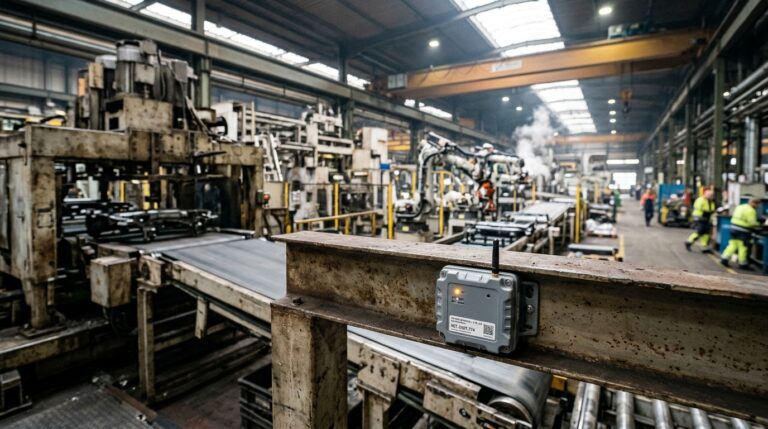
The software needs data. Accurate, timely, continuous data about where assets are, what condition they are in, and how they are being used. In theory, that data comes from connected devices: GPS trackers, telematics units, environmental sensors, RFID readers. In practice, many organizations deploy software first and figure out the device layer later. Or they connect vehicles but forget about containers, ULDs, ground support equipment, tooling, and reusable packaging.
I see this pattern constantly. A fleet manager invests in a solid FMIS or telematics platform for the truck. The truck is visible. But the trailer? The container it hauls? The specialized equipment inside? Those go dark the moment they leave the yard. And when an asset goes dark, the software has nothing to manage.
The distinction matters more than most vendors will admit. Shipment tracking follows a package or load from origin to delivery. The job ends at the destination. Asset tracking follows the physical asset through its entire cycle: deployment, transit, dwell time, return, maintenance, redeployment. If your reusable containers, ULDs, or GSE disappear from the system after delivery, you do not have asset management. You have shipment visibility with a lifecycle blind spot.
In aviation, this blind spot is especially costly. ULDs cycle between airlines, freight forwarders, ground handlers, and MRO providers across dozens of airports. Ground support equipment moves between ramps, hangars, and maintenance bays in conditions that destroy consumer-grade GPS units. A DO-160 approved tracker like the Thingfox T2 exists precisely for this environment: certified for airfreight, built to survive temperature extremes and vibration where generic hardware cannot.
In maritime operations, the pattern repeats. Container pools become invisible after delivery. Cycle times stretch because nobody knows where the empties sit. Dwell time accumulates. The software says “last seen 14 days ago,” and the operations team starts making phone calls instead of decisions.
The lesson: your device strategy and your software strategy are not separate purchases. They are one integrated decision. Before evaluating software vendors, map every asset class (vehicles, trailers, containers, ULDs, GSE, tooling, infrastructure) and ask a harder question: which of these generate zero data right now? That gap is where your ROI actually starts.
What Vendor Demos Conveniently Skip
Every demo looks good. Clean sample data, pre-built dashboards, smooth workflows. The gap between the demo and your reality is where projects stall. Five things vendors are less eager to discuss.
Implementation is the real cost
New Hampshire DOT migrated from a fleet system plus legacy tools to a full enterprise asset management platform covering fleet, equipment, roads, bridges, culverts, guardrails, and more. The EAM went live in July 2022, roughly seven months after starting. The telling detail: the agency initially involved only 300 of its 1,650 users. The biggest hurdle was understanding the product beyond its fleet capabilities. Adoption, not deployment, is always the bottleneck.
If you are planning for a 90-day implementation, add time for data migration, asset taxonomy cleanup, user training, workflow redesign, and the inevitable resistance from field teams who have done things on paper for years.
Vendor-reported ROI needs your baseline
Metro St. Louis reports 450,000-mile engine life. VLS reports 2.3x to 4.9x annual return on software. Rabbittransit reports one hour saved per day per site on fuel entry alone. These are useful directional signals. They are not transferable benchmarks. Every one comes from a vendor marketing page with no independent control group.
Before signing, establish your own baseline: current downtime, emergency repair frequency, PM compliance rate, parts stockout rate, fuel variance, and labor hours on data entry. Then run a measured pilot. The vendor’s case study tells you what is possible. Your baseline tells you what is probable.
Concentration risk is operational, not theoretical
The Microlise incident affected 80% of customers for 10 days. CISA’s Plan-Prevent-Protect framework offers a structured approach to transportation cybersecurity that starts before deployment, not after an incident. Can you dispatch manually if the platform goes down? Can you export your asset data regularly? Do you have offline access to critical maintenance records?
Data portability is your leverage
Ask every vendor: if we leave in three years, what format does our data come out in? How long do we have to export? Is API access included or charged separately? The answer reveals whether you are buying a tool or renting a dependency.
AI predictions still need human judgment
Predictive maintenance is real and valuable, but it inherits every flaw in your data: incomplete failure labels, inconsistent technician notes, missing asset identifiers. A model that triggers 40 false alerts per week will train your team to ignore it within a month. Pilot one high-cost failure mode. Measure precision, false positives, lead time, and actual avoided downtime. Then expand. Not the other way around.
A Selection Sequence That Works
Instead of starting with a vendor shortlist, start with a decision audit.
- Define which decisions must improve. Is it maintenance timing? Asset replacement planning? Utilization? Fuel cost? Compliance evidence? The answer determines which software category you actually need.
- Pick the category before the vendor. Telematics for real-time operational visibility. FMIS for maintenance and lifecycle control. EAM for mixed mobile and fixed assets with enterprise governance. Some organizations need two of these, connected through APIs. Almost none need all three from the same vendor.
- Map your asset types and data gaps. For every asset class, ask: does it generate data today? If not, what tracking device or sensor closes that gap? The software decision and the hardware decision happen together, or the software underperforms from day one.
- Score on the six capabilities above, not on feature counts. A vendor with 200 features and no asset hierarchy depth will cost you more in rework than a vendor with 50 features and rock-solid identity management.
- Demand a proof of value with your own data. Insist on loading your own asset IDs, historical work orders, and failure codes. If the vendor cannot handle your messy reality in a pilot, they will not handle it in production.
- Sequence the rollout. Establish asset identity, maintenance history, and compliance evidence first. Connect live telematics and mobile workflows second. Pilot AI-driven predictions third. This order captures near-term operational wins without confusing a fast dashboard deployment with complete asset management.

Frequently Asked Questions
What is asset management software for transportation?
Software that identifies, tracks, maintains, and manages the lifecycle of transportation assets. Depending on the organization, those assets may include trucks, trailers, buses, rail vehicles, containers, ULDs, ground support equipment, facilities, roads, or bridges. The right system connects asset identity, operating data, maintenance history, and financial decisions in one governed record.
Is fleet management software the same as asset management software?
Not exactly. Fleet management software typically focuses on vehicles, GPS, drivers, fuel, and compliance. Asset management goes further: work orders, parts, labor, warranties, lifecycle cost, fixed infrastructure, capital planning, and retirement decisions. A telematics platform can feed data into an asset management system, but it does not replace one.
How much does transportation asset management software cost?
Pricing varies widely by category and scale. Telematics platforms often charge per vehicle per month. FMIS and EAM suites may charge per user, per asset, or through enterprise licensing. The subscription is typically the smallest part of total cost; implementation, data migration, training, and integration often exceed the first year’s license fee.
Does predictive maintenance actually prevent breakdowns?
It can improve prioritization and provide earlier warning, but it requires clean data, clear failure definitions, and a controlled pilot. Start with one high-cost failure mode. Measure false positives, lead time, and actual avoided downtime on your own assets before expanding the scope.
Is this software legally required?
The software itself is not universally mandated. Specific records and processes are. FMCSA requires ELDs for most commercial drivers. FTA transit providers must set and report State of Good Repair targets. Aviation MRO operations must satisfy airworthiness documentation standards. The software’s value is making that required evidence accurate, reproducible, and audit-ready.
How does IoT tracking hardware connect to asset management software?
IoT devices (GPS, cellular, satellite, RFID, environmental sensors) generate the continuous location, condition, and usage data that asset management software needs to function. Without this hardware layer, the software depends on manual entry, which degrades over time. The two should be selected and deployed as one integrated solution.
If your operation involves assets that go invisible after delivery (containers, ULDs, trailers, GSE, reusable packaging), that is precisely the gap asset tracking closes. We build the data foundation that makes your software investment actually work. Reach out to our team or email info@datanetiot.com.






 +1 508 292 2210

One Response