

Aviation spent a record $50.8 billion on IT in 2025. Airlines alone committed $36 billion (3.6% of revenue). Airports added $14.8 billion (7.3% of revenue, up from 6.4% a year earlier). Every conference slide deck declares “transformation.” Every annual report now has an AI chapter.
And yet: only 22% of aviation executives say they’ve moved most operations to the cloud. Customer complaints surged 584% compared to 2019. Cyberattacks on aviation jumped 600% in 2025 versus 2024. One ransomware strike on a single vendor (Collins Aerospace’s MUSE system, September 2025) disrupted check-in and baggage at Berlin, Brussels, and Heathrow simultaneously.
That is the paradox of aviation digital transformation in 2026. The money is flowing. The urgency is real. But the gap between what airlines announce and what actually changes on the ramp, in MRO hangars, and inside crew operations remains wide. This article maps where the industry stands, what the leading carriers are doing differently, and where the biggest blind spots persist, especially on the physical asset layer that most transformation strategies quietly ignore.
What Aviation Digital Transformation Actually Means
Strip away the buzzwords and aviation digital transformation is straightforward: replacing analog, manual, and legacy-digital processes with modern, data-connected systems across the entire value chain. That includes aircraft design and manufacturing, airline operations, passenger experience, maintenance and MRO, distribution and retailing, airport management, and air traffic control.
The phrase gained traction around 2017 to 2019 as consulting firms and industry bodies like IATA pushed airlines to modernize distribution (NDC, ONE Order) and adopt cloud architectures. COVID accelerated it brutally. Airlines lost $84 billion in 2020 alone, three times the 2008 crisis. The carriers that survived best had digital self-service, flexible rebooking, and real-time operational visibility. The ones that didn’t learned the lesson the hard way.
What’s different in 2026 is scale. This is no longer a pilot program or an innovation lab exercise. BCG projects that the value generated by digital technologies inside airlines will more than quadruple between 2025 and 2027. Half of all airlines now rank AI as their number one technology priority. The question has shifted from “should we transform?” to “how fast can we transform without breaking safety, security, and the workforce?”
The Numbers Behind the Investment
Market sizing depends entirely on how you draw the boundary. Here’s the range, so you can pick the number that fits your context:
| Segment | 2025 Value | Projected | CAGR |
|---|---|---|---|
| Total IT spend, airlines + airports (SITA survey) | $50.8B | N/A | N/A |
| IT spending in aviation, all segments | $63.5B | $100B (2035) | 4.6% |
| Airline digital transformation (software/services) | $14.2B | $31.8B (2034) | 9.8% |
| Digital aerospace MRO | $1.02B | $1.88B (2030) | 16.5% |
The variance is large because consultancy forecasts often bundle cloud, outsourced IT, and implementation services. SITA’s $50.8B is a bottom-up survey of what airlines and airports actually spent. The $14.2B figure captures addressable transformation software and services, not total IT. When someone quotes a number at you, ask what’s included.
The strongest demand signal: 79% of airlines identify generative AI and large language models as their top investment priority for the next twelve months. That number was barely measurable two years ago. Right behind it: 64% of airports now deploy AI for cybersecurity anomaly detection (up from 51% the prior year), and 64% of airlines plan to issue their own digital credentials, double the 2024 figure.
Seven Technology Pillars Reshaping Aviation
Aviation’s digital transformation runs on seven interlocking layers. None works in isolation. A digital twin is useless without IoT sensors feeding it. AI needs cloud infrastructure. Biometric identity needs cybersecurity. Think of them as a stack, not a menu.
1. Cloud and Data Platforms
The foundational shift: move off legacy mainframe Passenger Service Systems and Departure Control Systems toward cloud-native, microservices-based architectures. American Airlines made Microsoft Azure its preferred cloud platform and runs internal crew and customer-facing workflows on it. IndiGo adopted a multi-cloud strategy to accelerate AI-driven customer service. Lufthansa deployed Palantir Foundry as its data backbone and consolidated all IT functions under one organization in September 2025.
Why it matters: cloud-native unlocks API-first distribution (NDC, ONE Order) and decouples innovation from five-year mainframe release cycles. You can’t run modern AI on 1990s infrastructure. But only 22% of aviation executives report having moved most operations to the cloud. That bottleneck gates everything above it.
2. Artificial Intelligence and Generative AI
AI is the fastest-moving pillar, and the one with the most noise. Here’s what’s actually in production, not just announced:
- Lufthansa’s Innovation Runway runs two GenAI agents: “Holly” (AI travel advisor analyzing billions of flight/hotel combinations for Eurowings Holidays) and “Swifty” (an LLM-powered booking assistant).
- Emirates launched an enterprise-wide ChatGPT rollout with an AI Centre of Excellence and internal champion network in November 2025.
- Qatar Airways deployed Sama 2.0, a holographic AI virtual cabin crew built with UneeQ, and partnered with Accenture for a group-wide AI transformation.
- Alaska Airlines’ “Flyways” GenAI co-pilot saved 480,000 gallons of jet fuel and 4,600 tons of CO2 in a six-month pilot. JetBlue is reclaiming 73,000 customer-service hours per quarter through AI automation. Air India’s “Maharaja” virtual agent serves 1,300 topics across bookings and refunds.
The recurring architecture BCG describes among leading digital airlines: a three-layer stack consisting of core systems, data products, and an algorithmic layer for AI agents. If your airline doesn’t have this stack, you’re building agents on sand.
3. Digital Twins
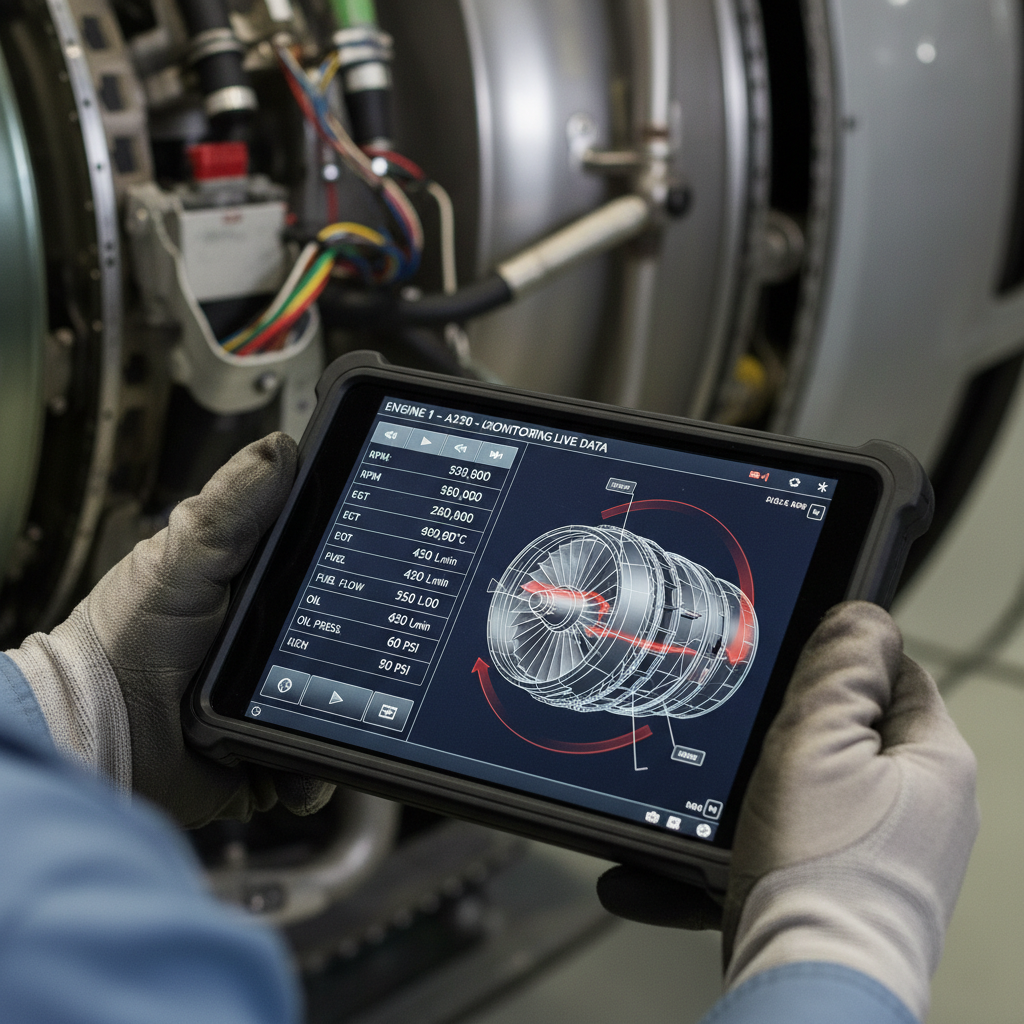
A digital twin is a living virtual replica of a physical asset, continuously updated with real sensor data. Not a 3D model you rotate on a screen. A simulation that predicts when a component will wear, what sequence to use in MRO, and how a change propagates across the fleet. For a deeper look at what an aerospace digital twin actually delivers, the results depend heavily on data quality and integration.
Airbus operates Skywise, connecting over 12,000 aircraft and 50,000+ users worldwide, with digital twin applications across A320, A350, Eurodrone, and FCAS programs. Boeing is moving data collection and logic onboard aircraft for predictive maintenance. Rolls-Royce’s R2 Data Labs (founded 2017) and Digital FIRST program build digital twins into engine lifecycle management. Industry benchmarks show digital twins deliver 19% cost savings on average, with 72% of organizations planning to expand their use.
4. IoT and the Connected Aircraft
This is where the digital world meets the physical. IoT sensors on aircraft, ground support equipment, and infrastructure feed the data that makes everything else work. Airbus’s “Connected Experience” links cabin components (galleys, trolleys, seats, lavatories) on a single IoT network so the cabin self-reports issues. Collins Aerospace offers nose-to-tail, air-to-ground connected aircraft solutions. Honeywell sunset its Forge platform in April 2025 and transitioned customers to its next-generation Genesis PRO.
SITA’s data shows 53% of airports already use AI in aircraft turnaround tracking, but only 17% of airlines monitor turnaround in real time. That 36-point gap tells you something: the sensor layer exists, but the data isn’t flowing between stakeholders. More on this blind spot later.
5. Biometrics and Digital Identity
Biometric boarding, once a novelty, is becoming the default. Dubai International Airport’s smart tunnel clears passport control through facial recognition in roughly 15 seconds. Lufthansa, SWISS, and Austrian rolled out Star Alliance Biometrics at Hamburg Airport in 2022 for contactless security and boarding. SITA projects biometric border control at 83% of airports by 2028, up from 54% today. The share of passengers who have never used biometrics at airports dropped from 41% in 2024 to 31% in 2025.
The tension is real, though. Independent research shows facial recognition disproportionately misidentifies women and people of color. A bipartisan Traveler Privacy Protection Act was introduced in the US Senate in 2025 to curb TSA biometric collection. Airlines building their passenger journey around biometrics need to track the regulatory landscape as closely as the technology itself.
6. Cybersecurity
The attack surface is widening faster than the defenses. Known 2024 incidents included ransomware on AerCap (January), a DDoS attack on Japan Airlines (December), breaches at Hamburg Airport and Seattle-Tacoma, and a service-provider attack on sunExpress affecting 250,000 customers. Then came 2025: the Collins Aerospace MUSE ransomware strike disrupted check-in and baggage systems at three major European hubs simultaneously.
SITA’s 2025 survey shows 71% of airports now rank cybersecurity as their top IT focus. But investment alone doesn’t solve the structural problem. The industry relies on a handful of vendors for core systems. When one goes down, the cascade is instant. Multi-vendor contingency, zero-trust architecture, and regular manual-fallback drills aren’t optional anymore. EASA published its first AI regulatory proposal for aviation in November 2025, covering AI assurance, human factors, and ethics. Binding standards are coming.
7. Next-Generation Networks and Quantum Computing
Private 5G networks are being deployed at airports (Dusseldorf, Singapore Changi, several US hubs) to support IoT, drone inspection, and autonomous ground vehicles. This is infrastructure, not glamour, but it’s the connective tissue that makes real-time IoT tracking and AI-driven turnaround management possible at scale.
Quantum computing remains earlier-stage but no longer theoretical. Airbus partnered with IonQ for quantum algorithms in aerospace optimization. D-Wave demonstrated quantum annealing for aircraft-to-flight schedule assignment. IBM published a 2024 report on quantum use cases for aerospace, focusing on CFD simulation and finite element analysis. Narrow applicability in the next 24 to 36 months, but real.
Who’s Actually Leading (and What It Costs)
Every airline claims to be transforming. Here’s who is producing measurable results.
Delta Air Lines became the first US airline to hit its 2025 jet fuel savings target: 45 million gallons cut, over $110 million saved through operational efficiencies, not just fleet renewal. That’s a direct line from data-driven operations to the income statement.
Lufthansa Group is the most aggressive in Europe. It consolidated IT under one organization, deployed Palantir Foundry as its data backbone, chose Amadeus Nevio (AI-native retailing) in January 2026, and announced it will cut roughly 4,000 administrative roles by 2030, replacing them with digital processes and AI. Financial targets: 8 to 10% adjusted EBIT margin and EUR 2.5B+ annual free cash flow by 2028 to 2030. That’s not a lab experiment. It’s a corporate restructuring built on digital.
Emirates went straight to OpenAI for an enterprise-wide deployment, with an AI Centre of Excellence and internal champion network. IAG (British Airways, Iberia, Aer Lingus) combined loyalty, payments, and identity into the Avios app and was named to the FTE Airline Digital Transformation Power List EMEA 2026. Singapore Airlines runs a dedicated digital blueprint backed by hundreds of millions in transformation spend.
The pattern among leaders, per BCG: they don’t treat digital transformation as a technology project. They treat it as a business model change, with dedicated product managers, reskilled talent, and executive ownership of data as a strategic asset.
The Physical Layer Most Strategies Ignore
Here’s where I have a bone to pick with most aviation digital transformation roadmaps.
Open any airline’s transformation plan and you’ll find chapters on AI, cloud, passenger experience, retailing, and sustainability. What you won’t find is a chapter on physical asset visibility: knowing, in real time, where every ULD, every piece of ground support equipment, every rotable part, and every tooling cart actually is.
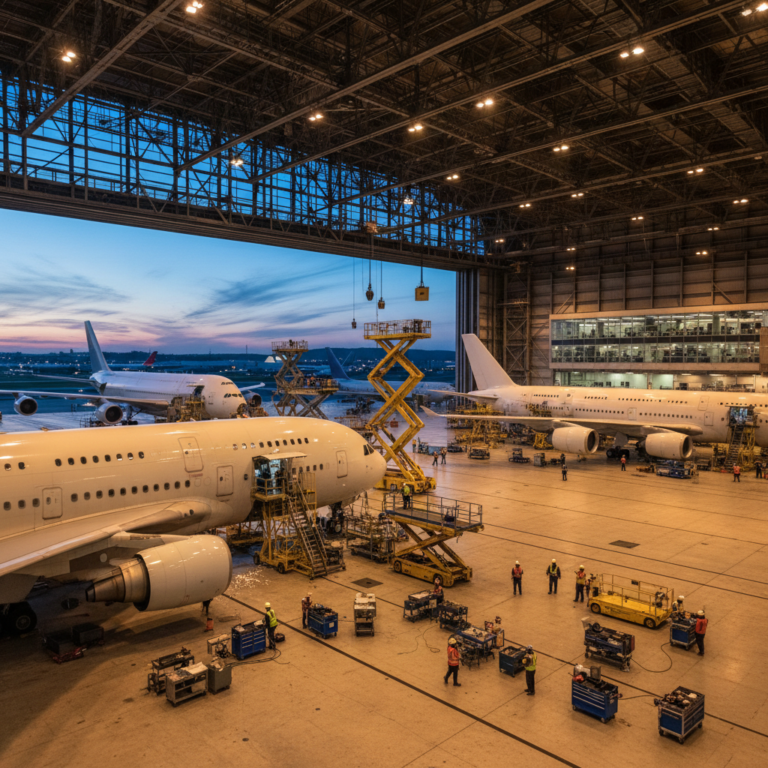
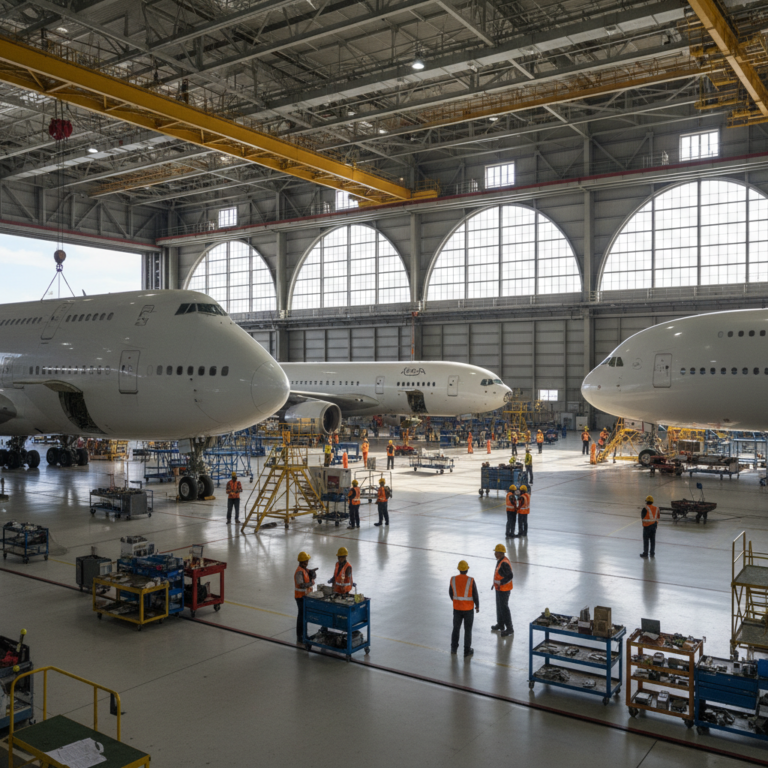
This is not a small gap. IATA estimated baggage mishandling alone cost the industry $2.2 billion in 2022. ULD pools worth hundreds of millions of dollars circulate between airlines, cargo handlers, and freight forwarders with cycle times that stretch weeks longer than necessary because nobody can see where they dwell. MRO shops lose hours every shift searching for tooling that’s physically present in the hangar but invisible in the system. Ground support equipment sits idle on one side of the airport while crews on the other side wait.
The digital twin of an A350 engine is extraordinary. But if the ground support tug that tows the aircraft isn’t tracked, if the cargo containers that feed it aren’t visible after handoff, if the rotable parts in the MRO pipeline have no location data between warehouse and workbench, then your digital transformation has a physical blind spot at the bottom of the stack.
Industry research consistently identifies data coordination between partners as the single largest operational blocker to extracting value from AI, cybersecurity, and sustainability investments. The physical layer is where that coordination breaks down most visibly. A shipment tracker tells you a package arrived. An asset tracker follows the container, the dolly, the ULD through every cycle, every dwell, every reuse. That distinction, between shipment tracking and asset tracking, is where operational dollars hide.
IoT hardware has matured enough that this is no longer a technology problem. Cellular trackers with multi-year battery life, GNSS positioning, DO-160 airfreight-approved devices, and ruggedized sensors for ramp and MRO environments all exist today. These same tracking technologies apply to critical emergency aviation equipment that must be located instantly during safety-critical situations. The problem is that most transformation programs skip this layer entirely because it doesn’t show up in a passenger-facing app or an AI demo.
Three Risks That Could Ground Everything
Cyber Fragility at Scale
A 600% increase in aviation cyberattacks in one year is not a trend. It’s a regime change. The Collins Aerospace MUSE incident proved that a single vendor going down can cascade across borders and airports within hours. The industry’s reliance on a small set of infrastructure vendors (for DCS, PSS, baggage, and check-in) creates systemic fragility that no amount of AI-powered anomaly detection fully addresses. Airlines need multi-vendor fallback plans, regular simulation of manual operations, and quarterly audit of their supply chain’s security posture.
Legacy Systems as Deadweight
94% of executives say digital transformation is essential. 22% have actually moved most operations to cloud. That 72-point gap is not procrastination. It’s structural. Legacy PSS platforms have 30 years of accumulated business logic that cannot be migrated in a quarter. Amadeus Nevio and Sabre Mosaic are trying to bridge this, but adoption takes years per carrier. British Airways selected Nevio in April 2024. Lufthansa followed in January 2026. The replacement wave is real, but it will run through 2029 at a minimum.
Workforce Displacement Without Reskilling
Lufthansa’s plan to remove 4,000 administrative roles by 2030 is the most explicit signal yet. AI doesn’t destroy labor across the board; it reprices it. The repeatable tasks go away. The data engineering, MLOps, and digital product management roles that design and maintain AI systems become more expensive and harder to hire for. Airlines that automate without investing equally in reskilling will find they can’t staff the digital operation they just built. Germany’s political environment will scrutinize Lufthansa’s move closely. Other carriers will watch what happens before committing publicly to similar programs.
What Comes Next: 2026 to 2028
Five shifts to plan around:
- GenAI agents become operational infrastructure. Swifty, Holly, Sama, Maharaja, Flyways. These are not chatbot experiments. They’re the first generation of AI agents that will multiply across operational workflows, from crew scheduling to fuel optimization to MRO planning. WNS predicts a model they call “Agentic AI” (autonomous, proactive operations) becoming mainstream across the industry in 2026.
- Biometric identity replaces physical documents as default. 83% of airports by 2028, per SITA. But privacy legislation in the US and EU is still evolving. Airlines that build passenger journeys entirely around biometrics without fallback risk regulatory disruption.
- Cloud-native PSS displaces mainframe PSS. The Boeing/Thoma Bravo divestiture ($10.55 billion for Jeppesen, ForeFlight, OzRunways, AerData) frees those platforms to compete independently. Amadeus Nevio and Sabre Mosaic race to replace legacy systems. Expect the PSS replacement wave to accelerate through 2027 to 2029.
- NDC reaches critical mass. NDC hit 21.2% of ARC-settled transactions in December 2025, with traditional agency adoption roughly doubling. IATA projects $40 billion in new annual industry value from NDC, ONE Order, and Dynamic Offers by 2030. That value is real but conditional on airlines actively retailing through NDC and decommissioning legacy EDIFACT inventories.
- Cybersecurity becomes a board-level, not IT-level, conversation. EASA’s November 2025 AI regulatory proposal is the first concrete guidance framework. Binding standards will follow. Airlines that treat cybersecurity as a compliance checkbox rather than operational architecture will learn the lesson the way Collins Aerospace’s customers did in September 2025.
Where Asset Visibility Fits in Your Transformation Roadmap
If your airline, MRO, or ground handling operation is deep in a transformation program, ask one question: can you see your physical assets in real time, across partners, after handoff?
Not the aircraft (you have ADS-B for that). The everything else. ULDs. GSE. Rotable parts in the MRO pipeline. Tooling carts. Cargo containers in the pool.
If the answer is no, you have the same blind spot most of the industry has. And it’s costing you in cycle time, utilization rates, dwell penalties, and MRO labor hours that never show up in your AI dashboard because the data was never collected at the source.
At Datanet, this is the layer we work in. We integrate IoT asset tracking solutions across aviation and aerospace operations: DO-160 approved airfreight trackers, rugged industrial devices for ground equipment and MRO, and complete end-to-end deployment that connects the physical layer to whatever data platform your transformation runs on. If this is a gap in your roadmap, let’s talk about it.
Frequently Asked Questions
What is aviation digital transformation?
It’s the adoption of cloud, AI, digital twins, IoT, biometrics, and cybersecurity technologies to modernize how airlines, airports, OEMs, and MRO providers design, operate, maintain, and retail air travel. It spans the entire value chain, from aircraft manufacturing to passenger boarding to post-flight maintenance and asset management.
How much is the aviation industry spending on digital transformation?
SITA’s 2025 survey places total airline and airport IT spending at a record $50.8 billion. The addressable airline digital transformation software and services market is estimated at $14.2 billion in 2025, growing to $31.8 billion by 2034 at 9.8% CAGR. Figures vary significantly depending on what’s included, so always check the scope.
Which airlines are leading in digital transformation?
Lufthansa Group, IAG (British Airways, Iberia), Emirates, Delta, Singapore Airlines, Qatar Airways, easyJet, and Ryanair are consistently named among the leaders. The FTE Airline Digital Transformation Power List EMEA 2026 recognizes 12 carriers and their named digital executives. Delta stands out for measurable fuel savings ($110M+), Lufthansa for structural reorganization around AI.
What role does AI play in aviation digital transformation?
AI is now the top technology priority for 50% of airlines (BCG, October 2025). Current production uses include fuel optimization (Alaska Airlines saved 480,000 gallons in six months), customer service automation (JetBlue reclaims 73,000 hours per quarter), predictive maintenance (Airbus Skywise, Boeing onboard analytics), and retailing personalization (Amadeus Nevio). Generative AI agents from Lufthansa, Emirates, Qatar Airways, and Air India are moving from pilots to operational deployment.
What are the biggest risks to aviation digital transformation?
Cybersecurity (600% attack surge in 2025, including the Collins Aerospace MUSE ransomware incident), legacy system inertia (only 22% of operations migrated to cloud), workforce displacement (Lufthansa cutting 4,000 administrative roles by 2030), and vendor concentration risk. Privacy regulation around biometrics is also evolving rapidly in both the US and EU.
How does IoT asset tracking connect to aviation digital transformation?
IoT sensors provide the physical data layer that feeds digital twins, AI models, and operational dashboards. Without real-time visibility into ULDs, ground support equipment, tooling, and rotable parts, airlines and MROs operate with blind spots that no amount of software can fix. Asset tracking closes the loop between digital strategy and physical operations.



 +1 508 292 2210

3 Responses