

An IATA audit of 262 air waybills across 9 flights found something that should keep every cargo operations leader up at night: only 27.5% of AWBs were accurate. The remaining 72.5% showed variance beyond ±10% from the planned manifest.
That single finding explains more about the state of aviation logistics management than any glossary entry will. This is a $152.5 billion industry where the foundational data layer, the air waybill, is wrong nearly three out of four times.
If you run cargo operations, manage MRO supply chains, oversee ground support fleets, or coordinate freight forwarding for aviation clients, this piece is the operational briefing you want before your next vendor review or tech investment. Not theory. Numbers, problems, and what the solutions actually look like in 2026.
What Aviation Logistics Management Actually Covers
Aviation logistics management is the coordination of physical goods, parts, equipment, and data across the air transport chain. From warehouse to tarmac to destination. And, critically, back again.
It is not just air freight. Air freight is one lane. Aviation logistics management spans six distinct operational pillars:
- AOG (Aircraft on Ground) response: emergency sourcing, routing, and delivery of parts to get grounded aircraft off the revenue clock. Time is money when an aircraft is on the ground, and AOG logistics operates on hours, not days.
- MRO supply chain: planned and unplanned maintenance parts flow. Think engine components moving from a smart factory aerospace line to wing, with every hour of delay measured in lost flight revenue.
- ULD management: unit load device procurement, pooling, positioning, maintenance, and repair across a global network of stations.
- Ground support equipment (GSE) logistics: tugs, loaders, GPU carts. Their maintenance schedules, location tracking, and repositioning between hubs.
- Cargo terminal operations: build-up, break-down, customs clearance, dangerous goods handling under IATA DGR.
- Freight forwarding and brokerage: the commercial layer connecting shippers to capacity, managing documentation, and ensuring regulatory compliance across jurisdictions.
The discipline sits at the intersection of IATA regulatory frameworks, digital standards like ONE Record and e-AWB, physical operations on the ramp, and financial performance in the boardroom. Get any one of these wrong and the others feel it fast, which is why strong aerospace quality management underpins every reliable logistics operation.
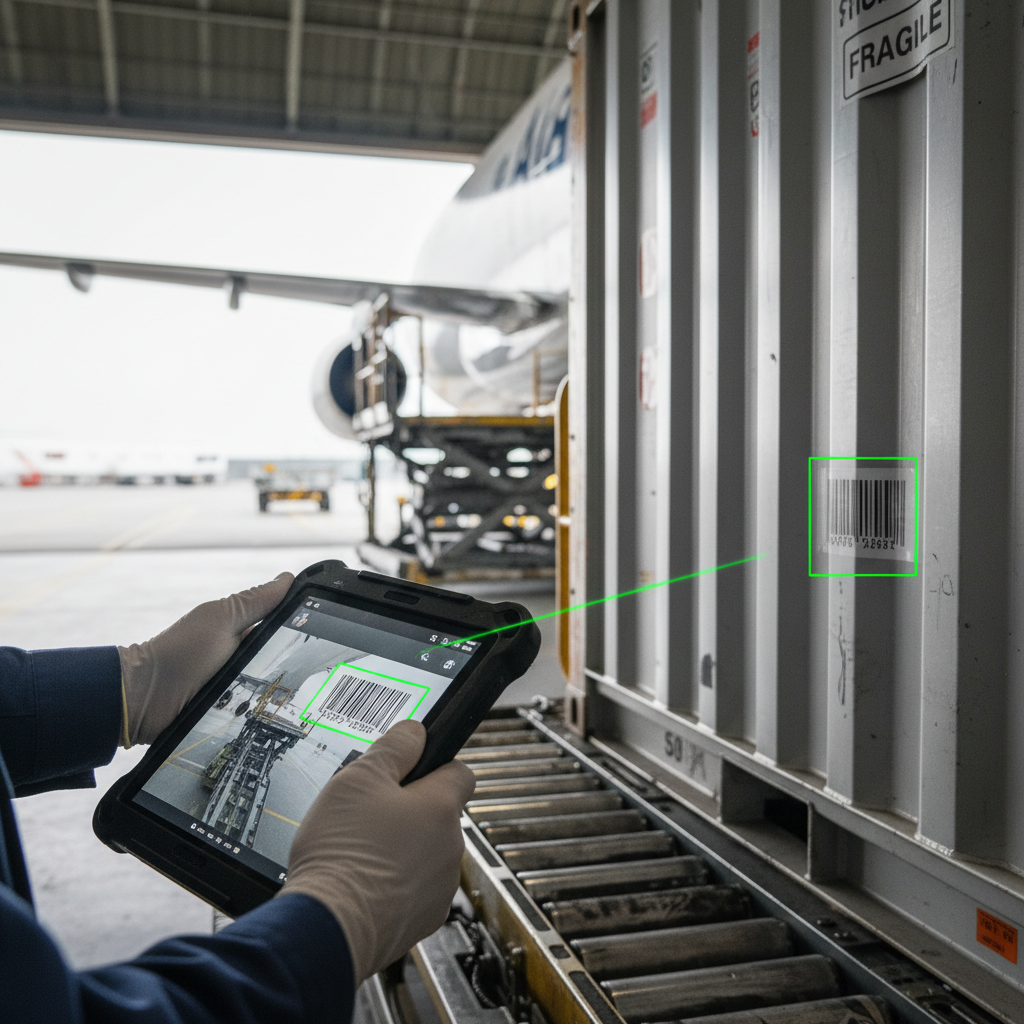
The Market: $152.5 Billion and Climbing
The global cargo airline industry was valued at approximately $152.5 billion in 2024, with worldwide air freight traffic reaching 57.7 million tonnes. Revenue more than doubled between 2004 and 2021, peaking near $175 billion during the pandemic surge.
The more specific aerospace logistics services segment tells its own story. That market reached $15.68 billion in 2025 and is forecast to hit $20.18 billion by 2029, a 6.5% CAGR. The connected logistics sub-segment (where IoT, telematics, and tracking live) reached $2.2 billion in 2025. Small relative to the whole, but the fastest-growing slice of the stack.
Volume trajectory gives you the operational pulse. December 2025 closed with +6% year-over-year air cargo volume growth, capping a full-year +4% gain after 2024’s +11% rebound. For 2026, Xeneta projects a more modest +2-3%.
The structural tailwinds are clear. E-commerce air cargo volumes have been growing at 14% annually. Pharmaceutical cold chains are expanding as manufacturers push toward carbon-neutral logistics by 2030. Airbus forecasts 1,195 cargo aircraft in North America alone by 2040.
But the macro numbers mask volatility that changes week to week at the lane level. And that volatility is where aviation logistics management either earns its keep or falls apart.
Geopolitics, Spot Rates, and the Capacity Trap
In March 2026, a Middle East conflict pushed global air cargo spot rates to $2.86/kg, the highest point since December 2024. Regional air capacity dropped roughly 30% below pre-conflict levels within five weeks. The share of global volumes moving under spot rates hit 52%. Just one point below pandemic-onset levels.
The lane-level dispersion was severe:
- South Asia + Southeast Asia to Middle East: +50-100%
- Europe to Africa: +31%
- South Asia to North America: approximately +75%
- Europe to North America: roughly -10% (the exception)
This was not the first shock. In early 2024, Red Sea disruptions pushed ocean shippers into air freight, spiking volumes across transatlantic and Asia-Europe corridors overnight.
The pattern is now structural: capacity-side risk outweighs demand-side risk. If your MRO parts or pharma shipments depend on spot capacity, you are one regional conflict away from a 50-100% rate spike on the exact lanes you need most. Pre-contracted block-space or dedicated charter capacity is not conservative planning anymore. It is baseline risk management.
The Data Accuracy Crisis at the Core
Now back to the number that matters most for day-to-day operations.
The IATA study did not just find that 72.5% of AWBs were inaccurate. It quantified what that inaccuracy costs in lost capacity. Those same 9 flights carried 22% free volume (18.25 m³). Of that, 14% (11.75 m³) was actually usable. Just sitting there. Revenue left on the tarmac because the load plan was built on wrong data.
When IATA scaled the analysis to roughly 1,000 flights, the pattern held: 24.8% free space, with 16.4% (27.05 m³) usable. A planning tool tested on 4 passenger flights over 3 months delivered 33.75% time savings in build-up and exposed 23.6% usable free space, a direct gain in aviation workforce productivity from better data rather than more staff.
The root cause is a messaging standard called CIMP (Cargo Interchange Message Procedures). It is over 50 years old. The air cargo industry still relies on manual paperwork and data duplication that create compounding inaccuracies at every handoff. The AWB was never designed for real-time decision-making. It was designed for paper-era accounting.
Airlines are not flying with empty capacity because demand is soft. They are flying with wasted capacity because the data feeding their load planning is wrong. Fix the data, and the aviation digitalization benefits follow as double-digit load-factor gains without adding a single flight.
The Technology Stack Reshaping Aviation Logistics
Three technology layers are converging to address this. At different speeds, with different levels of maturity.
Messaging: ONE Record Replaces a 50-Year-Old Protocol
IATA’s ONE Record became the preferred data-sharing standard on January 1, 2026. It replaces CIMP with a single canonical data model and open APIs, breaking the lock-in of legacy Type-B messaging.
As of December 2025, industry awareness exceeded 70%, readiness was around 50%, and over 30 pilot projects were running. Named participants include Cathay Pacific (eAWB submission, shipment tracking, customs status), Turkish Cargo (full shipment-level tracking for all processed cargo), and a combined Schenker, Riege, and Lufthansa project on end-to-end TMS-to-airline integration.
The transition window is 2026 to 2028. If your cargo management vendor cannot show a ONE Record timeline, that should be a line item in your next RFP.
AI: From Conference Decks to Contract Language
On March 11, 2026, IATA launched two AI artifacts: an AI Subject Matter Expert app (covering the Cargo Handling Manual and Dangerous Goods Regulations in plain-language queries) and an Air Cargo AI Excellence Hub that convenes regulators, tech providers, forwarders, handlers, and airlines.
Jettainer’s ULD management platform (JettwareNG, 99.9% uptime since its March 2025 launch) has AI integration on its 2026 roadmap. FreightAmigo documented AI-driven cargo optimization during 2025 U.S. air freight surges. IATA’s Technology Trend Radar places advanced analytics and wearables at under 5 years to mainstream adoption.
The shift is real. AI in aviation logistics is no longer a vendor pitch. It is becoming standard contract language for managed services.
Connected Logistics and IoT: The Physical-Asset Layer
The aerospace and defense connected logistics market reached $2.2 billion in 2025. As parts flow from connected manufacturing systems into the supply chain, Trackonomy’s cellular-tracker-as-reader architecture signals where the physical-asset layer is heading: persistent, automated data capture without dependency on manual scans at fixed checkpoints.
Here is the tension in 2026: the messaging layer is approaching standardization. The controls layer (IATA’s CargoIS with 300+ airlines, 21 million+ AWBs, and $65 billion in charges, plus CargoWise’s AirlineConnect) is consolidating. But the physical-asset layer, knowing where your equipment and containers are at all times, across their full lifecycle, remains the weakest link in the chain.
Asset Visibility: The Layer Most Operations Still Miss
This is where I see the gap every day.
Most aviation logistics managers have some form of shipment tracking. They know where the cargo is between origin and destination. The AWB, for all its inaccuracies, provides at least a partial status chain.
But ask those same managers where their ULDs are 48 hours after offload. Ask where their ground support equipment sits across three airports. Ask how many reusable containers are idle at a station 4,000 miles from where they are needed next.
Silence.
This is the core distinction between shipment tracking and asset tracking. Shipment tracking ends at delivery. Asset tracking follows the equipment through its full cycle: deployment, use, dwell, return, maintenance, redeployment. Two different problems. Two different data architectures. Most operations invest heavily in the first and ignore the second.
When the IATA audit found 22% free volume on 9 flights, part of that waste is a data problem (bad AWBs). But part of it is a visibility problem. If you do not know where your ULDs and containers are in real time, you cannot position them where the cargo is building up.
Airlines outsource ULD management to specialized providers precisely because the pooling, positioning, and maintenance logistics are complex enough to justify a dedicated partner. But outsourcing does not eliminate the need for visibility. It relocates it.
For ground support equipment, MRO tooling, and reusable air freight containers, the visibility gap is even wider. These assets do not have AWBs. They are not in CargoIS. They exist between the cracks of the cargo data infrastructure.
This is what we solve at Datanet. Whether it is a DO-160 approved tracker on an air freight container or a cellular device on a ground support cart that rotates between hubs, the objective is the same: close the gap between where cargo data ends and where operational dollars keep bleeding.
Three outcomes we see consistently when aviation operations deploy asset tracking alongside their existing shipment tracking (detailed analysis in our ROI of asset tracking in aviation study):
- Cycle time reduction of 15-30% on reusable containers and ULDs, because you can see dwell time at every station instead of guessing
- GSE utilization improvements that eliminate “phantom fleet” purchases (buying equipment you already own but cannot find)
- MRO parts accountability that tracks tooling and rotables from shop to aircraft and back, cutting search time and compliance gaps
If your container pool or GSE fleet feels invisible after offload, that is exactly the gap asset tracking closes. Talk to our team and we can walk you through what a deployment looks like for your specific operation.

Frequently Asked Questions
What is aviation logistics management?
Aviation logistics management is the planning, execution, and oversight of cargo, parts, equipment, and data flows across the air transport chain. It encompasses AOG response, MRO supply chain management, ULD operations, ground support logistics, cargo terminal operations, and freight forwarding. The discipline operates under IATA regulatory frameworks including DGR and ICHM.
How large is the aviation logistics market?
The global cargo airline industry was approximately $152.5 billion in 2024. The aerospace logistics services segment reached $15.68 billion in 2025 and is forecast to grow to $20.18 billion by 2029 at a 6.5% CAGR. The connected logistics sub-segment (IoT, telematics, tracking) for aerospace and defense hit $2.2 billion in 2025.
What is ONE Record and why does it matter?
ONE Record is IATA’s data-sharing standard replacing the 50-year-old CIMP messaging protocol. It provides a single canonical data model with open APIs, enabling end-to-end digital visibility across shipments. It became the IATA preferred standard on January 1, 2026, with over 30 active pilot projects including Cathay Pacific, Turkish Cargo, and Lufthansa.
What is the difference between shipment tracking and asset tracking in aviation?
Shipment tracking follows cargo from origin to destination and ends at delivery. Asset tracking follows equipment (ULDs, containers, ground support vehicles, MRO tooling) through their entire lifecycle: deployment, use, dwell, return, maintenance, and redeployment. Most aviation operations invest in shipment tracking but lack asset tracking, leaving billions in equipment poorly managed.
How do geopolitical events affect aviation logistics?
Regional conflicts can reduce air cargo capacity by 30% or more within weeks, causing spot rate spikes of 50-100% on affected trade lanes. In March 2026, a Middle East conflict pushed global spot rates to $2.86/kg. Operations dependent on spot capacity face severe cost and timing exposure during these events.
What role does AI play in aviation logistics management today?
IATA launched its Air Cargo AI Excellence Hub and an AI Subject Matter Expert tool in March 2026, covering the Cargo Handling Manual and Dangerous Goods Regulations. AI is being applied to load optimization, demand planning, ULD management, compliance queries, and predictive maintenance in aerospace. It is moving from pilot programs into standard managed-services contracts.








 +1 508 292 2210

One Response