

An Australian Transport Safety Bureau review found that emergency locator transmitters function as intended in only 40 to 60 percent of accidents where activation was expected. Older TSO-C91 units activated in less than 25 percent of crashes. That means the single device designed to find a downed aircraft fails more often than a coin flip in the exact scenario it was built for.
If you manage fleet safety, MRO operations, or airline compliance, tracking emergency aviation equipment is two parallel problems you’re solving with one budget: locating the aircraft during or after a distress event (the ELT and ADT world), and managing the hundreds of cabin safety items (life vests, oxygen bottles, fire extinguishers) that regulators expect to be inspected, current, and in position before every flight. Both are tracking problems. Both cost real money when they break. And both have changed substantially in the past three years.
Two Tracking Problems, One Aircraft
The phrase “tracking emergency aviation equipment” maps to two distinct operational domains, and most content online covers only one of them:
The first is distress tracking: knowing where the aircraft is when something goes wrong. This is the domain of Emergency Locator Transmitters (ELTs), Autonomous Distress Tracking (ADT), the Cospas-Sarsat satellite constellation, and supplementary systems like ADS-B. The stakes here are existential. When an aircraft goes down in remote terrain or open ocean, every hour of search delay compounds the risk to survivors. The FAA’s own guidance notes that survivability drops roughly 80 percent in the first 24 hours after an accident, and without a flight plan, the average delay before search even begins is 36 hours.
The second is cabin equipment tracking: knowing where every regulated safety item is, whether it’s expired, and whether it’s physically present aboard the aircraft. Life vests under seats. Portable oxygen bottles. Halon extinguishers. Megaphones. Survival kits. A single expired item found during a regulatory audit can ground a plane. A missing item can trigger a delay that cascades across the schedule.
They’re different problems. But they share a common root: if you can’t locate it and verify its status, it doesn’t exist operationally.
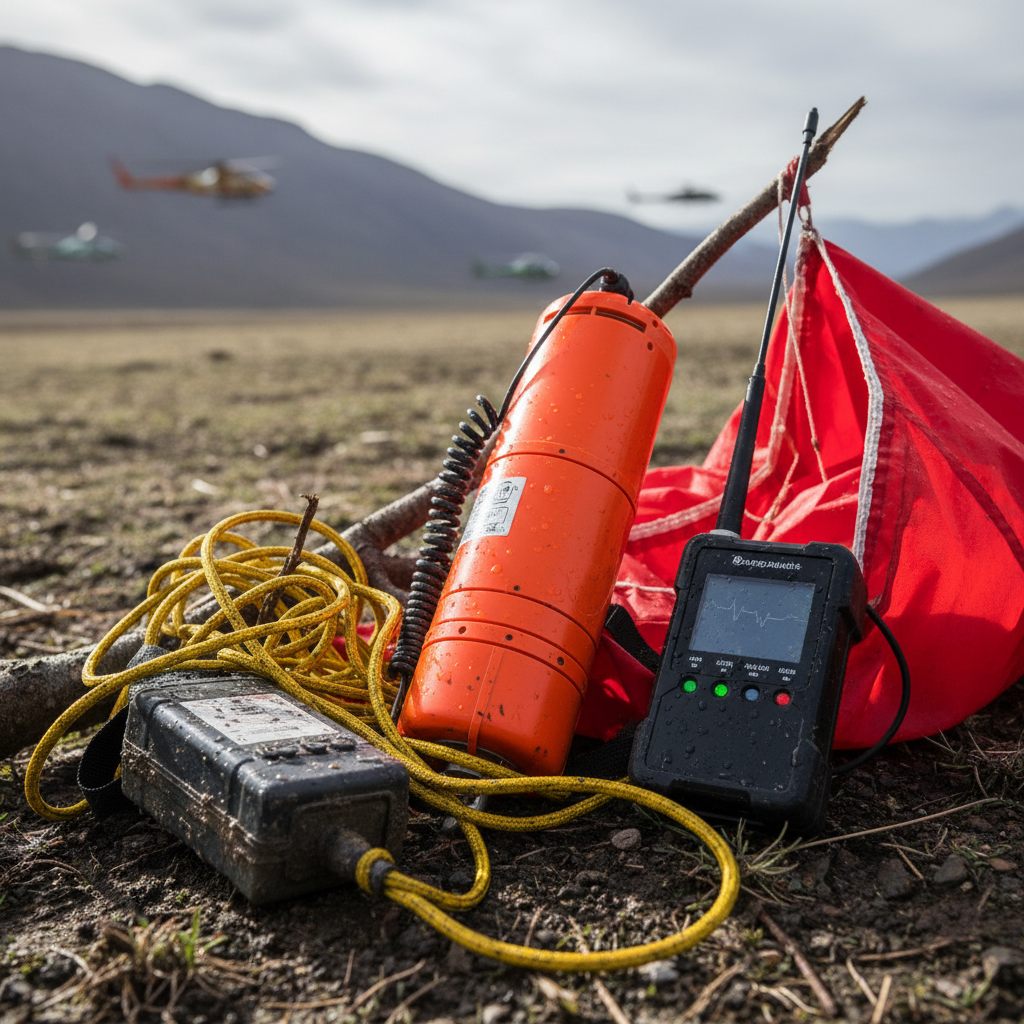
How Distress Tracking Actually Works
The backbone of aviation distress tracking is the Cospas-Sarsat system, an international satellite programme running since 1982 with roughly 65 satellites across low, medium, and geostationary orbits. It covers more than 200 countries and territories. When a 406 MHz ELT fires, the signal reaches Cospas-Sarsat, gets routed to Mission Control Centers (NOAA’s facility in Suitland, Maryland handles the U.S. side), is decoded and deduplicated, then forwarded to the nearest Rescue Coordination Center. No cost to beacon owners. No cost to SAR authorities.
The system has three satellite layers, each covering a gap left by the other:
- LEOSAR (low-Earth orbit): the original layer. Strong Doppler-based positioning, but limited coverage windows because the satellites are only overhead periodically.
- GEOSAR (geostationary): wide-area, always-on coverage, but no independent Doppler capability for precise positioning.
- MEOSAR (medium-Earth orbit): the newest layer, piggybacking on Galileo, GPS, and GLONASS navigation satellites. This one changes the game. It combines GEOSAR’s wide coverage with LEOSAR’s precise positioning, and shrinks first-alert latency from over an hour to single-digit minutes when multiple MEOSAR satellites detect the burst simultaneously.
On top of this, Galileo offers something no other GNSS constellation does: the Return Link Service (RLS). When a 406 MHz beacon with RLS capability fires, Galileo sends an acknowledgement back to the beacon confirming the signal was received. Average acknowledgement time: 37 seconds. That’s against a design target of 15 minutes. Availability: 99.99 percent, against a target of 95 percent. EU Commissioner Andrius Kubilius stated at the 2025 European Space Conference that Galileo helps save approximately 2,000 lives every year.
ADS-B (Automatic Dependent Surveillance-Broadcast) fills a different slot. It doesn’t replace an ELT. It broadcasts an aircraft’s GPS-based position during normal flight, giving controllers a precise last-known position before an incident. Space-based ADS-B via the Aireon/Iridium NEXT constellation extends this into oceanic airspace, where traditional radar never reached. The Civil Air Patrol’s Alaska ADS-B Project uses exactly this approach: when an aircraft goes overdue, search starts from the last ADS-B position rather than a flight plan estimate.
Together, the stack works like this: ADS-B gives you the aircraft’s precise last-known position. ADT transmits location every minute during distress. After impact, the 406 MHz ELT broadcasts to Cospas-Sarsat. MEOSAR refines the location. Galileo RLS tells survivors their signal was received. Layers, not a single point of failure.
After MH370: GADSS and the 1-Minute Rule
On 8 March 2014, Malaysia Airlines Flight 370 disappeared with 239 people aboard. No distress signal. No radar track beyond the South China Sea. The only forensic trail was a series of satellite “handshakes” with an Inmarsat satellite that were never designed for tracking purposes. The aircraft has still not been found.
MH370 exposed a structural flaw in global aviation safety: an aircraft’s tracking and distress systems could be disabled (or simply fail), and the SAR architecture had no fallback. ICAO responded with the Global Aeronautical Distress and Safety System (GADSS), organized into four layers:
- Normal tracking: aircraft position reported at least every 15 minutes during flight.
- Autonomous Distress Tracking (ADT): in a distress condition, position transmitted at least every minute, resilient to failures of electrical power, navigation, and communications.
- Post-impact localization: crash-survivable beacon continues transmitting after impact.
- SAR coordination: standardized response protocols linking operator, state, and RCC.
The ADT requirement was originally set for January 2021 for new-build aircraft over 27,000 kg maximum takeoff weight. Boeing and Airbus pushed back on certification timelines, and it was deferred to January 2023. EASA’s parallel rule (CAT.GEN.MPA.210) adds a 6 nautical mile accident-site accuracy requirement and a 48-hour homing beacon mandate.
The first GADSS-compliant ELT-DT to reach the market is the ARTEX ELT 5000, which earned Boeing 787 type certification in September 2025. Paired with SKYTRAC’s ADT software, it delivers in-flight distress tracking and post-crash localization in one unit. In March 2025, the U.S. Coast Guard formally elevated ELT-DT distress tracking to “Emergency Phase” status, which means RCCs now treat ELT-DT bursts at higher priority than legacy ELT alerts with accelerated coordination.
The regulatory architecture is catching up to the technology. And the technology is catching up to the lessons written in the disappearance of 239 people.
Why Legacy ELTs Fail When They’re Needed Most
Back to the number in the headline. The ATSB’s systematic review found that ELTs functioned in only 40 to 60 percent of crashes where activation was expected. Newer TSO-C91A units improved to 73 percent. But even at 73 percent, nearly one in four ELTs in the more modern standard failed when they were supposed to fire.
The failure modes are stubbornly mechanical:
Antenna separation on impact. The most common single failure. The ELT unit survives the crash. The antenna doesn’t. No antenna, no transmission. This is exactly what happened when Steve Fossett disappeared in September 2007. His single-engine Bellanca Super Decathlon went down in the Nevada mountains. No ELT signal was ever received because the antenna separated on impact. What followed was the largest civilian SAR operation in U.S. history, and Fossett was never found alive.
G-force switch limitations. Legacy ELTs use acceleration-triggered switches calibrated for crash forces in specific orientations. A low-angle, controlled crash into trees or water may not generate enough force in the right direction to trip the switch.
Battery degradation. ELT batteries have defined shelf lives. An expired or degraded battery may produce a signal too weak for satellite detection, or fail to power the unit at all.
The 121.5 MHz gap. Since February 2009, satellites no longer process the older 121.5/243 MHz analog ELT frequencies due to extreme false-alert rates. Aircraft still flying with 121.5 MHz-only units are invisible to satellite SAR. The only detection path is ground-based receivers or visual overflights. Canada addressed this directly with a 406 MHz ELT mandate for all Canadian-registered aircraft, effective 25 November 2025.
This is precisely why GADSS shifted the philosophy from “beacon fires after crash, hope it works” to “aircraft transmits every minute during distress, and the beacon is a backup layer.” Multi-layer redundancy instead of single-point dependence.
Tracking Cabin Emergency Equipment: The Other Half
Now the second tracking problem, and the one that hits MRO managers and ops teams every single day: the physical safety items aboard the aircraft.
A typical narrowbody carries life vests under every seat, portable breathing equipment, fire extinguishers (halon and water types), megaphones, survival kits, first aid kits, crash axes, and smoke hoods. A widebody adds life rafts, additional oxygen systems, and more. Each of these items has an inspection interval, an expiration date, and a required location. Multiply that by a fleet of 50, 100, or 200 aircraft, and you have thousands of serialized assets rotating through cabins, maintenance shops, and forward stocking locations.
The traditional process: cabin crew or ground staff physically check each item during pre-flight or scheduled inspections. Open the overhead bin, check the fire extinguisher gauge and expiry tag. Lift the seat cushion, verify the life vest pouch. Record it on paper or a tablet checklist. Repeat for every row, every compartment.
This process is slow (two or more hours per aircraft for a thorough check), error-prone (a missed expiration gets caught at audit, not during the check), and expensive (labor hours, delay penalties, regulatory findings). It’s also the exact kind of problem that modern asset tracking technology solves at scale.
RFID and BLE tags attached to each regulated item let handheld or fixed readers scan an entire cabin in minutes. Each tag stores the item’s serial number, type, expiration date, and assigned position. A single walkthrough with a reader flags missing items, expired items, and items in the wrong location. The data feeds directly into the airline’s maintenance management system, creating an automatic audit trail that satisfies regulatory requirements without manual data entry. This approach mirrors broader airport equipment tracking methodologies used across ground support equipment and terminal assets.
The complication is environment. Aviation is demanding: temperature extremes, pressure changes at altitude, vibration, electromagnetic compatibility requirements. Not every industrial RFID tag qualifies. Aviation-grade tracking hardware, certified to standards like DO-160 for environmental conditions, exists precisely for this use case. The same principles guide selecting asset management software for transportation fleets. The same ruggedized approach underpins military asset tracking, where visibility in harsh conditions is mission-critical.
The ROI math tends to be straightforward: reduce cabin inspection time by 80 percent or more, eliminate manual recording errors, catch expiring items before they trigger audit findings, and generate compliance documentation automatically. The operational dollars saved on avoided delays alone typically justify the deployment within a few months, especially once you weigh the full total cost of ownership of asset tracking against manual processes. For a detailed breakdown of these economics, see our analysis of the ROI of asset tracking in aviation.
What a Modern Tracking Stack Looks Like
The common mistake is treating distress tracking and cabin equipment tracking as completely separate initiatives. Separate budgets. Separate vendors. Separate data. They are different technologies, yes. But the operational philosophy should be consistent, and it belongs inside a broader aviation digital transformation: continuous asset visibility across the entire lifecycle, from the ELT hardware installed in the airframe to the last life vest in row 42. The same visibility principle drives accurate aviation logistics management, where reliable asset data prevents costly errors downstream. This is the same discipline that underpins effective aircraft parts lifecycle management, where every component is tracked from installation through retirement.
A complete stack for tracking emergency aviation equipment includes:
- Distress tracking layer: 406 MHz ELT-DT (GADSS-compliant) with ADT software, integrated into Cospas-Sarsat/MEOSAR. ADS-B as a surveillance complement providing last-known-position data for SAR.
- Cabin equipment layer: RFID or BLE tags on every regulated emergency item, paired with readers at gates, in maintenance hangars, and on handheld devices. Data flowing directly into maintenance/inventory platforms.
- Data integration layer: Both streams feeding a unified operational view. When a cabin scanner flags an expired oxygen bottle and the maintenance system schedules its replacement, that should update the aircraft’s MEL status and readiness posture in real time.
Operators who have deployed integrated tracking consistently report three outcomes:
- Pre-flight emergency equipment checks drop from 2+ hours to under 15 minutes per aircraft.
- Regulatory findings on expired or missing safety items fall 80 to 90 percent in the first year.
- Ground time per turn decreases, directly improving aircraft utilization and revenue per block hour.
The aviation beacons technology market is projected to reach $7.84 billion by 2035 at a 6.4 percent CAGR. That growth isn’t just new ELTs. It includes the broader tracking ecosystem: hardware, software, integration services, and the operational intelligence layer that turns scanning data into predictive maintenance signals.
If your fleet still runs 121.5 MHz ELTs, your aircraft are invisible to satellite SAR. That’s not opinion; it’s physics. If your cabin equipment checks still depend on paper and visual inspection alone, you’re carrying avoidable risk. The technology exists across both halves of this problem. What most operators lack isn’t hardware. It’s the integration expertise to connect aviation-specific requirements with scalable asset tracking architecture. That’s where we focus at Datanet IoT Solutions. If your emergency equipment goes dark after installation and before the next scheduled inspection, that’s a conversation worth having.

Frequently Asked Questions
What is the difference between an ELT and an ELT-DT?
A standard ELT activates on crash impact and transmits a 406 MHz signal to Cospas-Sarsat satellites. An ELT-DT adds in-flight Distress Tracking: it transmits the aircraft’s position at least once per minute during a distress event, even before impact. ELT-DT is the hardware class built to meet ICAO’s GADSS Autonomous Distress Tracking standard, combining in-flight tracking with post-crash localization in one unit.
Why did satellite monitoring of 121.5 MHz ELTs stop?
Cospas-Sarsat stopped processing 121.5/243 MHz analog signals on 1 February 2009 because of extreme false-alert rates and the inability to uniquely identify individual beacons. Aircraft still equipped only with 121.5 MHz ELTs depend on ground-based receivers or visual overflights for detection, which can take days or longer in remote areas.
What is GADSS and when did it take effect?
GADSS (Global Aeronautical Distress and Safety System) is the ICAO framework created after the disappearance of MH370. It requires normal tracking every 15 minutes, autonomous distress tracking at least every minute during emergencies, and post-impact localization. The ADT standard took effect in January 2023 for new-build aircraft exceeding 27,000 kg maximum takeoff weight.
Does ADS-B replace an ELT?
No. ADS-B broadcasts an aircraft’s GPS-based position during normal flight, providing a precise last-known position before an incident. It does not transmit after a crash and has no homing function. ADS-B narrows the search footprint; the 406 MHz ELT or ELT-DT provides the actual post-crash localization and survivor homing signal.
How does RFID tracking work for cabin emergency equipment?
RFID or BLE tags attached to life vests, oxygen bottles, and fire extinguishers store each item’s serial number, expiration date, and assigned position. Handheld or fixed readers scan an entire cabin in minutes, automatically flagging missing, expired, or misplaced items. The data integrates with the airline’s maintenance system, generating automated audit trails and compliance documentation.
What is the Galileo Return Link Service?
Galileo’s Return Link Service sends an acknowledgement back to an activated 406 MHz beacon, confirming the distress signal was received by SAR authorities. Average acknowledgement time is 37 seconds, with 99.99 percent availability. Galileo is the only GNSS constellation offering this return-link capability, and the service operates globally at no cost to the user.








 +1 508 292 2210

3 Responses