

One in twenty pharmaceutical air shipments records a temperature deviation during transit. Multiply that across the global pharma cold chain and you reach approximately USD 35 billion per year in losses attributable to temperature excursions during air transport. That number doesn’t include the insurance claims, the regulatory reporting burden, or the reputational damage when a hospital receives a rejected batch.
Here’s what most guides on this topic won’t tell you: the air leg itself, the part where your cargo is cruising at 35,000 feet, is rarely where the failure happens. The failure happens on the ground. At the handoff. On the tarmac. And your monitoring strategy either accounts for that reality or it doesn’t.
I’ve spent 15 years deploying IoT tracking across aviation, logistics and industrial supply chains. Temperature monitoring for air freight is one of the areas where I see the widest gap between what companies think they’re doing and what they’re actually measuring. This guide covers the full picture: the physics, the regulations, the hardware choices, and the operational decisions that separate a compliant cold chain from an expensive paper exercise.
What temperature monitoring for air freight actually means
Temperature monitoring for air freight is the practice of continuously measuring, recording and (in many cases) transmitting the temperature inside an air cargo consignment from acceptance at origin through final delivery at destination. The goal is twofold: maintain product integrity and produce documented evidence of compliance.
The canonical temperature ranges used across pharmaceutical and perishable air freight are:
- +2°C to +8°C: refrigerated biologics, vaccines, insulin
- +15°C to +25°C: controlled room temperature (CRT)
- +2°C to +25°C: extended room temperature (ERT)
- -20°C: standard frozen
- -70°C to -80°C: ultra-cold (mRNA therapies, gene therapies), maintained with dry ice at its sublimation point of -78°C
The monitoring device, whether a USB logger, a wireless probe or a single-use cellular tracker, sits inside or attached to the shipment and records temperature at intervals ranging from 1 minute to 15 minutes depending on the risk profile and regulatory requirement.
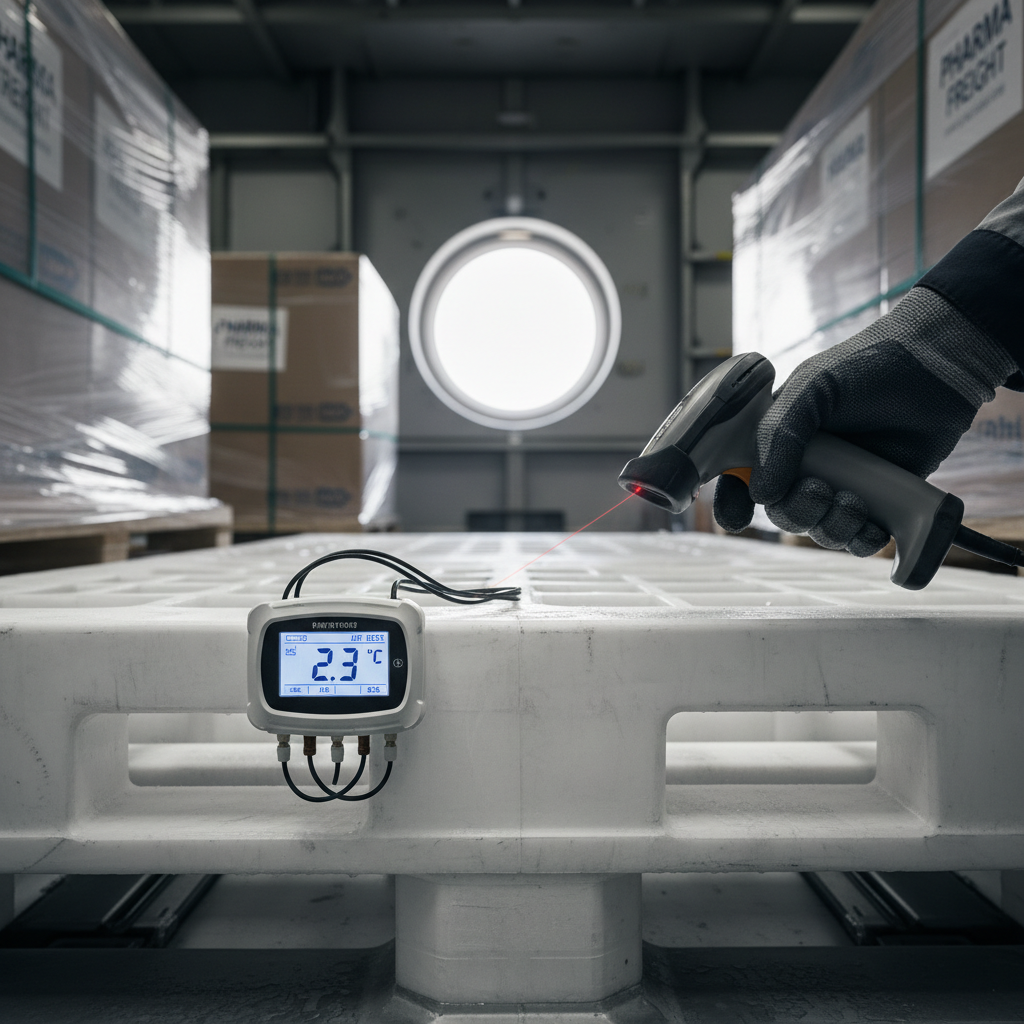
What distinguishes air freight monitoring from warehouse monitoring is the environment itself. An aircraft cargo hold can swing from -50°C at cruise altitude to +40°C or higher on a summer tarmac. That 90-degree swing can happen within a single flight cycle, which is why temperature and humidity monitoring demands purpose-built approaches here. No warehouse on earth does that.
Why the tarmac is your biggest risk, not the sky
Most people picture the monitoring problem as a cruising-altitude problem. The plane is cold up there. The hold isn’t heated. Makes sense to worry, right?
In practice, modern aircraft lower-deck holds stabilize within 2 to 3 hours of takeoff, and active or well-insulated passive containers handle that window comfortably. The temperature regime at altitude is cold but predictable.
The tarmac is neither.
On a July afternoon in Dubai, Memphis or Singapore, tarmac surface temperatures exceed 60°C. A pallet sitting on a dolly for 45 minutes between the warehouse and the aircraft absorbs heat from the ground, the sun and the ambient air simultaneously. Multiply that by the number of handoffs on a multi-leg route: origin warehouse to truck, truck to tarmac, tarmac to aircraft, aircraft to tarmac at hub, tarmac to connecting aircraft, aircraft to destination tarmac, tarmac to truck, truck to final warehouse.
Industry analyses estimate that 20 to 30 percent of all pharmaceutical temperature excursions originate in last-mile handoffs rather than during the air segment itself. Emirates SkyCargo recognized this early and deployed more than 50 dedicated cool dollies at Dubai International Airport to bridge the aircraft-to-truck gap.
The implication for your monitoring strategy: if your device only activates at origin and gets read at destination, you have zero visibility into the exact segment where most excursions occur. Real-time cellular or satellite-connected trackers close that gap. USB loggers don’t.
Regulatory requirements driving monitoring decisions
Four regulatory frameworks form the backbone of temperature monitoring obligations for air freight. If you ship pharmaceuticals or biologics by air, all four touch your operation.
EU Good Distribution Practice (GDP)
The EU GDP Guidelines (2013/C 343/01) are mandatory for any entity handling medicinal products within or transiting through the European Union. GDP requires documented evidence that products have been stored and transported within their validated temperature range. It mandates qualification of transport routes, calibrated monitoring equipment, and written procedures for investigating excursions.
FDA 21 CFR Part 11
For products destined for or originating from the United States, electronic temperature records must comply with FDA 21 CFR Part 11 requirements for electronic records and signatures. That means tamper-evident audit trails, system validation, and user access controls on whatever platform stores your monitoring data. A PDF downloaded from a USB logger without cryptographic signing does not satisfy a rigorous 21 CFR Part 11 audit.
IATA Temperature Control Regulations (TCR)
IATA’s TCR defines the operational standards airlines and ground handlers must follow when accepting, handling and transporting temperature-sensitive cargo. It covers labeling, documentation, acceptance checks (is the product within range at tender?), and segregation requirements.
IATA CEIV Pharma
IATA’s Center of Excellence for Independent Validators in Pharmaceutical Logistics (CEIV Pharma) is a voluntary certification, but it’s increasingly becoming a de facto requirement. Major pharma shippers now specify CEIV-certified carriers and handlers in their RFPs. IATA is explicitly expanding the program so small and medium-sized freight forwarders can adopt the same standard, which will broaden compliance expectations across the industry.
The practical takeaway: your monitoring hardware and software platform must produce records that satisfy all four simultaneously. A device that logs temperature but can’t generate a tamper-evident, time-stamped, audit-trail-compliant report leaves you exposed on the regulatory side regardless of how accurate the sensor is.
Three monitoring approaches and when each fits
The hardware landscape for air freight temperature monitoring falls into three families. Each has a legitimate role. The mistake is using the wrong one for your risk profile.
USB data loggers: post-delivery documentation
Devices like the ELPRO LIBERO series record temperature throughout transit and generate a tamper-evident PDF report when you plug them into a computer at destination. They are the lowest-cost option. They require no connectivity during transit. And they give you zero ability to intervene if something goes wrong mid-journey.
Use case: well-characterized, short-haul lanes with low excursion history where the primary need is compliance documentation rather than real-time intervention. If you’re shipping CRT product on a 4-hour direct flight with a single ground handler at each end, a USB logger makes economic sense.
Wireless real-time trackers: intervention capability
This is where the market has moved aggressively since 2020. Devices like the Tive Solo 5G (LTE-M with 2G fallback, ±0.5°C accuracy, approved by more than 170 air carriers without UN3481 hazardous-goods labeling) transmit location and temperature data every 60 minutes or less, enabling control-tower teams to reroute, intervene or escalate before the product is compromised.
Reusable alternatives like the SenseAnywhere AiroSensor deliver superior accuracy (±0.1°C, 0.01°C resolution) with a 10-year battery life, and produce FDA 21 CFR Part 11-compliant audit trails. These are typically pooled across a hub network and reused on every shipment.
Use case: high-value pharma, biologics, clinical trial materials, multi-leg routes with handoff risk, any lane where the cargo value exceeds the cost of the tracker by a factor of 100 or more.
Smart labels and single-use indicators
Thin-profile indicators that change color or log a binary breach (yes/no threshold crossed). They’re cheap, disposable, require no configuration. But they tell you something happened after the fact, not when it’s happening. And they produce limited evidentiary value for regulatory purposes.
Use case: secondary verification on lower-value perishable lanes. Not adequate as a primary monitoring method for GDP-regulated products.
Active vs passive containers: the decision that shapes your monitoring needs
Before you select a monitoring device, you need to decide what’s protecting the cargo thermally. That decision determines how much your monitoring system has to do.
Active containers (powered refrigeration)
Envirotainer’s RelEye family uses vacuum-insulated panels (VIP), carries its own compressor, supports a free set point of 4 to 30°C in 1°C increments, provides 130 to 170 hours of autonomy, and integrates 18 built-in sensors with a control-tower SLA of response within 15 minutes to any critical event. The CSafe RKN is a single-pallet active ULD with VIP insulation delivering 10x the thermal efficiency of foam, an ambient tolerance of -30°C to +54°C, and 10 onboard temperature sensors connected to the CSafe Connect cloud platform.
Active containers are the industry default for lane lengths over 36 hours and cargo values above USD 100,000. They have monitoring built in. Your separate tracker becomes a secondary verification layer rather than the primary source of truth.
Passive containers (insulated packaging with phase-change materials)
Sonoco ThermoSafe and similar providers supply insulated shippers, gel packs and phase-change materials (PCM) that maintain temperature ranges for defined durations without any power source. They are cost-effective for short, predictable routes.
With passive protection, your monitoring device IS your only source of truth. If the PCM runs out, or if a ground handler leaves the pallet in the sun 20 minutes too long, no compressor kicks in to save you. Your tracker either alerts someone in time, or you discover the failure at destination.
This is why I push clients toward real-time monitoring whenever they use passive containers. The combination of passive thermal protection and post-delivery-only documentation is a bet that nothing goes wrong. On paper it’s cheaper. In practice, it’s one bad handoff away from a six-figure loss.
The market reality: who’s doing this well
The air freight cold chain is not short of programs. Here’s what the reference carriers have built:
Cathay Pacific consolidated its pharma offering into Cathay Pharma in late 2022, connecting more than 70 qualified pharmaceutical stations across its network. They operate with seven container supplier partners, Bluetooth-based Ultra Track data loggers, and IATA ONE Record API integration for digital data exchange. Hong Kong hub has been CEIV Pharma-certified since 2017.
Lufthansa Cargo’s Frankfurt Pharma Hub anchors the European corridor with more than 30 CEIV and GDP-certified stations (out of 200+ total network stations) and partnerships with Envirotainer, CSafe and Dokasch for active container operations. They’ve added a proprietary “Passive Temp Support” reflective film for passive containers as a low-cost thermal bridge.
Emirates SkyCargo in Dubai integrates Envirotainer RelEye containers directly with its cool-chain infrastructure and the dedicated cool dollies mentioned earlier.
The pattern is consistent: the carriers who win pharma business combine certified infrastructure, active containers, real-time telemetry and ground-handling protocols into a single SLA. Temperature monitoring isn’t a standalone line item. It’s embedded in the operation.
The real cost of not monitoring (or monitoring badly)
The USD 35 billion annual loss figure is the headline. But most companies experience the cost in smaller, more insidious ways:
- Quarantine and investigation time. Every excursion triggers a stability-impact assessment, QP review and regulatory reporting cycle. Even if the product is ultimately released, the delay costs operational hours and may break delivery commitments.
- Insurance premium escalation. Cargo insurers price risk based on claims history. Three excursion claims in a year can move your premium by double digits.
- Contractual penalties. Pharma manufacturers increasingly embed temperature compliance in their forwarder contracts. A documented breach isn’t just a product loss; it’s a penalty event.
- Reputational decay. A hospital that receives a rejected vaccine batch switches suppliers. A biotech company that loses a clinical trial shipment switches forwarders. These decisions are quiet and permanent.
The air cargo cold chain market sits at USD 18.6 billion in 2025 and is projected to reach USD 38.2 billion by 2034. Growth at 7.8% CAGR means more temperature-sensitive volume competing for the same infrastructure. More volume means more handoffs. More handoffs means more excursion risk. The companies investing in monitoring now are the ones who will scale without proportional loss increases.
Building a monitoring strategy that survives the handoff chain
If you’re designing or upgrading your air freight temperature monitoring approach, here’s the framework I use with clients:
1. Map every handoff, not just the air leg
Draw the physical journey from your warehouse door to recipient warehouse door. Count the custody transfers. Each one is a risk node. Your monitoring must span all of them. If your tracker goes dark during any handoff, that’s a blind spot you’ll eventually pay for.
2. Match device capability to lane risk
Not every lane needs a cellular real-time tracker. A controlled, direct, 3-hour flight on a well-characterized route with active ULD protection may be served by a reusable Bluetooth probe that dumps data at destination. A multi-hop route through a hot-climate hub with three ground handlers demands real-time alerting.
Build a simple risk matrix: lane duration × number of handoffs × ambient temperature exposure × cargo value. The output tells you where to spend on real-time versus where post-delivery documentation is adequate.
3. Demand DO-160 or airline-approved hardware
This is where I see companies waste months. They select a tracker, deploy it on a pilot shipment, and discover the airline won’t accept it because it hasn’t been tested to DO-160 or doesn’t appear on the carrier’s approved device list. DO-160 environmental testing (vibration, altitude, temperature, humidity) is the baseline qualification for electronics in aviation environments. If your monitoring device doesn’t have it, your deployment timeline just doubled.
At Datanet, the Thingfox T2 is the device we deploy for exactly this reason: it’s DO-160 airfreight approved out of the box, which eliminates the carrier-acceptance bottleneck entirely.
4. Close the data loop into your systems
Temperature data sitting in a vendor portal is better than no data. But it doesn’t scale. The 2026 standard is API-first integration, ideally compatible with IATA ONE Record, flowing temperature events directly into your TMS, ERP or quality management system. This eliminates manual PDF downloads, reduces human error in documentation, and enables automated exception workflows.
5. Define your intervention protocol before you need it
Real-time monitoring without a defined response protocol is an expensive alert generator. Before you deploy, document: who gets the alert, what action they’re authorized to take, at what threshold, and within what timeframe. The NHS’s published guidance on managing temperature excursions provides a useful template for structuring this.
Where the market is heading
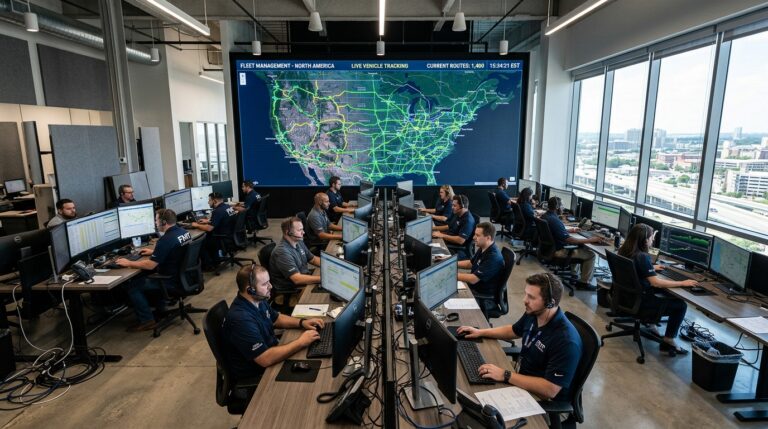
Three shifts are reshaping temperature monitoring for air freight right now. Platforms like Griffin Air Freight Visibility Platform integrate real-time monitoring with predictive analytics, enabling end-to-end cargo intelligence that spans the complete journey:
AI-driven excursion prediction. Platforms like Controlant Aurora and Paxafe are scoring shipments on multidimensional risk (temperature, humidity, shock, geofence, historical lane data) with the goal of predicting excursions before they happen, not just documenting them after. This moves the QA decision from reactive investigation to proactive intervention.
ESG and Scope 3 reporting. Envirotainer and CSafe now calculate per-shipment CO2 emissions on their container dashboards. As CSRD in Europe and equivalent frameworks elsewhere tighten Scope 3 requirements, this data moves from marketing material to purchasing criterion. Your monitoring platform will increasingly need to report carbon alongside temperature.
The death of the standalone USB logger on high-value lanes. Pharmaceutical Commerce identifies continuous digital monitoring as the highest-growth sub-segment of the pharma cold chain. The USB logger will survive on cost-led, low-risk lanes. On anything involving biologics, gene therapies or multi-leg routing, it’s being replaced by always-connected devices at pace. The question isn’t whether this happens. It’s whether you lead or follow.

Frequently asked questions
What temperature ranges are standard for pharmaceutical air freight?
The primary ranges are +2°C to +8°C (refrigerated biologics and vaccines), +15°C to +25°C (controlled room temperature), -20°C (frozen), and -70°C to -80°C (ultra-cold mRNA and gene therapies). Some carriers also define an extended room temperature range of +2°C to +25°C for products with broader stability profiles.
What causes most temperature excursions in air freight?
Tarmac exposure and ground handling handoffs cause the majority of excursions, not the flight itself. Industry data suggests 20 to 30 percent of pharmaceutical excursions originate in last-mile transfers where cargo sits unprotected between the warehouse and aircraft or between connecting flights.
Do I need DO-160 approval for a temperature tracker used on aircraft?
Yes, in most cases. Airlines maintain approved-device lists and will reject monitoring hardware that hasn’t been tested to DO-160 environmental standards (covering vibration, altitude, temperature extremes and humidity). Some single-use trackers bypass this by meeting exemption criteria (low battery energy, no lithium classification), but carrier acceptance must be confirmed before deployment.
What is IATA CEIV Pharma and is it mandatory?
CEIV Pharma is a voluntary certification from IATA that validates an airline, ground handler or freight forwarder meets pharmaceutical handling standards. It’s not legally mandatory, but major pharma shippers increasingly require it in contracts. IATA is expanding the program to small and medium-sized forwarders, broadening its industry reach.
How do active containers differ from passive packaging for cold chain air freight?
Active containers (Envirotainer RelEye, CSafe RKN) carry powered refrigeration, onboard sensors and cloud connectivity, maintaining set-point temperatures for 130+ hours. Passive packaging relies on insulated walls and phase-change materials without power, effective for shorter, well-characterized routes. Active containers cost more but dramatically reduce excursion risk on long or multi-leg lanes.
What does a temperature monitoring system cost versus a single excursion event?
A single-use cellular tracker runs USD 50 to 150 per shipment. A reusable probe amortizes to single-digit dollars per use over its multi-year lifespan. A single pharma excursion event, including quarantine investigation, batch rejection, regulatory reporting and insurance impact, routinely exceeds USD 100,000. The math resolves itself quickly.
If your air freight monitoring strategy ends at the airport door, that’s the gap where losses accumulate. We help logistics teams close it with airfreight-approved hardware and end-to-end visibility solutions. Talk to our team or reach us at info@datanetiot.com.






 +1 508 292 2210

5 Responses