

Search “Griffin Air” today and you’ll find an HVAC contractor in Virginia, a compressed air supplier in Scotland, an FAA aircraft registration, and a discontinued iPod dock from 2007. Five unrelated companies, one overlapping name. But in 2026, one Griffin Air dominates the conversation: the Digital Matter Griffin Air, an airline-certified GPS asset tracker purpose-built for air cargo and multi-modal logistics.
I’ve spent 15+ years deploying IoT tracking across aviation, freight, and industrial supply chains. When Digital Matter launched the Griffin Air in June 2026, it landed in a gap our clients have described for years: a single device that tracks cargo through air, road, and warehouse without manual reconfiguration at each mode change. This article disambiguates every “Griffin Air” entity, then goes deep on the one that matters most for operations teams managing containers, ULDs, and high-value assets.
Five Companies Called Griffin Air (Which One Do You Need?)
Let’s clear the name collision first.
| Entity | Industry | Location | Status in 2026 |
|---|---|---|---|
| Digital Matter Griffin Air | IoT / Asset Tracking | Global (HQ Atlanta, GA) | Active, launched June 2026 |
| Griffin Air LLC | HVAC / Plumbing | Hartfield, Virginia | Merged with Miller’s Services, Jan 2024 |
| Griffin Air Systems Ltd | Compressed Air Equipment | Clydebank, Scotland | Active since 1990 |
| Griffin Air LLC | Aviation (aircraft owner) | Lynden, Washington | Active, single Learjet 45 (N76AX) |
| Griffin AirDock | Consumer Electronics | N/A | Discontinued (~2007) |
Looking for HVAC in Virginia? Griffin Air LLC merged with Miller’s Services in January 2024. The combined company continues to serve Virginia’s Middle Peninsula for heating, cooling, and plumbing.
Need compressed air equipment in Scotland? Griffin Air Systems Ltd has supplied compressors, dryers, and maintenance services from Glasgow for over 30 years.
Tracking aircraft N76AX? That Learjet 45 is registered to Griffin Air LLC in Lynden, Washington.
If you’re researching air freight tracking, IoT asset visibility, or cargo monitoring devices: the rest of this article is for you.
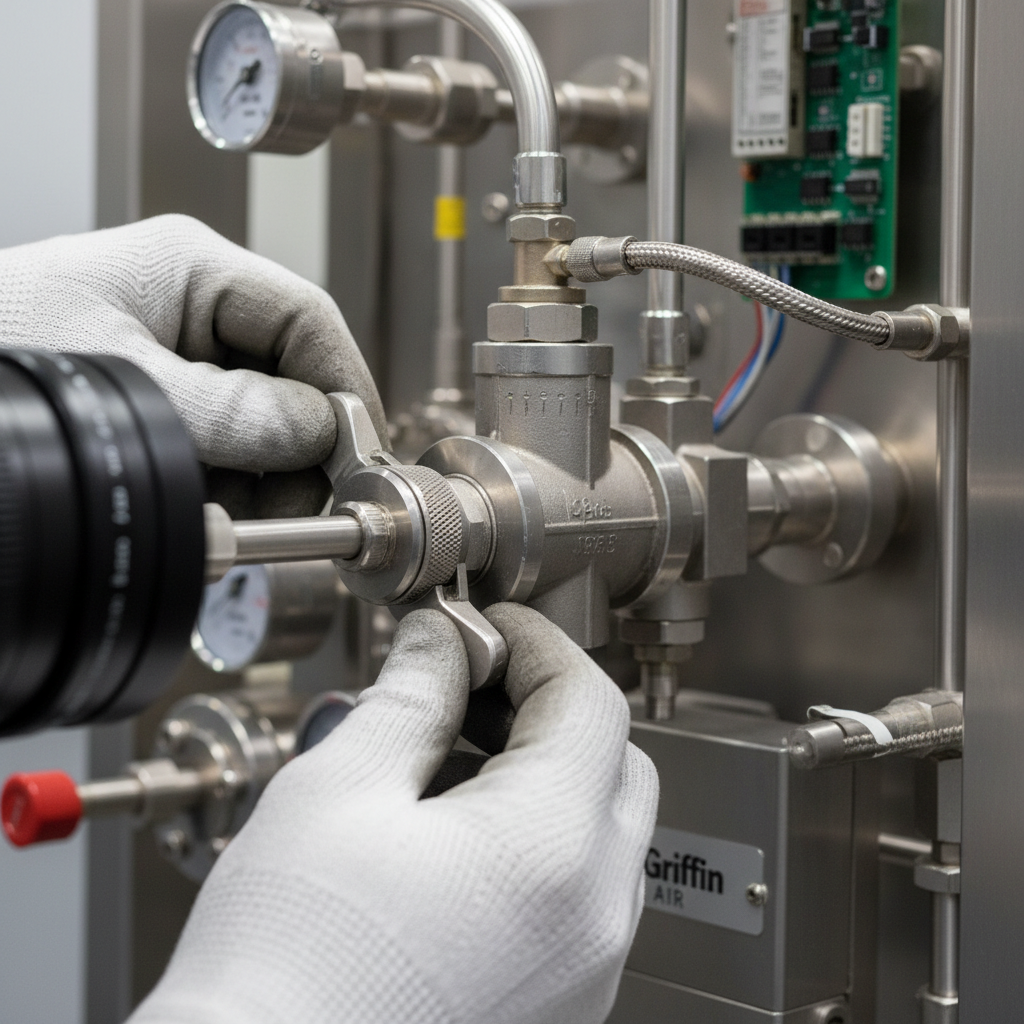
The Digital Matter Griffin Air: Air Cargo Tracking, Solved
Digital Matter was founded in 2000 in Johannesburg, South Africa and now operates from offices in Atlanta, the Netherlands, South Africa, and Australia. They’ve spent 25+ years building battery-powered GPS and IoT tracking devices. The Griffin Air is their entry into the airline-certified air cargo segment, and the timing aligns with explosive market demand: the global asset tracking market reached $25.75 billion in 2025, growing at 14.9% CAGR toward $51.59 billion by 2030.
The IATA 2026 Air Cargo Technology Trends report, surveying 120+ industry professionals, confirms real-time shipment visibility as a top-priority technology investment for airlines and freight forwarders. The Griffin Air was built for exactly that demand.
Inside the IP67 nylon-glass housing (108 x 86 x 30 mm, 170g with batteries): 4G LTE Cat 1bis cellular with 2G fallback, multi-constellation GNSS (GPS, GLONASS, Galileo, BeiDou, QZSS), Wi-Fi access point scanning for indoor positioning, and a Bluetooth 5.2 gateway for connecting external BLE sensors. An onboard 3-axis accelerometer and barometer serve a specific function that separates this device from every conventional GPS tracker on the market.
| Specification | Detail |
|---|---|
| Dimensions | 108 x 86 x 30 mm |
| Weight (with batteries) | 170g |
| Housing | Nylon glass, IP67 |
| Operating temperature | -30°C to +60°C |
| Power | 3x AA (LiFeS2 recommended) |
| Battery life | 7+ years |
| Cellular | 4G LTE Cat 1bis / 2G fallback |
| GNSS | GPS, GLONASS, Galileo, BeiDou, QZSS |
| Indoor positioning | Wi-Fi AP scanning, cell tower fallback |
| Short-range | Bluetooth 5.2 Gateway |
| Sensors | 3-axis accelerometer, barometer |
| Encryption | AES-256 end-to-end |
| Integration | TCP Direct, MQTT, HTTPS Webhooks, API |
| Warranty | 2 years |
How the Griffin Air Detects Flight Automatically
Putting a cellular tracker on air cargo creates a safety problem. Radio transmissions during flight can interfere with aircraft navigation systems. Airlines don’t take that risk casually. Each carrier individually evaluates and approves tracking devices before allowing them aboard. There is no single industry-wide certification that covers all carriers.
Most tracking devices handle this with geofences (disable transmissions when the device enters a predefined airport boundary) or manual power-off procedures. Both approaches introduce operational friction. Geofences require pre-configured airport coordinates and break on ad-hoc route changes. Manual procedures depend on ground handlers toggling devices consistently. In the freight operations I’ve worked with, that consistency hovers around 80% on a good day.
The Griffin Air solves this differently. Its barometer and accelerometer continuously monitor ambient pressure and motion. When sensor data matches a takeoff profile (rapid pressure decrease combined with sustained acceleration), the device disables cellular transmission automatically. It continues logging location and sensor data to internal flash memory throughout the flight. On landing, when pressure stabilizes and deceleration registers, cellular connectivity resumes and the device uploads everything it recorded in the air.
No geofences to configure. No manual toggles. No reliance on ground handler discipline.
This automatic detection system, validated through RTCA DO-160G:2010 environmental testing, is the reason 49 global carriers have approved the Griffin Air. That list includes Emirates, FedEx, Korean Air, Lufthansa Cargo, Qatar Airways, Singapore Airlines Cargo, American Airlines, United Airlines, Cathay Pacific, and Turkish Airlines, among others.
Each approval on that list represents a separate carrier-level evaluation process. To see what that looks like in practice: Korean Air’s approved cargo GPS tracker list from December 2024 shows the Griffin Air under approval FT-GPS-24-021, clearing validation six months before the device’s public launch. Digital Matter secured carrier approvals before marketing the product. In air cargo, that sequence makes sense: a tracker without carrier approval is commercially useless, so regulatory clearance is the prerequisite, not the milestone.
For competitors, this creates a compounding disadvantage. The longer Digital Matter operates and accumulates approvals, the more costly it becomes for a new entrant to replicate the coverage. Forty-nine airlines in year one is a moat that deepens with time.
Three AA Batteries, Seven Years of Tracking
Battery life is where most tracking deployments quietly collapse. A device that needs monthly charging creates operational overhead that never appears in the spec sheet. Someone retrieves the tracker, charges it, returns it. Across a fleet of 500 ULDs scattered globally, that retrieval cycle can cost more in logistics labor than the hardware itself.
The Griffin Air runs on three AA lithium batteries (LiFeS2, specifically Energizer Ultimate Lithium) and delivers 7+ years under default tracking parameters. Those defaults: GPS fix every 2 minutes during movement, cellular upload every 30 minutes, 12-hour heartbeat while stationary. Sleep current stays below 10 microamps.
Two design decisions make that longevity possible.
First, location computation is offloaded to Digital Matter’s cloud-based Location Engine. Instead of running power-intensive GPS calculations on the device itself, the Griffin Air sends raw satellite data to the cloud, which resolves the position and returns it. This trades a small data transmission for a large reduction in on-device processor draw.
Second, adaptive tracking. The device monitors its accelerometer continuously. When motion stops, it drops into deep sleep. When motion resumes, tracking activates without intervention. A ULD sitting idle in a warehouse for three weeks drains almost nothing. The moment it’s loaded onto a dolly, full tracking resumes automatically.
The batteries are user-replaceable. No factory return, no special tools. Open the housing, swap three AAs, close it. At fleet scale, your maintenance team handles battery changes as a routine task, not a service ticket.
Compare this to rechargeable competitors that require a 24-hour charge cycle after each use, or disposable trackers that get discarded entirely. The math is straightforward: a reusable tracker with a 7-year battery amortized across hundreds of shipment cycles costs a fraction per journey of what a single-use disposable device costs on its one trip.
Real Applications: Air Freight, Cold Chain, Aerospace MRO
ULD and Air Cargo Tracking
The primary use case. Attach a Griffin Air to a Unit Load Device, cargo container, or pallet. It tracks through road transport to the airport, logs silently through the flight, resumes cellular reporting on landing, and continues through last-mile delivery. One device, multiple transport modes, zero reconfiguration at handoffs.
For freight forwarders managing multi-carrier routes, this fills what I call the “flight black hole”: the period between departure and arrival airports where cargo has historically gone dark. The Griffin Air closes that hole by caching data to flash memory and uploading the complete record the moment cellular connectivity returns.
Cold Chain and Pharmaceutical Shipments
The Bluetooth 5.2 gateway creates a practical cold chain architecture. Place a BLE temperature sensor inside the insulated container to preserve the thermal seal. Mount the Griffin Air on the exterior. The device reads BLE sensor data and includes temperature, humidity, or shock readings in its regular uploads.
For pharmaceutical and biological sample shipments, where temperature excursion documentation is a regulatory requirement, this provides an auditable data trail across the entire journey. That includes the air leg, where many monitoring solutions lose visibility because they cannot transmit.
Aerospace MRO and High-Value Components
MRO supply chains move expensive parts through complex custody hand-offs: manufacturer to warehouse, warehouse to airline maintenance facility, back again for repair or recalibration. Indoor positioning via Wi-Fi access point scanning gives the Griffin Air visibility inside warehouses and maintenance hangars where GNSS signals don’t penetrate. Combined with geofencing and impact detection, the device addresses a specific MRO pain point: confirming exactly where a $200,000 engine component sits at 2 AM when nobody is monitoring a dashboard.
Flash memory for offline data logging means that even in RF-dead zones inside large metal structures, the device records location attempts and sensor readings for upload once it regains connectivity.
Griffin Air vs. the Alternatives
The airline-certified tracking device market has a handful of serious players. Here’s how they compare on the dimensions that drive fleet deployment decisions:
| Device | Battery | Airline Approvals | Connectivity | Model |
|---|---|---|---|---|
| Digital Matter Griffin Air | 7+ years, 3x AA replaceable | 49+ carriers | 4G/2G, BLE 5.2, GNSS, Wi-Fi | Reusable |
| Tive Solo 5G | Single-use | Multiple carriers | 5G/LTE, GPS | Disposable |
| OnAsset SENTRY series | Varies by model | Multiple carriers | Cellular, GPS | Reusable |
| Decklar BeeSense Air | ~24h per charge cycle | Select carriers | Cellular, GPS | Reusable (rechargeable) |
The fundamental strategic split in this market: disposable vs. reusable.
Tive’s Solo line is designed for single-shipment use. Attach, ship, discard. No retrieval logistics, no battery management. The trade-off is per-shipment cost. A $30-50 disposable tracker used once will always cost more per journey than a reusable device spread across hundreds of cycles. For one-off shipments where the hardware won’t come back, disposable makes sense. For recurrent logistics chains, the economics invert rapidly.
OnAsset Intelligence has been operating in the airline-certified tracking space longer than most. Their SENTRY product line spans ultra-thin smart labels to rugged enterprise units, and their AI-powered analytics platform goes further down the software stack than Digital Matter has ventured (at least as of mid-2026). If your organization needs predictive risk scoring and automated exception management on top of raw location data, OnAsset is further along that path.
Decklar (formerly Roambee’s hardware division) offers the BeeSense series with rechargeable batteries on a roughly 24-hour charge cycle. This works well when devices return to a base station on a predictable daily rotation. For a ULD fleet scattered simultaneously across 30 airports on three continents, managing daily recharges is a logistics operation in itself.
The Griffin Air is strongest in long-cycle, high-value, multi-modal logistics where assets circulate globally through multiple carriers. Seven-year battery life eliminates charging overhead. Forty-nine airline approvals eliminate compliance friction. User-replaceable batteries eliminate factory return cycles. At fleet scale, those three factors compound into a significant total cost of ownership advantage.
We’ve been deploying Digital Matter hardware across freight and aviation operations as part of our asset tracking solutions portfolio for years. The Griffin Air extends that capability into the airline-certified segment. If your cargo tracking goes dark during the flight leg, or your reusable container pool vanishes after delivery, that’s exactly the gap this device closes. Our Griffin Air field guide covers deployment specifics. Or just reach out: info@datanetiot.com.

Frequently Asked Questions
What is Griffin Air?
“Griffin Air” refers to several unrelated entities. The most prominent in 2026 is the Digital Matter Griffin Air, an airline-certified GPS asset tracker for air cargo and multi-modal supply chains. Other entities include Griffin Air LLC (HVAC/plumbing in Virginia, merged with Miller’s Services in 2024), Griffin Air Systems Ltd (compressed air equipment in Scotland, active since 1990), Griffin Air LLC (a Learjet 45 owner in Washington state), and the Griffin AirDock (a discontinued iPod accessory from 2007).
How many airlines have approved the Griffin Air tracker?
As of June 2026, 49 global carriers have approved the device. The list includes Emirates, FedEx, Korean Air, Lufthansa Cargo, Qatar Airways, Singapore Airlines Cargo, American Airlines, and United Airlines. Digital Matter maintains a process for requesting additional carrier approvals as needed.
How long does the Griffin Air battery last?
Over 7 years on three user-replaceable AA lithium batteries (LiFeS2 recommended). Default parameters include a GPS fix every 2 minutes during movement, cellular upload every 30 minutes, and a 12-hour heartbeat when stationary. Sleep current stays below 10 microamps.
Does the Griffin Air work indoors?
Yes. It uses Wi-Fi access point scanning for indoor positioning (roughly 10 to 100 meters accuracy) and cell tower triangulation as a secondary fallback. This multi-layer approach maintains visibility in warehouses, maintenance hangars, and other GNSS-denied environments where satellite signals don’t reach.
What is the difference between the Griffin Air and Tive Solo?
The Griffin Air is reusable with 7+ year battery life and replaceable cells, designed for recurrent, high-value logistics chains. Tive Solo is single-use and disposable, built for one-time shipments where retrieval isn’t practical. The Griffin Air delivers lower per-shipment cost at scale. Tive Solo eliminates device retrieval entirely.
Is Griffin Air Systems in Scotland related to the Digital Matter Griffin Air?
No. Griffin Air Systems Ltd is an independent compressed air equipment company based in Clydebank, Glasgow, operating since 1990. It has no connection to Digital Matter or the Griffin Air IoT asset tracker.








 +1 508 292 2210

9 Responses