

A billion active NB-IoT and LTE-M connections worldwide, and the choice between them has never been more confusing. AT&T pulled out of NB-IoT entirely. Deutsche Telekom extended NB-IoT to satellite orbit. Module prices start at $5 (with a 20,000-unit minimum nobody quotes upfront). If you’re comparing NB-IoT vs LTE-M for your next deployment, the internet will hand you a tidy table and a confident pick. The field will hand you something messier.
I’ve watched this decision play out across aviation ground support equipment, freight containers, and industrial supply chains for years now. The pattern is consistent: teams that choose based on spec sheets revisit the decision within 18 months. Teams that choose based on their actual workload, deployment geography, and maintenance budget don’t.
This is the comparison I wish existed when we started deploying asset trackers across those environments. Not the laboratory version. The operational one.
NB-IoT vs LTE-M: The Comparison Table
You came here for this, so here it is. But stay for what comes after, because the table alone has misled more procurement decisions than I can count.
| Dimension | NB-IoT | LTE-M |
|---|---|---|
| Radio bandwidth | 180 kHz | 1.4 MHz |
| Peak downlink (Cat-NB2 / Cat-M1) | ~127 kbps | ~588 kbps |
| Peak uplink (Cat-NB2 / Cat-M1) | ~159 kbps | ~1,119 kbps |
| Indicative latency | 1.5 to 10 seconds | 50 to 100 ms |
| Mobility support | Supported; improved in Cat-NB2 | Full connected-mode mobility |
| Max coupling loss (deep coverage) | ~164 dB | ~160.7 dB |
| VoLTE | No | Yes |
| Power-saving modes | PSM, eDRX | PSM, eDRX |
| Best fit | Fixed, small-message, deep-indoor telemetry | Mobile assets, larger payloads, interactive sessions |
Technical baselines drawn from Nordic Semiconductor’s cellular IoT fundamentals and Quectel’s BG95 LPWA specification. Your actual results will vary by operator, signal conditions, and device configuration.
Now, what the table doesn’t tell you. Latency in NB-IoT can spike well beyond 10 seconds when coverage enhancement kicks in (more signal repetitions, more delay). LTE-M’s throughput advantage becomes irrelevant if your device sends 50 bytes once an hour. And “mobility support” in Cat-NB2 does not mean NB-IoT handles handovers the way LTE-M does during a continuous session. Context is everything.
Where NB-IoT Earns Its Place
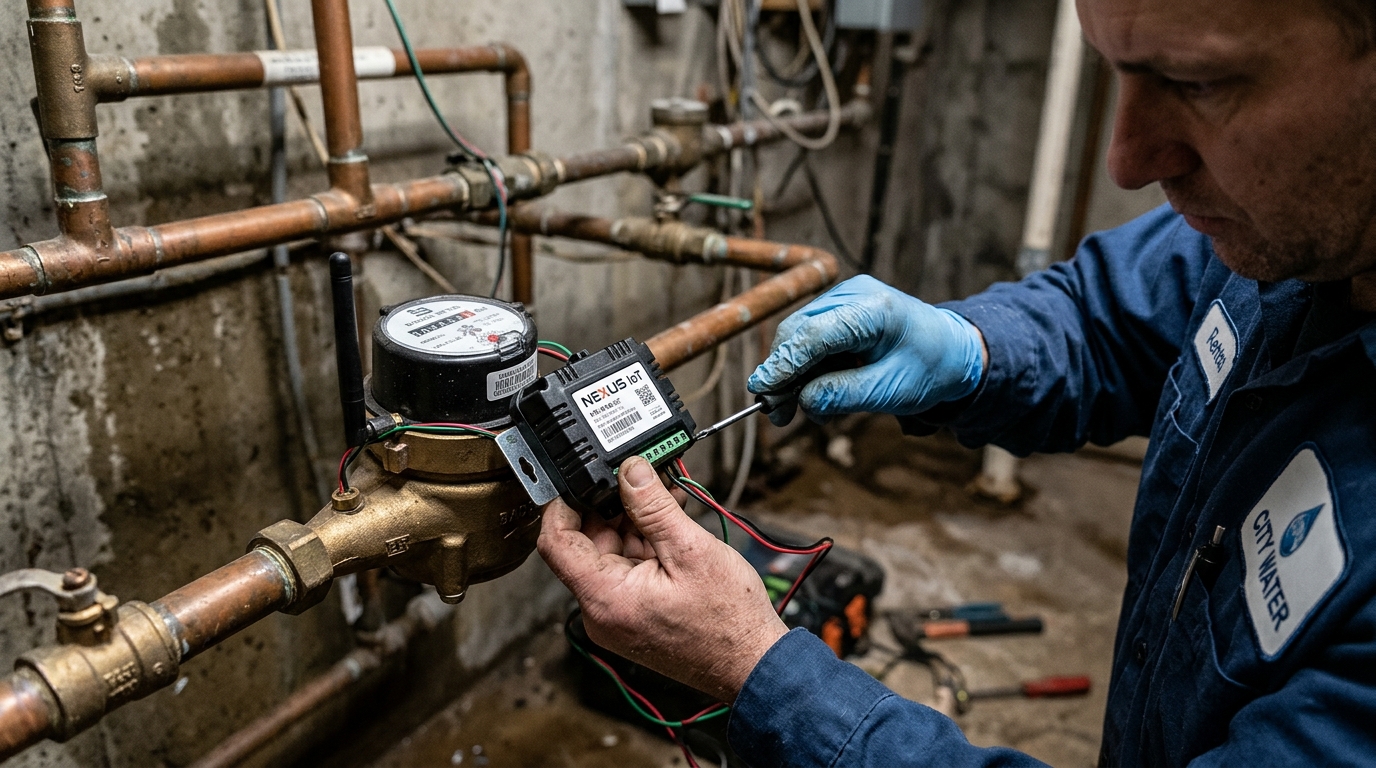
NB-IoT was designed for a specific job: getting small messages out of hard-to-reach places without burning through a battery. When the deployment matches that job description, it delivers.
The clearest recent example is SES Water’s smart-meter rollout in the UK. Instead of ripping out existing meters, they used B4T’s Jellyfish bridges: each bridge connects up to eight semi-smart meters via short-range radio, then sends compressed data over Vodafone’s NB-IoT network. Two engineers deployed 5,000 devices in four months. The result: 70% lower rollout costs across 30,000+ properties, 93% connectivity, and hourly readings that enabled faster leak detection.
The lesson is not “NB-IoT is cheap.” The deployment architecture created the saving: reusing installed hardware, aggregating connections, designing around small payloads. The radio was the right fit because the meters don’t move, the messages are tiny, and the meters sit in pits and cabinets where penetration is non-negotiable.
SUEZ and Vodafone are pursuing a similar logic at larger scale. Their partnership announced in April 2024 targets 2 million NB-IoT meters in service by 2030, with 15-year battery life targets for underground installations across the UK, France, Italy, Spain, and New Zealand. That’s a multi-decade bet on NB-IoT’s longevity in utility infrastructure.
NB-IoT works when your assets are fixed, your payloads are small, your reporting cadence is infrequent, and penetration into basements, underground vaults, or shielded enclosures is the hard requirement. Understanding industrial IoT device range capabilities helps determine whether NB-IoT’s deep coverage advantages outweigh its throughput limitations for your specific deployment scenario.
Where LTE-M Pulls Ahead
LTE-M wins the moment assets start moving or the application needs more than periodic telemetry.
Sony’s Visilion platform is a good illustration. Running on Telenor’s LTE-M connectivity, it tracks shipments in transit (route deviations, geofencing, shock events) and hospital equipment indoors. The use case demands continuous location updates, event-driven alerts, and enough throughput for a real mapping interface. NB-IoT’s multi-second latency and narrow bandwidth would strangle that workflow.
Then there’s the wearable angle. Navigil’s 580 emergency watch uses AT&T LTE-M for one-button two-way voice calls, location assistance, and fall detection. Battery life is measured in weeks, not years, because frequent interaction and positioning consume real power. Fundamentally different energy profile from a water meter, fundamentally different radio requirement.
Firmware updates tell a similar story. Both technologies technically support over-the-air updates. Nordic documents FOTA over both NB-IoT and LTE-M, confirming it’s possible. In practice, pushing a firmware image over NB-IoT at 127 kbps peak with multi-second latency and potential retransmissions in poor coverage turns a 15-minute LTE-M update into an hours-long ordeal that drains the battery. Possible and practical are different conversations.
LTE-M is the stronger choice for mobile assets, interactive applications, voice-enabled devices, and any deployment where firmware maintenance is part of the operational plan.
Five Questions That Actually Drive This Decision
Forget the technology war. These five questions will narrow your choice faster than any comparison table.
1. Does the asset move?
If yes, LTE-M handles connected-mode mobility and session continuity far better. NB-IoT’s Cat-NB2 improved on Cat-NB1, but it still isn’t built for continuous tracking sessions on a moving vehicle or container. If the asset is bolted to a floor, wall, or underground vault, NB-IoT is viable.
2. How much data, how often?
A temperature reading every hour: NB-IoT handles that comfortably. GPS coordinates every 30 seconds with shock and tilt events: you need LTE-M’s throughput. The payload size and reporting frequency determine whether NB-IoT’s narrow channel is elegant or strangling.
3. Where exactly are you deploying?
Global coverage maps lie by omission. GSMA reports a billion LPWA connections across 100+ countries, but Ericsson’s June 2026 Mobility Report places roughly 70% of cellular IoT connections in North East Asia. In the U.S., AT&T shut down NB-IoT entirely. T-Mobile and Verizon kept it, for now. Verify the specific operators serving each installation site, not a color on a map.
4. What’s your maintenance plan for the next 5 to 10 years?
Will you push firmware updates? Remotely reconfigure devices? Respond to security patches? If yes, LTE-M’s higher throughput and lower latency make remote maintenance practical. If the device is truly deploy-and-forget (no updates, no config changes, just periodic readings until the battery dies), NB-IoT’s simplicity works in your favor.
5. What happens if your carrier changes strategy?
AT&T announced its NB-IoT withdrawal in November 2024, targeting completion by Q1 2025, migrating customers to LTE-M. A dual-mode modem (like Quectel’s BG95, supporting both Cat-M1 and Cat-NB2) gives you a fallback. An SGP.32-compatible eSIM gives you operator portability. Neither solves the problem if you deployed a single-mode NB-IoT device on a carrier that no longer supports it.
The Cost Equation Beyond the Module
T-Mobile advertises NB-IoT modules starting at $5. That price requires purchasing at least 20,000 units within 12 months. It’s a volume incentive, not a universal device cost.
Here’s what a real total cost of ownership model includes:
- Hardware: Module plus MCU, antenna, enclosure, battery, sensors. The module is typically 15 to 25% of the device BOM.
- Certification: FCC, PTCRB, carrier-specific approvals. Each certification cycle costs time and money, and NB-IoT and LTE-M may require separate test campaigns. This is the cost almost nobody in the comparison articles mentions.
- Licensing: Sisvel’s published cellular IoT program lists NB-IoT royalties from $0.08 to $0.66 per unit depending on product selling price, and $2.00 per unit for LTE-M smart utility metering devices. These apply to finished products, not components.
- Connectivity: Monthly SIM fees, data charges, roaming premiums. A device that retransmits heavily in poor coverage consumes more data and energy than the plan assumed.
- Installation: SES Water’s 70% saving came from not replacing meters. The installation architecture can dominate the connectivity cost by an order of magnitude.
- Migration: Battery replacement, device swap-outs, and the cost of moving to a different technology if a carrier sunsets yours.
Optimize for cost per successful reading or completed service event, not cost per modem.
Field Realities the Spec Sheet Skips
Battery life is a system outcome, not a radio feature
“Up to 10 years” appears in both NB-IoT and LTE-M marketing. That number comes from a narrow scenario: infrequent transmissions, strong signal, minimal processing, no GNSS, no firmware updates, controlled temperature.
An empirical study by Foivos Michelinakis and colleagues tested NB-IoT devices across two operators in Western Europe. One configuration change reduced transaction energy from 0.82 J to 0.12 J under good signal conditions. Under poor coverage, behavior differed substantially between operators. Same hardware, same technology, different networks, wildly different energy consumption.
The takeaway: measure your complete device on your intended network. Accept no generic battery claims.
Coverage enhancement has a hidden price
NB-IoT’s deep-coverage capability (up to 164 dB maximum coupling loss, per the GSMA deployment guide) works by repeating transmissions. More repetitions means more energy, higher latency, and lower effective throughput. A device that “reaches” from a basement but takes 30 seconds to deliver a message while burning 5x the normal energy per transaction isn’t necessarily a win. Validate real-world behavior in your specific installation environment.
Roaming is not a checkbox
Digital Matter’s operational guidance on LTE-M vs NB-IoT roaming warns that some roaming SIM configurations trigger unnecessary network searches that drain batteries. Band compatibility, APN settings, operator whitelists, and power-saving timer negotiations all vary by geography and carrier. A SIM that works in Germany may drain a battery in Brazil while searching for a network that doesn’t support its technology.
For international deployments, test the actual SIM on the actual network in the actual country. No shortcut exists.
What’s Shifting: Satellite, eSIM, and RedCap
Three developments are reshaping the landscape. None of them erase the NB-IoT vs LTE-M decision. They layer on top of it.
Satellite NB-IoT
Deutsche Telekom commercially launched multi-orbit IoT connectivity, partnering with Skylo (GEO), Sateliot and OQ Technology (LEO), and adding Iridium in September 2026. The catch: it requires Release 17 NB-IoT compatible devices and specific firmware. Your existing terrestrial NB-IoT fleet is almost certainly not satellite-ready without hardware changes.
Satellite extends NB-IoT’s geographic reach into remote areas. It does not change its throughput, latency, or mobility characteristics.
SGP.32 eSIM
In July 2026, Soracom commercially released SGP.32-compatible IoT eSIMs enabling remote operator profile switching via API. If your carrier exits your technology, you can switch to another operator remotely. But an eSIM cannot convert an NB-IoT-only modem into LTE-M hardware. Profile portability and radio capability are separate problems.
RedCap
3GPP’s Reduced Capability (RedCap) devices offer 10 Mbps peak rates on 5G infrastructure. Ericsson counts 14 commercial RedCap launches as of mid-2026. It’s a different performance tier: more capability than LTE-M, but also more power consumption, higher module cost, and a younger ecosystem. For most LPWA deployments today, RedCap is worth watching, not ready to replace.
The practical play: design for dual-mode (LTE-M/NB-IoT) hardware now, with eSIM flexibility for operator changes, and keep RedCap on your three-year roadmap.
When Neither Is the Right Answer
Sometimes the honest answer to “NB-IoT vs LTE-M” is “neither.”
If your application needs 10 Mbps throughput or closer-to-full LTE functionality, LTE Cat 1 bis runs on existing infrastructure with a single receive antenna. No special base-station upgrades required.
If you control the deployment territory and can engineer your own network, LoRaWAN may offer more operational control and lower per-device costs. And for short-range tag-based tracking, the active RFID vs BLE choice is a separate radio decision worth understanding, as is knowing whether RFID tags work on metal in your environment, how far RFID tags can be read, and how long active RFID tags last. Yorkshire Water and Netmore’s planned 1.3 million-meter LoRaWAN program had already identified over 1,000 customer-side leaks and was saving 1.22 megaliters daily in early rollout.
The right question is not “NB-IoT or LTE-M?” It’s “what does my deployment actually need?” Sometimes that question leads outside the LPWA category entirely.

Frequently Asked Questions
Is NB-IoT dead after AT&T’s shutdown?
No. AT&T’s decision reflects one carrier’s commercial strategy, not a global technology failure. GSMA reported a billion combined NB-IoT and LTE-M active connections at end-2025. Deutsche Telekom expanded NB-IoT to satellite in 2026. The technology is alive globally, but carrier-level risk is real. Verify your specific operator’s commitment before deploying.
Can I use one device for both NB-IoT and LTE-M?
Yes. Dual-mode modules like Quectel’s BG95 support both Cat-M1 and Cat-NB2. This is the safest hardware strategy for deployments spanning multiple regions or facing uncertain carrier roadmaps. Confirm that your target operators support both technologies in each deployment country.
Which technology gives longer battery life?
Neither inherently wins. Battery life depends on message size, reporting frequency, signal quality, retransmissions, GNSS usage, firmware updates, temperature, and operator-specific network behavior. Empirical testing under real field conditions is the only reliable predictor. Treat generic “10-year” claims as marketing ceilings, not engineering guarantees.
Is NB-IoT always cheaper than LTE-M?
Not necessarily. NB-IoT modules cost less at volume, but total cost includes certification, licensing, installation, connectivity fees, battery replacement, and potential migration. SES Water’s 70% cost reduction came from deployment architecture, not module savings. Evaluate total cost per successful data delivery over the device’s service life.
Can NB-IoT handle firmware updates over the air?
Technically yes. Practically, it’s slow and energy-expensive. A firmware image that takes minutes over LTE-M can take hours over NB-IoT in marginal coverage. Budget the time, energy, storage, and failure-recovery mechanisms before committing to NB-IoT for devices requiring periodic updates.
Which should I pick for asset tracking?
If the assets are fixed (installed equipment, meters, static infrastructure), NB-IoT can work well. If the assets move (containers, vehicles, ground support equipment, returnable packaging), LTE-M’s mobility and throughput make it the stronger choice. For mixed fleets, dual-mode hardware covers both scenarios.
At Datanet, we deploy tracking across both profiles: fixed ground support equipment and mobile containers, aviation MRO assets and freight in transit. Whether it’s an Oyster Edge on a moving ULD or an environmental sensor on a stationary compressor, the connectivity choice follows the operational requirement. If you’re weighing NB-IoT vs LTE-M for a specific deployment and want a second opinion grounded in field data, reach out to our team or drop a note to info@datanetiot.com.







 +1 508 292 2210

2 Responses