

In a sealed vertical farm, every plant is a humidifier. Transpiration pushes water vapor into a room with no wind, no weather, no natural exhaust. That vapor has to go somewhere, and removing it is expensive. A California ETCC project found that cooling and dehumidification account for roughly 40% of energy consumption in indoor farms using efficient lighting. Not 40% of the HVAC budget. Forty percent of the total energy bill.
If you’re operating a vertical farm, designing one, or investing in one, humidity control isn’t a climate-comfort feature. It’s your largest controllable operating cost after lighting. And the gap between farms that manage it well and farms that bleed cash shows up in crop quality, disease rates, equipment longevity, and whether the business survives its third year.
This is a practical guide to vertical farming humidity control: where the moisture comes from, what to measure, how to remove it, and how to build a business case that holds.
Where All That Moisture Comes From
A vertical farm is a sealed box full of living humidifiers. Every plant transpires continuously, pushing water vapor from roots through leaves into the surrounding air. Irrigation adds more moisture. And unlike a greenhouse, where wind and ventilation carry vapor away, an indoor farm traps it.
The numbers are instructive. During a 12-hour light period, the ratio of latent (moisture) cooling load to total cooling load runs approximately 0.75. When lights go off and sensible heat drops, that ratio approaches 1.0. Translation: during the dark period, almost all the cooling your system performs is pulling water out of the air.
This catches operators off guard. Intuition says “lights off, load drops.” Reality says the moisture load barely changes because plants keep transpiring at night while LED heat disappears. Your HVAC is suddenly working almost entirely as a dehumidifier. If the system was sized only for temperature, the room gets wet.
Three sources feed the moisture load:
- Plant transpiration. The dominant source. A healthy crop with good VPD will transpire heavily. That’s biologically desirable and operationally expensive.
- Irrigation and wet surfaces. Every watering cycle adds water that doesn’t immediately reach roots. Standing water, wet media, and moist floors all contribute vapor.
- Human activity and door openings. Staff entering and leaving introduce variable humidity pulses. In smaller container farms, a single open door can shift conditions noticeably.
The practical implication: if you size dehumidification from floor area or room volume, you’ll undersize it. Size it from your transpiration rate, irrigation schedule, and lighting cycle instead.
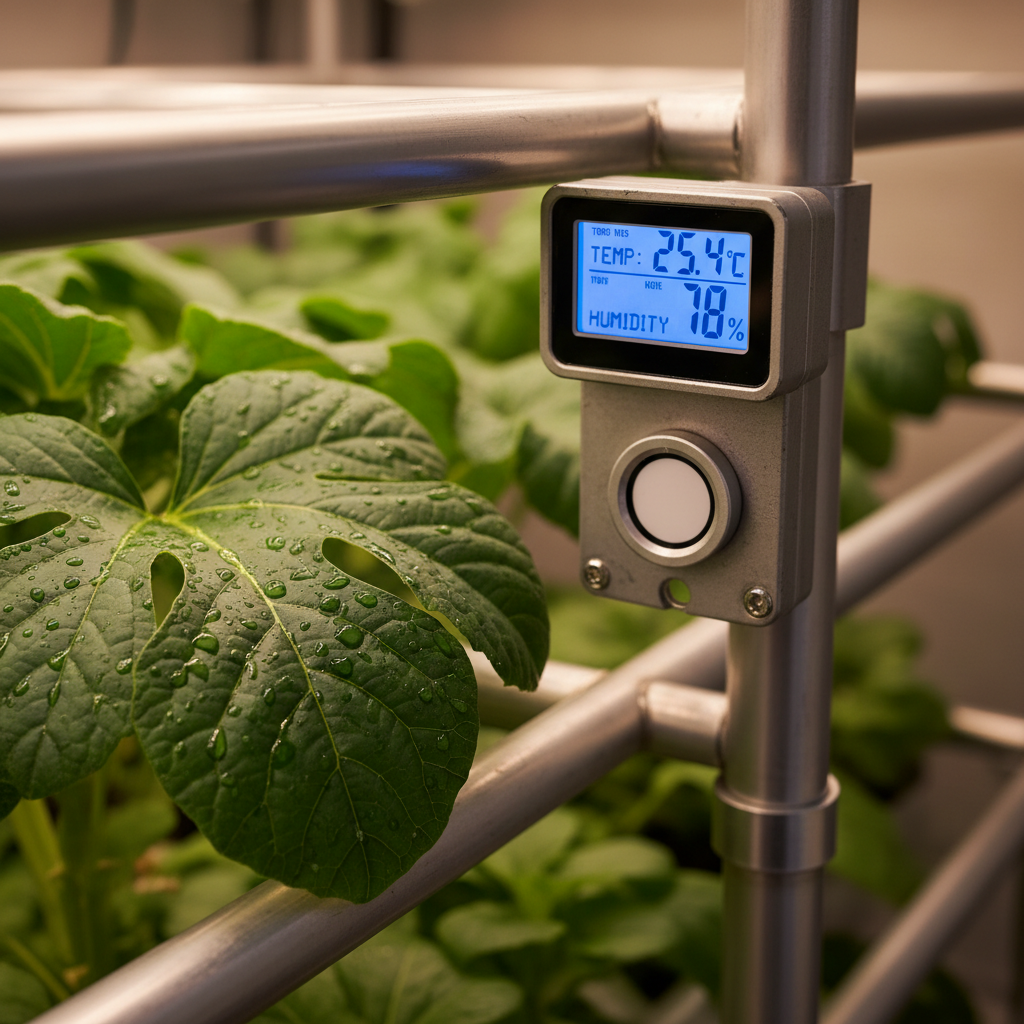
VPD Over RH: Measure What the Plant Actually Feels
Most facility dashboards show relative humidity. It’s familiar, easy to read, and frequently misleading.
Relative humidity describes how much water vapor is present compared to the maximum the air could hold at that temperature. The problem: warm air holds more moisture. A 20°F rise in dry-bulb temperature roughly doubles the air’s moisture-holding capacity. So the same RH reading at 70°F and 80°F represents very different evaporative conditions for the plant.
Vapor pressure deficit (VPD) closes that gap. VPD is the difference between the vapor pressure of fully saturated air and the vapor pressure actually present. It measures the drying power of the air, which is what the plant’s stomata respond to. High VPD means the air pulls water from leaves aggressively. Low VPD means the air is nearly saturated and transpiration slows.
Both extremes cause problems:
- VPD too high (dry air): stomata close to conserve water, photosynthesis slows, leaf edges burn, growth stalls.
- VPD too low (saturated air): transpiration nearly stops, nutrient uptake slows, leaf surfaces stay wet, and fungal pathogens thrive.
Published VPD targets for leafy greens typically range from 0.8 to 1.2 kPa, but these shift with crop, cultivar, growth stage, and lighting intensity. A 2024 study in Applied Energy modeled lettuce scenarios at 21°C and 70% RH, producing a VPD around 0.54 kPa, while other scenarios in the same research used significantly different conditions. The correct target for your facility depends on what you measure, not what a chart says.
One more metric matters for disease prevention: dew point. The dew point is the temperature at which moisture begins condensing on surfaces. When leaf temperature drops below the dew point, water forms on the leaf surface, creating germination sites for Botrytis and powdery mildew. This happens most during the dark period, when lighting stops warming the canopy but transpiration continues. Controlling the dew-point margin (the gap between leaf temperature and dew point) overnight is one of the most effective disease-prevention moves in indoor farming.
The Tier-Level Measurement Problem
Here’s where I see the most expensive mistakes in controlled-environment agriculture.
A vertical farm isn’t one room with uniform conditions. It’s a stack of microclimates. The bottom tier gets different airflow than the top. LED fixtures create heat plumes. Plant density varies by growth stage. Fans don’t always reach the back corner of the third shelf.
Frontiers research notes that near-crop hot spots, stagnant air, and changing plant inventories can make one return-air sensor look healthy while an entire tier is wet or heat-stressed. A single sensor near the HVAC return duct tells you what the system sees, not what the crop experiences.
This creates a dangerous gap. The control system reads 65% RH and holds steady. Meanwhile, a low-airflow pocket on tier three sits at 85% RH with condensation forming on leaf undersides. By the time anyone notices, the mold has spread.
The fix is architectural, not just technological:
- Fixed sensors at multiple tiers. Minimum one temperature/RH sensor per rack level, placed at canopy height, not above the lights.
- Mobile spot-checks. Periodic handheld readings in known problem zones (corners, bottom tiers, near doors) to validate fixed sensors.
- Calibration schedules. High-humidity environments accelerate sensor drift. A sensor reading 65% might actually be seeing 72% after six months without recalibration.
- Rate-of-change alerts. A single high-RH threshold alarm catches the problem late. Monitoring the rate of increase catches it early. If RH climbs 5 points in 30 minutes, something changed, and you want to know before the canopy gets wet.
Ohio State identifies RH, VPD, airflow, CO2, light, and temperature as core CEA control variables and notes that adding variables increases control-logic complexity. True. But the alternative, ignoring variables because they’re complex, is always more expensive. The question isn’t whether to measure at the tier level. It’s whether you’d rather spend on sensors or on lost crops.
Five Approaches to Removing Moisture (and Their Trade-Offs)
No perfect dehumidification technology exists. Each approach solves one problem while creating another. The right choice depends on your climate, crop, CO2 strategy, scale, and tolerance for complexity.
| Approach | How it works | Best for | Main trade-off |
|---|---|---|---|
| Outdoor-air ventilation | Exchanges moist indoor air with drier outdoor air | Dry, mild climates with low pest pressure | Can introduce insects and disease; makes CO2 enrichment above outdoor levels difficult |
| Refrigerant dehumidification | Condenses moisture on cold coils; separate system handles sensible cooling | Proven operations wanting controllable, familiar systems | Two parallel systems (dehumidifier + cooler) create transfer inefficiency and add rejected heat back into the room |
| Solid-desiccant with heat pump | Sorbent material captures moisture; heat pump regenerates it; indirect evaporative cooling handles sensible load | Energy-focused operations pursuing water and heat recovery | Projected 30 to 65% energy savings, but still in demonstration without widespread third-party validation |
| Fog or mist humidification | Adds moisture when air is too dry; can also provide evaporative cooling | Propagation, germination, and dry-climate grows | Poorly designed droplets wet leaf surfaces and electronics, increasing disease and corrosion risk |
| Dynamic model-based control | Adjusts humidity, temperature, light, CO2, and irrigation based on real-time crop data | Data-mature operations with per-tier sensing and validated crop models | Requires reliable sensors, adequate air mixing, validated models, and sufficient historical data |
A common mistake: treating these as mutually exclusive. Most well-designed facilities combine two or three. A sealed room with refrigerant dehumidification, supplemental fogging for propagation zones, and model-based setpoint adjustment is entirely practical. The architecture just needs to be planned, not improvised.
Airflow deserves its own note. Fans don’t remove moisture, but they distribute it. Without adequate circulation, stagnant pockets form where humidity climbs and sensors lie. UMass recommends plant spacing, mesh benches, moving air, and watering early enough for surfaces to dry before evening. In a vertical rack, this translates to direct airflow at every tier, not just whatever leaks down from the shelf above.
What Goes Wrong When Humidity Gets Away From You
Three categories of damage. Each alone can justify a serious humidity-control investment.
Crop disease and loss. Botrytis cinerea (gray mold) and powdery mildew are the most common humidity-driven pathogens in vertical farms. Both germinate when free water sits on leaf surfaces, typically during the dark period when canopy temperature drops below the dew point. A single outbreak can destroy an entire harvest cycle. In a farm running weekly harvests of leafy greens, that’s not an inconvenience. It’s a month of lost revenue and potentially contaminated adjacent racks.
Electronics and LED degradation. Indoor farms invest heavily in LED arrays, control boards, sensors, and automation hardware. Persistent high humidity corrodes connectors, degrades circuit boards, and shortens LED lifespan. Condensation on a warm LED fixture creates ideal conditions for electrical faults. Some operations report LED investments of $50,000 to $100,000 per growing level. Allowing humidity to compromise that hardware is a silent capital drain that doesn’t show up until replacement costs hit the balance sheet.
Business failure at scale. Bowery Farming ceased all operations in November 2024 after reaching a peak valuation of $2.3 billion and raising more than $700 million in venture capital. The company failed to secure financing or a sale. Humidity control didn’t cause the shutdown directly, but the operating model it represents (high fixed costs for climate management, lighting, labor, and facilities, all committed before revenue arrives) exposes how thin the margin for error is. When climate systems underperform, crop loss accelerates cash burn. When energy exceeds projections, the financial model cracks.
The counterpoint is instructive. AeroFarms declared bankruptcy in 2023, then reported two profitable quarters by mid-2025 after cutting its facility footprint, focusing on higher-margin microgreens, and hiring people with food-production expertise. The turnaround wasn’t about better dehumidifiers. It was about matching climate-control costs to a crop and margin that could absorb them. Two quarters aren’t proof of long-term viability, but the pattern is clear: operational discipline and crop economics matter more than technology ambition.
From Fixed Setpoints to Dynamic Humidity Control
The default approach in most vertical farms is a fixed recipe: set temperature to 21°C, RH to 65%, hold those numbers around the clock. It works. It also wastes energy and misses what the plant actually needs at different hours and growth stages.
A 2024 review in Frontiers in Science argues that humidity, airflow, water, nutrients, CO2, temperature, and light should all change dynamically with plant physiology. The rationale: stomatal conductance (how open or closed the leaf pores are) can vary 30% to 60% even under constant room conditions. The plant is already dynamic. The environment should respond.
A pilot study modeled 48 combinations of humidity, photoperiod, and HVAC setpoints for lettuce. Flexible scenarios (reducing lighting intensity by up to 10% while adjusting humidity targets) produced measurable energy and carbon gains. Rigid scenarios that extended crop duration to compensate for lower light actually increased HVAC demand. Optimizing humidity isn’t just turning the dehumidifier down. It’s coordinating moisture removal with every other variable in the system.
A 2025 review identifies sensor affordability, adequate air mixing, and data interpretation as the key bottlenecks for precision climate control in vertical farms. Without reliable multi-point sensing, validated crop models, and operators who understand the data, “dynamic control” is just an unstable system with a marketing label.
The practical roadmap, based on what I’ve seen work in vertical farming automation and industrial monitoring:
- Install multi-point sensing and establish a calibrated baseline. Know your actual conditions before changing anything.
- Map your moisture and energy balance. Identify where the latent load peaks, which tiers run hot or wet, and what the dark-period profile looks like.
- Pilot dynamic adjustments on one rack or zone. Compare crop output, energy use, and disease rates against your fixed-recipe baseline.
- Scale what works. Add heat recovery, upgraded dehumidification, or expanded sensing only after pilot data justifies the investment.
Building the Business Case for Better Humidity Control
The strongest argument for investing in humidity control isn’t “plants grow better.” It’s the line items you’re already paying when you don’t.
Start with energy. A 2025 benchmark puts current lettuce-specific energy consumption at 10 to 18 kWh per kilogram, with a technical target of 3.1 to 7.4 kWh/kg. Much of that gap sits in HVAC, where dehumidification dominates the load. Moving from 15 kWh/kg to 8 kWh/kg on a farm producing 150 tons of lettuce per year is a measurable reduction in operating cost, not a marginal tweak.
Add shrink. A well-controlled humidity environment reduces post-harvest decay, extends shelf life, and lowers the percentage of harvested product that never reaches the customer. For farms selling through retail (where produce must look fresh for 5+ days on the shelf), the connection between canopy humidity and saleable kilograms is direct.
Add equipment life. LEDs, sensors, motor drives, and control boards all last longer in stable humidity. Replacing corroded sensor arrays on one rack costs less than a crop loss, but replacing them across an entire facility because humidity was never managed adds up quietly.
Three metrics that belong in any vertical farm humidity-control business case:
- kWh per kg of saleable product. Not total energy. Not energy per square meter. Energy per kilogram that actually gets sold. This forces you to account for crop loss and post-harvest shrink.
- Disease incidence per harvest cycle. Track Botrytis, mildew, tipburn, and any humidity-related defect. A 2% loss rate sounds low until you multiply it by 52 weekly harvests.
- Dehumidification energy as a percentage of total HVAC. If it’s above 50%, there’s room to improve. If you don’t know the number, that’s the first problem to fix.
A life-cycle analysis of Dutch lettuce production found a vertical farm’s baseline carbon footprint 5.6 to 16.7 times higher than conventional methods, with electricity representing 85%. As retailers and regulators scrutinize supply-chain emissions, that carbon load is becoming a market-access risk, not just an environmental concern. Reducing the HVAC share of that electricity bill is one of the highest-leverage moves available.
Humidity control isn’t the only factor in vertical farm viability. Crop selection, pricing power, labor efficiency, and capital structure all matter. But humidity touches everything: energy, crop quality, equipment life, disease risk, and carbon intensity. Getting it right doesn’t guarantee success. Getting it wrong makes failure significantly more likely.
If your facility lacks per-tier environmental data, that’s the gap to close first. Multi-point temperature and humidity monitoring gives you the baseline before investing in HVAC upgrades, dynamic control software, or facility expansion. Start with visibility. Everything else follows.
Questions about environmental monitoring for controlled-environment agriculture? Talk to our team or reach us at info@datanetiot.com.
Frequently Asked Questions
What is the ideal humidity for a vertical farm?
There’s no universal number. Targets vary by crop, cultivar, growth stage, temperature, and lighting. VPD (vapor pressure deficit) is more useful than RH alone because it accounts for temperature and reflects what the plant actually experiences. Published VPD targets for leafy greens typically range from 0.8 to 1.2 kPa, but the correct target for your facility depends on measured canopy conditions, not a generic chart.
Why does humidity rise so fast in a sealed indoor farm?
Plant transpiration continuously pumps water vapor into the air, even at night. In a sealed building, that moisture has no natural exit. During the dark period, when LED heat disappears, almost all remaining cooling load becomes latent (moisture removal). Without active dehumidification, RH climbs fast.
Is high humidity or low humidity more dangerous?
Both cause problems through different mechanisms. High humidity (low VPD) slows transpiration, promotes condensation, and creates ideal conditions for Botrytis and powdery mildew. Low humidity (high VPD) triggers stomatal closure, water stress, and reduced growth. The goal is a stable VPD within the crop’s range, with enough dew-point margin to prevent nighttime condensation on leaves.
How much energy does humidity control consume?
Cooling and dehumidification can account for roughly 40% of total energy in an indoor farm with efficient lighting. In facilities with older HVAC, the share can be higher. This makes humidity control one of the largest levers for reducing operating costs and improving unit economics per kilogram of saleable product.
Can I use outside air instead of mechanical dehumidification?
In dry, temperate climates, outdoor-air ventilation reduces dehumidification load and saves energy. The trade-off: it can introduce insects, pathogens, and uncontrolled temperature swings, and makes CO2 enrichment above outdoor concentration difficult. Most scaled vertical farms use sealed mechanical systems for biosecurity and year-round consistency.
Where should humidity sensors be placed in a multi-tier farm?
At canopy level on each growing tier, not near the HVAC return duct. A single return-air sensor can read 65% RH while a stagnant lower tier sits at 85%. Supplement fixed sensors with periodic handheld spot-checks and keep a regular calibration schedule. High-humidity environments accelerate sensor drift significantly within months.






 +1 508 292 2210

3 Responses