

The global geolocation tracking device market hit USD 4.2 billion in 2025 and is barreling toward USD 9.83 billion by 2030. That’s a lot of hardware being purchased, deployed, and (in too many cases) underperforming. I’ve spent 15+ years deploying tracking solutions across aviation, freight, and industrial supply chains, and the pattern repeats: companies buy a geolocation tracking device expecting full asset visibility, then discover the device covers one slice of the problem while the rest stays invisible.
This guide exists because the SERP for this topic is crowded with product pages pushing specs and consumer gadget roundups comparing AirTags to Tile. If you’re here to make an operational decision (fleet, logistics, MRO, freight, port equipment), you need something different. You need to understand what technologies exist, where each one fails, and how to match the right device to the right problem before signing a contract.
What a Geolocation Tracking Device Actually Does
A geolocation tracking device determines its geographic position and transmits that position to a server, platform, or app so someone (or something) can act on it. That’s the whole job. The complexity lives in how it determines position, how it communicates, and how long it can do both before needing power or maintenance.
The core architecture is consistent across devices: a GNSS receiver calculates coordinates from satellite signals, a communications module (cellular, satellite, BLE, or LoRaWAN) transmits data, and a microcontroller ties it together with onboard memory and a power source. Some devices push data in real time (active tracking). Others log positions internally for later download (passive tracking). The distinction matters because it determines whether you get live alerts or historical records.
Beyond that skeleton, everything is a design tradeoff. Longer battery life means less frequent position reports. Smaller form factor means smaller antenna, which means weaker satellite reception. Cheaper hardware means fewer security layers. Every device you evaluate is a bundle of these tradeoffs, and the right answer depends entirely on your use case.
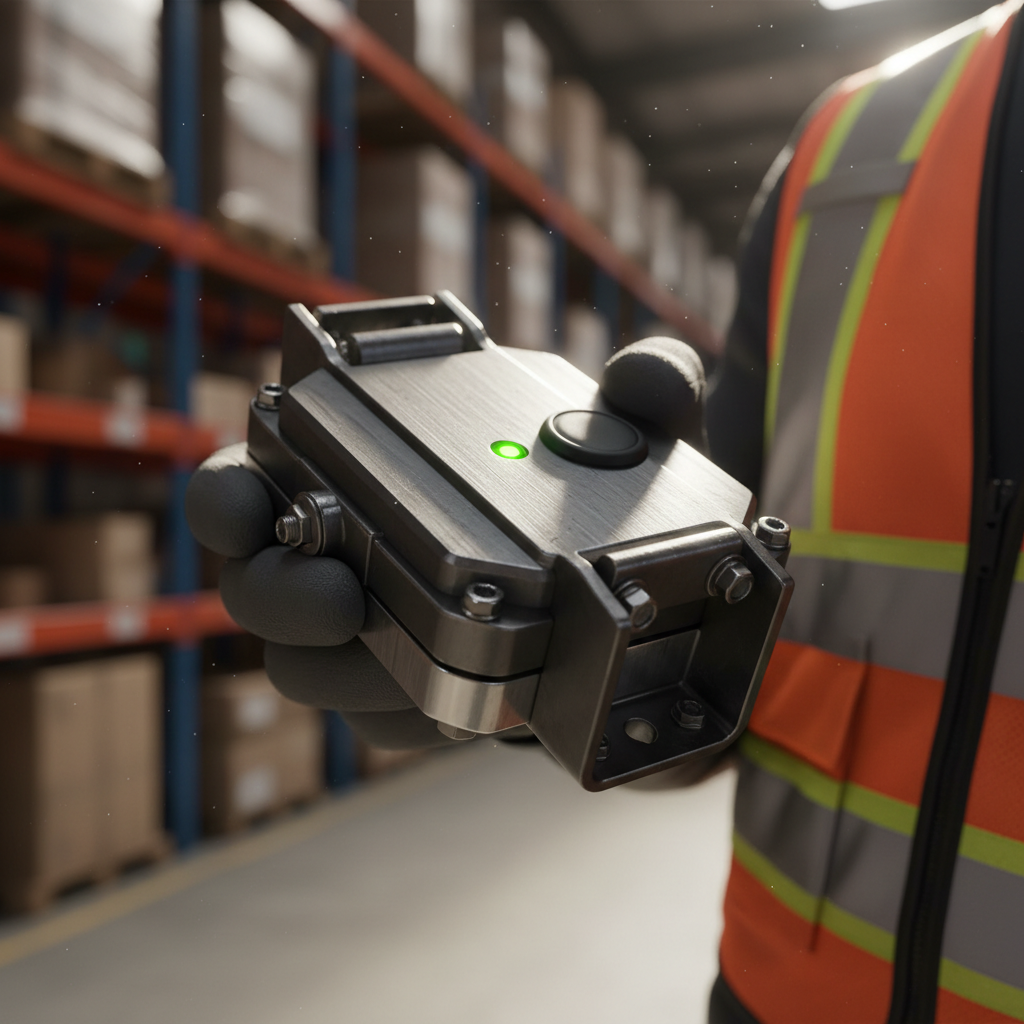
Five Technologies, Five Different Accuracy Profiles
The term “geolocation tracking device” gets applied to everything from a USD 29 AirTag to a DO-160 certified airfreight tracker. These are not the same technology. They don’t work the same way, don’t perform in the same environments, and don’t solve the same problems. Here’s the honest breakdown.
GPS/GNSS: The Outdoor Standard
Modern dual-frequency GPS receivers (L1 + L5) achieve roughly 3-meter accuracy outdoors, pulling signals from 30+ satellites. That’s excellent for fleet tracking, container monitoring, and any asset that spends most of its life outside. The problem: GPS signals don’t penetrate buildings, shipping containers, or aircraft cargo holds reliably. Indoor accuracy degrades to 10-50 meters, and in many warehouses or metal structures, you get no fix at all.
If your asset moves between outdoor and indoor environments (which most industrial assets do), GPS alone leaves you blind during the indoor segments. That’s not a spec sheet footnote. That’s a coverage gap that erases visibility exactly when dwell time, staging, and handoff decisions happen.
BLE (Bluetooth Low Energy): Low Power, Room-Level
BLE provides room-level accuracy of 5-10 meters at very low power consumption, with a range of roughly 10-50 meters. It’s the technology behind Apple AirTag, Samsung SmartTag, and Tile. The device itself doesn’t know where it is. It broadcasts a signal, and nearby smartphones or gateways report its location to the network.
This means BLE accuracy is entirely dependent on network density. An NYU study across 29 countries confirmed that AirTag gets location updates in under 10 minutes (because billions of iPhones act as detection nodes), while Tile updates can take hours in areas with fewer companion devices. For consumer item-finding, BLE is elegant and cheap. For industrial asset tracking in a port yard or cargo warehouse, BLE requires deploying your own gateway infrastructure to be reliable.
UWB (Ultra-Wideband): Centimeter Precision, Short Range
UWB delivers 10-30 centimeter accuracy, which is extraordinary. It’s the right choice for indoor manufacturing zones, robot navigation, and secure access control. The constraint: range is limited to 5-15 meters per anchor, and the UWB market (projected to reach USD 17.62 billion by 2030) reflect its growth in high-value environments like smart factories and warehouses. Outside those environments, UWB doesn’t make sense. The infrastructure cost per square meter is too high for open-air applications.
Cellular (4G/5G): The Communication Backbone
Cellular isn’t a positioning technology per se (though cell-tower triangulation gives rough location). It’s the data pipe. Most active GPS trackers use cellular modems to transmit coordinates. The critical point right now: 2G network shutdowns are actively disrupting the market. On the GPS-Trace platform, Coban’s share fell from 40.4% to 36.5% as their 2G-dependent devices lose connectivity. If you’re buying tracking hardware today, anything that isn’t 4G or 5G capable is already obsolete.
Hybrid: Where Serious Deployments Are Heading
The hybrid tracking segment (combining multiple positioning technologies) is projected to generate USD 4.3 billion by 2035. This isn’t a marketing buzzword. It reflects operational reality: no single technology covers every scenario. GPS for the outdoor leg, BLE or UWB for the indoor segment, cellular or LoRaWAN for data backhaul. The devices that work best across a full asset lifecycle combine at least two positioning methods.
| Technology | Outdoor Accuracy | Indoor Accuracy | Range | Power Draw | Best Fit |
|---|---|---|---|---|---|
| GPS/GNSS | ~3 m (dual-freq) | 10-50 m or no signal | Global | High | Fleet, outdoor assets |
| BLE | 5-10 m | 5-10 m | 10-50 m | Very low | Consumer tags, warehouse zones |
| UWB | 10-30 cm | 10-30 cm | 5-15 m | Medium | Factory floors, precision zones |
| Wi-Fi | 5-15 m | 5-15 m | 50-100 m | High | Supplemental indoor positioning |
| LoRaWAN | N/A (data backhaul) | N/A | 2-15 km | Very low | Low-power data transmission |
Where Geolocation Tracking Devices Deliver Real ROI
Specs don’t pay for the device. Operational outcomes do. Here are the use cases where geolocation tracking generates measurable returns, not just dashboard pings.
Fleet Management: The Proven Case
GPS fleet management reduces fuel costs by 20-30% annually through route optimization and idle-time reduction. It eliminates up to 95% of unauthorized vehicle usage through geofencing. 71% of fleets recoup their tracking investment within 12 months, and most small fleets cover costs within the first 30-60 days from fuel savings alone.
Vehicle tracking holds a 46.9% market share for good reason: the ROI math is simple. A 10-vehicle service fleet typically saves USD 15,000-30,000 per year in fuel, overtime, insurance, and theft avoidance combined. GPS tracking adoption sits at roughly 67% across commercial fleets, but drops below 50% for fleets under 10 vehicles. That gap represents pure waste.
Reusable Asset and Container Pool Tracking
This is where I see the largest disconnect between what companies buy and what they actually need. Most tracking purchases focus on shipment tracking: where is this container right now on its way to the customer? That job ends at delivery. The device pings during transit, confirms arrival, done.
Asset tracking is a different discipline. It follows the container, ULD, pallet, or ground support equipment through its entire lifecycle: outbound, dwell at destination, return, staging, reuse. The question isn’t “where is my shipment?” It’s “where are my 500 containers, how many are sitting idle, and what’s my average cycle time?”
When you track shipments, you optimize delivery. When you track assets, you optimize your entire container pool. The difference in operational dollars is significant: one large freight operator I’ve worked with discovered that 22% of their reusable containers were sitting in dwell for over 30 days, invisible to their system. That’s capital stuck in a parking lot.
Aviation, MRO, and Ground Support Equipment
Aviation adds a layer most tracking discussions ignore: certification. A geolocation tracking device deployed in an aircraft cargo hold or mounted to airfreight containers must meet DO-160 environmental standards (vibration, temperature, altitude, humidity). Consumer or automotive trackers fail these requirements immediately. The Thingfox T2, for example, is DO-160 airfreight approved specifically because standard hardware doesn’t survive the environment or pass airline compliance. The ROI of asset tracking in aviation becomes clear when you account for these certification requirements and the value of tracked assets.
Ground support equipment (tugs, belt loaders, dollies, ULD trailers) presents a different problem. These assets move constantly across aprons, hangars, and maintenance bays, crossing outdoor and indoor zones. A GPS-only device loses the asset the moment it enters a hangar. A hybrid approach (GPS + BLE gateways at facility entry/exit points) maintains visibility across the full operating area, which is exactly how a baggage cart tracking system recovers idle units and pays for itself.
Personal Safety and Vulnerable Persons
The personal tracking segment is projected to reach USD 4.4 billion by 2035, driven by child safety devices, elder monitoring, and special-needs wearables. Solutions like AngelSense and Jiobit combine GPS, cellular, and Wi-Fi positioning to maintain accuracy across indoor and outdoor environments. The technology here is proven. The challenge is privacy, which I’ll address below.
The Security Problem Nobody Wants to Talk About
In 2022, Bitsight discovered six critical vulnerabilities in the MiCODUS MV720 GPS tracker, including one rated CVSS 9.8 (the near-maximum severity score). These flaws allowed remote vehicle shutdown, real-time surveillance, and ransomware deployment. The device was deployed across 1.5 million units in 169 countries, including Fortune 50 companies and a nuclear power plant.
Separately, 30 GPS tracker models from a single Chinese manufacturer were found to leak location data due to zero encryption, enabling eavesdropping, location spoofing, and malware injection.
The lesson: a geolocation tracking device that transmits your asset positions over an unencrypted channel, or that runs firmware with known vulnerabilities, doesn’t just fail to protect your assets. It actively compromises them. Procurement teams need to ask three questions before approving any tracking hardware:
- Does the device use encrypted communication between hardware and platform?
- Does the manufacturer provide regular firmware updates and publish a vulnerability disclosure policy?
- Where is your location data stored, and who has access to it?
If the vendor can’t answer all three clearly, walk away. A USD 20 device with critical security holes is more expensive than no device at all.
Legal Landscape: What You Can and Can’t Track
Two U.S. Supreme Court decisions set the boundaries. In United States v. Jones (2012), the Court held that attaching a GPS device to a vehicle without a warrant constitutes a Fourth Amendment search. In Carpenter v. United States (2018), the Court extended this principle to cell-site location data, ruling that the government needs a warrant to access a person’s location history.
For commercial operators, these rulings primarily constrain law enforcement. But state-level legislation is expanding fast: at least 26 U.S. states introduced geolocation privacy bills in 2026, creating a patchwork of consent requirements, data retention limits, and breach notification standards.
For fleet operators and asset managers, the practical guidance is straightforward:
- Tracking assets you own (vehicles, containers, equipment): legal in all U.S. jurisdictions.
- Tracking employees: legal in most states with proper notice and consent. Check your state’s specific requirements.
- Tracking third-party property: don’t.
The AirTag stalking controversy (a federal judge allowed a class-action lawsuit against Apple to proceed, finding that Apple’s anti-stalking measures were insufficient) is pushing the entire industry toward mandatory anti-misuse features. That’s a consumer-device problem more than an industrial one, but it signals where regulation is heading.
How to Choose: A Decision Framework
Forget comparing spec sheets across 15 devices. Start with four questions.
1. What environment does the asset spend most of its time in?
Outdoor only (trucks, trailers, containers in yard): GPS/GNSS is sufficient. Indoor or mixed (warehouse, hangar, cargo hold): you need GPS + BLE or GPS + UWB, depending on precision requirements.
2. Do you need real-time alerts or historical data?
Active trackers (cellular transmission) give you live geofence alerts and immediate theft detection. Passive loggers cost less to operate (no cellular subscription) but only deliver data when retrieved. For fleet and high-value assets, active tracking pays for itself. For low-value items at scale, passive logging or BLE-based zone detection may be enough.
3. What’s the power situation?
Hardwired to vehicle power: unlimited runtime, deepest integration (CAN bus data, ignition status). Battery-powered: flexible placement, but battery life is a direct function of reporting frequency. A device reporting every 60 seconds might last two weeks. The same device reporting every 4 hours can last 12 months. Match the reporting interval to what you actually need, not what sounds impressive.
4. Are you tracking shipments or assets?
If your visibility need ends at delivery, you’re tracking shipments. If you need to know where your reusable containers, ULDs, or equipment are throughout their entire cycle (outbound, dwell, return, staging, redeployment), you’re tracking assets. The hardware might be similar. The platform, analytics, and deployment strategy are completely different.
The 2G Sunset: Replace Now or Lose Visibility
This is urgent and underappreciated. As 2G networks shut down globally, any tracker dependent on 2G cellular becomes a paperweight. The data is already visible: on the GPS-Trace platform (253,208 connected devices as of January 2026), manufacturers reliant on 2G hardware are losing market share while 4G models like the Teltonika FMB920 gain ground.
If your fleet or asset pool runs 2G trackers, budget for replacement within the next 12-18 months. This isn’t optional. The networks are shutting down on carrier timelines, not yours.
For new deployments: insist on 4G LTE-M or NB-IoT as the minimum cellular standard. These are designed for IoT applications (low power, small data payloads, long range) and have a network lifespan measured in decades, not years.
What the Market Gets Wrong
Most geolocation tracking device comparisons focus on hardware price and battery life. Those matter, but they’re inputs, not outcomes. Here’s what actually determines whether a tracking deployment succeeds or wastes money:
Platform integration matters more than device specs. A tracker that reports perfect coordinates to a platform that can’t integrate with your TMS, WMS, or ERP is an expensive map pin. Before choosing hardware, confirm that the platform supports the data flows your operations need.
Deployment speed determines adoption. A turn-key solution that’s operational in days beats a technically superior solution that takes months to configure. I’ve seen multi-million dollar tracking programs stall at integration for six months while assets kept disappearing.
Scalability kills latecomers. A solution that works for 50 devices but collapses at 500 (performance, licensing costs, platform limits) forces a painful re-evaluation just when you’ve proven the concept and need to expand. Ask about pricing at 10x your initial deployment before signing anything.
Total cost of ownership, not unit price. A USD 10/month device with a 6-month battery replacement cycle and manual firmware updates is more expensive over 3 years than a USD 25/month device with 5-year battery life and OTA updates. Calculate TCO before comparing unit costs.

Perguntas Frequentes
What is a geolocation tracking device?
A geolocation tracking device is a piece of hardware that determines its geographic position (using GPS satellites, cellular towers, BLE, UWB, or Wi-Fi) and transmits that position to a server or app. Active devices transmit in real time over cellular or satellite networks. Passive devices log positions internally for later download. Most modern industrial trackers combine GPS for outdoor positioning with a cellular modem for real-time data transmission.
How accurate are geolocation tracking devices?
Accuracy depends on technology. Outdoor GPS with dual-frequency receivers achieves roughly 3 meters. Single-frequency GPS delivers about 15 meters. Indoors, GPS degrades to 10-50 meters or fails entirely. BLE provides 5-10 meter room-level accuracy. UWB achieves 10-30 centimeter precision but only within 5-15 meters of an anchor point. For most fleet and asset tracking, 3-meter GPS accuracy is more than sufficient.
Can geolocation trackers be hacked?
Yes. In 2022, Bitsight found six critical vulnerabilities in the MiCODUS MV720, a tracker used by 1.5 million users across 169 countries, including Fortune 50 companies. The flaws allowed remote vehicle shutdown and surveillance. Always verify that your device uses encrypted data transmission, receives firmware updates, and comes from a manufacturer with a published security disclosure policy.
What’s the difference between shipment tracking and asset tracking?
Shipment tracking monitors a package or container from origin to delivery. The job ends when it arrives. Asset tracking follows the physical asset (container, ULD, equipment) through its entire lifecycle: deployment, transit, dwell, return, staging, and reuse. Shipment tracking optimizes delivery performance. Asset tracking optimizes your container pool, cycle time, and capital utilization.
How long do geolocation tracker batteries last?
It varies by orders of magnitude. Hardwired vehicle trackers draw from the vehicle and run indefinitely. Battery-powered trackers range from 2 weeks (high-frequency GPS + cellular reporting) to 12+ months (infrequent reporting or BLE-only). Battery life is directly tied to reporting frequency: reporting every 60 seconds drains batteries fast, while reporting every 4 hours can extend life to a year or more. Match the interval to your operational needs.
Is it legal to use a GPS tracker on company assets?
Tracking assets you own (vehicles, containers, equipment) is legal across all U.S. jurisdictions. Tracking employees requires proper notice and, in many states, written consent. At least 26 U.S. states introduced geolocation privacy legislation in 2026, so review your state’s specific requirements. Tracking third-party property without authorization is illegal everywhere.
If your container pool, fleet, or ground support equipment feels invisible after delivery or between assignments, that’s the gap asset tracking closes. We build complete tracking solutions across aviation, freight, and industrial supply chains, from hardware selection to platform integration. Talk to our team, or browse our asset tracking devices to see what fits your environment.








 +1 508 292 2210

5 Responses