

The same terminal that tracks 33 million checked bags a year with 99%+ RFID accuracy has zero real-time visibility on its own baggage carts. I keep running into this pattern: airports spend millions on IATA 753 compliance, install readers at every sortation hall and claim belt, then run their cart fleet on the clipboard counts and guesswork that a proper airport inventory management system would replace. A proper baggage cart tracking system isn’t a separate capital investment. In most cases, it’s a configuration change away.
The airline industry spent an estimated $5 billion on mishandled baggage in 2024, with 33.4 million bags delayed, lost or damaged across 5.3 billion passenger journeys. That loss is one slice of a far larger problem in aviation supply chain visibility, where billions disappear into untracked assets. The tracking infrastructure deployed to fight that number (RFID readers, BLE gateways, cloud platforms) already sits inside most major terminals. Extending it to cover your cart fleet is a marginal-cost expansion of what you’ve already paid for.
This piece covers what a baggage cart tracking system actually involves, how the technology options compare, what real deployments have delivered, and where the return shows up on a balance sheet.
What a Baggage Cart Tracking System Does
A baggage cart tracking system gives airport operators and concessionaires real-time visibility over the location, count, usage and condition of passenger luggage trolleys across terminals, curbside areas, parking structures, retail zones and (where relevant) the apron.
The system runs on five functional layers:
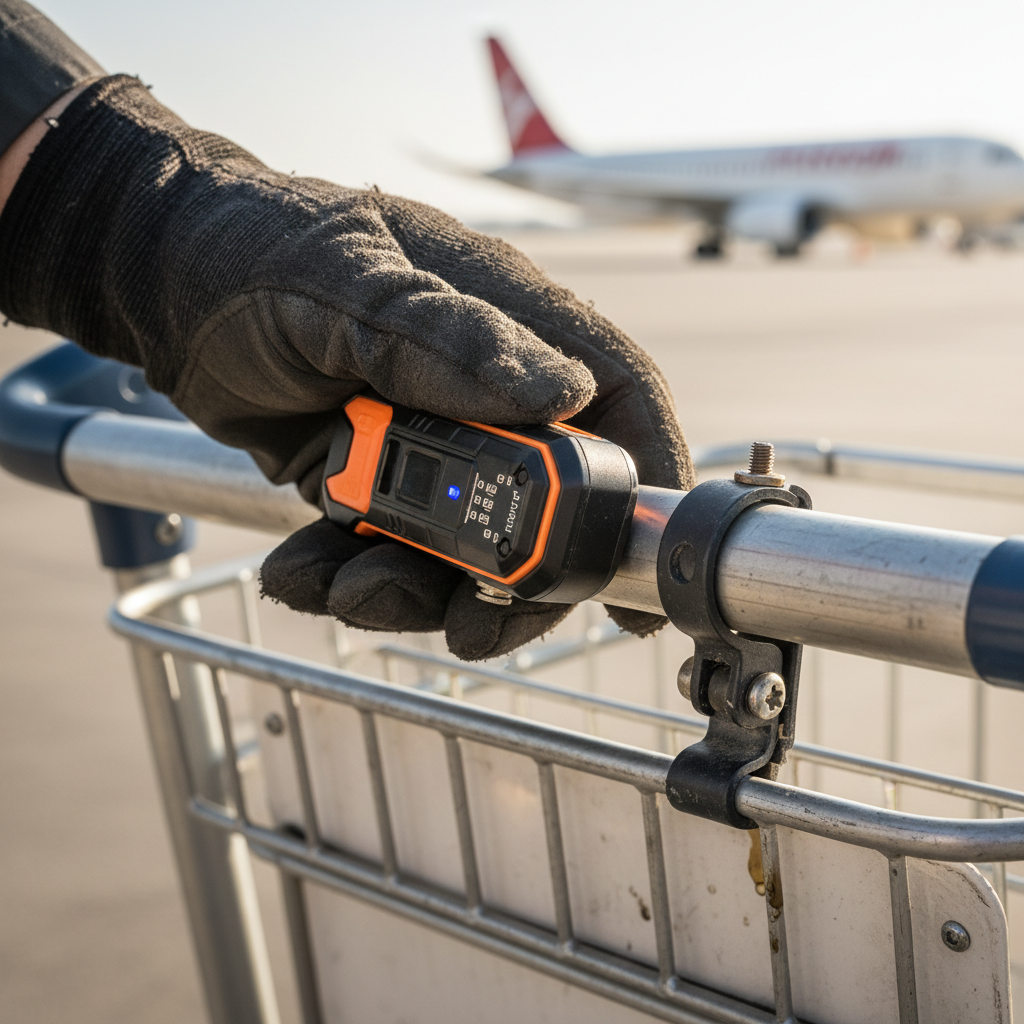
- An identifier on the cart itself: passive RFID tag, BLE beacon or QR code.
- Fixed infrastructure to read those identifiers: overhead RFID readers at chokepoints, BLE gateways along corridors, cameras at collection areas.
- Connectivity to move data off the floor: Wi-Fi, cellular, LoRaWAN or satellite, depending on indoor/outdoor coverage needs.
- A software platform that turns raw scans into operational decisions: dashboards, zone alerts, demand prediction.
- Integration with existing airport systems: the Airport Operational Database (AODB), Baggage Reconciliation System and IATA messaging standards.
Here is the distinction that matters: this is asset tracking, not shipment tracking. A checked bag moves from A to B and the tracking job ends. A baggage cart cycles. Terminal to curbside to parking garage to collection bay, back to terminal. The tracking never stops at “delivery.” It restarts. That continuous cycle is exactly what most operators lose visibility on. They know how many carts they bought. They have no idea where those carts are at 2 PM on a Tuesday.
The Technology Stack: RFID, BLE, GPS and Computer Vision
Four tracking technologies compete for cart-tracking deployments. Each carries a real trade-off between cost, coverage and data richness:
| Technology | Cost per Tag | Read Range | Best For | Limitation |
|---|---|---|---|---|
| Passive RAIN RFID | $0.05 to $0.50 | 1 to 10 m | Chokepoint counts (entry, exit, claim) | Checkpoint-only; no continuous position |
| BLE Beacons | $3 to $15 | Up to 100 m | Continuous indoor zone tracking | Battery life (1 to 3 years); higher tag cost |
| GPS + Cellular | $20 to $80 | Global outdoor | Remote lots, off-airport, multi-site | No indoor signal; higher power draw |
| Computer Vision (cameras + AI) | Per camera, not per cart | Camera field of view | Count, condition, flow analytics | Requires fixed CCTV infrastructure |
Passive RAIN RFID remains the cost leader, and it powers most existing baggage-tracking deployments. At $0.05 to $0.50 per tag, you can equip thousands of carts for under $500. The catch: RFID only tells you a cart passed a reader. It doesn’t tell you where it is between readers.
BLE closes that gap with continuous zone-level positioning through geolocation tracking technology, but at 10x to 30x the tag cost. For an airport managing 3,000 carts, the difference between RFID and BLE is the difference between a $1,500 tag budget and a $45,000 one. Before you add gateways.
GPS and cellular make sense when carts leave the building: remote parking lots, rental car areas, off-airport facilities. Indoors, GPS goes blind. Most airports that need both zones deploy a hybrid.
Computer vision is the newest layer. The 2026 trend toward “baggage biometrics” means airports are repurposing existing CCTV networks with deep-learning models to count trolleys in real time, detect abandoned carts in retail zones, and forecast redistribution needs. Wanzl’s TrolleyFlow platform, deployed at Venice Marco Polo Airport, combines cameras with RFID and BLE so operators can pick one, two, or all three data sources.
The most effective deployments are not single-technology. They layer RFID at chokepoints for count accuracy, BLE where continuous positioning matters, and GPS for outdoor coverage. The question isn’t which technology is best. It’s which combination matches your coverage gaps.
IATA Resolution 753 Already Built Half Your System
This is the part most cart-tracking conversations miss.
IATA Resolution 753, in force since June 2018, requires every IATA-member airline to track each checked bag at four mandatory points: passenger handover, aircraft loading, transfer between aircraft, and arrival handover. Compliance has driven massive RFID reader and BRS software deployments across major hubs worldwide.
The infrastructure those airlines installed (readers at sortation, loading docks, transfer belts and claim halls) is physically present in the same terminal where baggage carts circulate. Extending that infrastructure to read cart tags is not a second capital project. It’s a configuration expansion. The readers are already mounted. The network is already wired. The software already processes scan events.
This convergence is why the $674 million baggage carts market increasingly piggybacks on the $3.8 billion airport baggage tracking system market. An airport that has already invested in IATA 753 compliance can add cart-level visibility at marginal cost: RFID tags, a few additional reader positions, and a software module.
If you’ve already spent the money to track bags, the question isn’t whether you can afford to track carts. It’s why you haven’t started.
Real Deployments Worth Studying
Four documented cases show the range of what’s been tried and what each delivered.
London Heathrow: The Proof of Concept
Heathrow ran a three-month UHF RFID pilot from October 2017 to January 2018, deploying Impinj readers and Vero Solutions software to track carts passing chokepoints between the baggage-claim area entry and exit. The pilot proved feasibility of real-time cart movement capture in a major hub. What it didn’t publish: accuracy metrics, cost savings or operational impact numbers. Heathrow validated the concept. The business case remained open.
Venice Marco Polo Airport: Production-Grade SaaS
Venice deployed Wanzl’s TrolleyFlow platform (co-developed with Italian IT firm NAITEC) starting in late 2023. The system uses cameras, passive RFID and BLE to count, locate and predict trolley demand by zone. Wanzl’s published outcome: Venice improved trolley service quality without purchasing additional trolleys. That’s the detail worth pausing on. The system paid for itself by improving aviation asset utilization and preventing unnecessary fleet expansion, not just by finding lost carts.
Delta Air Lines: Network-Wide RFID
Delta embedded RAIN RFID in baggage labels across its hub network. Published results: 10% improvement in loading rates, 13% reduction in mishandling, 21% decrease in bag-handling injuries, all running on 99%+ read accuracy. Delta’s deployment focuses on checked bags, not carts. But the reader infrastructure it installed is exactly what enables cart-level tracking at the same terminals, at marginal incremental cost.
European Ground Handlers: IoT at Scale
Several IoT vendors have documented tracker deployments with European ground-support operators like TCR across multiple airports. These platforms use LoRaWAN and GPS hybrid trackers on belt loaders, tugs, dollies, and by extension, baggage cart fleets managed by the same handlers. The same logic that justifies tracking airport support vehicles applies here: this is the model closest to how most mid-size European airports will likely adopt cart tracking, bundled with broader GSE tracking rather than as a standalone cart proj See also the article: Aircraft Spare Parts Logistics: A $150K/Hour Race.ect.
A pattern emerges. The airports that succeed don’t treat cart tracking as a separate initiative. They extend existing tracking infrastructure to cover one more asset class. The incremental cost per cart is small. The incremental visibility is not.
The ROI Math Airports Keep Avoiding
Something unusual about this market: nobody publishes hard ROI numbers for baggage cart tracking. Smarte Carte doesn’t disclose them. Wanzl cites “significant cost savings” without quantifying. The Heathrow pilot published no financial outcome. Delta published operational metrics for bags, not carts.
When you’re evaluating vendors, treat “ROI” claims as directional, not precise. That said, the cost framework is straightforward. Cart tracking reduces four categories of spend:
- Replacement costs. Airports lose carts to theft, abandonment in parking structures, and unreported damage. If you don’t know a cart is missing, you can’t recover it. You buy another one. Tracking converts “lost” into “located” before the replacement order goes out.
- Labor for redistribution. Without real-time demand data, ground staff drive collection routes on fixed schedules or on complaints. They collect 40 carts from Terminal B while Terminal A runs empty. Predictive redistribution (like Venice’s TrolleyFlow deployment) replaces guesswork with data.
- Unnecessary fleet expansion. This is Venice’s specific win. When you can’t see your carts, the default response to “not enough carts at arrivals” is buying more. Tracking often reveals you have enough carts. They’re just in the wrong place.
- Passenger experience and non-aero revenue. A cart that isn’t at arrivals when a passenger needs it is a friction point. That friction cascades: the passenger who carries bags by hand skips the terminal shop, grabs a taxi instead of browsing retail. Cart availability is upstream of spend.
The tag-side investment is almost trivially small. Passive RFID tags for 5,000 carts run under $2,500 at bulk rates. BLE tags for the same fleet run $15,000 to $75,000. The larger investment is in readers, gateways, software licensing and integration labor. If your terminal already has RFID readers for IATA 753 compliance, you’ve absorbed the heaviest line item.
The question for procurement isn’t “can we justify tracking carts?” It’s “given what we’ve already spent on bag-tracking infrastructure, can we justify not tracking them?”
Matching Technology to Your Operation
There’s no universal answer, but there is a decision sequence that holds across operation sizes.
If your primary problem is cart counts (how many are in Terminal A vs. Terminal B right now), passive RFID at chokepoints is the lowest-cost, fastest-to-deploy option. Tags cost cents. Readers can piggyback on existing IATA 753 infrastructure. Implementation is measured in weeks, not quarters.
If your problem is continuous location (finding specific carts, tracking movement patterns, measuring dwell time in zones), BLE is the right layer. Higher tag cost, but the data density justifies it when manual search-and-collect operations eat significant labor hours.
If carts leave the terminal (remote lots, off-airport facilities, multi-site operations), GPS and cellular enter the picture. Indoor tracking goes blind outside. Outdoor tracking goes blind inside. Most airports that cover both zones deploy a hybrid: BLE or RFID indoors, GPS outdoors, one platform merging both views.
If you want analytics beyond location (cart condition scoring, demand forecasting, flow optimization), computer vision and AI add a layer that no tag-based technology provides alone. This is the leading edge. Deploy it after the basics work.
For ground handlers managing mixed fleets (baggage carts, belt loaders, tugs, dollies, ULDs), the practical answer is a single IoT platform that handles all asset classes. Treating cart tracking as part of broader airport ground handling equipment management avoids the data silos and doubled integration effort that come from deploying separate tracking systems per asset type for no operational gain.
At Datanet, we build tracking systems that follow assets through their full cycle, not just point A to point B. If your baggage cart fleet goes invisible once carts leave the claim area, that’s the visibility gap asset tracking closes. Talk to our team or explore our asset tracking device catalog to see what fits your operation.

Frequently Asked Questions
What is a baggage cart tracking system?
A system that gives airports and ground handlers real-time visibility over the location, count and condition of passenger luggage trolleys. It typically combines identifiers on the carts (RFID tags, BLE beacons or QR codes), fixed readers or gateways at key positions, wireless connectivity and a cloud software platform for dashboards, alerts and demand prediction.
How much does it cost to track baggage carts with RFID?
Passive RAIN RFID tags cost $0.05 to $0.50 each at volume. Tagging 5,000 carts runs under $2,500 for tags alone. The larger investment is in readers, software licensing and integration work. Airports that already have RFID infrastructure for IATA Resolution 753 compliance can extend it to carts at marginal cost, since the readers and network backbone are already in place.
Which airports have deployed baggage cart tracking?
Documented deployments include London Heathrow (three-month RFID proof of concept, 2017 to 2018), Venice Marco Polo Airport (Wanzl TrolleyFlow in production since 2023), and multiple European airports using IoT trackers on ground-support equipment fleets. Delta Air Lines operates network-wide RAIN RFID for baggage with infrastructure that supports cart-level extension.
What is IATA Resolution 753 and how does it relate to cart tracking?
Resolution 753 requires IATA-member airlines to track checked bags at four mandatory points: passenger handover, aircraft loading, transfer and arrival handover. In force since June 2018, it has driven large-scale RFID reader and BRS software deployments. Those same assets (readers, gateways, cloud software) can be reused for cart tracking, making Resolution 753 compliance infrastructure a launchpad for cart visibility.
RFID or BLE: which is better for baggage cart tracking?
Passive RFID is cheaper ($0.05 to $0.50 per tag) and ideal for chokepoint-based counting at entries, exits and claim areas. BLE costs more ($3 to $15 per tag) but provides continuous indoor zone positioning. Most large deployments combine both: RFID for accurate counts at fixed points, BLE for real-time location where labor savings justify the higher tag cost.
Can I track baggage carts outdoors?
Yes, but it requires GPS and cellular connectivity. Indoor technologies like RFID and BLE lose coverage outside the terminal structure. Airports with remote parking lots or multi-site operations typically deploy hybrid systems: RFID or BLE indoors, GPS and cellular outdoors, unified under a single software platform that merges both data streams.









 +1 508 292 2210

4 Responses