

Somewhere in your hospital right now, a nurse is spending 20 minutes looking for an infusion pump that’s sitting in a clean utility room on the wrong floor. Multiply that across every shift, every unit, every day. HIMSS and GE estimate this kind of waste costs US hospitals $14 billion in lost productivity every year. The equipment isn’t gone. It’s just invisible.
Healthcare asset tracking solves that. Yet only 15% to 20% of hospitals have deployed any form of real-time asset visibility. The other 80% are still running on phone calls, whiteboard logs, and tribal knowledge. This article breaks down what a healthcare asset tracking system actually involves, which technologies make sense for which use cases, what documented ROI looks like, and the human factors that kill deployments before they start. Whether you’re a hospital COO building a business case or a clinical engineering director evaluating vendors, the goal here is to give you the clearest picture possible of what works, what doesn’t, and what it costs.
What Healthcare Asset Tracking Actually Means
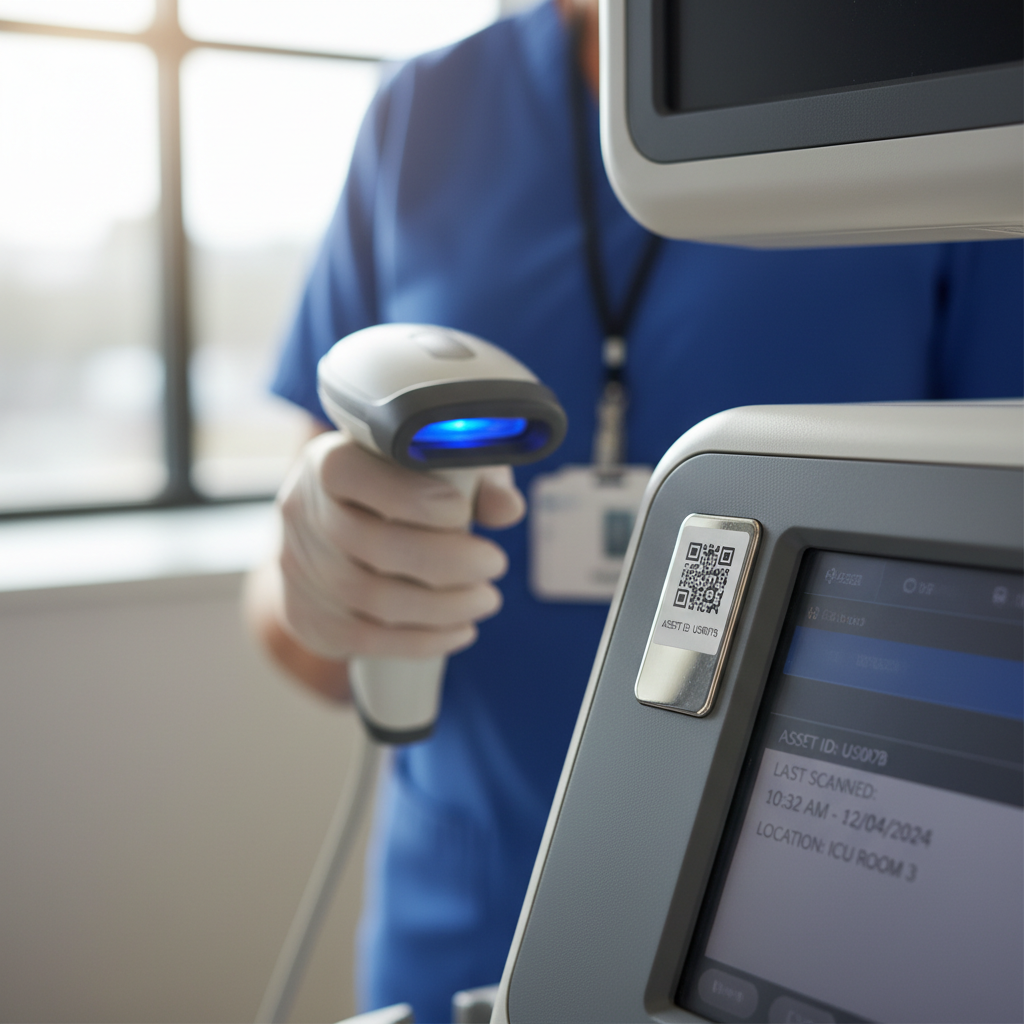
Healthcare asset tracking is the use of wireless technology to locate, monitor, and manage medical equipment, staff badges, and patient wristbands inside a healthcare facility in real time. A tag attached to the asset emits a radio signal. Fixed infrastructure (readers, gateways, antenna arrays) picks up that signal. Software translates it into a dot on a floor plan and applies business rules: alerts, utilization reports, maintenance triggers, PAR-level management.
The scope goes well beyond “find my wheelchair.” A mature deployment covers:
- Mobile equipment location (infusion pumps, ventilators, monitors, beds)
- Preventive maintenance scheduling based on actual usage and location data
- Inventory right-sizing by measuring utilization rates per unit
- Recall compliance for flagged devices
- Environmental monitoring (temperature and humidity for medication, blood, vaccine storage)
- Patient flow and OR turnover optimization
- Infant security and wander management
Here’s the distinction I keep making with every client I talk to: there’s a difference between knowing where something is right now and managing its full lifecycle. Shipment tracking ends at delivery. Asset tracking follows the equipment through deployment, usage, maintenance, redeployment, and eventual retirement. Most hospitals that say they “track assets” are really doing periodic inventory counts. That’s not tracking. That’s archaeology.
The Numbers Behind the Chaos
Hospital administrators don’t lose sleep over technology specs. They lose sleep over budget. Here’s what the absence of asset visibility actually costs:
- $4,000 per bed per year in equipment lost, stolen, or unaccounted for.
- 20% to 40% over-purchasing in specialty departments because nobody trusts the inventory data.
- 21 minutes per nurse per shift spent searching for equipment, according to HIMSS/GE research.
- One-third of nurses report losing an hour per shift to hunting for devices, per CenTrak’s field data.
That last number deserves a closer look. An hour per shift, per nurse, spent on non-clinical work. In a hospital battling 20% nursing vacancy rates, that’s not an efficiency problem. It’s a patient safety problem and a staff retention problem wrapped together. Every minute a nurse spends looking for a pump is a minute she’s not at bedside.
Then there’s the rental trap. When a hospital can’t find its own equipment, it rents. RWJBarnabas Health documented $9 million in savings after deploying real-time location systems across its network, with $1.4 million of that from eliminating unnecessary rentals and replacements alone. The equipment was in the building the entire time.
Four Technologies, One Decision
Every vendor will tell you their technology is the obvious choice. It’s not that simple. Healthcare asset tracking runs on four wireless families, each with different accuracy, cost, and infrastructure profiles.
| Technology | Accuracy | Tag Cost | Best For | Limitation |
|---|---|---|---|---|
| Passive RFID (RAIN/UHF) | Choke-point / shelf-level | Cents per tag | Storeroom inventory, cabinet-level counts | No real-time continuous location |
| Active RFID | 1 to 3 meters (room level) | $5 to $25 | General mobile equipment tracking | Lower precision than BLE AoA or UWB |
| BLE 5.1 (Angle-of-Arrival) | 0.1 to 1 meter (sub-room) | $10 to $30 | High-value equipment, patient flow, staff safety | Requires purpose-built antenna arrays |
| UWB (Ultra-Wideband) | 10 to 30 cm | $30 to $50+ | Surgical instruments, infant security, precision applications | Highest infrastructure and tag cost |
| Wi-Fi RSSI | 3 to 10 meters | $15 to $30 | Overlay on existing WLAN for basic zone-level visibility | Least precise, interference-prone |
BLE Angle-of-Arrival is emerging as the pragmatic sweet spot for most hospital deployments in 2026. It delivers sub-meter accuracy without UWB’s infrastructure price tag, and it can often leverage existing Bluetooth access points as a foundation. UWB still wins on raw precision (10 to 30 cm), but here’s the math that matters: at $50 per tag across 10,000 assets, you’re spending $500,000 on tags alone before a single antenna is mounted. BLE AoA cuts that tag bill significantly while staying accurate enough for the vast majority of clinical workflows.
The real-world answer for most mid-to-large hospitals is hybrid: passive RFID for storerooms and cabinets, BLE AoA for mobile high-value assets, and UWB reserved for precision use cases like infant security or surgical instrument tracking.
Documented ROI: What Hospitals Actually Saved
I’m always skeptical of vendor ROI claims that lack specifics. Here are the documented cases with real numbers.
Pediatric hospital BLE overlay. A leading pediatric hospital layered BLE-based RTLS on its existing Bluetooth access points and documented expected annual savings exceeding $1 million from higher utilization and reduced rental expense. The key insight: they didn’t build a parallel wireless network. They used what they already had. That compressed the payback window from years to months.
Vizzia Technologies multi-site. Vizzia published case studies showing $2 million in system-wide savings across one health system, with a single hospital in the network saving $600,000 per year. Their model is fully managed, meaning the vendor operates the RTLS, which removes the need for an in-house engineering team.
Houston Methodist. Houston Methodist consolidated multiple legacy tracking systems onto a single RTLS platform and reported what their operating department described as “HUGE cost savings.” The mechanism was consolidation: eliminating duplicate gateways, badge types, software licenses, and integration points.
Infusion pump inventory reduction. A peer-reviewed study in PMC found that hospital units using RTLS data were up to 17% more likely to right-size their infusion pump inventory (95% CI: 7% to 27%). That’s not a vendor claim. That’s controlled research.
The three ROI buckets are consistent across every case I’ve seen:
- Utilization gains: finding and deploying equipment you already own instead of renting or purchasing more.
- Time savings: returning clinical hours to bedside care.
- Loss prevention: reducing theft, hoarding, and misplacement.
A reasonable expectation for the first year, based on industry benchmarks: a 4.5% return on deployed capital, with significantly higher returns in years two and three as utilization data matures and drives procurement changes.
Total Cost of Ownership: Beyond the Tag Price
Vendors love to talk about tag cost. They have less enthusiasm for the total cost of ownership conversation. Here’s what the full picture looks like:
Tags at scale. That $50 tag across 10,000 assets is $500K. A $15 BLE tag across the same fleet is $150K. The delta matters, but it’s only the starting line.
Infrastructure. Ceiling-mounted sensor grids (the approach used by CenTrak, Sonitor, Midmark) deliver excellent accuracy but require physical installation in every zone. Wi-Fi or BLE overlay approaches reuse existing access points, cutting infrastructure cost dramatically, but with accuracy trade-offs. Budget for $1,000 to $5,000 per reader/gateway depending on technology.
Software licensing. Most RTLS platforms charge per-tag or per-bed annual licensing fees. This is the recurring line item that surprises budget committees. Ask for a 5-year total software cost in every RFP, not just year-one pricing.
Battery replacement. Active RFID and BLE tags last 3 to 6 years. UWB tags last 1 to 3 years depending on ping frequency. Factor in the labor cost of physically swapping tags across thousands of assets. Some hospitals assign a full-time technician to this task.
Integration. Connecting the RTLS to your EMR, CMMS, nurse-call system, and hand-hygiene compliance platform is where scope creep lives. Budget 15% to 25% of the total project cost for integration and middleware.
Capex vs. managed service. The market is shifting toward OPEX managed-service contracts. Vizzia’s model, where the vendor owns and operates the infrastructure, is gaining traction among mid-size hospitals that can’t staff an in-house RTLS team. It trades lower upfront cost for a longer contractual commitment.
The Human Factor That Kills Deployments
Here’s something the SERP doesn’t cover well, and it’s the single biggest risk factor for any healthcare asset tracking project: clinician adoption.
A peer-reviewed study of 117 nurses who used an RTLS asset-tracking system for 3 months reported moderate satisfaction scores of 2.7 to 3.4 out of 5. Not great. The dissatisfaction wasn’t about the technology failing. It was about workflow disruption and battery-life complaints. A systematic review in JAMIA identified “substandard functionality and difficulty integrating RTLS” as the primary implementation barriers across multiple hospitals.
Translation: the technology works. The deployment often doesn’t. Three problems keep recurring:
1. Surveillance perception. Staff see the tags and assume management is tracking their movements. Published research on RFID privacy in healthcare confirms this isn’t paranoia: room-visitation patterns can be linked back to specific staff members. Hospitals that frame RTLS as a safety tool (panic buttons, hand-hygiene nudges, infant security) face less resistance than those that let the narrative default to productivity monitoring. Some institutions have shifted to alternative duress-button models specifically to avoid the “big brother” perception tied to full RTLS.
2. Inadequate training. Deploying thousands of tags without teaching floor nurses how to actually use the search interface is a recipe for shelfware. The technology has to save time from day one, or the staff will route around it.
3. Integration gaps. If the RTLS doesn’t talk to the EMR and CMMS, nurses end up toggling between systems. That’s additional clicks, not fewer. The RFP should weight integration depth as heavily as tag accuracy.
The lesson from the field: budget 20% of your implementation timeline for change management, training, and feedback loops. The hospitals that succeed treat RTLS as a workflow project that happens to involve technology, not a technology project that happens to affect workflow.
Where the Market Is Heading
Healthcare RTLS is a $2.5 billion market in 2026, projected to reach nearly $10 billion by 2032. The broader healthcare asset management market (including RFID, software, and services) is forecasted to grow from $49.67 billion in 2026 to $284.87 billion by 2034. Five shifts are reshaping how hospitals should think about procurement.
AI on top of location data. Machine learning layered on RTLS data can predict peak equipment demand, identify bottlenecks before they cascade, and automate PAR-level adjustments. This turns location data from a reactive search tool into a predictive operations layer. Any 2026 RFP should require an AI/analytics roadmap from vendors, not just hardware specs.
Vendor consolidation. Sonitor and Tagnos merged in August 2025, combining high-precision RTLS with clinical workflow software. Securitas Healthcare deepened its Sonitor partnership to lower total cost of ownership. Sonitor won the 2026 Best in KLAS RTLS award with a score of 85.9, after Securitas Healthcare took the 2025 award. The viable vendor list for a serious RFP has shrunk from roughly 25 players in 2018 to 8 to 10 tier-one contenders today. Expect more M&A in the next 18 months.
BLE AoA replacing Wi-Fi RSSI as the default mid-tier option. Sub-meter accuracy at BLE infrastructure cost is now standard, not premium. This compresses UWB’s price umbrella and makes room-level precision accessible to hospitals that couldn’t justify a dedicated sensor grid.
Cybersecurity requirements hardening. Securitas Healthcare earned the Censinet Cybersecurity Transparent Award for its RTLS platform three consecutive years (2022, 2023, 2024). The FDA continues to regulate RFID electromagnetic compatibility with active medical devices. Vendor security questionnaires (SIG, HITRUST, Censinet) are becoming mandatory procurement criteria, not nice-to-haves. Run an EMC risk assessment before activating any 2.4 GHz or UWB readers near ICU/ED equipment.
RFID moving into pharmacy. The American Hospital Association’s 2025 market scan highlights RFID for medication inventory management as an emerging use case. Hospital pharmacies are becoming a major new buyer segment for RFID cabinet and shelf-level tracking systems.
How to Evaluate a Healthcare Asset Tracking System
If you’re building an RFP or shortlisting vendors, here’s the framework I’d use. Not theoretical. Based on what I’ve seen work across industrial IoT deployments and what the healthcare data confirms.
Start with the use case, not the technology. What are your top three pain points? If it’s infusion pump hoarding and rental costs, BLE AoA on existing infrastructure may be enough. If it’s infant security and surgical instrument tracking, you need UWB precision. The wrong technology for the right use case wastes money. The right technology for the wrong use case wastes time.
Demand a 5-year TCO model. Include tags, infrastructure, software licensing, integration, battery replacement, and training. Compare the vendor’s capex model against a managed-service contract. Many mid-size hospitals find the managed model delivers faster time-to-value.
Score integration depth equally with accuracy. A system that can’t feed data into your EMR (Epic, Cerner, Meditech) and CMMS is a standalone tool, not an operations platform. Ask vendors for a live integration demo, not a slide deck.
Check the KLAS scores, then check them again. Best in KLAS leadership rotated three times in four years (CenTrak through 2022, Securitas in 2025, Sonitor in 2026). A vendor’s 2023 ranking tells you very little about their 2026 product. Request recent customer references, not legacy case studies.
Plan for the human layer from day one. Allocate budget for change management. Publish a clear, narrowly scoped data-use policy before the first tag is deployed. Frame the system as a clinical tool that serves the staff, not a surveillance layer that monitors them.
Where IoT Asset Tracking Meets Healthcare Beyond the Hospital Walls
Most of the RTLS conversation focuses on what happens inside the building. But healthcare asset tracking doesn’t stop at the facility door. Medical equipment moves between campuses. Pharmaceutical shipments require unbroken temperature monitoring from warehouse to clinic. Reusable transport containers cycle between hospitals, labs, and distribution centers.
This is where the distinction between shipment tracking and asset tracking becomes visible. A shipment tracker tells you the package arrived. An asset tracker follows the container, the cooler, or the transport case through its full lifecycle: deployment, transit, dwell time, return, and reuse. The same visibility gap shows up in ocean freight, where maritime asset tracking keeps containers accountable long after they leave the port. If your reusable container pool feels invisible after delivery, that’s the gap asset tracking closes.
Environmental monitoring for vaccine cold chains, temperature-sensitive medications, and biological specimens is a parallel need that runs on the same IoT infrastructure principles. The sensor technology differs (temperature, humidity, light exposure), but the architecture (tag, gateway, cloud platform, alerts) is identical.
If you’re looking at healthcare asset tracking and want to explore how IoT-based solutions work across the full equipment lifecycle, including environmental monitoring, talk to our team. We build end-to-end tracking systems that go where hospital RTLS stops: across campuses, through supply chains, and into the field. You can also explore our asset tracking devices and environmental monitoring solutions to see what fits your operation.

Frequently Asked Questions
What is healthcare asset tracking?
Healthcare asset tracking uses wireless technologies (RFID, BLE, UWB, or Wi-Fi) to locate and manage medical equipment, staff, and patients in real time within a healthcare facility. Tags on assets emit signals captured by fixed readers, and software translates those signals into actionable location data on a floor plan. The system supports equipment search, utilization analysis, maintenance scheduling, and compliance reporting.
How much does a hospital asset tracking system cost?
Costs vary widely by technology and scale. Tag costs range from cents (passive RFID) to $50+ (UWB). A mid-size hospital tracking 10,000 assets can expect $150K to $500K in tags, plus infrastructure, software licensing, and integration. Total first-year deployment for a 400-bed hospital typically falls in the $500K to $2M range. Managed-service models convert this to an OPEX monthly fee.
What is the ROI of healthcare RTLS?
Documented outcomes include $1 million in annual savings at a pediatric hospital (Cognosos), $2 million system-wide at a multi-site health network (Vizzia), and up to 17% infusion pump inventory reduction in units using RTLS data (PMC peer-reviewed study). Most deployments target payback within 12 to 24 months, with ROI accelerating in years two and three as utilization data drives procurement changes.
What is the difference between RFID and RTLS?
RFID (radio frequency identification) is a family of tag-and-reader technologies used to identify items, typically at choke points like doorways or cabinets. RTLS (real-time locating system) is a broader system that delivers continuous, room-level or sub-room-level coordinates using any combination of RFID, BLE, UWB, or Wi-Fi. Passive RFID alone doesn’t qualify as RTLS. Active RFID, BLE AoA, and UWB typically do.
Which RTLS technology is best for hospitals?
BLE 5.1 with Angle-of-Arrival (AoA) is the pragmatic choice for most hospital-wide deployments in 2026. It delivers sub-meter accuracy at lower infrastructure cost than UWB, and can often leverage existing Bluetooth access points. UWB remains the accuracy leader (10 to 30 cm) for precision applications like infant security. Most mature deployments use a hybrid approach: passive RFID for storerooms, BLE AoA for mobile assets, UWB for high-precision zones.
Who are the leading healthcare RTLS vendors in 2026?
Based on KLAS Research awards, Gartner Peer Insights, and published case studies: Sonitor (2026 Best in KLAS), Securitas Healthcare (2025 Best in KLAS), CenTrak, Zebra Technologies, Midmark CareFlow, Vizzia Technologies, Cognosos, Kontakt.io, Litum, and Impinj. The market is consolidating rapidly, with the Sonitor-Tagnos merger (August 2025) and the Securitas-Sonitor partnership reshaping the vendor landscape.







 +1 508 292 2210

4 Responses