

Only 1 in 5 shippers say their logistics providers offer sufficient shipment visibility, according to a 2025 FreightWaves industry survey. One in five. In 2026, with a $3.5 billion market of platforms competing for your attention, four out of five supply chain operators still feel blind once cargo leaves the dock.
That gap between available technology and actual operational coverage is where the money evaporates. Detention fees, demurrage charges, line-stop penalties, WISMO calls eating up customer service hours. The question behind “real-time shipment visibility” is not really “what is it.” It’s “why don’t I have it yet, and what is that costing me?”
I spend most of my time working with freight forwarders, airlines, and industrial shippers who track assets across continents. Here’s what I’ve learned: the visibility problem is not a software problem. It’s a connectivity problem, a hardware problem, and often a mindset problem. Let me walk you through the full picture.
What Real-Time Shipment Visibility Actually Means (and What It Doesn’t)
Real-time shipment visibility is the ability to know where a shipment is, what condition it’s in, and when it will arrive, continuously, without asking anyone. Not milestone updates every 12 hours. Not a carrier portal you have to log into. Continuous, automated, exception-driven data flowing into your operations. This is particularly critical in airfreight operations where real-time cargo tracking must account for rapid transit times and strict handling protocols.
The “real-time” part trips people up. In ocean freight, “real-time” might mean position updates every few hours via AIS signals. In road freight, it means GPS pings every few minutes through ELD or telematics hardware. In airfreight, it could mean status updates at key handling points plus continuous condition monitoring (temperature, shock, humidity) from IoT sensors onboard the ULD. This kind of real-time environmental data is what turns raw sensor feeds into decisions your operations team can act on.
What it is NOT: a tracking number on a website. That’s parcel tracking. It tells your customer “your package is in Memphis.” Real-time shipment visibility tells your operations team “this shipment will arrive 4 hours late due to port congestion at Rotterdam, which means the downstream truck needs to be rescheduled and the warehouse receiving window needs to shift, and here are three options ranked by cost.”
The distinction matters because most companies believe they already have visibility. They have a TMS. They have carrier portals. They have someone on the team who calls the carrier when something seems late. That’s not visibility. That’s reactive inquiry dressed up as process.
The $10 Million Number: What Invisibility Actually Costs
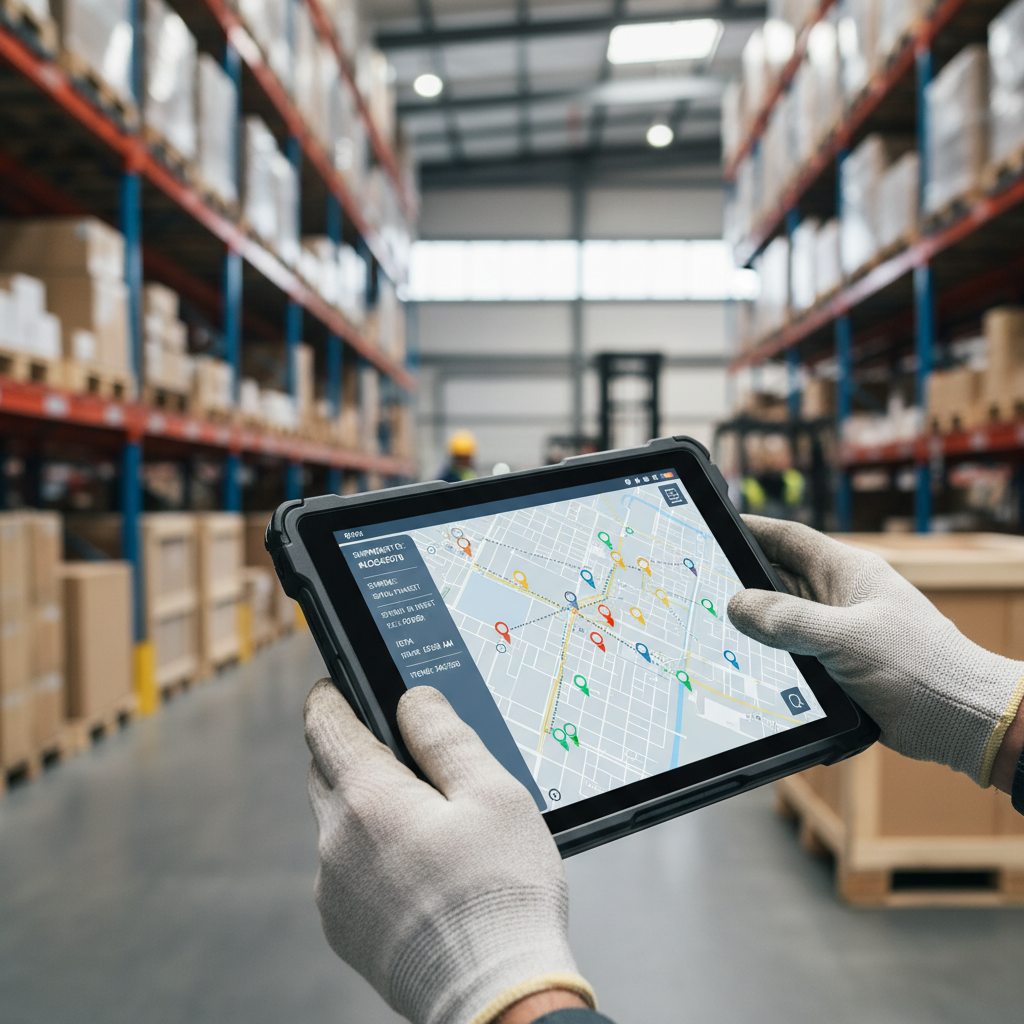
Let me ground this in dollars. FourKites publishes aggregated customer data showing $300K to $500K per month in fines and penalties avoided through real-time visibility, with total detention fee reduction reaching roughly $10 million per year across their customer base. Schreiber Foods alone cut unsubstantiated detention requests by 15% after deployment.
Those numbers come from a single cost category: detention and demurrage. They don’t include:
- Customer churn from late deliveries you couldn’t warn about in advance
- Expedited shipping premiums when you discover a delay too late to reroute
- Line-stop penalties in JIT manufacturing (tens of thousands per hour in automotive)
- Spoilage in cold chain when a temperature excursion goes undetected until arrival
- Labor waste from warehouse crews staffed against appointment slots that don’t reflect reality
TotalEnergies deployed real-time visibility across their oil and gas deliveries and saw inbound support calls drop by roughly 50% within three months. That’s half the customer-service burden eliminated. Not through better scripts or more headcount, but through proactive SMS alerts triggered automatically by transport events. 75,000 alerts in 90 days, replacing phone calls that cost labor on both ends.
The arithmetic is straightforward. If you move more than a few hundred shipments per month and you’re operating without continuous visibility, you’re paying an invisibility tax. You just can’t see it on one line item because it’s distributed across detention invoices, customer credits, expedite charges, and wasted labor.
Why 62% of Companies Still Operate Partially Blind
Over 62% of organizations have limited supply chain visibility, and only 6% have achieved full end-to-end coverage—a blind spot that also undermines inventory visibility solutions. With all the investment and all the platforms available, why?
Three reasons.
Carrier connectivity is the actual bottleneck. project44 estimates that most enterprises operate at only 40-70% network visibility because their platform hasn’t been connected to the full carrier base. You might have visibility on your top 10 carriers who handle 60% of volume. But the other 40%? Regional truckers, asset-based carriers, overseas partners who don’t expose APIs? Blind spots. And exceptions don’t politely limit themselves to your well-connected lanes.
Hardware gaps on the asset itself. Software platforms aggregate data. But the data has to originate somewhere. If there’s no GPS device on the trailer, no IoT sensor in the container, no telematics feed from the carrier’s fleet, the platform has nothing to aggregate. This is the layer most visibility articles skip because the platform vendors don’t sell hardware. They assume the data exists. Often it doesn’t.
Organizational inertia. Visibility exposes problems. It shows that carrier X is consistently 6 hours late. It shows that your warehouse in Dallas has a 3-hour average dwell time that nobody was measuring. Some organizations aren’t ready to act on what visibility reveals. The data is politically inconvenient before it becomes operationally useful.
The Technology Stack: From Sensor to Decision
Real-time shipment visibility runs on four layers. Understanding them helps you diagnose where your own gaps sit.
Layer 1: Data capture (hardware). GPS trackers on containers, trailers, and pallets. IoT sensors measuring temperature, humidity, shock, light (door-open detection). Electronic Logging Devices in trucks. AIS transponders on vessels. RFID at handling checkpoints. This is where location and condition data originates. No hardware, no data. No data, no visibility.
Layer 2: Data transport (connectivity). Cellular networks (LTE-M, NB-IoT) for land-based tracking. Satellite for ocean and remote areas. Wi-Fi and BLE for yard and warehouse proximity. The choice of connectivity determines update frequency, power consumption, and cost per device. A cellular tracker on a reusable container might report every 15 minutes. A satellite-connected ocean device might report every few hours.
Layer 3: Data aggregation (platform). This is where the RTTVPs live: project44, FourKites, Shippeo, and the broader ecosystem. They normalize data from thousands of carriers, merge it with weather, traffic, port congestion feeds, and compute ETAs. Machine learning predicts arrival times with 82-91% accuracy on well-instrumented lanes. Anomaly detection flags exceptions before they escalate.
Layer 4: Decision and action (orchestration). The newest layer. project44 acquired LunaPath.ai in April 2026 to add autonomous AI agents that handle carrier check calls, appointment confirmations, and claims initiation without human intervention. Shippeo acquired Logward the following month to convert transport events into automated workflow actions. This layer turns “I can see the problem” into “the problem is being handled.”
Most companies invest in Layer 3 (the platform) and assume Layers 1 and 2 will sort themselves out. They won’t. If your carriers don’t share telematics, you need devices on the assets themselves. That’s where the hardware conversation becomes essential.
Shipment Tracking vs. Asset Tracking: The Gap Nobody Talks About
Here’s the distinction that matters most to my work and probably to yours if you manage reusable assets, containers, ULDs, ground support equipment, or any pooled fleet.
Shipment tracking ends at delivery. The platform tells you your cargo arrived at the destination. Job done. The tracking relationship terminates.
Asset tracking follows the container, the pallet, the ULD through its entire life cycle. Delivery, dwell at customer site, return trip, maintenance, redeployment. The asset doesn’t stop existing when the shipment is delivered. But most visibility platforms stop watching it.
For anyone operating a reusable container pool, this creates a massive blind spot. You know where the cargo went. You don’t know where your container is sitting empty. You don’t know its cycle time. You don’t know if it’s been sitting at a customer site for 47 days when your agreement says 14.
Real-time shipment visibility solves the in-transit problem. Asset tracking solves the lifecycle problem. The best operations combine both: visibility during transit (via the RTTVP layer) plus continuous hardware-based tracking on the asset itself (via IoT devices that report regardless of whether a shipment is active).
If your container pool feels invisible after delivery, that’s the gap asset tracking closes.
What the Regulatory Landscape Is Forcing
Visibility is no longer optional in two verticals.
The Drug Supply Chain Security Act (DSCSA), updated October 2025, mandates interoperable, electronic, package-level traceability for prescription drugs distributed in the U.S. The FSMA Final Rule on Additional Traceability Records requires food companies to maintain records that can be produced within 24 hours of an FDA request. In both cases, “we didn’t know” is no longer a defense.
For pharmaceutical and food shippers, the compliance question has flipped. It’s not “should we invest in visibility?” It’s “can we prove chain of custody, temperature integrity, and location history for every regulated shipment, in real time, on demand?” If the answer is no, you’re exposed.
In aviation, DO-160 environmental testing standards govern what hardware can fly on aircraft. This limits sensor options significantly. You can’t slap any GPS tracker onto an air cargo ULD and call it compliant. The device needs to be tested and approved for the airfreight environment: vibration, altitude, temperature extremes, electromagnetic interference. Specialized airfreight visibility tools address these compliance requirements while delivering real-time tracking data.
These regulatory pressures are converting visibility from a competitive advantage into table stakes. The companies that move now build the data history and process muscle before compliance deadlines become enforcement actions.
Implementation Reality: What Actually Works
I’ve seen enough deployments succeed and fail to know the pattern. Here’s what separates the two.
Start with the lane that hurts most. Don’t try to instrument everything at once. Pick the route with the highest detention cost, the coldest cold-chain risk, or the most customer complaints. Prove ROI there. Then expand.
Hardware selection matters more than platform selection. A sophisticated platform with bad data is worse than a simple dashboard with reliable data. Choose devices rated for your environment (DO-160 for airfreight, IP67 for ocean, long-battery-life cellular for reusable containers on multi-month cycles). The device determines data quality. The platform just displays it.
Carrier onboarding is your longest lead time. If you’re relying on carrier-provided telematics, budget 3 to 6 months for integration, testing, and coverage validation. If you’re deploying your own devices on assets, you skip the carrier dependency entirely, but you take on hardware management.
Define your exception rules before go-live. Visibility without action rules is just a more expensive way to watch problems happen. Before deployment, define: what triggers an alert? Who receives it? What’s the escalation path? What’s the automated response? The technology is the easy part. The operational process around it is where implementations stall.
Where the Market Is Heading in 2026 and 2027
The RTTVP market is projected to grow at 17.8% CAGR through 2034, reaching $12.8 billion. But the interesting shift isn’t size. It’s architecture.
Visibility platforms are absorbing execution. project44 calls their vision an “agentic iTMS” where AI agents, not humans, are the unit of execution. Shippeo’s Logward acquisition adds automated workflow triggers. FourKites has a recommendation engine that suggests reroutes proactively. The category is moving from “see the problem” to “solve the problem without a phone call.”
Cloud dominates deployment at 73.4% versus on-premises. This reflects the multi-party nature of the data: you can’t run real-time visibility on a server in your closet when the data comes from 200 carriers across 40 countries.
The carrier connectivity race will drive the next wave of M&A. The platform with the broadest carrier network wins, because analytics accuracy on any given lane is bounded by data coverage on that lane. Expect acquisitions of regional carrier networks, ELD aggregators, and maritime data providers through 2027.
And for anyone managing physical assets (not just shipments), the convergence of RTTVP software with IoT hardware is where the real operational value compounds. A platform tells you where things are during transit. A device on the asset tells you where things are, always.
Perguntas frequentes
What is real-time shipment visibility?
Real-time shipment visibility is the continuous, automated ability to know where a shipment is, what condition it’s in, and when it will arrive, without manual inquiries. It replaces periodic milestone updates with live data streams from GPS, IoT sensors, and carrier telematics, enabling proactive exception management instead of reactive firefighting.
How is real-time visibility different from a TMS?
A Transportation Management System plans and executes shipping decisions (routing, carrier selection, tendering). A real-time visibility platform monitors what happens after the planning decision. They integrate but solve different problems. Visibility feeds exception data back into the TMS; it doesn’t replace it.
What ROI can I expect from real-time shipment visibility?
Published customer outcomes include $300K-$500K per month in avoided fines and penalties, $10 million per year in reduced detention fees, 15% fewer unsubstantiated detention claims, and 50% reduction in inbound support calls. ROI varies by volume, mode mix, and how effectively you act on exceptions.
Why do most companies still lack full visibility?
Three reasons: carrier connectivity gaps (most enterprises cover only 40-70% of their carrier network), missing hardware on assets that don’t report telematics natively, and organizational resistance to acting on what visibility reveals. The bottleneck is data origination, not software availability.
What’s the difference between shipment tracking and asset tracking?
Shipment tracking monitors cargo from origin to delivery and ends there. Asset tracking follows the physical container, pallet, or equipment through its full lifecycle: delivery, dwell, return, maintenance, redeployment. Companies with reusable asset pools need both to eliminate blind spots after delivery.
Which industries are adopting real-time visibility fastest?
Retail and e-commerce lead at 28.4% of deployments, followed by manufacturing (21.7%), logistics service providers (19.3%), and healthcare (12.8%). Healthcare adoption is accelerating due to DSCSA and FSMA regulatory mandates requiring documented chain-of-custody and temperature integrity.
If your operation burns hours chasing carrier updates, eats detention fees you can’t substantiate, or loses track of reusable assets after delivery, the gap is measurable. We build tracking solutions that cover the full asset lifecycle, from in-transit visibility through return and redeployment. Talk to our team or explore our asset tracking hardware to see what fits your operation.





 +1 508 292 2210

2 Responses