

Every international departure sets off a chain of 5 to 15 specialized ground support equipment units: pushback tractors, belt loaders, GPUs, air start units, de-icers, catering trucks, lavatory vehicles. That part is well understood. What most airport operators and airline ground teams underestimate is what happens when they lose track of those assets across the apron, across shifts, across seasons.
Ramp accidents cost the airline industry at least $10 billion every year, with roughly 27,000 ground incidents and 243,000 worker injuries globally. The root cause isn’t mysterious. It’s a visibility gap. Equipment isn’t where it should be, isn’t maintained when it should be, isn’t charged or fueled when the next flight needs it. Airport ground handling equipment management is the discipline that closes that gap. And in 2026, the cost of getting it wrong is compounding faster than most operators realize.
What Ground Handling Equipment Management Actually Covers
Most definitions stop at “maintenance and procurement.” That’s like calling fleet management “oil changes and buying trucks.”
The real scope covers the full lifecycle of every asset on the ramp: acquisition planning, deployment and scheduling, real-time location tracking, utilization monitoring, preventive and predictive maintenance, regulatory compliance, operator training, and end-of-life disposal or resale. This is comprehensive airport asset management in practice. At each stage, it asks a blunt question: do we know where this asset is, what condition it’s in, and whether it’s earning its keep?
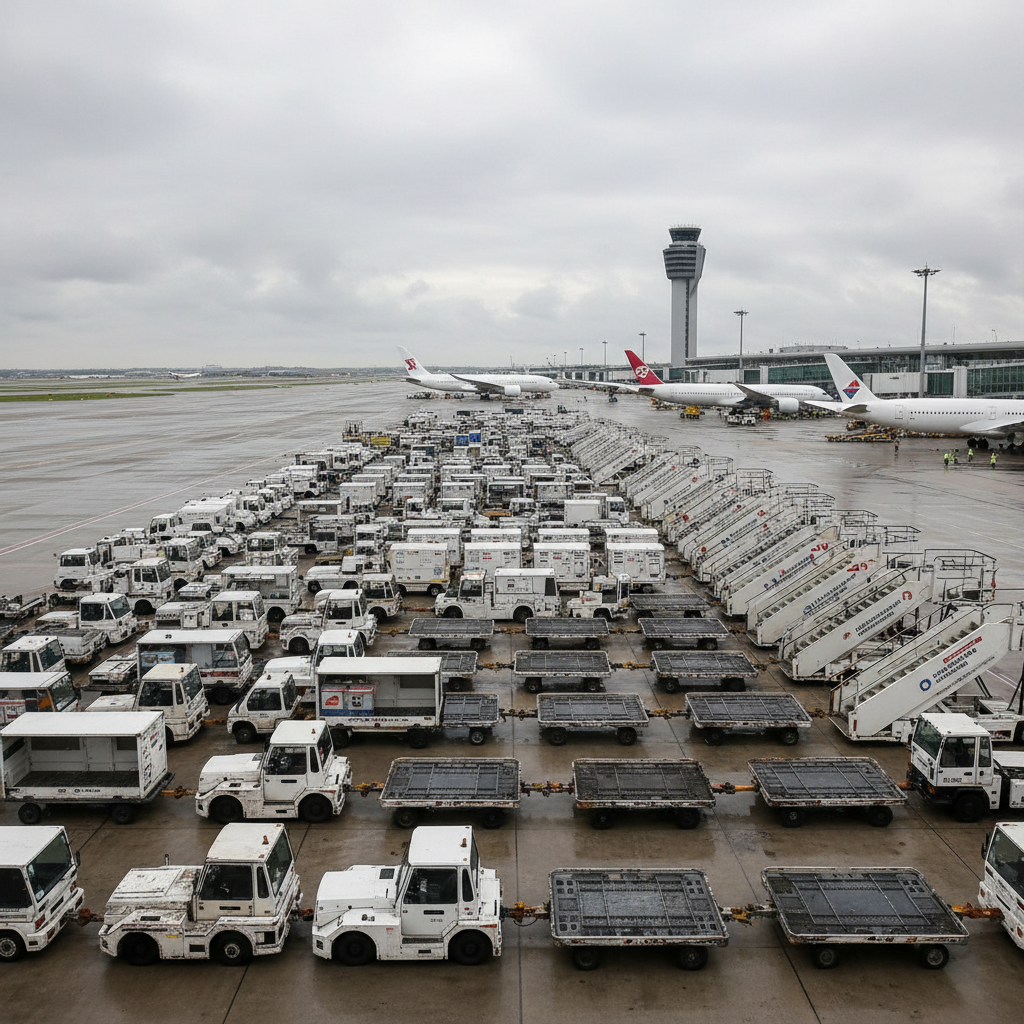
A single hub airport can operate 500+ pieces of GSE. Managing that fleet by radio calls and spreadsheets is exactly what produces the $10 billion accident baseline the industry has normalized. The gap isn’t in hardware. It’s in the management layer sitting on top of it.
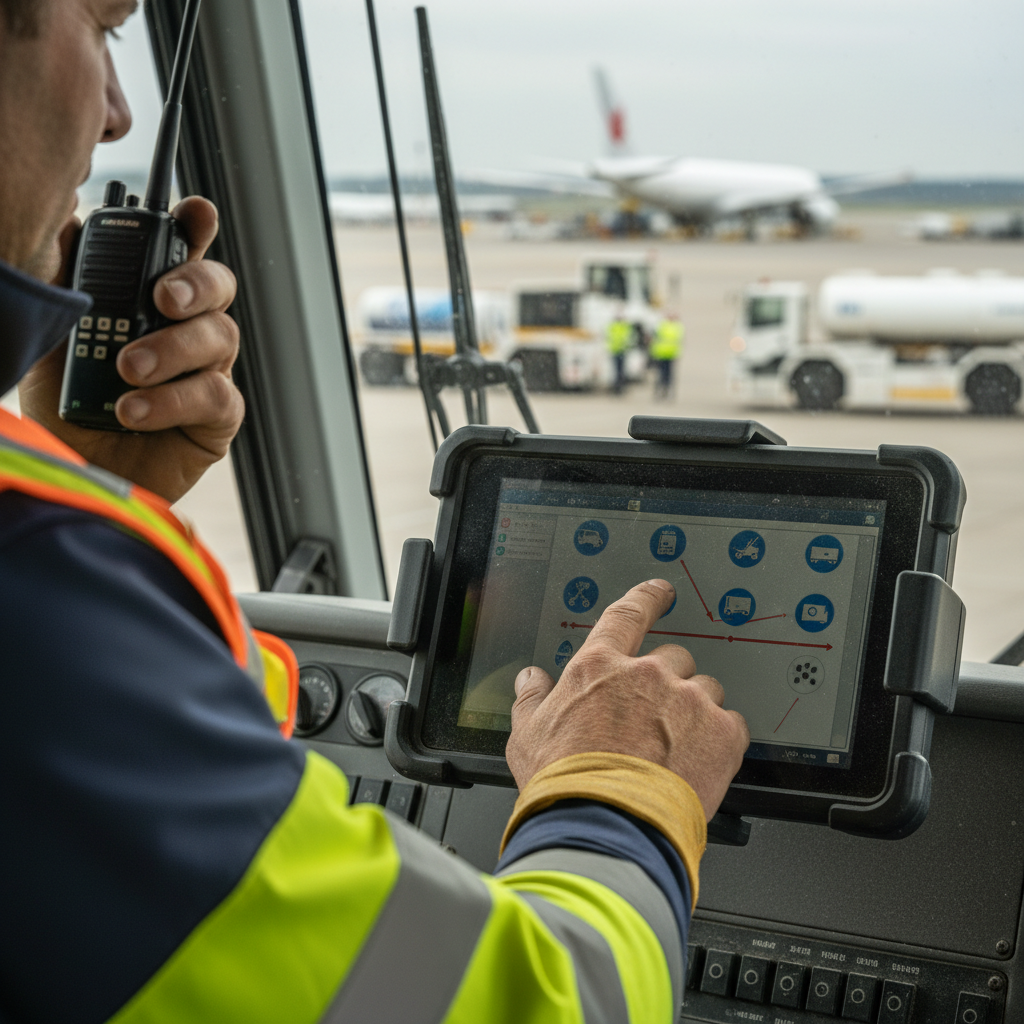
The Equipment You’re Managing
Before discussing how to manage GSE, it helps to map what’s actually on the ramp.
| Function | Equipment | Powered? |
|---|---|---|
| Aircraft movement | Pushback tractors, towbar-less tugs, tow bars | Yes (tow bars: No) |
| Cargo and baggage | Belt loaders, container/K-loaders, hi-lift loaders, baggage tractors, ULD dollies | Mix |
| Ground power and air | GPUs (mobile and fixed), air start units, preconditioned air units | Yes |
| Passenger movement | Boarding stairs, ambulifts, apron buses | Yes |
| Aircraft servicing | Catering trucks, lavatory vehicles, potable water trucks, cabin cleaning vehicles | Yes |
| Turnaround support | De-icers/anti-icers, fuel bowsers | Yes |
| Non-powered support | Baggage dollies, wheel chocks, cones, tow bars, ULD carts | No |
The management challenge scales with the mix. Non-powered assets are low-cost, high-volume, and easy to lose. You buy 200 baggage dollies; six months later, 40 are unaccounted for. Powered assets are high-cost, lower-volume, and easy to neglect until peak operations expose the gaps. A ground handler at a mid-size international airport might run 50 powered units and 300 non-powered units simultaneously. The only way to manage that spread is systematic visibility across the entire fleet.
The Real Cost of Getting GSE Management Wrong
The Flight Safety Foundation puts the injury rate at 9 per 1,000 departures. At a hub handling 300,000 departures per year, that translates to 2,700 injuries annually at one airport. Loss-adjusting data from McLarens showed that 64% of all worldwide aviation incidents (excluding light aircraft) occurred on the ground or during ramp operations.
Safety numbers get attention. But the operational cost of mismanaged GSE is often larger and harder to see. A failed pushback tractor during peak operations can cascade into a 45-minute flight delay. At a major hub, that delay ripples through the afternoon wave, affecting connecting passengers, gate allocation, and crew legality. Multiply that by the frequency per month and you understand why IATA’s 2026 Annual Review flagged $11.3 billion in added costs from leasing inefficiencies, missed fuel-efficiency gains, inventory holding, and maintenance.
Then there’s the compliance layer. The IGOM 2026 edition introduced nearly 100 changes to standard ground operations, effective January 1. Airlines and handlers that can’t demonstrate current procedures, equipment inspections, and operator qualifications face audit penalties, contract renegotiations, and potential loss of handling licenses. If your GSE management still runs on paper logs, compliance isn’t a future risk. It’s a present one.
Electrification Is Rewriting the Fleet Management Playbook
If you’re planning GSE procurement or fleet renewal right now, the electrification question isn’t “if” but “how fast.” The management implications go far beyond swapping diesel for batteries.
Hawaiian Airlines reached 68% electric on its Honolulu ramp fleet by May 2026, backed by 30 charging stations with four more coming by year-end. That’s the most aggressive airline-led conversion publicly documented. On the handler side, Swissport raised its electric GSE share from 20.8% to 24.2% in a single year, a 16% year-over-year expansion across 279 airports and EUR 3.7 billion in revenue.
What neither headline captures is the management complexity behind these numbers. Electric GSE requires:
- Charging infrastructure planning: not just stations, but grid capacity, substation reinforcements at continental hubs, and charge scheduling to avoid peak-demand surcharges
- State-of-charge monitoring per vehicle, per shift, per gate assignment
- Different maintenance profiles: battery management systems, thermal monitoring, and cell degradation tracking replace traditional engine and hydraulic service cycles
- Mixed-fleet coordination during the transition period, when diesel and electric units coexist with different operational constraints
- Emissions accounting: IATA reports electric GSE produces 35 to 52% fewer CO2 emissions and runs 5.5 to 8.3 dB(A) quieter per turnaround, but you need per-unit data to prove it in Carbon Accreditation audits
And then there’s hydrogen. In September 2025, Amsterdam Schiphol launched the first hydrogen-fuel-cell tow tractor in routine daily service, moving KLM 737s between gates and hangars. Hydrogen targets the heaviest duty cycles (high-utilization pushbacks, de-icers, snowplows) where battery weight is still a constraint. It doesn’t replace electric GSE. It fills the gap electric can’t reach yet. The practical implication for fleet managers: you’re now coordinating diesel, battery-electric, and hydrogen units with three different infrastructure requirements, three different maintenance profiles, and three different data stacks.
Why Tracking Is the Foundation, Not an Add-On
I’ve spent over 15 years working in IoT-based asset tracking, and the pattern repeats across industries. Organizations try to optimize assets they can’t locate. They schedule maintenance on equipment they can’t find. They buy replacements because the existing units are “somewhere on site.”
Airport ramps amplify this problem. GSE moves constantly across large, open areas. Shifts change. Handlers rotate between airlines. Non-powered dollies migrate from one terminal to another and never come back. Powered units idle in corners while dispatchers radio frantically for an available belt loader at Gate 14.
Effective GSE management requires a tracking layer that answers four questions in real time:
- Where is this asset right now?
- What’s its operational status (available, in use, maintenance-due, charging)?
- How much has it been utilized this shift, this week, this quarter?
- When was its last inspection, and when is the next one due?
Without that baseline, every other management initiative (electrification planning, maintenance optimization, fleet right-sizing, compliance reporting) is built on guesswork. With it, you can make real decisions: which units are underutilized and can be redeployed, which are overworked and approaching failure, which gates are chronically under-equipped, and where bottlenecks form during peak hours.
The technology exists. Cellular and GNSS-based industrial asset trackers handle the outdoor, high-vibration, temperature-variable conditions on an airport ramp. Battery life on modern devices runs months to years depending on reporting frequency. The question isn’t technical feasibility. It’s whether your organization treats tracking as a cost line or as the infrastructure that makes every other efficiency investment measurable.
Here’s the distinction that matters: shipment tracking ends when the asset arrives. Asset tracking follows the equipment through its entire operational cycle, including dwell time, redeployment, maintenance downtime, and utilization patterns. For GSE, which never “arrives” anywhere but constantly circulates, asset-level visibility is the only kind that matters.
The Regulatory Pressure Stacking Up in 2026
Three regulatory shifts are compressing timelines for GSE management upgrades, and they’re happening simultaneously.
The IGOM 2026 edition (effective January 1, 2026) revised turnaround actions, standardized chocking procedures, updated special cargo guidance, and clarified safety briefing requirements. Nearly 100 changes in a single edition. If your SOPs still reference the previous IGOM version, you’re operationally non-compliant today.
FAA Advisory Circular 00-34B (issued July 2024) consolidated guidance on aircraft ground handling, servicing, and marshalling for US-based operators: fueling additives, oxygen-servicing hygiene, chocking requirements, marshalling vest specs, and prohibitions during fueling operations. Combined with 14 CFR Part 43 (maintenance) and Part 139 (airport certification), this forms the baseline compliance layer for every GSE interaction with an aircraft.
The biggest fleet-planning impact comes from Airport Carbon Accreditation Level 5 (released February 2026), which commits participating airports to net zero for Scope 1 emissions. That explicitly includes GSE: tugs, baggage tractors, all diesel-powered ramp equipment. Any airport pursuing Level 5 certification now has a documented obligation to transition its GSE fleet away from fossil fuels, tied to accreditation cycles that affect funding eligibility, tenant negotiations, and public positioning.
The combined effect: you need auditable, digital records of GSE maintenance, operator certification, utilization, and emissions per unit. Paper logs don’t survive an IGOM audit. Spreadsheets don’t satisfy Carbon Accreditation Level 5 reporting requirements.
Autonomous GSE: From Pilots to Planning Horizon
In January 2024, Aurrigo and International Airlines Group launched an autonomous baggage-handling program at Cincinnati/Northern Kentucky International Airport. Two months later, Fraport completed autonomous baggage and cargo tractor trials at Frankfurt. Changi Airport Group ran parallel trials of Aurrigo’s Auto-DollyTug on a similar timeline.
These aren’t concept videos. They’re commercial pilots with real baggage on real aprons. The Auto-DollyTug operates in rain up to 50 mm/hr, uses 3D digital twins for simulation, and runs on a fleet management platform that dispatches vehicles without human intervention.
The driver mirrors the electrification story: labor economics and safety. When the industry baseline is 27,000 ramp incidents per year and hiring qualified ramp agents gets harder every season (Menzies ground handlers walked out in the UK in September 2025; Lufthansa prepared a two-day ground-staff strike in 2024), a vehicle that doesn’t fatigue, doesn’t cut corners, and logs every movement by default starts looking less futuristic and more like the next logical step.
For fleet managers, autonomous vehicles add another category to monitor, dispatch, and maintain. But they also generate vastly more data per unit than human-operated equipment, making the tracking and analytics infrastructure underneath them even more consequential.
The Vendor Landscape Is Consolidating Fast
Anyone managing GSE procurement should understand the structural changes happening on the supply side.
Oshkosh Corporation acquired JBT AeroTech for $800 million in 2023, absorbing products that load roughly 70% of overnight express packages globally and serve approximately 75% of US airport travelers. That single deal reshaped the manufacturer map. Oshkosh now competes head-to-head with TLD, Textron GSE/Charlatte, Mallaghan, Tronair, and Goldhofer, while Chinese manufacturers like CIMC and Weihai Guangtai push from the volume end.
On the leasing side, TCR Group (Belgium) operates as the dominant global GSE rental and full-service fleet-management specialist, particularly across Europe. For airports and handlers that don’t want to own their fleets outright, the lease-vs-buy decision is becoming more complex as electric GSE changes residual values and maintenance profiles.
The practical implication: electric GSE demands battery integration, BMS software, AC/DC charging support, and ISO 9001-grade validation that mid-tier vendors struggle to fund independently. Expect further consolidation through 2028. If you’re running a multi-vendor fleet, plan for aftermarket-service continuity risks now, not after your supplier gets acquired.
Five Principles for GSE Management That Actually Works
After working with aviation and logistics operators for over a decade, I’d distill effective GSE management into five principles. None are revolutionary. All are under-implemented.
1. Track before you optimize. You cannot improve what you cannot see. Before investing in fleet planning software, charging infrastructure, or predictive maintenance platforms, get a real-time picture of where every asset is and how it’s being used. This single step eliminates the most common GSE management failures: lost non-powered assets, underutilized powered units, and maintenance scheduled by calendar instead of actual usage.
2. Plan electrification as infrastructure, not procurement. Buying electric GSE without planning charging logistics, grid capacity, and mixed-fleet scheduling creates a different set of problems, not fewer. Hawaiian Airlines’ Honolulu success works because they built 30 charging stations first. The equipment purchase followed the infrastructure commitment.
3. Shift maintenance from reactive to condition-based. Calendar-based preventive maintenance is better than reactive. Condition-based maintenance using real telemetry (operating hours, fault codes, vibration, state-of-charge history) is better than both. The GSE that fails during peak operations is rarely the one being properly monitored.
4. Treat compliance as operational discipline. IGOM 2026, FAA AC 00-34B, Carbon Accreditation Level 5: these aren’t administrative burdens. They’re codified best practices. When your GSE management system produces audit-ready reports as a byproduct of normal operations, compliance stops being a quarterly scramble and becomes a competitive advantage.
5. Right-size through data, not instinct. Most airports own more GSE than they need because they compensate for poor utilization visibility with excess inventory. Tracking data typically reveals that 15 to 25% of a fleet is redundant: sitting idle for extended periods or duplicating coverage that better scheduling would eliminate. That’s capital you can redeploy or retire.
If your ramp fleet feels invisible once it leaves the maintenance bay, that’s exactly the gap asset tracking closes. It’s what we build solutions around at Datanet, and it’s the foundation every other GSE management improvement depends on. If any of this resonates with where your operation stands today, reach out to our team or drop a line at info@datanetiot.com.
Frequently Asked Questions
What is airport ground handling equipment management?
It covers the full lifecycle of all ground support equipment on the airport ramp: procurement, deployment, real-time tracking, utilization monitoring, preventive and predictive maintenance, regulatory compliance, and end-of-life disposal. The goal is ensuring the right equipment is available, operational, and safe for every aircraft turnaround.
How much do ramp accidents cost the airline industry?
The Flight Safety Foundation estimates at least $10 billion per year, with approximately 27,000 ground incidents and 243,000 worker injuries globally. The injury rate is about 9 per 1,000 departures. In recent data, 64% of all worldwide aviation incidents occurred on the ground.
What types of ground support equipment need tracking?
Both non-powered assets (baggage dollies, tow bars, chocks, cones) and powered equipment (pushback tractors, belt loaders, GPUs, air start units, catering trucks, de-icers, fuel bowsers, passenger stairs, ambulifts, apron buses). Non-powered assets are the most commonly lost; powered assets carry the highest per-unit cost when mismanaged.
How does electrification change GSE fleet management?
Electric GSE requires charging infrastructure planning, state-of-charge monitoring per vehicle, different maintenance profiles (battery management replaces engine servicing), and mixed-fleet coordination during the transition. IATA data shows electric GSE produces 35 to 52% fewer CO2 emissions per turnaround, but proving those savings requires per-unit tracking and reporting.
What regulations govern GSE operations in 2026?
Key frameworks include the IATA Ground Operations Manual (IGOM 2026 edition, effective January 1, 2026, with nearly 100 changes), FAA Advisory Circular 00-34B (July 2024), IATA Airport Handling Manual Chapter 9, ISO 6858 for GPU connectors, 14 CFR Parts 43 and 139, and Airport Carbon Accreditation Level 5 (February 2026) requiring net-zero Scope 1 emissions from GSE.
Are there autonomous GSE vehicles operating at airports today?
Yes. Aurrigo and IAG launched autonomous baggage handling at Cincinnati in January 2024. Fraport completed autonomous tractor trials at Frankfurt two months later. Changi ran parallel pilots. These are fully electric vehicles with rain-sensing, 3D digital twins, and autonomous dispatch. Commercial fleet-scale deployment is expected at 30+ airports by 2030.





 +1 508 292 2210

4 Responses