

Search “aircraft towbar tracking” and you get catalogs. Towbar models for every airframe from a Cessna 172 to an A380. Shear pins, adapter heads, aluminum vs. steel, universal vs. aircraft-specific.
But you probably already own the towbars. The reason you searched for tracking is different: you need to know where those towbars are right now, which ones are fit for service, and why two went missing last month.
In 1999, an NTSB investigation at LaGuardia found that 228 of 361 towbars (63%) in one airline’s fleet had maintenance discrepancies. The root cause was not defective hardware. It was the absence of a preventative maintenance tracking system. Twenty-six years later, most airports still manage towbars with spreadsheets, radio calls, and a walk around the ramp.
This piece covers what aircraft towbar tracking actually involves in 2026, why the gap between owning equipment and knowing its status costs real operational dollars, and what closing that gap looks like in practice.
What Aircraft Towbar Tracking Really Means
Two distinct problems hide inside the phrase “aircraft towbar tracking,” and lumping them together causes bad decisions.
The first is asset location. Where is towbar serial 4471 right now? Gate B14? Maintenance bay 3? Somewhere on the south ramp? On a busy airfield covering thousands of acres, a single towbar can sit idle for days in a spot nobody checks. Multiply that by 80 towbars of 12 different types and the search problem becomes a daily time sink.
The second is lifecycle management. When was towbar 4471 last inspected? Has the shear pin been replaced on schedule? Is it certified for the 737 MAX pushing back at Gate 22 in 40 minutes? This is the compliance layer, and it turns a steel beam into an auditable, traceable asset.
Most ground operations have a partial version of the second (paper logs, maybe a CMMS entry), often bolted onto a broader airport inventory management system or dedicated airline asset management software. Almost none have the first.
A quick primer for context. An aircraft towbar is an articulated beam, steel or aluminum, that connects a pushback tractor to the aircraft’s nose landing gear. The safety-critical component is the shear pin: a calibrated bolt engineered to snap before the nose gear takes damage if towing loads exceed safe thresholds. A conventional towbar costs around EUR 6,000 (roughly USD 6,500). Major hubs stock dozens of types, each matched to specific aircraft families. That’s a pool worth hundreds of thousands of dollars, often managed with a whiteboard and good intentions.
The distinction that matters here is one I come back to constantly in asset tracking: shipment tracking ends when the towbar arrives at your facility. Asset tracking follows it through every pushback, every inspection, every idle period, every reassignment, for its entire operational life. That second model is what turns equipment from an invisible cost center into a managed fleet.
The Finding That Made Towbar Tracking a Safety Issue
On November 27, 1999, a Boeing 727-232 (N521DA) at LaGuardia Airport rolled forward into its tug during pushback. The cause: a defective towbar with shear pins softer than specification and pin holes elongated approximately 0.030 inches beyond tolerance.
That incident triggered a fleet-wide examination. The results were stark. Out of 361 towbars inspected, 228 showed discrepancies. Sixty-three percent of the fleet. The NTSB’s causal finding was not that towbars are inherently unreliable. It was that the airline lacked an adequate preventative maintenance program for its tow bars, combined with shear pins that did not meet specification.
That finding is 26 years old. The question worth asking in 2026: has your operation actually closed that gap, or just papered over it?
Recent evidence suggests many haven’t. In April 2024, a pushback tug collided with an American Airlines A321 at Charlotte, causing considerable damage to the nose gear and fuselage. In July 2025, the ATSB opened an investigation into a ground handling incident involving an A380 at Sydney. A 2010 ATSB study found that 28% of ground operations occurrences happen while aircraft are parked at the gate.
Not all of these are towbar-specific failures. But they share a common thread: insufficient real-time visibility into equipment condition and position during ground operations. Paper logs cannot keep pace when you run hundreds of pushbacks a day. A towbar that failed inspection last Tuesday looks exactly like one that passed. Without a digital identity tied to each asset, the ramp defaults to “grab the nearest bar and hope it’s cleared.”
How Tracking Technology Works on the Ramp
No single technology covers every scenario on an active airfield. Aircraft towbar tracking in 2026 runs on a layered architecture where different technologies handle different zones.
GPS handles outdoor positioning on the open ramp. Accuracy to a few meters is enough to determine which stand area a towbar sits at, or confirm it’s moving toward Gate 14 for a scheduled pushback.
Under hangars, inside maintenance bays, and near covered gate areas, GPS drops out. BLE (Bluetooth Low Energy) beacons and active RFID tags fill those gaps with proximity-based location. BLE sensors are engineered for ultra-low power consumption, supporting multi-year battery life on small cells, which is exactly the profile you need for equipment that nobody is going to recharge weekly.
Cellular backhaul (LTE-M or NB-IoT) carries data from each tracker to the cloud. A towbar tracker does not stream video. It sends a position ping every few minutes, a motion event when the bar moves, and a heartbeat to confirm it’s active. Low-power wide-area protocols handle this at minimal power draw.
Edge motion sensors are what make the data actionable. A position fix tells you location. A motion sensor tells you context: this towbar just started moving (deploy alert), or this towbar has been stationary for 72 hours in an unusual zone (possible misplacement).
The cloud platform normalizes all of it into a single dashboard. Geofences define zones (ramp, hangar, maintenance bay, off-airport). Alerts trigger on unauthorized movement, extended dwell time, or entry into restricted areas. Maintenance schedules tie to the asset record so inspection flags propagate automatically.
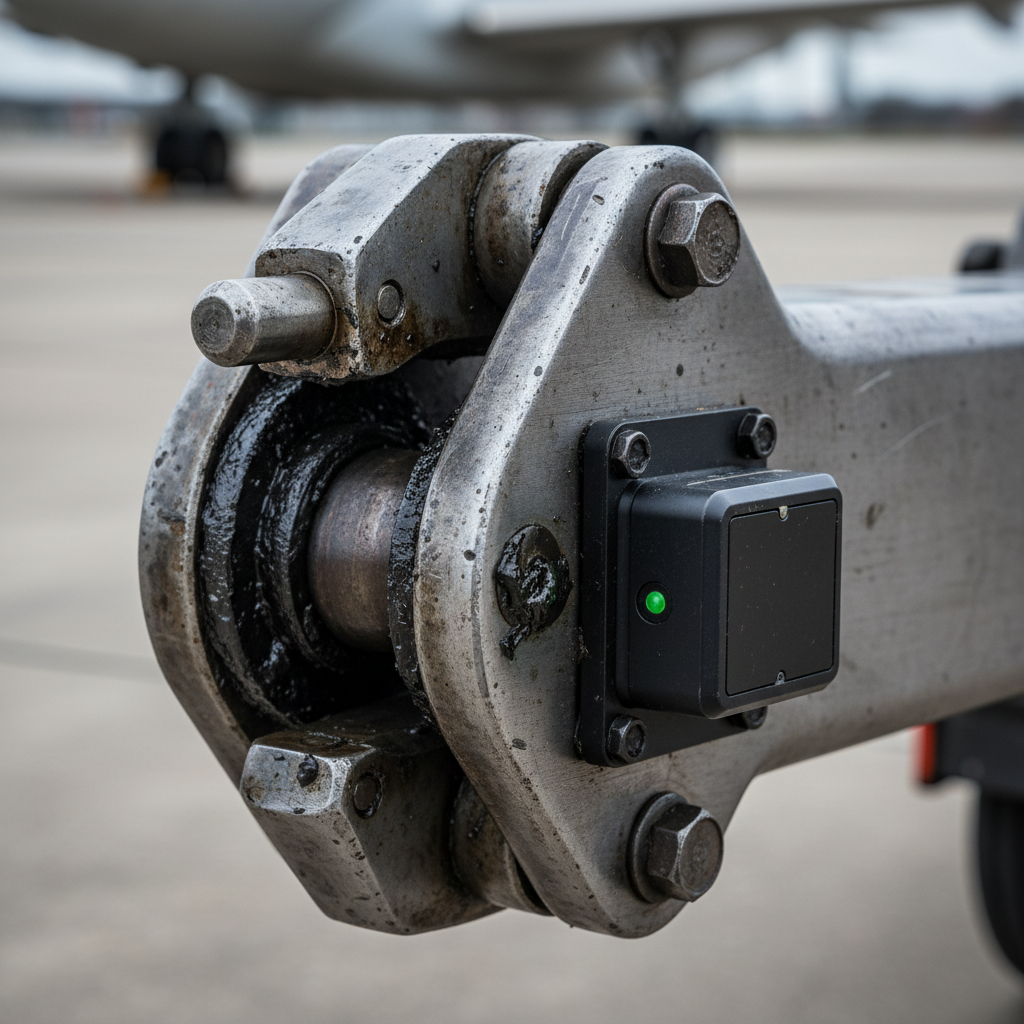
The hardware requirements are tighter than in most industrial asset tracking. Ramp equipment gets pressure-washed. It sits in rain, snow, jet blast, de-icing fluid, and summer tarmac heat. Anything bolted to a towbar needs IP67 or IP69K rating (dust-tight, high-pressure-washdown tolerant), multi-year battery life, and a form factor tough enough to survive being dragged across concrete.
Devices like the Oyster3 and Oyster Edge fit this profile: IP67-rated, years of battery on cellular, configurable GPS and motion sensing. For operations handling airfreight-adjacent equipment with DO-160 compliance needs, the Thingfox T2 adds aviation-grade certification, which is also why the same tracking discipline carries over into aircraft spare parts logistics. The point is not the specific device. It’s that the hardware is field-proven and not the bottleneck. Deployment strategy and integration with your existing ground ops workflow are where the real work happens.
Towbarless Operations Still Need Tracking
A common assumption: “We’re migrating to towbarless tractors, so towbar tracking is a sunset investment.” This misreads the situation in two ways.
First, most ramps run mixed fleets for years during any transition. Towbarless tractors handle widebody pushbacks at major hubs, but conventional towbars still serve narrow-bodies, regional jets, business aviation, and aircraft types without towbarless certification. You don’t eliminate the towbar pool overnight. You shrink it gradually, and the remaining pool still needs visibility.
Second, towbarless tractors need tracking more, not less. An electric TBLT valued at EUR 150,000 to 400,000 is a far more expensive asset than a EUR 6,000 towbar. Knowing its location, charge state, next maintenance window, and operator assignment matters at a different financial scale.
| Factor | Conventional Towbar + Tracker | Towbarless Tractor + Tracker |
|---|---|---|
| Unit cost | ~USD 6,500 per towbar | USD 150,000 to 400,000+ per tractor |
| Inventory complexity | Multiple towbar types per aircraft family | One tractor handles multiple aircraft types |
| Shear pin management | Recurring replacement SKU, inspection-critical | Eliminated (cradle system, no pin) |
| Tracking ROI driver | Locating the right type fast, maintenance compliance | Charge optimization, utilization rate, cost-per-move |
| Data density per asset | Position + motion + inspection schedule | Position + motion + battery SOC + CAN bus diagnostics |
Mototok’s Spacer 8600 at Heathrow Terminal 5 completed 350,000 pushbacks in two years with a 54% reduction in pushback-related delays. That performance depends on real-time fleet visibility and strong aviation asset utilization: knowing which tug is available, charged, and closest to the gate that needs service.
Swissport committed in July 2025 to invest roughly USD 1.5 billion over five years in fleet electrification. Their global electric GSE share hit 25%, with Zurich Airport at 44% and targeting 55% by year-end. From January 2025, all new Swissport GSE procurement is electric-only. The GSE fleet is getting more expensive per unit and more instrumented per vehicle, which is why tracking airport support vehicles has shifted from nice-to-have to baseline. Tracking is not optional in that world. It’s the operating system.
The Business Case in Three Numbers
Published deployment data from ground handlers practicing modern airport ground handling equipment management gives us concrete benchmarks, not projections:
- 70% reduction in manual search time. Ground crews stop walking the ramp looking for equipment. The dashboard shows location in seconds. Across hundreds of daily pushbacks, that time compounds into real labor savings.
- 50% improvement in equipment search efficiency. Documented GSE deployments tracking thousands of assets globally show dolly and towbar search times dropping from 30 minutes to 15. For towbar pools specifically, the gain is often larger because these pools are more fragmented by type.
- Full ROI in under 12 months. Hardware, cellular subscription, and cloud platform costs are offset by reduced search time, fewer lost assets, and lower replacement spend within the first year of deployment.
Those three numbers anchor the operational case. But the fourth outcome is the one that changes the conversation during audits.
Digital compliance trails. Every inspection, every shear pin replacement, every out-of-service flag timestamped and geolocated. When the auditor asks for the maintenance history of towbar serial 4471, you pull it up in 10 seconds instead of digging through binders. That’s the outcome that prevents findings. And in aviation, a finding is never just paperwork. It’s cost, it’s exposure, it’s operational disruption.
Consider the cost of not tracking. Aviation Insurance Resources estimates casualty costs around USD 50,000 per towbar incident, with engine-related damages ranging from USD 35,000 to 65,000. A single preventable incident pays for years of tracking infrastructure across your entire towbar fleet.
Electrification, Autonomy, and the Ramp of 2030
The aircraft towbar market is projected to grow from USD 99.6 million in 2026 to USD 184.9 million by 2034 at an 8.04% CAGR, according to Fortune Business Insights. The broader GSE market sits at USD 5.4 billion in 2025, heading to USD 9.3 billion by 2033. Both hardware and tracking are in a structural growth phase.
Three forces converging right now will reshape what “towbar tracking” means by 2030.
The nearest-term force is electrification. Swissport’s USD 1.5 billion commitment is the benchmark, but other major handlers are following. Electric GSE requires charging infrastructure, predictive maintenance, and fleet optimization that only works with real-time tracking data. An electric tractor sitting idle with a depleted battery at the wrong end of the ramp is invisible revenue loss. Tracking makes it visible.
The second force is autonomy, and it’s crossing from prototype to deployment. Toyota Industries’ 3TE25 autonomous tractor achieved Level 4 capability and operates in three units at Tokyo Haneda Airport, winning Japan’s Prime Minister’s Invention Award in 2025. Separately, EasyMile’s TractEasy (a TLD joint venture) supplies John Deere with the EZTow autonomous tow tractor, which has logged over 1,000,000 km across 400+ sites in 30+ countries. Autonomous vehicles are, by definition, fully instrumented. They don’t just need tracking. They ARE tracking endpoints. This convergence mirrors trends in asset tracking in aircraft manufacturing, where component-level visibility extends from production floor through operational life.
The third force is A-CDM (Airport Collaborative Decision Making) integration. Standalone GSE telemetry is useful. GSE telemetry feeding a federated airport data exchange that drives turnaround optimization, runway deconfliction, and predictive maintenance is transformational. Platforms like Overdrive IoT already market runway deconfliction capability that detects GSE approaching protected zones and issues proximity alerts. Individual towbar tracking becomes one input into a system-wide operational picture.
The convergent implication: within five years, the boundary between a towbar, a tractor, and a sensor platform blurs. Every piece of ramp equipment becomes a node in a connected network. Operations that start tracking towbars now are not just solving today’s visibility problem. They’re building the data foundation for an autonomous, electrified, A-CDM-integrated ramp, and for the broader aviation supply chain visibility that connects ground assets to fleet-wide operations.
How to Deploy Without Disrupting Daily Ops
The objection I hear most from ramp managers is straightforward: “We can’t shut down operations to install a tracking system.”
You don’t have to. Modern GSE trackers are self-contained, battery-powered devices that bolt or magnetically mount to the towbar frame. No wiring. No integration with the towbar’s mechanical systems. No modification that would affect certification or compliance with FAA Advisory Circular AC 00-65A.
Deployment follows a practical sequence:
- Audit the pool. Count towbars by type, location, and condition. This step alone surfaces surprises. Missing units, expired inspections, duplicate records. I’ve seen fleets where 15% of the “active” towbar inventory couldn’t be physically located.
- Match hardware to environment. IP67 minimum for ramp-exposed assets. Multi-year battery. Cellular + GPS + motion sensing as the baseline. For mixed indoor/outdoor operations, devices with BLE fallback cover the dead zones under hangars and jet bridges.
- Configure geofences and alerts. Define zones (ramp areas, hangars, maintenance bays, off-airport) and set triggers for unauthorized movement, extended dwell (possible loss), or entry into restricted zones.
- Integrate with existing systems. Tracking data delivers the most value when it connects to your CMMS, dispatch workflow, and compliance scheduling. APIs handle this without replacing what you already run.
- Scale from towbars outward. Start with the towbar fleet because it’s the fastest win with the clearest ROI. Expand to dollies, bag carts, GPU cables, de-icing units, and eventually the tractor fleet itself. The same discipline applies to tracking emergency aviation equipment, where visibility gaps carry the highest stakes of all.
Implementation timeline for a mid-size operation is weeks, not months. The key is a turn-key approach that minimizes integration friction so the tracking system works around your operation, not the other way around.
If your towbar pool feels invisible once equipment leaves the maintenance bay, that’s exactly the gap asset tracking closes. We help aviation ground operations deploy end-to-end GSE tracking, from hardware selection through platform integration, without disrupting daily ops. See the full range of tracking devices we deploy, or reach out directly at datanetiot.com/contact-us.

Frequently Asked Questions
What is aircraft towbar tracking?
It combines two capabilities: real-time GPS/RFID location of physical towbar assets on the ramp, and digital lifecycle management covering inspection history, shear pin replacements, and compliance records. The goal is knowing where every towbar is and whether it’s fit for service, at any moment.
How much does it cost to track aircraft towbars?
Individual tracker hardware runs from a few hundred dollars per unit, with annual cellular and cloud subscription costs per device. For a pool of 50 towbars, total first-year cost is typically offset by reduced search time and fewer lost assets. Published deployments show full ROI in under 12 months.
Do towbarless tractors eliminate the need for towbar tracking?
No. Most ramps run mixed fleets where conventional towbars remain in active service alongside towbarless tractors. Towbarless units (valued at USD 150,000 to 400,000 each) require even more rigorous location and maintenance tracking because of the higher per-unit cost.
What regulations govern towbar handling and tracking?
FAA Advisory Circular AC 00-65A (updated August 2023) governs towbar and towbarless aircraft movement in the United States. EASA provides companion guidance in Europe. No regulation currently mandates digital tracking specifically, but the documentation and inspection requirements in both frameworks are far easier to satisfy with automated systems.
Can tracking devices survive ramp conditions?
Industrial-grade trackers rated IP67 or IP69K handle dust, water submersion, pressure washing, jet blast, de-icing chemicals, and temperature extremes common on airport ramps. Battery life on quality cellular devices exceeds five years with no external power source required.
How does towbar tracking data integrate with airport operations?
Position, motion events, and maintenance triggers flow via cellular (LTE-M or NB-IoT) to a cloud platform. From there, APIs feed your CMMS, dispatch system, or airport-wide A-CDM platforms for turnaround optimization and compliance documentation.








 +1 508 292 2210

5 Responses