

In November 2024, Bowery shut down after raising more than $700M in venture capital. Six months earlier, Oishii had opened a 237,500-square-foot indoor strawberry farm in New Jersey. Same industry. Opposite outcomes.
The difference was not who had more sensors or fancier robotics. It was who picked the right crop, matched it to the right energy profile, and used real-time data to protect unit economics per saleable kilogram. That is the real question behind smart vertical farming: not whether the technology works, but whether the business does.
What Smart Vertical Farming Is (and What It Isn’t)
Smart vertical farming is controlled-environment agriculture (CEA) where crops grow in stacked layers, usually without soil, while sensors, software, artificial lighting, and climate controls regulate the production environment. The multi-story concept traces back to Dickson Despommier’s work at Columbia University in 1999. The physical format (stacking trays in enclosed spaces) is not the smart part. Greenhouses have stacked plants for decades.
What makes it “smart” is the data layer: IoT sensors measuring temperature, humidity, CO2, pH, electrical conductivity, and light spectrum, feeding readings into control systems that adjust conditions in real time. A farm without that feedback loop is just an expensive warehouse with grow lights.
The three dominant soilless growing methods each carry distinct trade-offs:
| Method | How It Works | Strength | Main Risk |
|---|---|---|---|
| Hydroponics | Roots sit in nutrient-rich water | Mature, controllable, proven for leafy greens | Contaminated recirculating water can spread pathogens through the entire crop |
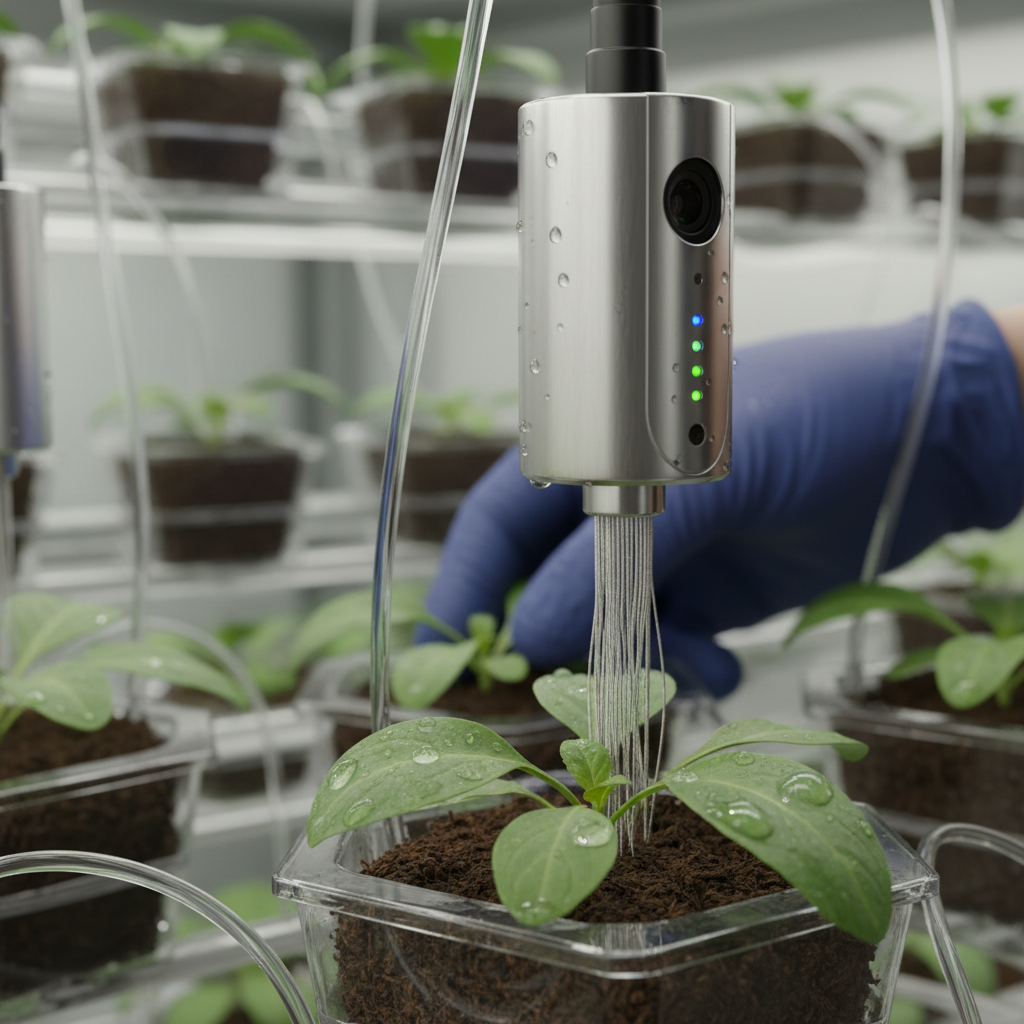
| Aeroponics | Roots hang in air, sprayed with nutrient mist | High root oxygenation, low water volume | Pump, nozzle, or power failures expose roots immediately |
| Aquaponics | Fish waste provides nutrients to plants | Dual output (fish + crops) | Biological balance is harder to maintain and certify |
The market around this technology is real, but its size depends on who is measuring and what they include. Mordor Intelligence estimates $7.53B in 2026 growing to $12.11B by 2031. Grand View Research puts 2026 at $11.4B and projects $39.2B by 2033. That is a 3x to 5x disagreement. When forecasts diverge this much, it means the definitions differ (hardware, software, produce, services, greenhouses, pure-play indoor farms). Treat any single number as a scenario, not an audited total.
The more reliable baseline comes from production data. CEA operations in the US rose from 1,476 in 2009 to 2,994 in 2019, with output reaching 7.86 million hundredweight (a 56% increase). The 2022 Census of Agriculture reported $982M in greenhouse vegetables and fresh-cut herbs, up 31% from 2017. Only 1,401 farms exceeded 10,000 square feet, but they generated 87% of total value. In smart vertical farming, scale and commercialization determine the economics. The mere presence of technology does not.
The Technical Stack Behind a Smart Farm
A smart vertical farm runs on four layers. Remove any one, and the system either fails or stops being “smart.”
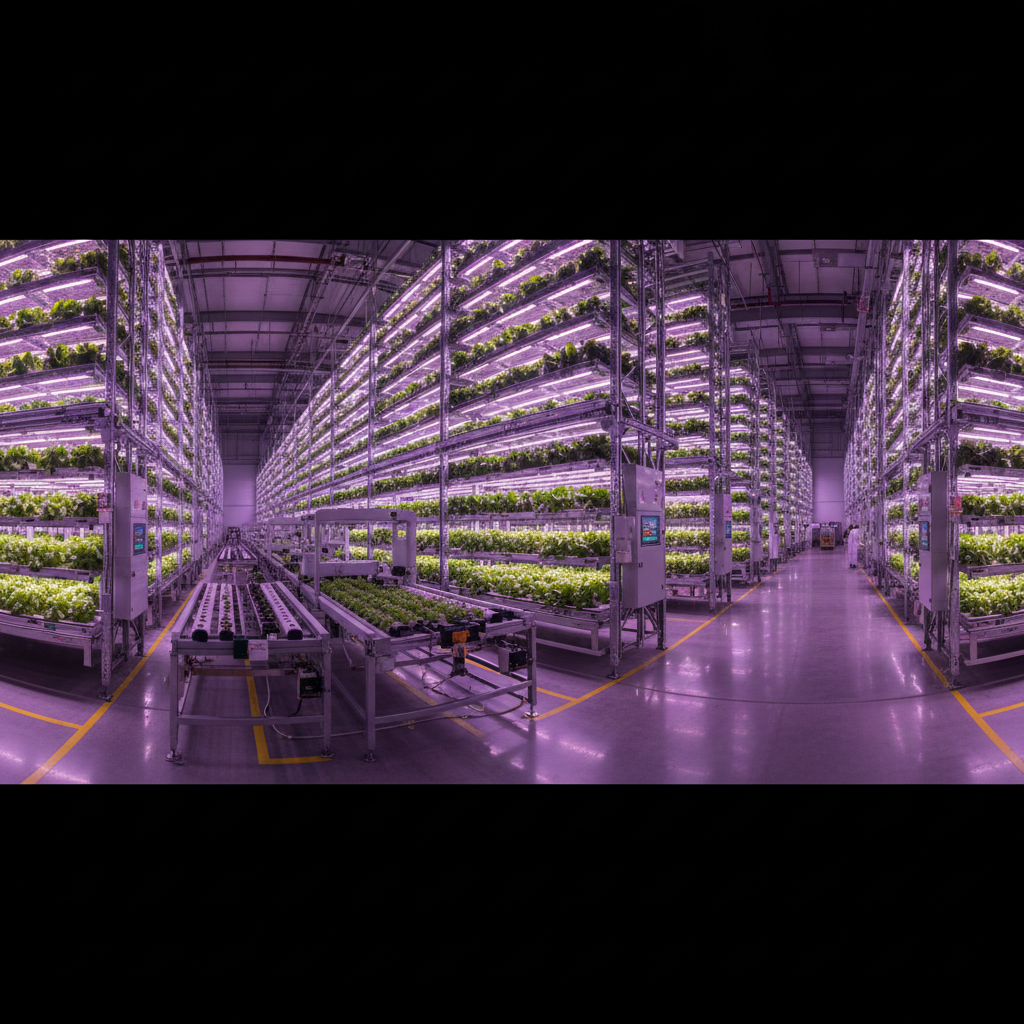
Layer one is the physical stack: multi-tier growing beds or towers inside an enclosed environment using hydroponics, aeroponics, or aquaponics. Layer two is resource delivery: pumps, reservoirs, nutrient dosing, filtration, drainage, and water recirculation. Layer three is environmental control: LED lighting, HVAC, dehumidification, CO2 injection, and air circulation. Layer four is the information backbone: sensors, dashboards, predictive models, alerts, and automated adjustments.
Lighting is where the biggest operational dollars move. A 2025 review in the Korean Journal of Agricultural Science reports LED efficacy at 3.0 micromol/J versus 1.2 micromol/J for legacy high-pressure sodium lamps, with spectral optimization at 660 nm (red) and 450 nm (blue) associated with a 20% yield increase in controlled study conditions. In June 2025, Signify launched the Philips GrowWise smart spectrum platform, pushing LED recipe management further into software-defined territory. The direction is clear: light is becoming a programmable input, not a fixed overhead.
The information layer is what separates automation from intelligence. The same review documents PID controllers and sensor networks maintaining temperature within ±1°C and humidity within ±5%, with one farm reducing energy use by 30% compared to manual HVAC adjustments. Those figures come from specific implementations, not industry averages. But they illustrate the principle: sensors feeding control systems compress environmental variance, and compressed variance lowers cost per kilogram.
That cost-per-kilogram framing matters, because the crop you grow determines whether the technology investment pays back at all.
Which Crops Actually Pay
This is where most smart vertical farming narratives collapse. The technology can grow nearly anything indoors. The economics support a narrow set of crops.
Lettuce, herbs, microgreens, spinach, and selected fruits (primarily strawberries) dominate commercial production. They share three traits: short harvest cycles, compact plant architecture, and high retail value per kilogram. USDA data confirms this concentration. Tomatoes, lettuce, and cucumbers represented 60-70% of US CEA output in both 2009 and 2019.
Staple crops like wheat, corn, rice, and soybeans? A 2025 review in the Journal of Horticultural Science and Biotechnology states they remain beyond current economic potential because the energy required to bring them to maturity under artificial light exceeds any plausible retail return. Adding more sensors or better algorithms does not fix that arithmetic.
The same review points to a longer-term frontier: plant genetics. Varieties bred specifically for stacked indoor environments (higher harvest index, reduced root biomass, dwarf architecture, improved photosynthetic efficiency) could eventually expand the viable crop list. But that is a breeding program timeline, not a next-quarter roadmap.
The operators who survived the last two years understood this constraint. They did not try to replace field agriculture. They picked crops where indoor growing solves a problem the field cannot: year-round availability, consistent quality, proximity to retail, or a premium the consumer visibly pays at the register.
The 2024-2026 Scoreboard
The vertical farming sector between 2024 and mid-2026 produced the clearest test of what separates funded from viable.
Bowery raised more than $700M in venture capital and shut down in November 2024. Consumers were unwilling to pay persistent premiums for produce that looked similar to conventional options on the shelf.
Plenty closed its Compton, California leafy-greens operation in December 2024, citing rising California energy costs, and pivoted entirely to strawberries.
AppHarvest entered Chapter 11 restructuring, with petitions filed by the company and eleven affiliated debtors.
Now the other side of the ledger.
AeroFarms filed for bankruptcy in 2023, then narrowed its entire operation to microgreens. Fast Company reported in May 2025 that the company had been profitable for two consecutive quarters, selling through Whole Foods and Costco. The turnaround followed operational simplification, not technology escalation.
Oishii opened its Amatelas facility in New Jersey in June 2024: more than 237,500 square feet dedicated to premium indoor strawberries, running on renewable energy and designed to grow 20 times more strawberries than its previous operations.
80 Acres Farms and Soli Organic announced a strategic merger in August 2025, claiming seven nationally distributed vertical farms, over 17,000 retail storefronts, annual capacity of 15-20 million pounds, and projected first-year revenue approaching $200M.
The pattern is consistent. Survivors combined three things the failures lacked: a crop with a price premium that justifies indoor economics, distribution relationships that convert production into revenue, and operational discipline built on contribution margin rather than venture runway.
Energy: The Variable That Decides Everything
Electricity is the largest controllable cost in most smart vertical farms. It is also the largest environmental liability.
A PMC review on energy in indoor vertical farming places electricity at 25-30% of total operating cost, with artificial lighting as the primary driver. The percentage shifts by geography, crop, and system design, but the directional point holds: power price determines margin. Plenty left Compton partly because California energy costs eroded the numbers.
The environmental dimension is equally conditional. A life cycle assessment of a commercial Swedish vertical farm producing 520 metric tons of lettuce in 2022 recorded 0.98 kg CO2-eq per kilogram of produce. Under a scenario using 100% renewable electricity, that dropped to 0.75 kg CO2-eq/kg. Electricity dominated the impact across nearly all environmental categories, and the authors explicitly warned against generalizing results across regions.
There is an uncomfortable detail many advocates skip. Switching to renewables reduced carbon emissions but increased some mineral and metal resource impacts from the manufacturing of solar panels and wind turbines. Sustainability is not a binary toggle. It is a set of trade-offs that changes depending on where a farm operates and what power it can actually source.
Before investing in more sensors, more LEDs, or more robotics, a smart vertical farm needs affordable, reliable, low-carbon power locked in. If the electricity bill eats the margin, nothing downstream saves the operation.
What the Smart Layer Actually Requires
The farms that survive share a common infrastructure trait: they treat environmental monitoring as an operational backbone, not a feature to retrofit later.
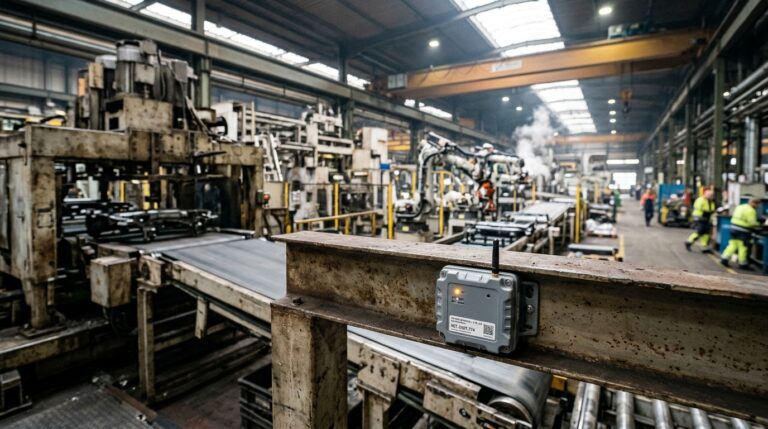
Temperature, humidity, CO2, pH, electrical conductivity, water quality, light intensity, and spectrum all need continuous measurement. Not daily spot checks. Not manual logs on a clipboard. Continuous, timestamped, centralized data that feeds automated responses and generates an auditable record.
80 Acres Farms replaced handwritten downtime logs with real-time data capture across its production lines in 2026. That shift from paper to sensor-driven monitoring is the same gap I see across every industry we work with at Datanet, from aviation MRO to cold-chain logistics. The asset (in this case, the crop and its environment) needs continuous visibility, not periodic snapshots.
Food safety makes this even more critical. FAO published a scientific overview of indoor-farming hazards in August 2025, addressing controls and regulatory considerations specific to controlled-environment production. The assumption that “indoor equals safe” does not survive contact with reality. A 2025 review of hydroponic food safety documented a 2021 multistate outbreak linked to hydroponic leafy greens: 31 salmonellosis cases and four hospitalizations. Contamination routes include source water, substrate, worker contact, and surfaces. No tested intervention eliminated pathogens from seeds, sprouts, or plants entirely.
The FDA’s Produce Safety Rule under FSMA applies regardless of whether produce grows outdoors or indoors. Water testing, sanitation protocols, traceability, and recall readiness need to be wired into the sensor and data infrastructure from day one.
A farm with thousands of sensors and no integrated response workflow is generating noise. A farm with the right sensors connected to the right dashboards and alerts (covering environmental conditions, equipment health, water quality, and food-safety parameters) is running a defensible operation. That distinction is the entire meaning of “smart.”
If you are building or expanding a controlled-environment operation and need environmental monitoring that covers temperature, humidity, soil, and water quality across sites, that is exactly what we build at Datanet. Questions about what a sensor layer should look like for your setup? Talk to our team.
Frequently Asked Questions
What is smart vertical farming?
Stacked indoor crop production combined with IoT sensors, automated climate and nutrient controls, LED lighting, and real-time data analytics. “Smart” refers to the continuous feedback loop between sensors and control systems, not just the vertical layout. Crops typically grow in hydroponic, aeroponic, or aquaponic systems within enclosed, climate-controlled environments.
Which crops are most profitable in vertical farms?
Lettuce, herbs, microgreens, spinach, and premium fruits like strawberries dominate commercial operations. They combine short harvest cycles, compact plant architecture, and high retail value per kilogram. Staple grains (wheat, corn, rice, soybeans) remain economically unviable indoors because the energy cost of artificial lighting exceeds any plausible return.
How much water does smart vertical farming save?
Closed-loop systems can reduce water consumption substantially: a 2025 review reports savings of 90% for hydroponics, 95% for aeroponics, and 98% for aquaponics compared to field agriculture. Actual results vary by crop, recirculation efficiency, and how well the farm manages water quality to avoid full-system flushes triggered by contamination.
Is vertical farming sustainable?
Conditionally. A Swedish commercial farm recorded 0.98 kg CO2-eq per kilogram of lettuce with its grid mix and 0.75 kg CO2-eq/kg with fully renewable electricity. Electricity dominated the environmental impact across nearly all categories. A vertical farm running on coal-heavy power may carry a larger carbon footprint than field-grown produce shipped by truck.
Why have so many vertical farming companies failed?
High capital costs, electricity bills that consume margins, undifferentiated commodity crops exposed to field-grown price competition, and growth strategies funded by venture capital rather than positive contribution margin. Bowery raised over $700M and still closed. AeroFarms survived by narrowing to microgreens and cutting operational complexity.
What role do IoT sensors play in a smart vertical farm?
Sensors measure temperature, humidity, CO2, pH, electrical conductivity, light spectrum, and water quality in real time. That data feeds automated controls for lighting, HVAC, and nutrient dosing, while also supporting food-safety compliance (water testing, traceability, recall readiness). One documented implementation reduced energy consumption by 30% compared to manual climate adjustment.



 +1 508 292 2210

4 Responses