

Vertical farming automation attracted nearly $8 billion in investment between 2018 and 2022. Less than $1 billion has followed. Bowery, once valued at $2.3 billion, shut down after burning through more than $700 million. Jones Food Company, behind the UK’s largest vertical farm, entered administration in 2025. Eden Green permanently closed its Texas greenhouses. 80 Acres Farms wound down in August 2026 after a prospective buyer walked away. (See also: vertical farm climate control.) (See also: vertical farming humidity control.) (See also: vertical farm environmental monitoring.)
The technology worked. The sequence did not. In farm after farm, robots and grow-light rigs were financed before sensor data, crop economics, and committed demand justified the spend. Before spending, it helps to see vertical farming technology in the context of a $9B reality check. The path toward smart vertical farming depends on getting that order right.
The operations that survived did something specific: they automated the constraint that was actually expensive and measurable, then expanded from there. Here is what that looks like in practice.
What Vertical Farming Automation Actually Covers
Vertical farming automation is the coordinated use of sensors, control systems, software, AI, and robotics to grow crops in stacked indoor layers. It sits inside a broader category: controlled environment agriculture (CEA), which the US government defines as a food, technology, and energy intersection rather than a wholesale replacement for conventional farming.
The system is layered. Understanding those layers matters, because each carries a different cost, a different risk profile, and a different payback timeline. Similar layered approaches apply in aquaculture automation, where water quality monitoring and environmental control follow comparable economic principles.
| Layer | What It Does | Automation Value |
|---|---|---|
| Grow structure | Stacked shelves, channels, trays, hydroponic or aeroponic root systems | Increases growing area per square foot, but also increases airflow, access, and material-handling complexity |
| Sensor layer | Measures temperature, humidity, CO2, pH, electrical conductivity, dissolved oxygen, light intensity, water flow | Creates a zone-level data stream; without it, every layer above operates blind |
| Control layer | Manages LED schedules, HVAC, irrigation, fertigation, airflow, nutrient dosing | Converts crop recipes into closed-loop actions |
| Analytics layer | Rules, machine learning, computer vision, disease detection, yield prediction, anomaly alerts | Turns raw telemetry into actionable decisions |
| Robotics layer | Seeding, transplanting, tray transport, harvesting, washing, packing | Replaces repeatable manual motion with consistent throughput |
| Farm software | Crop recipes, work orders, batch traceability, inventory, maintenance, remote ops | Makes a farm repeatable across rooms or sites |
| Safety and resilience | Alarms, access control, backups, network segmentation, cybersecurity, manual bypasses | Limits the blast radius when equipment, software, or network failures occur |
The distinction that matters most: a dashboard displaying pH is not the same thing as an automated fertigation system. A camera that spots leaf stress is not an autonomous harvest robot. Monitoring, control, and full automation are three different investments with three different price tags. Conflating them is how farms overspend on layers that don’t pay back yet.
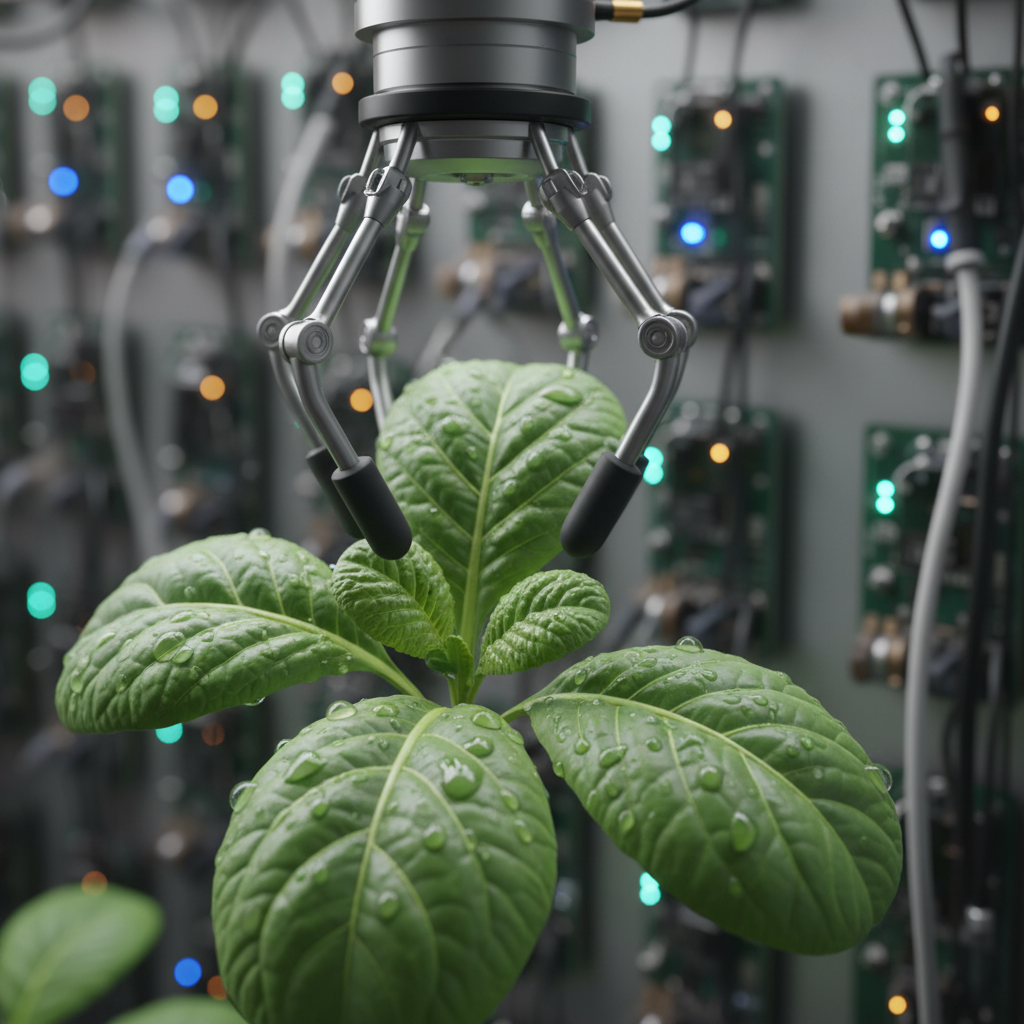
The $8 Billion Failure Pattern
The failures are not ancient history. They cluster in the last two years, and they share a mechanism.
Bowery Farming laid off 187 workers after raising over $700 million and failing to secure additional financing. Jones Food Company, with a 15,000-square-meter facility and potential capacity of 1,000 tons per year, could not find investors and made 61 people redundant. Eden Green’s Texas WARN filing cited 102 terminated positions. 80 Acres Farms raised $115 million in early 2025, acquired two companies, announced a merger projecting $200 million in first-year revenue, then wound down 18 months later when a prospective acquirer withdrew.
The common thread is not bad technology. It is fixed costs and financing obligations that outpaced utilization. Giant facilities were commissioned before crop-level unit economics were proven. Automation increased throughput capacity, but capacity without contracted demand is just overhead.
An adviser to 80 Acres summarized it clearly: the industry needs right-sized facilities, simpler technology, and realistic investor expectations. That summary applies to every automation decision in the sector.
The Real Economics of Automated Indoor Farming
USDA’s Economic Research Service publishes the most transparent cost benchmarks for the US market. Startup costs for a vertical farm range from $150 to $400 per square foot, compared to $50 to $150 for a greenhouse. Under a 16-hour photoperiod, energy costs run approximately $3.45 per square foot for a small farm and $8.02 for operations above 10,000 square feet. Rigorous vertical farming data analytics is what separates a margin saver from a money pit in these numbers.
These numbers explain why automation alone cannot rescue a bad crop or location choice. Robots reduce handling labor. They do not reduce photon delivery, cooling loads, debt service, or demand risk. Disciplined vertical farming resource management is what keeps these fixed costs from sinking an operation.
Energy deserves its own line in every business case. A 2025 benchmark pegs current specific energy consumption at 10 to 18 kWh per kilogram and roughly 1,150 kWh per square meter per year. USDA states directly that lower-value, energy-intensive crops need major energy advances before they become viable indoors. Lettuce and herbs survive the math. Corn and wheat do not.
Labor is the other misunderstood variable. Automation changes the labor mix. It does not eliminate headcount. Advanced CEA operations need controls engineers, horticulturists, electricians, mechanics, sanitation specialists, food-safety staff, and supervisors who can interpret exceptions when the model is uncertain. USDA notes that while robotics may reduce some operational labor costs, full integration is expensive and technical expertise requirements raise overall labor spending.
Market size: a useful range, not a single number
Published 2025 estimates for the global vertical farming market range from $5.78 billion to $9.55 billion, depending on scope. The Business Research Company puts it at $9.55 billion including structures, irrigation, sensors, and lighting. Market Research Future reports $5.78 billion at a 10.7% CAGR through 2035. Global Market Insights lands at $7.4 billion with a 14.5% CAGR to 2035.
The gap comes from category definitions. Some forecasts count farm-operator revenue. Others count technology components. A few count both. Use these as directional signals. And never add produce revenue to equipment revenue in the same model without checking for overlap.
Three Automation Strategies That Survived
Not every operation failed. The farms that made it through the capital drought share a thread: they automated around a specific bottleneck their crop economics could fund.
OnePointOne and AutoStore: automation as logistics
AutoStore and OnePointOne launched Opollo Farm outside Phoenix in May 2025. Thousands of herbs and vegetables grow in robot-powered bins, with integrated lighting, irrigation, and HVAC. The farm supplies leafy greens and microgreens to select Whole Foods Market stores under the Willo brand. The partners report harvest-ready greens in 15 days and up to 95% less water than traditional farming.
The strategic bet: warehouse-grade robotics colocating production with distribution. Short-cycle crops, premium buyers, automated material handling. The figures are partner claims, not independently audited, but the model demonstrates what works. Predictable crops near committed retail partners.
AeroFarms: focus after failure
AeroFarms went through bankruptcy in 2023. It closed R&D facilities, reduced staff, brought in food-production expertise, and narrowed to nutrient-dense microgreens. By early 2025, the company reported profitability for two consecutive quarters, selling through Whole Foods and Costco.
The lesson is focus, not technology. Microgreens are compact, short-cycle, high-margin, and well-suited to aeroponic automation. Two profitable quarters do not prove vertical farming works at scale. They prove that a specific crop, in a right-sized facility, with disciplined operations, can generate positive cash flow. That distinction matters.
Oishii and Tortuga: premium crops justify premium robotics
Oishii acquired Tortuga AgTech’s AI models, robotics software, custom hardware, and engineering team in March 2025. The technology targets strawberry harvesting, plant data collection, trimming, and UV-C treatment. Oishii claims the robots could reduce harvest expenses by 50%.
This is a different thesis from commodity lettuce. Premium berries sell at prices high enough to absorb the cost of computer vision and gentle manipulation. The acquisition also signals an industry trend: instead of every operator building every robot from scratch, specialist IP and engineering talent consolidate around the crops that can pay for them.
Crop Selection Decides More Than Technology Does
USDA describes successful vertical-farm crops as compact, short-cycle, hydroponically suitable, and harvestable in their entirety. That list includes leafy greens, herbs, microgreens, and some berries. It does not include corn, rice, wheat, or soybeans.
The yield multipliers are real but conditional. Protected-crop yields can increase by 40% for strawberries, 400% for tomatoes, and over 2,100% for cucumbers relative to open-field benchmarks. These are USDA-cited research figures, not commercial guarantees. The gap between what is biologically possible and what is economically viable depends on energy cost, selling price, cycle time, and automation cost per unit.
The practical filter: if a crop’s selling price cannot cover its lighting and HVAC load at your local electricity rate, no amount of robotic handling will close the margin gap. Start the business case at the crop, not at the technology.
Sensing and Control: The Foundation Nobody Glamorizes
I spend most of my working hours on IoT deployments across logistics, aviation, and supply chain operations. The lesson transfers cleanly: the operations that perform best are the ones that invested in reliable sensing before they automated any physical movement. Vertical farming is no different.
A vertical farm needs continuous, calibrated measurement of at least these parameters at the zone level:
- Air temperature and relative humidity
- CO2 concentration
- Root-zone pH and electrical conductivity
- Dissolved oxygen in nutrient solution
- Light intensity and spectrum (PAR)
- Water flow rate and reservoir levels
- Electricity consumption per zone
Without reliable data at this resolution, your control layer is guessing. Your analytics layer is training on noise. And your robotics layer is moving trays between zones whose conditions you cannot verify. This is where environmental monitoring automation becomes the foundation for everything else in the facility.
This is where I see the biggest gap in farms that struggle. They invest in the visible hardware (racks, LEDs, robots) and underinvest in the invisible infrastructure (sensor networks, calibration schedules, alarm escalation, data quality protocols). The sensor layer is not glamorous, but choosing the right indoor farming sensors is what makes it reliable. It is also not optional.
The energy co-optimization opportunity compounds the case. Researchers are already testing dynamic daily light patterns that adapt to real-time changes in the growing environment. But dynamic light recipes are impossible to run without reliable, zone-level telemetry on canopy temperature, humidity, and plant response, which is why LED lighting monitoring for vertical farms can cut energy use significantly. Sensor density and data quality are prerequisites for energy optimization, not afterthoughts.
One layer most farms defer too long: cybersecurity. A 2026 study on CEA cybersecurity warns that connected farm systems can expose crops, food safety, worker safety, business continuity, and regional supply chains when a cyber incident hits. Network segmentation, identity management, incident response, and manual operating fallbacks belong in the farm design from day one.
A Practical Automation Sequence
The failure cases, survival stories, and cost data above point to a consistent order of operations. Here is the sequence that pays back:
- Calibrated sensing and environmental control. Temperature, humidity, CO2, pH, EC, light, water flow, and power consumption. Zone-level resolution. Defined calibration schedules. Clear alarm escalation. This is your operating system. Everything else depends on it.
- Water and nutrient automation. Closed-loop fertigation with automated dosing, pH correction, and recirculation monitoring. The nutrient cycle is the crop’s lifeline and the easiest subsystem to automate reliably.
- Climate control with recipe management. Link HVAC, dehumidification, and LED schedules to crop-specific recipes. Prove the system holds conditions within spec across day/night cycles and seasonal variation before expanding capacity.
- Batch traceability and farm software. Every tray tracked from seed to harvest. Yield per batch, energy per batch, labor per batch. Without this data, you cannot demonstrate unit economics to yourself, your board, or your lender.
- Material handling. Tray transport, seeding automation, transplanting. This is where repetitive manual labor concentrations are highest, and where robots deliver measurable savings.
- Computer vision and specialized harvesting. The most expensive layer to build and maintain. Justified only for crops with high labor-to-harvest ratios and margins that cover the robotics amortization. Strawberries, yes. Lettuce, possibly. Basil, probably not yet.
- AI-driven optimization. Plant-level decision models connecting images, root-zone telemetry, light recipes, HVAC load, and yield forecasts. This layer earns its keep only when every layer below it produces clean, reliable data.
The pattern: automate measurement before movement. Prove the crop before scaling the facility. Finance each layer from the margin the previous one created. This margin-first approach to vertical farming optimization is what separated the survivors from the casualties.
If your vertical farm still relies on manual spot-checks for temperature and humidity, or lacks zone-level environmental data, that gap is the place to start. Our team at Datanet works across agriculture, logistics, and supply chain with environmental monitoring devices built for exactly this kind of foundation. If you want to talk through what a sensor layer looks like for your operation, we are here.
Frequently Asked Questions
What is vertical farming automation?
The integrated use of sensors, control systems, software, AI, and robotics to manage crop production in stacked indoor layers. The scope ranges from automated fertigation and climate control to end-to-end material handling, harvesting, and packing. A complete system connects environmental monitoring with crop management and logistics decisions.
Is a “fully automated” vertical farm truly autonomous?
Not in practice. “Fully automated” usually describes the intended material-flow workflow. Humans still manage agronomy, maintenance, sanitation, food-safety compliance, exception handling, and decisions outside the system’s trained operating envelope. The term describes a design target, not a staffing level of zero.
Which crops work best in automated vertical farms?
Leafy greens, herbs, microgreens, and some berries lead the field. USDA identifies successful vertical-farm crops as compact, short-cycle, hydroponically suitable, and harvestable in their entirety. Staple crops like wheat, corn, and rice remain far better suited to conventional outdoor farming due to energy and light requirements.
How much does it cost to start an automated vertical farm?
USDA data puts startup costs at $150 to $400 per square foot, versus $50 to $150 for a greenhouse. Energy costs under a 16-hour photoperiod range from $3.45 to $8.02 per square foot depending on facility size. Add financing, technical labor, maintenance, and software licensing before projecting break-even.
Is vertical farming profitable?
Some farms and crops can be. AeroFarms reported two profitable quarters after restructuring around microgreens. But Bowery, Jones Food Company, Eden Green, and 80 Acres Farms all ceased operations despite substantial funding. Profitability depends on crop selection, energy cost, facility scale, demand commitments, and operational discipline tested at the unit level.
What should a vertical farm automate first?
Start with calibrated environmental sensing, water and nutrient control, climate management, and batch traceability. Add material handling once growing conditions are stable and measurable. Reserve computer vision and specialized harvesting for crops whose margins cover the robotics investment. Every automation layer requires clean data from the layer below it.




 +1 508 292 2210

2 Responses