

A vertical farm monitoring system can measure dozens of variables every few minutes. That sounds like progress until you look at the numbers that actually matter. Current vertical farms consume 10 to 18 kWh per kilogram of lettuce. The technical benchmark sits between 3.1 and 7.4 kWh/kg. That gap, roughly 3x, is where operational dollars vanish. And it’s the gap monitoring is supposed to close. (See also: led lighting monitoring for vertical farms.)
But monitoring alone doesn’t close anything. Bowery Farming raised over $700M, deployed sophisticated automation, and still shut down. Plenty filed Chapter 11. AeroFarms went bankrupt before pivoting to profitability with a completely different crop. The pattern: sensors collect data; what turns data into margin is the loop from measurement to decision to action to verification.
This is a field guide to vertical farm monitoring systems. Not a sensor catalog. Not a pitch for more dashboards. It covers what to measure, how the architecture works, where the real costs hide after installation, and how to pick a system that earns its keep.
What a Vertical Farm Monitoring System Actually Does
A vertical farm monitoring system is a connected stack that observes climate, root zone, water chemistry, light, crop condition, equipment, and energy inside a controlled growing facility. Then it turns those observations into alerts, adjustments, and (in advanced setups) automatic control actions.
The definition matters because “monitoring” is used loosely. Sticking a temperature sensor on a rack is monitoring. So is a platform that coordinates 200 sensors, fires an irrigation valve, adjusts LED schedules, and predicts harvest readiness. Those two things solve different problems at different price points.
The useful distinction is between open-loop and closed-loop systems:
- Open-loop: Sensors collect data. A human reads a dashboard. The human decides what to do. The system doesn’t verify whether the action worked.
- Closed-loop: Sensors collect data. The platform compares readings against a target or recipe. An actuator adjusts (HVAC, dosing pump, LED dimmer). The system measures again to confirm the correction landed.
Most real deployments live somewhere in between. Vertical farm climate control might be closed-loop, while nutrient dosing stays manual. Lighting schedules might be automated, while harvest timing depends on a crew lead’s judgment. That’s fine. The question isn’t “is everything automated?” It’s “for each variable I care about, does the system close the loop or leave it open?”
The minimum viable stack for a production farm covers room climate (temperature, humidity, CO2), root zone (pH, EC, moisture, flow), light (PAR intensity and schedule), and energy (electricity per rack, per room, per kilogram). Research designs add O2, chlorophyll, wind speed, steam pressure, and network analysis, but those additions are justified only when tied to a specific decision the operation needs to make.
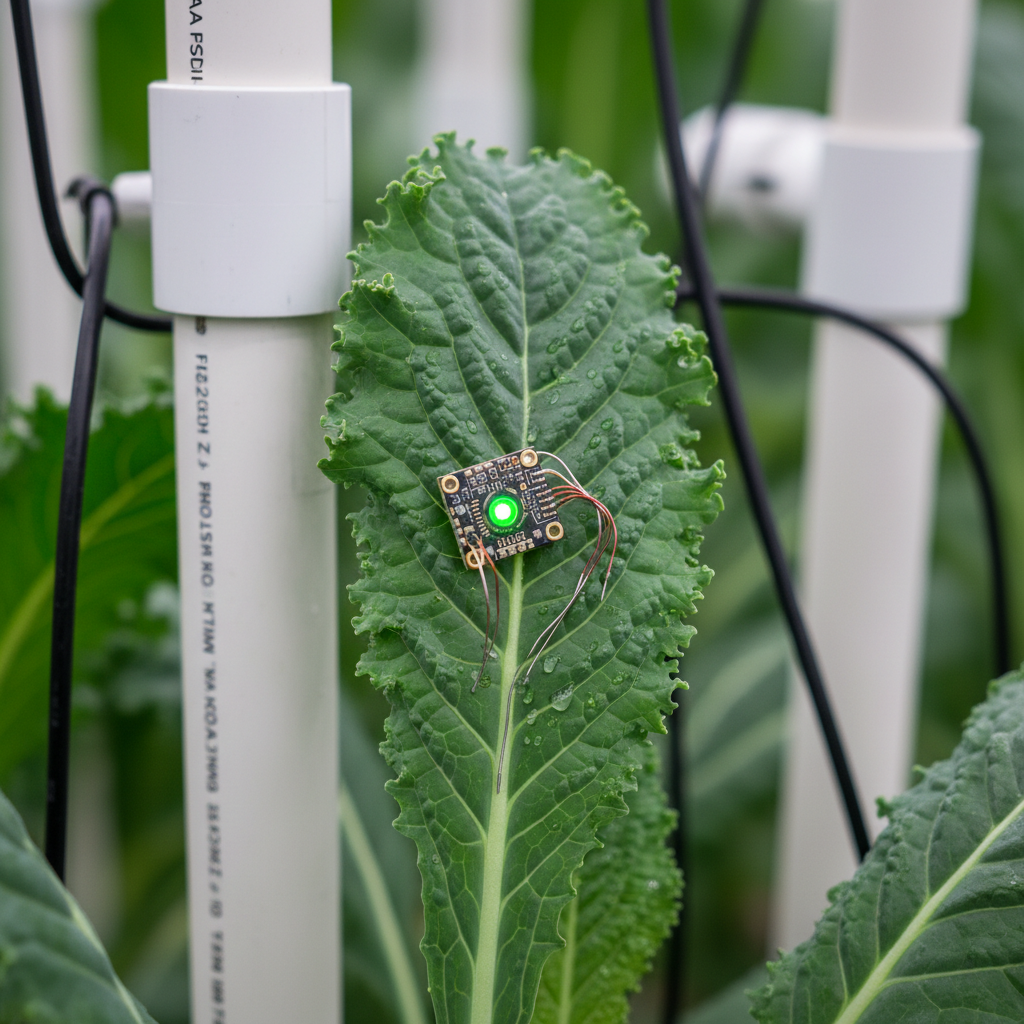
Six Parameters That Determine Yield and Cost
Every monitoring vendor will hand you a sensor catalog. What matters more than the catalog is the link between each parameter, the crop outcome it controls, and the action it should trigger when readings drift.
| Parameter | What it controls | What happens when it drifts | Action the system should trigger |
|---|---|---|---|
| Temperature | Photosynthesis rate, transpiration, nutrient uptake | Tip burn, bolting, slowed growth, root disease | HVAC adjustment, airflow redistribution, alarm if deviation exceeds ±1°C for more than 15 min |
| Relative humidity / VPD | Transpiration, stomatal opening, disease pressure | Mold, powdery mildew, calcium deficiency from low transpiration | Dehumidification, fan speed change, fogging, or ventilation |
| CO2 | Photosynthetic rate, yield ceiling | Under 400 ppm limits growth; above 1,500 ppm wastes gas and risks worker safety | CO2 dosing on/off, ventilation interlock, safety alarm |
| Light (PAR/PPFD) | Daily light integral, crop morphology, energy cost | Low DLI produces leggy, pale crops; excess wastes electricity and adds heat load | LED dimming and scheduling, recipe adjustment by growth stage |
| pH and EC | Nutrient availability, root health | pH outside 5.5 to 6.5 locks out nutrients; EC drift signals over- or under-feeding | Acid/base dosing, nutrient concentrate adjustment, reservoir flush alert |
| Energy (kWh/kg) | Unit economics, operational viability | Invisible cost bleed; farms can lose money on every head of lettuce without knowing it | Load shifting, LED efficiency audit, HVAC optimization, demand scheduling |
Notice the last row. Energy isn’t a growing parameter. It’s a business parameter. And it’s the one most monitoring systems either ignore or bury in a separate utility dashboard. A benchmarking study found that LED efficiency has a greater influence on energy per kilogram than the HVAC operating range alone. If your monitoring system tracks temperature to two decimal places but doesn’t show you kWh per saleable kilogram, it’s solving the wrong problem. And this is exactly what growers miss about vertical farming temperature monitoring.
CO2 management deserves a note. Dosing CO2 to 800 to 1,200 ppm can lift photosynthesis and yield, but only if light levels, temperature, and humidity are simultaneously in range. Monitoring CO2 in isolation is like monitoring fuel injection without watching engine temperature. The variables interact. Your system needs to reflect that.
System Architecture: From Sensor to Closed-Loop Control
A vertical farm monitoring system follows a layered architecture. Understanding the layers helps you evaluate vendors, spot single points of failure, and plan for growth.
Layer 1: Sensors and edge devices
Sensors sit at the crop canopy, inside reservoirs, on racks, in HVAC ducts, and on power distribution panels. Edge devices (microcontrollers, gateways) collect, timestamp, and pre-process raw signals locally. This is where fast safety interlocks live. If pump pressure spikes, the edge device shuts it off in milliseconds without waiting for a cloud round-trip.
I’ve deployed IoT sensors in environments from aircraft cargo holds to ocean containers. Vertical farms share a problem with all of them: the sensor itself is only as good as its placement, its calibration schedule, and the edge logic that protects the asset when connectivity drops.
Layer 2: Connectivity
Data moves from edge to platform via WiFi, Ethernet, LoRa, Zigbee, or cellular, depending on facility size and interference profile. Metal racking in vertical farms creates real RF problems. LoRa handles longer range and obstacles well but at lower bandwidth. WiFi is faster but can drop in dense metallic environments. One published architecture acquires sensor values every 15 minutes, uploads to the cloud every 30 minutes, and refreshes the dashboard every 30 minutes. That cadence works for climate trends and crop planning. It does not work for emergency shutoffs, which is why the edge layer exists.
Layer 3: Platform and analytics
The cloud or local server stores historical data, runs analytics, displays dashboards, fires alerts, and runs optimization models. Some platforms add computer vision, using cameras to track individual plants, detect stress, or predict harvest timing. The digital-twin approach goes further: a 2025 study combined environmental and operational data with what-if scenarios and Q-learning, achieving 78.5% demand fulfillment versus 58.5% for traditional optimization in a simulated vertical farm. Promising results. But the authors flag computational intensity and training-data requirements as real constraints. Not something to ignore.
Layer 4: Actuation
Pumps, valves, HVAC units, LED drivers, dosing equipment, fans. The monitoring system sends commands. The actuator executes. Then the sensors measure again to confirm the state changed correctly. Without this verification step, your “automated” farm is really a farm that sends commands into the void and hopes for the best.
The critical design decision is what stays local and what goes to the cloud. A reliable rule: anything that protects equipment or crop survival stays at the edge. Recipe optimization, scheduling, and business analytics can use the cloud. If your internet drops at 2 AM, your pumps and HVAC should still follow safe defaults.
The Energy Problem Your Dashboard Probably Ignores
Energy is the single largest operating cost in most vertical farms. It’s the cost that a monitoring system should attack first, which is why disciplined vertical farming resource management separates the survivors from the failures.
The numbers bear repeating. 10 to 18 kWh per kilogram in current practice. 3.1 to 7.4 kWh/kg as the technical benchmark. That gap isn’t theoretical. It’s cash leaving the building every hour through inefficient lighting, oversized HVAC, dehumidification running against cooling, and light schedules that ignore electricity tariffs. Getting vertical farming humidity control right is a big part of closing that energy gap.
A Swedish modular farm study makes the point even sharper. Electricity was the largest contributor to nearly all environmental impact categories, and the results were not generalizable outside the local grid context. A farm in Texas running on coal-heavy power has a fundamentally different environmental and economic profile than one in Sweden running on hydro. Your monitoring system needs to know the difference.
What a vertical farm monitoring system should show you, front and center:
- kWh per saleable kilogram, per crop, per room. Not total facility kWh.
- LED efficiency trend over time (degradation is real and gradual).
- HVAC load versus outside conditions. Are you cooling against your own lights?
- Dehumidification energy. In sealed growing environments, this can rival lighting cost.
- Tariff-aware scheduling. If electricity costs 3x more at peak hours, your light recipe should know.
If your current dashboard shows room temperature and humidity but not energy per kilogram, you’re monitoring symptoms and ignoring the diagnosis.
After Installation: Calibration, Drift, and Real Operating Costs
Installation day is the easy part. Day 2 is where monitoring systems earn or lose their value.
Sensor drift and calibration
pH sensors in hydroponic reservoirs drift. It’s physics, not a defect. A pH probe exposed to nutrient solution 24/7 needs recalibration every 2 to 4 weeks, depending on the solution and temperature. EC probes are more stable but still degrade. CO2 sensors can be thrown off by humidity condensation on the optic path. Temperature sensors are relatively stable, but placement matters: a sensor in an air pocket between racks reads differently than one at canopy level. Water chemistry monitoring shares similar challenges in aquaculture—see our guide to fish farm monitoring.
Your monitoring system should flag sensor health, not just sensor readings. A flatlined pH reading isn’t “stable.” It’s probably a dead probe.
RF interference and connectivity
Vertical farms are metal boxes filled with metal racks, water, and LED drivers that generate electromagnetic noise. WiFi and Zigbee signals bounce, attenuate, and occasionally disappear. If your architecture doesn’t account for this (redundant gateways, local buffering, wired backbones for critical nodes), you’ll have blind spots in the interior racks that need the most attention.
In 15 years of deploying IoT across aviation, logistics, and maritime, I’ve seen this pattern repeat. The environment always fights the signal. Budget for it upfront or pay for it in lost data and crop risk later. Similar connectivity challenges appear in aquatic environments—learn more about shrimp farm monitoring systems.
The OpEx nobody budgets
A research design for a container farm estimated sensor hardware alone at EUR 48,064. That’s CapEx. The ongoing costs nobody publishes include:
- Cloud platform subscriptions (often per-sensor or per-data-point pricing).
- Sensor replacement: pH probes every 6 to 12 months, others every 2 to 5 years.
- Calibration labor and consumables (calibration fluids expire).
- Software updates and integration maintenance when firmware changes.
- Connectivity costs (cellular gateways, SIM cards, bandwidth).
Budget for monitoring OpEx at 15% to 25% of initial sensor CapEx annually. If a vendor won’t discuss ongoing costs, that tells you something about the relationship you’re entering.
Open vs. Closed: How to Choose Your Architecture
The vertical farm monitoring market splits into two camps. Centralized, integrated platforms that control climate, water, light, and energy from one system. And open, protocol-agnostic platforms that connect sensors from multiple manufacturers through standard protocols.
Argus describes TITAN as a centralized system managing physical plant, fertigation, grow rooms, chambers, nurseries, and propagation. Priva Connext integrates light, climate, water, and energy using inputs like transpiration, temperature, irrigation, slab weight, and moisture. These systems reduce integration headaches. One vendor, one support contract, one data model. The trade-off is lock-in. If you need to add a sensor the vendor doesn’t support, or export historical data to a different platform, you may hit a wall.
Growlink advertises support for BACnet, Modbus, SDI-12, 0-10V, 4-20mA, MQTT, and an open API. That openness sounds ideal until you realize that protocol support doesn’t mean plug-and-play. BACnet compatibility on paper still requires mapping data points, configuring polling intervals, testing fail-safe behavior, and validating that sensor X from manufacturer A writes correctly into platform B’s data model. That’s engineering work.
| Scenario | Better fit | Why |
|---|---|---|
| New facility, single vendor preference | Centralized (Argus, Priva) | Less integration risk, single point of accountability |
| Existing facility with mixed equipment | Open platform | Connects legacy sensors and controllers without ripping them out |
| Multi-site with different equipment generations | Open platform | Data standardization across sites matters more than single-site optimization |
| Small research farm or pilot | Either, but prioritize data export | You’ll likely change platforms as you scale; trapped data is expensive |
Regardless of camp, test three things during any pilot: Can you export all historical data in a standard format? Can you add a non-native sensor without vendor intervention? What happens to actuation if the cloud connection drops?
Cybersecurity: not a feature request, a requirement
A vertical farm monitoring system is an industrial control system. It opens and closes valves, adjusts climate, and doses chemicals. Compromised, it can kill a crop in hours.
NIST’s agricultural IoT recommendations call for minimum cybersecurity requirements and governance covering ownership, privacy, and security of data. In practical terms: unique credentials per device, network segmentation between IT and operational technology, signed firmware updates, audit logs, offline fallback modes, and a documented incident response plan.
Ask your vendor: who has remote access to my system? How are firmware updates authenticated? If I terminate the contract, who owns my data? Vague answers are a disqualifier.
What Three Farm Failures Reveal About Monitoring Limits
The most important lesson in vertical farm monitoring has nothing to do with sensors. It has everything to do with vertical farming data analytics and the margins they reveal.
Bowery Farming raised over $700M, operated advanced automated facilities, and then ceased all operations, laying off 187 workers. Reporting cited rising costs, vanishing venture capital, and wavering consumer demand for premium produce. Their monitoring didn’t fail. Their unit economics did.
Plenty filed for Chapter 11 in March 2025 and emerged in May with a narrower focus: streamlined operations, a Richmond farm expansion, and a strawberry technology program. The restructuring wasn’t a data problem. It was a portfolio problem. Too many crops, too many facilities, not enough margin in any of them.
AeroFarms went bankrupt in 2023 but reported profitability in its most recent quarters, selling microgreens through Whole Foods and Costco. They shut R&D in New Jersey and Abu Dhabi, focused on a single high-margin product, and emphasized that productivity (not just output) lowers energy per plant.
Three takeaways for anyone buying a monitoring system:
- Monitoring makes operations visible. It cannot make an unprofitable crop profitable.
- The most valuable metric isn’t yield per square meter. It’s contribution margin per kilogram after energy, labor, packaging, and distribution.
- A monitoring system should support crop and channel selection, not just climate control. If you can’t see which product line makes money, you can’t cut the ones that don’t.
Where Vertical Farm Monitoring Goes Next
The next 24 months will reward systems that do less and prove more. The market is shifting from “we monitor 200 variables” toward “we proved a 12% reduction in kWh per kilogram in a controlled pilot.” That shift is exactly why vertical farm environmental monitoring that pays back is becoming the buying benchmark.
Energy-aware supervisory control. Farms will optimize lighting, HVAC, and dehumidification together instead of treating them as separate systems. The benchmark data supports it: HVAC runs 0.5 to 2.5 kWh/kg at COP 2 to 6, but LED efficiency has greater influence on the total. Co-optimizing both is the next efficiency frontier.
AI with evidence, not just labels. Computer vision platforms claim 24/7 plant tracking, daily scouting, and yield forecasts. A systematic review of 52 articles found that AI and big-data adoption in vertical farming remains limited in scope and effectiveness. The credible AI deployments in 2026 will publish accuracy rates, false-alarm rates, and measured yield improvements by crop. The rest will remain in pitch decks.
Crop-specific monitoring packages. After the restructuring wave, vendors will package monitoring by crop rather than by facility. Lettuce, strawberries, herbs, and microgreens have different sensor needs, different cycle times, and different economics. One-size-fits-all platforms will lose ground to crop-tuned solutions that carry tested recipes, calibration schedules, and margin benchmarks.
Cybersecurity as a procurement filter. As farms connect more actuators to cloud platforms, the attack surface grows. NIST’s recommendations will increasingly show up in procurement checklists, insurance requirements, and food-safety audits.
The U.S. CEA sector grew from 1,015 operations in 1998 to 2,994 in 2019, and analyst forecasts put the U.S. vertical farming market at $2.5 billion by 2029. The growth is real. But so are the failures, as we explore in smart vertical farming. The winning farms will be the ones where monitoring doesn’t just collect data. It closes the loop between what the crop needs, what the facility delivers, and what the business can sustain.
At Datanet, we’ve spent years building IoT monitoring stacks across aviation, logistics, and maritime. The fundamentals translate: reliable sensors, edge intelligence, connectivity that survives hostile RF environments, and platforms that tie environmental data to operational decisions. If your vertical farm monitoring challenge involves environmental tracking hardware or integration across mixed sensor fleets, that’s a conversation we know how to have. Reach out at info@datanetiot.com. Our maritime experience includes vessel monitoring systems with proven reliability in challenging environments.

Frequently Asked Questions
What is a vertical farm monitoring system?
It’s a connected system of sensors, edge devices, software, and (optionally) actuators that tracks climate, water, light, crop health, equipment, and energy inside a vertical farm. The goal is to turn continuous environmental data into decisions that improve yield, reduce cost, and prevent crop loss. Systems range from simple dashboards to full closed-loop automation platforms.
Which sensors are essential for a first deployment?
Start with temperature, relative humidity (or VPD), CO2, light (PAR/PPFD), pH, EC, irrigation flow, and energy metering. These cover the core variables that determine crop health and operating cost. Add O2, chlorophyll, dissolved oxygen, or plant imaging only when tied to a specific operational decision.
How much does a vertical farm monitoring system cost?
Sensor hardware for a container-scale farm can run EUR 48,000 or more based on published research designs. Full infrastructure, including growing systems and controls, can approach EUR 140,000. Ongoing costs (cloud, calibration, sensor replacement, connectivity) typically add 15% to 25% of initial sensor CapEx per year.
Can monitoring alone make a vertical farm profitable?
No. Monitoring makes operations visible and controllable, but profitability depends on crop selection, energy cost, pricing, distribution, and utilization. Bowery Farming operated advanced monitoring and automation and still closed after raising over $700M. A good system helps you find and fix the binding constraint. It cannot replace a viable business model.
Should I choose a centralized or open monitoring platform?
Centralized platforms reduce integration complexity and provide single-vendor accountability. Open platforms offer protocol flexibility and data portability across mixed equipment. Choose centralized for new builds with limited engineering resources. Choose open for multi-site operations, legacy equipment, or when data portability is a strategic requirement. Either way, test data export, non-native sensor support, and offline behavior before committing.
How does AI fit into vertical farm monitoring in 2026?
AI is strongest for image-based plant scouting, anomaly detection, and harvest-timing predictions. It’s weaker for fully autonomous growing decisions, where training data and crop variability remain constraints. A 2025 digital-twin study showed improved demand fulfillment using Q-learning but flagged computational intensity and data limitations. Treat AI as a decision-support layer, not a replacement for agronomic expertise.





 +1 508 292 2210

8 Responses