

Two of the most funded vertical farms in history collapsed within months of each other. Bowery shut down after raising over $700 million. Plenty filed for bankruptcy after nearly $1 billion. Both invested heavily in vertical farming sensors and automation. The sensors worked fine. The business models didn’t. (See also: vertical farm environmental monitoring and our reality check on vertical farming technology.)
That contrast tells you everything about where sensor investment actually creates value. The right measurements, connected to control logic, can cut water use by 70-95%, compress crop cycles, and lower labor per kilogram. The wrong sensor strategy just adds cost to an operation already spending 10-18 kWh per kilogram of lettuce on energy alone.
The problems I see in vertical farming are identical to the ones I see across industrial IoT: sensor drift nobody budgets for, connectivity gaps in metal-dense environments, and dashboards full of data that never triggers an action. The fix is never more sensors. It’s fewer, better measurements connected to decisions that move the margin.
Six Sensor Categories, Ranked by ROI Impact
Most guides split vertical farming sensors by individual variable. That’s a shopping list, not a system design. A better frame is six functional categories, each solving a different operational problem. The first three are table stakes. The last three separate farms that monitor from farms that optimize.
| Category | Key Variables | Decision It Enables | ROI Tier |
|---|---|---|---|
| Air and climate | Temperature, RH, VPD, CO2, airflow | HVAC, dehumidification, CO2 dosing | Foundation |
| Root zone and nutrients | pH, EC, water level, flow, dissolved oxygen | Fertigation, irrigation, nutrient correction | Foundation |
| Light and radiation | PAR, PPFD, spectrum, photoperiod | LED tuning, spectrum control, energy management | Foundation |
| Plant physiology | Chlorophyll fluorescence, photosynthetic efficiency | Stress detection, recipe optimization | Optimization |
| Computer vision | Growth rate, canopy coverage, anomalies | Yield forecasting, quality grading | Optimization |
| Utilities and equipment | kWh, water consumption, equipment status | Unit economics, energy allocation, maintenance | Optimization |
Most commercial vertical farms today operate in the first three categories. That’s often the right starting point. But farms that never instrument the last three will never know whether their recipe is optimal or just adequate, whether their energy spend is necessary or wasteful, or whether a stress event started two days before visible symptoms appeared.
Air, Root Zone, and Light: The Control Foundation
Air and climate
Temperature, relative humidity, CO2, and airflow form the minimum viable sensor set. Without them, you’re growing blind.
But “measuring temperature” and “useful temperature data” are not the same thing. In a multi-tier rack, a single sensor at aisle height misses the thermal gradient between the top shelf (closest to LED heat) and the bottom shelf (closest to floor cooling). A peer-reviewed monitoring architecture uses distributed, wireless measurement nodes precisely because conditions vary by position within the same room.
CO2 has the highest single-variable leverage. Supplemental CO2 at 800-1200 ppm can boost yield by 20-30% for many leafy greens. But dosing without accurate measurement wastes gas, raises operating costs, and creates worker safety risks at high concentrations. Accuracy, stability, and measurement range matter far more than brand name or form factor when selecting a CO2 sensor.
The variable most farms underweight is vapor pressure deficit (VPD). Relative humidity alone doesn’t reveal whether plants are transpiring properly. VPD, calculated from temperature and RH together, gives you a direct indicator of water stress and disease risk. A room at 75% RH and 28°C has a very different VPD than one at 75% RH and 20°C. Farms that control for VPD rather than RH alone typically see better canopy management and fewer pathogen events.
Root zone and nutrients
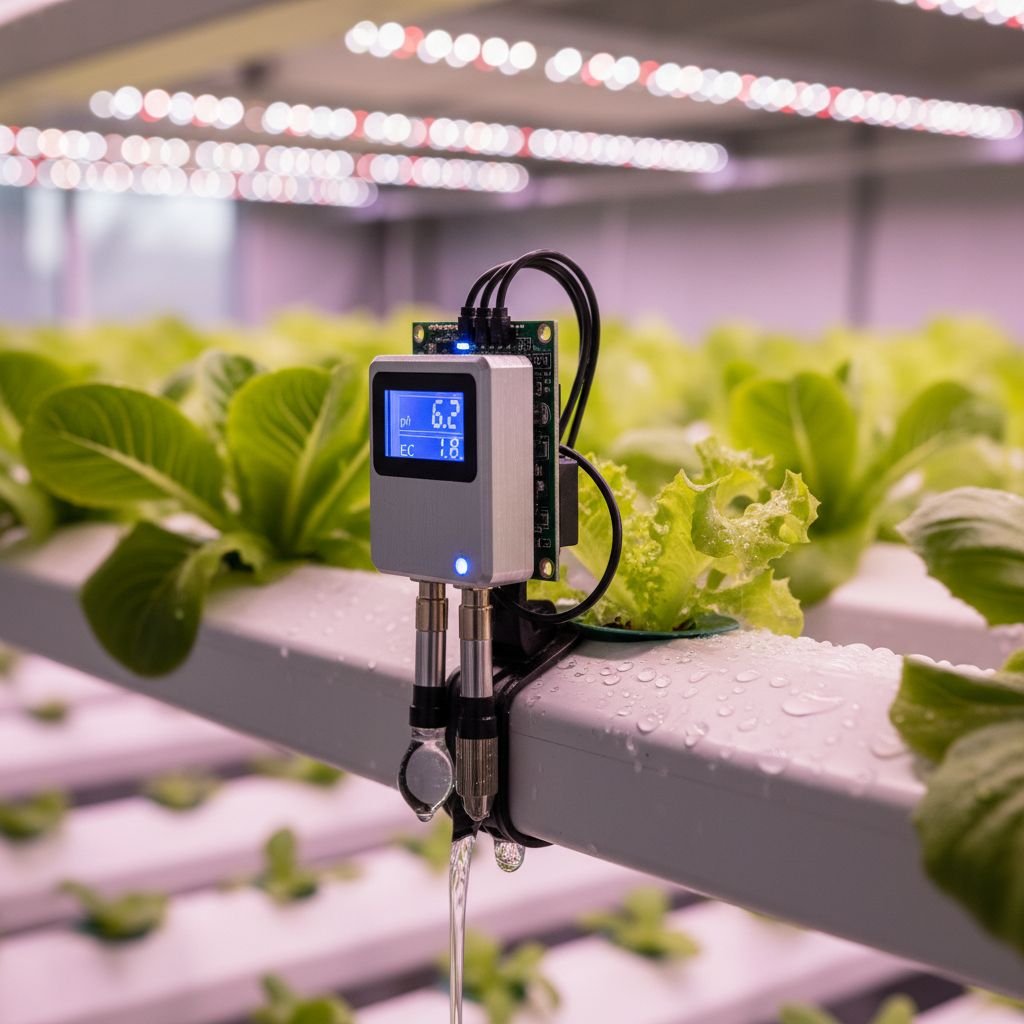
pH and electrical conductivity (EC) are the two readings that kill crops fastest when they drift. In a hydroponic system, pH outside the 5.5-6.5 window locks out nutrient uptake regardless of how balanced your solution is. EC indicates total dissolved solids but not which ions are present. Treat it as a proxy, not a full prescription. Reliable water quality monitoring sensors ensure these critical parameters stay within range.
Water level and flow sensors protect against dry-outs from pump failure and flooding from valve malfunction. Dissolved oxygen in the nutrient solution matters for root health, particularly in deep water culture and NFT systems where stagnant conditions invite root rot. The same dissolved oxygen monitoring principles that drive aquaculture productivity improvement apply directly to hydroponic root zones.
A hydroponic vertical farm doesn’t necessarily need soil moisture sensors. NFT, DWC, and aeroponic systems monitor pH, EC, water level, flow, and root zone temperature instead. Match the sensor to the growing method, not to a generic checklist.
Light and radiation
In a fully artificial light environment, PAR (photosynthetically active radiation) sensors quantify the light energy available for photosynthesis. That lets you tune LED intensity and spectrum to the crop stage, and catch LED degradation before it shows up in yield.
Lighting represents 65-85% of energy consumption in a typical vertical farm. Any efficiency gain here compounds directly into unit economics. That makes PAR sensors one of the highest-value measurements per dollar spent, which is why LED lighting monitoring for vertical farms can deliver dramatic energy savings.
Plant Physiology and Vision: The Intelligence Layer
Environmental sensors tell you what the room and the nutrient solution are doing. Plant-level sensors ask a different question: is the crop responding the way you intended?
Gardin’s optical sensors measure photosynthetic efficiency directly. In a case study with Dutch grower FromBoer, Gardin enabled plant-driven growing decisions based on real-time quantified photosynthetic activity rather than environmental proxies alone. That’s the shift from managing the room to managing the plant.
Computer vision platforms like IUNU’s LUNA use AI to track plant development, capture growth metrics without manual input, and connect to climate control and ERP systems. In 2026, a Priva and IUNU integration produces rolling one-to-eight-week yield forecasts that update continuously as conditions evolve. This is not a static crop recipe. It’s a feedback loop that improves with every cycle.
These systems are powerful. They’re also expensive. The honest question for any operator: does the intelligence layer change a decision that improves margin? For a startup growing commodity lettuce at thin margins, a well-calibrated pH probe delivers more ROI than a $50,000 vision system. For a high-value herb operation running thousands of crop cycles per year, the compounding value of recipe optimization and early stress detection shifts that equation considerably.
Why Protocol Choice Matters More Than Probe Specs
This is where most vertical farming sensor guides stop being useful. They describe what to measure. They skip how data gets from a probe on shelf seven to a controller that adjusts a valve.
Vertical farms are hostile RF environments. Metal shelving, water in grow troughs, dense LED arrays, and HVAC ducting create interference, reflections, and dead zones. The connectivity protocol you choose determines whether your system is reliable or intermittent.
Wi-Fi works for small installations with strong access-point coverage. High bandwidth, low latency. But power draw per node is high, range through metal obstacles is limited, and a dropped connection in a dense rack creates a monitoring blind spot.
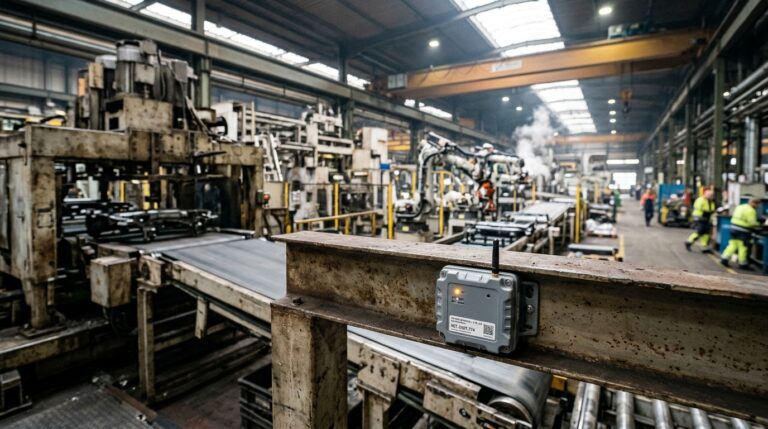
LoRaWAN offers long range and strong obstacle penetration at very low power. Some vendors deploy LoRaWAN multi-sensors inside growing boxes and machinery, combining temperature, light, humidity, and capacitance readings in one compact device. The tradeoff: lower bandwidth and higher latency. Fine for 15-30 minute monitoring intervals, less suited for real-time actuator control.
Wired connections (Ethernet, RS-485, 4-20mA) remain the most reliable path for critical control loops. No interference, no battery replacement, no signal dropouts. The cost is cabling and installation labor, which scales with rack height and facility density.
The practical answer for most commercial farms is a hybrid architecture. Wire the critical loops: pH dosing, HVAC, irrigation valves. Use wireless for monitoring and environmental logging. And keep local control logic at the edge so a cloud outage doesn’t shut down your dosing system. A peer-reviewed sensor architecture explicitly supports both remote cloud connection and a local server fallback for exactly this reason.
Calibration and Drift: The Cost Nobody Budgets For
In a vertical farm’s warm, humid, chemically active environment, every sensor has a drift curve. Ignoring it doesn’t save money. It costs crops.
Humidity sensors drift from condensation and contaminants, while pH and EC probes foul from salt deposits and biofilm. CO2 sensors lose baseline accuracy over months. PAR sensors accumulate residue on optical surfaces in humid air. These aren’t edge cases. They’re the default behavior of probes in a controlled-environment agriculture setting.
A published cost model for a vertical farm monitoring system estimated nearly EUR 140,000 for the full infrastructure. Within the same study, individual CO2 sensors ran EUR 435 each, while chlorophyll-content sensors cost EUR 2,258 each. Hardware is a fraction of the total lifecycle cost. Calibration, cleaning, probe replacement, and the labor to maintain the network are the recurring line items that catch operators off guard.
A practical maintenance baseline:
- pH and EC probes: clean every one to two weeks, calibrate monthly, replace every six to twelve months.
- Humidity sensors: inspect monthly for condensation fouling, recalibrate quarterly.
- CO2 sensors: baseline check quarterly, replace NDIR elements per manufacturer schedule.
- PAR sensors: clean the optical surface weekly in humid environments.
- Flow sensors: inspect for biofilm or particulate buildup monthly.
Here’s the tell: if a reading looks perfectly stable for months in a vertical farm, the sensor is probably drifting alongside the environment, not reporting genuine stability. Redundancy at critical measurement points (a second pH probe on the same line, a backup temperature sensor on the same rack) catches drift before it costs a crop cycle. That’s not over-engineering. It’s insurance.
What $1.7 Billion in Failures Teaches About Sensor ROI
Bowery and Plenty raised a combined $1.7 billion. Both operated with advanced environmental monitoring and control systems. AeroFarms survived Chapter 11 only by closing R&D facilities, cutting staff in half, and refocusing on high-value microgreens.
The lesson isn’t that sensors don’t matter. Sensors are operating instruments. They reduce uncertainty, compress response time, detect failures early, and enable automation that removes manual labor. What they cannot do is create consumer willingness to pay premium prices for indoor-grown lettuce, or eliminate the energy physics that dominate a vertical farm’s cost structure. This same tension applies to indoor farming sensors more broadly. For a broader look at the economics, our analysis of smart vertical farming explores where the industry growth actually happens.
Current lettuce energy use runs 10-18 kWh per kilogram against a technical benchmark of 3.1-7.4 kWh/kg under optimized lighting and climate control. Energy accounts for roughly 90% of the carbon footprint in most published analyses. Sensors can identify waste, optimize LED schedules, and reduce HVAC overcorrection. They cannot change the thermodynamics of artificial photosynthesis.
The farms that survive treat their sensor stack as a tool for operational discipline, tying every measurement back to smarter vertical farming resource management:
- Fewer crop losses per cycle through faster detection and automated response
- Lower labor per kilogram through monitoring that replaces manual walkthroughs
- Data-driven crop selection based on what’s actually profitable to grow indoors, guided by vertical farming data analytics
- Energy allocation tied to production output, not facility uptime
The right question isn’t “which sensors should I buy?” It’s “which measurements will change a decision that improves my margin?” This margin-first mindset is the core of true vertical farming optimization. Start with the smallest stack that proves a material outcome. Expand where the data demonstrates payback.
If the bottleneck in your vertical farm isn’t the sensors themselves but the integration layer, getting reliable data from probes to controllers across metal-dense racks, making different hardware talk to the same platform, that’s the kind of problem we solve every day across industrial IoT. Explore our environmental tracking solutions or reach out directly.
Frequently Asked Questions
What sensors are essential in a vertical farm?
At minimum: temperature, relative humidity (ideally calculating VPD), CO2, PAR light, pH, electrical conductivity, and water level or flow. The exact list depends on your growing method and crop. A hydroponic NFT system prioritizes pH and EC. An aeroponic system adds pressure and nozzle-flow monitoring. Match the sensor to the water-delivery mechanism, not to a generic list.
How often should vertical farming sensors be calibrated?
It varies by type. pH probes need monthly calibration and weekly cleaning. Humidity sensors should be recalibrated quarterly. CO2 sensors need baseline verification every three to six months. In a humid, chemically active vertical farm, drift is not a question of if but when. Build calibration into your operating schedule, not your troubleshooting protocol.
How much does a vertical farm sensor system cost?
The range is wide. A small research rack can be instrumented for a few thousand dollars. A published academic model estimated nearly EUR 140,000 for a comprehensive commercial infrastructure, with individual chlorophyll sensors over EUR 2,200 each. The real cost is lifecycle: probes, mounting, calibration, cleaning, replacement, software, data transport, and labor.
Can sensors alone make a vertical farm profitable?
No. Sensors reduce crop loss, improve recipe consistency, and enable labor-saving automation. They cannot create a viable selling price, eliminate energy costs, or fix a weak distribution strategy. Bowery and Plenty spent over $1.7 billion combined and still failed. Sensing must be evaluated alongside crop margin, energy cost, labor model, and willingness to pay.
Do I need Wi-Fi or LoRaWAN for vertical farm sensors?
Most commercial farms benefit from a hybrid approach. Wire critical control loops (pH dosing, HVAC, irrigation) for maximum reliability. Use LoRaWAN or Wi-Fi for monitoring and environmental logging where real-time control isn’t required. Keep local control logic at the edge so your farm doesn’t lose pH regulation because the cloud connection dropped.




 +1 508 292 2210

4 Responses