

Every product listing for a solar powered asset tracker leads with the same headline: “10-year battery life.” “Set it and forget it.” “Zero maintenance.” And most of those claims are technically true, under laboratory conditions with perfect sun exposure, low reporting frequency, and a narrow temperature band.
The field is different. Your trailer sits under a bridge deck for three weeks. Your container gets stacked with the solar panel facing down. Your generator bakes in a dusty yard where 120°F days degrade lithium cells faster than the panel can charge them. The tracker that looked invincible on the spec sheet goes silent at the worst possible moment.
I’ve spent 15+ years deploying IoT tracking across aviation, maritime, and industrial supply chains. Solar trackers are genuinely useful tools, and the value ultimately comes down to how well the IoT tracking sensors turn raw data into real ROI. But the gap between what marketing promises and what the asset actually needs is where operational dollars disappear. This guide closes that gap.
What a Solar Powered Asset Tracker Actually Is
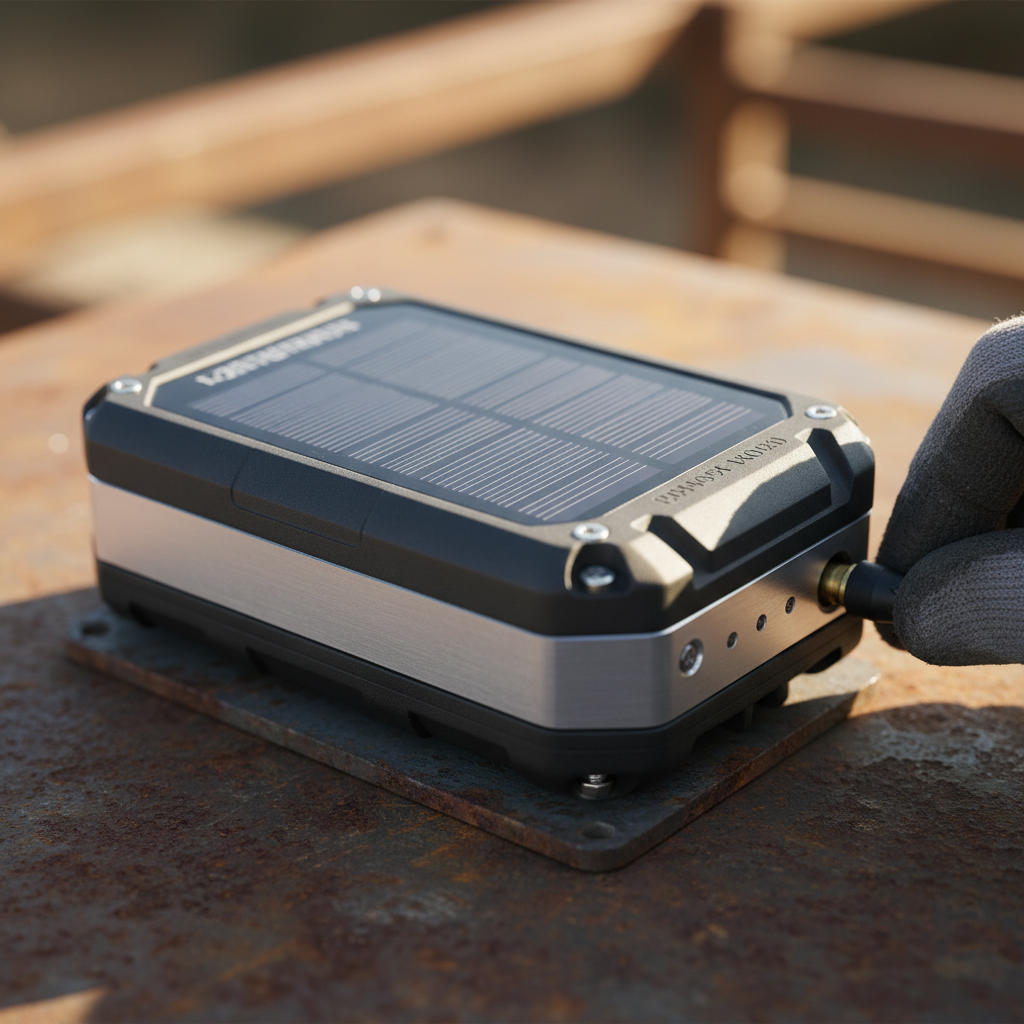
A solar powered asset tracker is a self-contained device that uses a photovoltaic panel to harvest energy, stores it in a rechargeable battery, determines its position via GNSS (GPS, GLONASS, Galileo, BeiDou), and transmits location and sensor data over a wireless network to a cloud platform.
The target is any asset with no wired power source and limited maintenance access. Trailers, shipping containers, generators, construction equipment, fishing boats, airport ground support, agricultural machinery, remote utility infrastructure.
The core design pattern: sunlight hits the panel, a power-management IC regulates the charge, a battery stores the energy for nights and cloudy periods, firmware schedules GNSS fixes and radio transmissions, and the data lands on a dashboard you can act on.
What separates a good solar tracker from a marketing slide is how honestly the manufacturer accounts for the energy budget. The SODAQ/e-peas TRACK Solar design uses a 6.9 x 6.9 cm monocrystalline panel, a 2,400mAh lithium-ion battery, and is rated for up to one month of autonomy without sunlight. That’s a specific, measurable claim with stated boundaries. Compare it to a product page that says “solar powered, long battery life” with no conditions attached, and you’ll see why the details matter more than the label.
How the Energy System Actually Works
The solar panel is not the power source. The battery is. The panel is the charger.
This distinction changes the question you should be asking. Instead of “does it have solar?” the operational question is: how many days of autonomy does the battery provide when the panel produces zero?
And zero-solar scenarios are common, not edge cases:
- A container stacked below others in a port yard. Panel blocked completely.
- A trailer parked inside a covered warehouse or under a canopy. No direct sunlight.
- A tracker mounted on the wrong side of the asset. Sun never reaches the panel.
- Northern latitudes in winter. Four hours of weak, low-angle light.
- Dust, bird droppings, or snow accumulation degrading charge efficiency over months.
Minew publishes refreshingly honest numbers for its LTB01-S LoRaWAN tracker: a 2,000mAh battery, 5V/40mA solar input, roughly one month of autonomy at a 30-minute reporting interval, or 12 months at a 12-hour interval. The catch? Continuous solar-powered operation requires intervals above one hour plus three to five hours of 100,000 lux direct sunlight daily. That’s full, unobstructed sun. Not overcast. Not indoors. Not “kind of sunny.”
When evaluating any solar tracker’s energy system, five variables determine whether the device will actually perform in your environment (and for environmental sensing, a dedicated moisture tracker follows the same logic):
- Battery capacity (mAh) and chemistry. Lithium-ion recharges; primary lithium doesn’t but often holds more energy per gram.
- Zero-sun autonomy at your required reporting interval, not the manufacturer’s lowest-power mode.
- Panel efficiency under real conditions, including angle, latitude, dirt accumulation, and partial shading.
- Operating temperature range. Lithium cells lose capacity in extreme cold and degrade permanently in sustained heat.
- Low-battery alerts. The device should warn you before it goes dark, not just die silently.
A well-designed solar tracker with a 7,500mAh battery and conservative firmware can genuinely run for years on an exposed trailer roof in a temperate climate. That same device, mounted on a shaded construction crane in Scotland, might need battery service within months. Context determines performance. Not the spec sheet.
Choosing the Right Radio for Your Assets
The solar panel harvests energy. The radio spends it. Which radio you choose shapes update frequency, geographic coverage, service cost, and whether the tracker can report when it matters most.
No single connectivity option wins everywhere. That’s the uncomfortable truth most product pages skip.
| Connectivity | Best for | Typical update rate | Coverage boundary | Energy cost |
|---|---|---|---|---|
| LTE-M / NB-IoT | Trailers, containers, equipment on road networks | Minutes to hours | Urban, suburban; gaps in rural, ports, offshore | Moderate |
| LoRaWAN | Controlled sites with gateways (yards, ports, warehouses) | Minutes to hours | Limited to gateway range (2+ km open area) | Very low |
| Satellite (LEO) | Maritime, mining, agriculture, cross-border, remote | Hours (some support minutes) | Global, including oceans and deserts | Higher per message |
| Hybrid (cellular + satellite) | Assets crossing between covered and uncovered zones | Variable, policy-driven | Combined terrestrial + satellite | Depends on active radio |
Cellular LTE-M and NB-IoT remain the default for commercial fleets. Low data costs, frequent updates, broad coverage along highways and populated areas. Telic’s Solar tracker, for example, combines LTE Cat M1, NB2, and 2G fallback with multi-GNSS and BLE sensor connectivity in a slim IP6K9K container form factor. The limitation is real, though: coverage disappears in rural corridors, port canyons surrounded by stacked steel, and anywhere the asset goes genuinely off-grid.
Satellite is the answer for remote assets. Fishing boats on 15-day trips. Mining equipment in the Outback. Containers crossing oceans. Iridium Edge Solar advertises IP68, BLE, two-way over-the-air configuration, and up to 10 years of deployment. The tradeoff: airtime costs more per message, the antenna needs a clear view of the sky, and latency can stretch to minutes.
LoRaWAN excels inside a managed footprint. If you operate a port, rail yard, or warehouse complex with your own gateways, LoRaWAN trackers deliver remarkably low power consumption and near-zero airtime cost. Outside that gateway range, they’re deaf.
Hybrid is the category gaining ground fastest. Several manufacturers now offer devices whose firmware automatically routes messages over cellular or satellite based on availability, with some hybrid plans starting below $1 per device per month. This solves the route-variability problem but adds provisioning and billing complexity. On the standards side, 3GPP Release 17 established normative NB-IoT and LTE-M satellite access, and Release 18 adds positioning, mobility, and discontinuous-coverage improvements. The practical implication: expect more hybrid modem choices and less dependence on proprietary terminals over the next few product cycles.
Start with the asset’s geography. If it stays on covered routes, cellular wins on cost and frequency. If it goes beyond coverage, satellite is the only reliable option. If it regularly crosses between both, hybrid earns its complexity.
Where Solar Trackers Earn Their Keep
The commercial case is strongest where three conditions converge: the asset lacks wired power, maintenance access is expensive or rare, and the asset’s location (or misuse) carries measurable financial consequences.
Trailers and intermodal containers
This is the largest segment. A non-powered trailer might sit idle for weeks, travel across state lines, and return to a different yard. Without visibility, you’re estimating utilization. With it, you’re measuring.
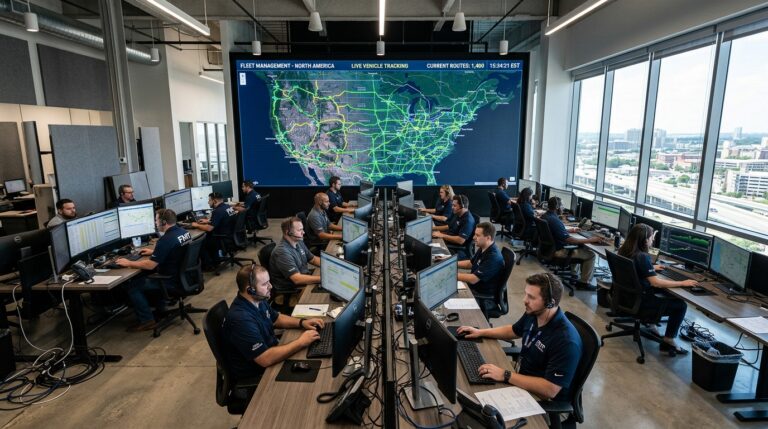
Recent integrations between solar-powered trailer tracker manufacturers and fleet management platforms have collapsed hardware, billing, and analytics into a single procurement path, making it easier to add trailer visibility without assembling a multi-vendor stack. Zonar describes event-based visibility for trailers and field assets, including dispatching, yard management, and door or temperature sensors.
Measurable outcomes from trailer tracking programs:
- Reduced dwell time. Knowing where trailers sit idle means you redeploy them instead of leasing more.
- Detention billing accuracy. Proof of arrival and departure times replaces disputed paperwork.
- Theft recovery. A motion alert at 2 AM on a parked trailer gives you a window to act before the asset disappears.
- Utilization metrics that feed fleet-sizing decisions quarter over quarter.
Maritime and fishing compliance
Small fishing boats often lack stable electrical systems and operate beyond cellular coverage for days. ORBCOMM reported that Ecoinsoft in Cambodia used the SC1000 to bring satellite monitoring to small fishing boats where it had previously been unfeasible. TOPFLYtech published a case describing 15-day fishing trips monitored by its SolarX 120, with IP67 protection, stored historical logs, and real-time positioning for regulatory compliance. For broader context on maritime and offshore asset tracking challenges beyond solar power, specialized solutions address satellite connectivity, harsh environmental conditions, and extended deployment cycles.
In both cases, solar solves a power problem that previously made tracking either impossible or prohibitively maintenance-intensive on small vessels.
Construction, airports, and remote infrastructure
Generators, welders, compressors, airport refuelers, tugs, baggage loaders. They share the same profile: expensive, mobile between sites, parked outdoors for extended periods, and almost never wired for telematics. SODAQ estimates that energy harvesting can eliminate battery changes for over five years, saving the equivalent of more than 50 non-rechargeable batteries per device over that period.
In aviation ground support, a pushback tug or a loader sitting on the wrong apron costs delay minutes. Knowing which equipment is where, in real time, without depending on manual radio calls or walk-the-ramp checks, directly reduces turnaround variability. That’s operational money, not theoretical savings.
Solar vs. Battery-Only vs. Wired: When Each Wins
Solar is not always the right answer. Sometimes a high-capacity battery device is simpler, cheaper, and more reliable for the specific environment. Sometimes wired power is available and the entire solar conversation is unnecessary.
| Power source | Best scenario | Autonomy | Main limitation |
|---|---|---|---|
| Solar + rechargeable battery | Outdoor, exposed, infrequent maintenance access | Years (with adequate sun) | Fails in shade, indoor, or panel-obstructed installations |
| Primary battery (non-rechargeable) | Mixed indoor/outdoor, shaded, or stacked assets | Years at low reporting intervals | No recharging; life is a finite countdown |
| Wired (vehicle or mains power) | Powered vehicles, fixed infrastructure | Unlimited while powered | Installation cost and wiring complexity; not feasible for unpowered assets |
Consider a practical example: the Digital Matter Oyster3 uses three replaceable lithium batteries, draws under 10 microamps in sleep mode, and can deliver an estimated 10 years of daily position fixes, 6 years with movement-based updates, or 3.5 years with hourly updates. No solar panel. No recharging. IP68 and IK07 rated. For an asset that spends significant time indoors, stacked, or in persistent shade, this type of battery-only tracker can outperform a solar device that never gets enough light to maintain its charge.
The decision is environmental, not technological. If your asset lives outdoors with a clear sky view and you need years of near-zero-maintenance tracking, solar earns its premium. If the asset moves between covered and exposed environments unpredictably, a high-capacity primary battery may deliver more consistent results.
Total Cost Over Three Years
The sticker price on a solar powered asset tracker is the smallest part of its cost. The real number is what you spend over 24 to 36 months including hardware, connectivity, platform access, installation, and any field service.
Public pricing reveals a wide spread. GoTrack lists a solar tracker at $79.95 with a $200 annual plan. Btracking lists devices at $169.99 to $199.99 before subscription. Globalstar’s SmartOne Solar sits at $350 before satellite airtime. Myriota’s hybrid plans start at $0.99 per device per month, though device pricing varies.
Here’s what a rough 3-year total cost of ownership looks like for a fleet of 100 cellular solar trackers:
| Cost element | Low estimate (per unit) | High estimate (per unit) |
|---|---|---|
| Hardware | $80 | $350 |
| Subscription / airtime (36 months) | $250 | $1,800 |
| Installation | $0 (magnetic mount) | $50 (bracket + labor) |
| Field service over 3 years | $0 | $100 |
| 3-year total per unit | $330 | $2,300 |
At 100 units, you’re looking at $33,000 to $230,000 over three years. The spread is enormous, driven primarily by subscription tier and update frequency. Industry best practice is to compare total cost over 24 to 36 months rather than shopping on hardware price alone, factoring in activation fees, airtime, platform access, and any field-service visits.
The cost most buyers overlook is the value of data they’re NOT getting. A cheap tracker with 12-hour updates won’t capture a theft in progress. An expensive satellite tracker reporting every minute on an asset that never leaves suburban highways is burning airtime for no operational gain. Match the investment to the asset’s risk profile and actual route, not to the lowest or highest line item on a quote.
Before You Deploy: A Field-Tested Checklist
After deploying trackers across aviation, port, and industrial environments over the years, here’s the checklist I walk through with every customer before they scale:
- Model the energy budget under worst-case light. Take the darkest month, the worst mounting angle, and assume panel obstruction will happen. If the battery can sustain your required reporting interval through that entire period, the device is viable. If it can’t, you need a larger battery, a lower reporting rate, or a battery-only alternative.
- Test network coverage on the actual route. Not the carrier’s coverage map. The actual route, including yards, ports, rural highway segments, and border crossings. Ship a sample device on a representative trip before committing to a fleet rollout. I’ve seen $200K deployments fail because someone trusted a coverage map that didn’t account for a rural dead zone on a critical corridor.
- Verify mounting and sky view. The GNSS antenna needs sky. The solar panel needs sun. The cellular or satellite antenna needs reasonable horizon visibility. A tracker bolted to the underside of a chassis fails on all three counts simultaneously.
- Address security and data handling upfront. NIST identifies device visibility, authentication, configuration, data security, and lifecycle inventory as core IoT risk areas. Encrypted transmission, authenticated firmware updates, role-based platform access, and data retention policies are baseline requirements for any fleet deployment, not optional extras.
- Settle privacy and consent before the first device ships. Tracking company-owned assets is standard practice. Tracking vehicles that employees drive home enters different legal territory. The U.S. Supreme Court’s 2012 decision in U.S. v. Jones established that attaching a GPS device and monitoring movement constitutes a Fourth Amendment search. Clear policies, employee notification, and legal review protect both the organization and its people.
- Confirm platform integration before procurement. A tracker that feeds a standalone dashboard creates a data silo. The operational value multiplies when position, sensor, and event data flow into your existing TMS, WMS, ERP, or maintenance system through documented APIs.
And one principle above all: test before you scale. Mount a handful of units on representative assets, run them through a full operating cycle including the worst season, and measure actual energy balance, connectivity uptime, and data quality. Vendor specs are a starting point. Field data from your own assets is the decision.
What’s Changing in Solar Asset Tracking
Three shifts are reshaping this market in 2026, and they all point the same direction: the tracker is becoming less about the panel and more about the system around it.
Hybrid connectivity is dissolving the cellular-vs-satellite boundary. With 3GPP Release 18 adding positioning, mobility, and discontinuous-coverage improvements for satellite IoT access, more devices will seamlessly switch between terrestrial and satellite radios. IoT Analytics reports that legacy satellite connectivity modules held 98% of the satellite IoT market in 2024 but may fall to 49% by 2030 as standards-based alternatives gain ground. For buyers, this means less lock-in to proprietary terminals and more flexibility in how assets report across changing geographies.
The tracker is also evolving into a sensor hub. Modern solar devices pair GNSS with BLE 5.x, accelerometers, temperature, light, and door sensors. Instead of transmitting a constant location stream (expensive in energy and airtime), the device transmits an event: “the container door opened at this location at this time.” Event-driven reporting is more efficient for solar autonomy and far more useful operationally than a mechanical 5-minute ping.
Finally, sustainability claims are facing harder questions. SODAQ estimates its solar design saves the equivalent of 50+ disposable batteries per device over five years. That’s a meaningful number. But a complete lifecycle assessment must include panel manufacturing, lithium cell degradation, enclosure materials, and end-of-life recycling. Solar tracking is almost certainly better for the environment than disposable-battery tracking over a long deployment. But “green” is not automatic, and buyers with ESG reporting obligations should ask manufacturers for the full accounting.

Frequently Asked Questions
How long does a solar powered asset tracker last without sunlight?
It depends on battery capacity and reporting interval. Published examples range from one month (SODAQ TRACK Solar, 2,400mAh battery) to several months at very low reporting frequencies. Always request zero-sun autonomy at your specific update rate, not the manufacturer’s peak-sun performance figure.
Do solar asset trackers require a subscription?
Almost always. Cellular and satellite trackers need airtime for data transmission, plus cloud platform access for maps, alerts, and APIs. Subscription costs range from roughly $7/month for basic cellular plans to $50+ for enterprise satellite service. Factor the subscription into your 3-year total cost of ownership, not just the hardware price.
Can I use a solar tracker on a container that gets stacked?
You can, but a stacked container may block the solar panel entirely. The device runs on stored battery power until it’s unstacked. If your containers are regularly stacked for weeks, a high-capacity battery-only tracker like the Digital Matter Oyster3 may be more reliable than a solar unit that can’t recharge.
Is cellular or satellite connectivity better for solar trackers?
Cellular (LTE-M, NB-IoT) is more cost-effective and supports higher update rates where terrestrial coverage exists. Satellite is necessary for assets that operate beyond coverage: open ocean, remote mining sites, deserts, rural agriculture. Hybrid devices that switch automatically between both networks are available and growing fast in 2026.
How accurate is the GPS position?
Under good sky conditions, published accuracy ranges from 1.5 m to 5 m CEP depending on the GNSS chipset and constellation support. Real-world accuracy degrades near buildings, under tree cover, or inside metal structures. Ask about cold-start fix time too: a device waking from deep sleep may take longer to acquire an accurate position.
What’s the difference between asset tracking and shipment tracking with these devices?
Shipment tracking ends at delivery. Asset tracking follows the physical asset through its entire lifecycle: deployment, transit, idle time, return, maintenance, and reuse. A solar tracker on a reusable container or trailer is an asset tracking tool. It earns value across every cycle, not just one trip. If your container pool feels invisible after delivery, that’s the gap asset tracking closes.
If you’re evaluating solar trackers for your fleet or asset pool, we can help match the right device, connectivity, and platform to your actual operating conditions. If you’re wondering where to buy a tracking device, browse our full asset tracking device catalog or reach out to our team directly.






 +1 508 292 2210

2 Responses