

The environmental monitoring sensor market crossed $14.4 billion in 2024 and is on track for $20.1 billion by 2030. Billions of dollars in hardware, software, telemetry, and services. And yet, the most common failure I see in the field has nothing to do with the sensor itself.
The sensor works. The system around it doesn’t.
Environmental monitoring sensors have become cheap enough to deploy at scale, connected enough to stream data in real time, and small enough to fit inside a shipping container, a soil probe, or a cold-chain pallet. The technology is not the bottleneck anymore. What kills most deployments is the gap between collecting a reading and doing something useful with it.
This article is for operations managers, compliance leads, and engineers who need environmental monitoring sensors that produce decisions, not just dashboards. If you’ve ever watched a green-dot map go red and still not known who should act, or what they should do, you already know the problem I’m describing.
What Environmental Monitoring Sensors Actually Do
Environmental monitoring sensors are instruments or connected devices that measure physical, chemical, or biological conditions in air, water, soil, or built environments. They convert a condition (temperature, humidity, particulate concentration, dissolved oxygen, soil moisture, gas levels) into a data signal that can trigger a decision, feed a compliance report, or warn someone before a threshold is crossed.
That definition sounds simple. It isn’t. The word “environment” covers everything from the air inside a pharmaceutical cleanroom to the methane plume above an oil field. USGS defines water quality alone through physical, chemical, and biological characteristics, each demanding a different transduction method, calibration regime, and maintenance cycle.
There is no universal environmental sensor. There are measurement problems, each requiring a specific tool matched to a specific decision.
The measurement hierarchy helps clarify this. At the top sit reference-grade instruments: expensive, accurate, legally defensible, but limited in how many you can deploy. Below them sit lower-cost connected sensors: portable, dense, fast to deploy, but less accurate and prone to drift. Above both, satellites and aircraft provide broad regional context but cannot tell you what’s happening at street level or inside a warehouse.
WHO recommends hybrid networks that combine reference monitors, low-cost sensors, satellites, and models. Not because any single approach fails. Because each covers a different piece of the picture.
Six Domains, Six Different Measurement Problems
The temptation in any “types of environmental sensors” article is to list ten categories and move on. The reality is that each domain comes with its own deployment risks, calibration headaches, and failure modes. Here’s what matters operationally:
| Domain | Key Variables | Common Approach | Main Deployment Risk |
|---|---|---|---|
| Ambient Air | PM2.5, PM10, ozone, NO2, SO2, CO, VOCs, CO2 | Optical particle counters, electrochemical gas sensors, reference analyzers | Humidity interference, cross-sensitivity, siting errors, calibration drift |
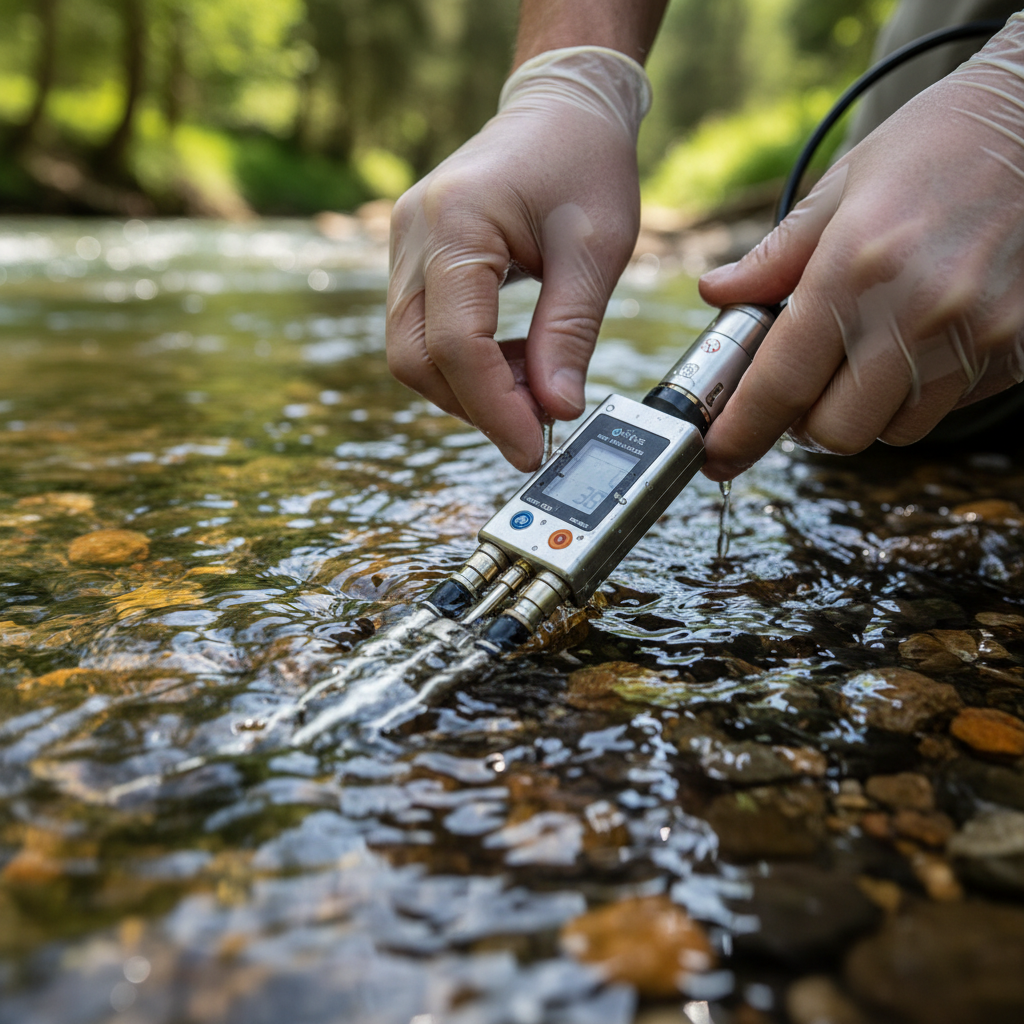
| Water Quality | pH, dissolved oxygen, conductivity, turbidity, temperature, depth, nutrients | Multiparameter sondes, optical sensors, electrodes, lab confirmation | Biofouling, sediment, drift, poor representativeness |
| Soil & Agriculture | Moisture, matric potential, temperature, salinity | Capacitance probes, tensiometers, weather stations | Soil heterogeneity, wrong placement relative to root zone |
| Weather & Atmosphere | Wind, precipitation, pressure, humidity, visibility, radiation | Anemometers, radar, barometers, hygrometers, ceilometers | Exposure, icing, power, calibration traceability |
| Industrial Emissions | SO2, NOx, CO2, CO, particulates, mercury, flow | Continuous emission monitoring systems (CEMS) | QA burden, uptime requirements, regulatory audit trail |
| Remote Sensing | Methane, CO2, smoke, vegetation, water surface | Satellite/aircraft spectrometers, UAVs | Revisit time, cloud cover, daylight, retrieval assumptions |
A few things stand out from this table.
First, the deployment risk column matters more than the sensor column. A perfectly calibrated soil-moisture probe placed in the wrong soil texture or outside the wetted irrigation zone will generate confident, wrong data. A turbidity sensor with a fouled optical window will show calm water while the river carries sediment.
Second, most environmental monitoring failures are maintenance failures. A USGS guidance document on continuous water-quality monitors requires representative siting, at least two cross-section surveys per year, field checks before and after servicing, and approved calibration solutions. That’s not bureaucratic overhead. That’s what separates data from noise.
Third, the domains are converging. A logistics operation monitoring cold-chain temperature inside a container is solving an environmental monitoring problem. So is a grower running greenhouse environmental monitoring, a port operator tracking humidity exposure on ground equipment, or an MRO shop logging ambient conditions around sensitive aerospace parts. The sensors are the same physics. The decisions they serve are what differ.
The Accuracy Problem Most Buyers Skip Past
Accuracy is not one number on a spec sheet. A sensor can be precise but biased. Responsive but poorly selective. Accurate in a lab but unreliable in a humid, dusty, vibrating real-world environment.
The low-cost air sensor boom illustrates this perfectly. PurpleAir now reports over 35,000 sensors in more than 100 countries, making real-time air quality visible at a density no reference network can match. But a peer-reviewed study found that uncorrected PurpleAir PM2.5 readings can be biased and become nonlinear above 300 micrograms per cubic meter during extreme wildfire smoke. The readings look plausible. They just aren’t correct without a correction model validated against a reference instrument, which is why a properly designed air quality monitoring system matters more than the raw sensor.
This doesn’t mean low-cost sensors are useless. Berkeley Lab researchers concluded that low-cost home monitors can provide actionable information during wildfire events. The point is that “actionable” requires knowing the sensor’s limits and correcting for them.
Water monitoring tells the same story from a different angle. USGS guidance notes that commercial turbidity sensors commonly have accuracy of plus or minus 5% or 2 NTU, whichever is greater. That sounds tight until you realize a dirty optical window, trapped bubbles, or an unrepresentative intake location can make the readings plausible but wrong for weeks before anyone notices. This is why choosing the right water quality monitoring sensors matters as much as how you maintain them.
And then there’s Flint. A residential sample collected after 45 seconds of flushing contained more than 1,000 parts per billion of lead. The EPA described the sampling techniques as seriously flawed. Sensors didn’t fail in Flint. Sampling did. Governance did. The lesson: sensor procurement cannot compensate for biased sampling, weak protocols, or delayed escalation.
The practical control loop looks like this: collocation against a reference, initial calibration, deployment, scheduled maintenance, drift detection, and revalidation. Skip any step and you’re building confidence on a foundation that erodes over time. Budget for it from day one, or budget for bad decisions later.
Selecting Sensors: Start With the Decision, Not the Datasheet
Most procurement conversations start with the wrong question. “What’s the best environmental monitoring sensor?” is like asking “What’s the best vehicle?” without saying whether you’re hauling freight across the Atlantic or driving to the airport.
The right first question: what decision does this reading need to support?
If the decision is legal compliance (FDA temperature logs, EPA CEMS, PFAS monitoring), the method is often prescribed. You don’t choose. The regulation does. Your job is implementing the approved method with a defensible audit trail.
If the decision is operational (irrigate or wait, dispatch a crew, close an outdoor event, adjust a process setpoint), you need a sensor accurate enough to distinguish the action threshold from noise, fast enough to be useful, and connected enough to reach the person who acts.
If the decision is screening (where should we deploy permanent monitors? which zones have exposure problems?), a lower-cost sensor with known bias may be exactly right, as long as you don’t confuse screening data with compliance data.
Here’s a selection framework that works in the field:
- Define the consequence of a false positive and a false negative. If a false negative means spoiled pharmaceutical inventory or a missed emissions exceedance, you need reference-grade or approved methods. If a false positive means an unnecessary irrigation cycle, a less expensive sensor may be fine.
- Specify the total cost per valid data hour, not just the purchase price. Sensor drift, fouling, battery replacement, cellular data plans, calibration gases, cloud subscriptions, field visits, and eventual disposal can dominate lifetime economics. A $200 sensor with $1,500 in annual service costs is a $1,700 per year commitment.
- Require a pilot with collocation. Before scaling to 50 or 500 units, deploy a handful alongside a known reference for at least one full cycle of conditions (seasons, process states, cleaning intervals). Compare readings. Document the correction model.
- Evaluate the data pipeline, not just the hardware. Can you export raw data? Do you own the calibration records? Is the API documented? What happens if you switch vendors? Managed sensing-as-a-service models can reduce deployment friction, but they raise questions about data portability, algorithm transparency, and exit costs.
- Budget maintenance from day one. University of Arizona guidance on soil sensors recommends removing blockages, refilling water columns, checking seals, and verifying readings against manual measurements. If your deployment plan doesn’t include a maintenance schedule and trained personnel, your data will degrade silently.
The interoperability question deserves its own mention. NIST identifies interoperability testing and certification as a solution to IoT sensor-device compatibility challenges. In practice, most organizations end up with sensors from multiple vendors across multiple domains. If those sensors can’t feed a common data layer with consistent timestamps, units, calibration metadata, and uncertainty flags, you’ll spend more time reconciling data than acting on it.
Where Real ROI Shows Up
The strongest environmental monitoring business cases link one measurement to one intervention. When the loop is tight, the numbers are clear.
Clemson University reported that using soil-moisture sensors can increase average farm net income by almost 20%. The mechanism is simple: a probe in the root zone tells the farmer when to irrigate and when to wait. No more calendar-based watering. No more guessing. EPA WaterSense evidence suggests at least 20% water savings from soil-moisture-based irrigation control, potentially saving millions of gallons across operations.
In supply chain and logistics, environmental monitoring sensors protect cargo value directly. A temperature excursion inside a pharmaceutical container during transit doesn’t just damage product. It triggers a deviation investigation, potential lot rejection, regulatory reporting, and (if caught late) liability. A connected sensor that alerts within minutes of a threshold breach can save a shipment worth orders of magnitude more than the device itself. Modern vessel monitoring systems integrate environmental sensors throughout the supply chain to track these conditions across maritime operations.
Industrial emissions monitoring produces ROI through compliance cost avoidance. EPA states that CEMS are required under some regulations for continual compliance determinations. The cost of a CEMS installation is high. The cost of an emissions exceedance penalty, production shutdown, or permit revocation is higher, which is why industrial environmental monitoring pays for itself.
The weak business case is the one I see most often: a dashboard that collects readings without a decision owner, baseline, service-level target, or response protocol. If nobody is assigned to act when a threshold triggers, and no workflow exists to escalate, the sensor becomes expensive decoration. Green dots on a screen are not ROI, which is exactly why environmental monitoring automation closes the gap between a reading and an action.
Regulation Is Writing Your Requirements
Two regulatory developments are reshaping environmental monitoring sensor procurement in 2026.
First, the EU Directive 2024/2881 requires standardized measurement techniques and common criteria for sampling-point number and location. It also mandates work on standards for evaluating sensor-system performance for gaseous pollutants, PM10, and PM2.5. The practical effect: sensor deployments in the EU will increasingly need to demonstrate traceable methods, documented uncertainty, and interoperable reporting. A black-box device with proprietary algorithms and no calibration history won’t survive an audit.
Second, EPA requires public water systems to complete initial monitoring for specified PFAS by 2027. PFAS detection requires specialized analytical methods, not a generic pH or conductivity probe. But the compliance timeline creates ripple demand for broader water-quality monitoring infrastructure, sampling protocols, and data management systems.
Community monitoring programs add a third vector. EPA announced funding for community air monitoring in locations like New Bedford, Massachusetts ($391,821 for air monitoring at 20 locations). California’s AB 617 program requires air districts to report community monitoring data for selected communities. These programs demonstrate that environmental monitoring is also a governance tool. Sensor placement, public data access, community ownership, and response authority matter as much as the hardware specification.
For operators in logistics, aviation, and industrial supply chains, the takeaway is this: compliance programs are moving toward auditable, interoperable data pipelines. If your environmental monitoring data lives in spreadsheets, vendor-locked dashboards, or disconnected silos, the regulatory direction is running away from you.
What’s Shifting in 2026
Several trends are converging fast enough to change buying decisions this year.
Hybrid networks are becoming standard practice, not experimental. WHO’s recommendation to complement reference-grade stations with low-cost sensors, satellites, and models is no longer a research aspiration. NASA’s TEMPO spectrometer now provides hourly daytime air-quality observations over North America, with spatial detail down to a few square miles and data delivery in under three hours. Combine that with ground-level IoT sensors and you get context (satellite) plus precision (ground). Neither alone is sufficient.
Edge AI is moving closer to the sensor. Current research uses machine learning for classification, anomaly detection, and sensor fusion, but also reports noisy data, interoperability limits, and computational complexity as real constraints. The winning design is a tiered system: edge processing for fast alerts, cloud processing for fleet-wide training and audit, and raw data preservation for later review. A model that only sends conclusions (without retaining the evidence) creates an accountability gap.
Managed sensing is competing with owned hardware. Subscription models that bundle sensors, connectivity, calibration, data transmission, and maintenance can shorten deployment time. But they shift control. Buyers should require exportable raw data, documented calibration methods, transparent algorithms, and a clear exit plan before signing a multi-year service contract.
Maintenance and lifecycle cost are becoming differentiators. The market is starting to measure total cost per valid data hour, not just unit price. Devices that self-diagnose, expose health metrics, support remote firmware updates, and preserve auditable maintenance history will win over devices that are simply cheap at the point of purchase.

Frequently Asked Questions
What are environmental monitoring sensors?
Instruments or connected devices that measure conditions like air quality, water chemistry, soil moisture, temperature, humidity, gas concentrations, or weather parameters. The right sensor depends on the measurand and the decision it needs to support. There is no single universal device.
Are low-cost air quality sensors accurate enough for compliance?
Not on their own. WHO recommends them as complements to reference-grade instruments, not replacements. They’re valuable for spatial coverage, screening, and community awareness, but they require periodic calibration against a reference and a documented correction model to produce defensible data.
How often should environmental sensors be calibrated?
No universal interval applies. It depends on the sensor type, measurand, exposure conditions, manufacturer recommendations, and regulatory requirements. USGS water-quality guidance requires field checks, calibration verification, and recurring cross-section surveys. Define calibration triggers (drift thresholds, maintenance events) alongside calendar schedules.
Can a general environmental sensor detect PFAS in water?
No. Standard pH, turbidity, conductivity, or dissolved-oxygen probes do not detect PFAS. EPA requires specified analytical methods for PFAS monitoring, with initial compliance deadlines by 2027. A credible PFAS program needs specialized sampling, laboratory analysis, chain of custody, and reporting workflows.
What is the difference between a sensor and a monitoring system?
A sensor or transducer produces a response to a measurand. A monitoring system adds power, data acquisition, communications, storage, quality assurance, alerts, and governance. Choosing the right environmental monitoring equipment means looking beyond the sensor to the full system. Continuous Emission Monitoring Systems (CEMS) are a clear example: they combine analyzers, sampling, data acquisition, and regulatory reporting into an auditable whole.
Do satellites replace ground-based environmental sensors?
No. Satellites provide regional context and broad coverage, while ground sensors deliver local concentration measurements and validation. NASA’s TEMPO provides hourly daytime observations over North America but requires ground-truth comparison. The strongest monitoring architectures combine both.
If your operation needs connected environmental monitoring for temperature, humidity, soil, or water across distributed assets or field sites, that’s the territory we work in every day. Take a look at our environmental tracking devices, or reach out directly at datanetiot.com/contact-us. We’ll tell you honestly whether our solutions fit your measurement problem, or whether you need a different approach entirely.





 +1 508 292 2210

3 Responses