

Somewhere on your ramp right now, a belt loader sits idle in the wrong spot. A tow bar is “missing.” (It’s behind Hangar 3, where someone left it Tuesday.) A fuel truck is 200 hours overdue for maintenance, but nobody flagged it because the schedule runs on calendar, not actual usage.
These aren’t edge cases. About 27,000 ramp incidents happen globally every year, roughly one per 1,000 departures. Aircraft ground damage costs alone are on track to exceed $8 billion by 2030. And 94% of that damage comes down to three patterns: equipment striking parked aircraft (39%), aircraft parts contacting objects while parked (23%), and aircraft hitting objects during towing (32%). Every single one involves someone not knowing where something was.
Airport equipment tracking exists to close that gap. But after years of deploying IoT tracking across aviation and logistics operations, I keep seeing the same mistake: implementations that stop at a dot on a map. The real financial impact sits downstream, in usage-based maintenance, turnaround analytics, regulatory compliance, and the structured data layer that now feeds AI and autonomous ramp systems.
Here’s what the technology actually looks like in 2026, where the ROI hides, and what changes in the next 24 months.
What Airport Equipment Tracking Actually Covers
Airport equipment tracking is the real-time monitoring, management, and lifecycle oversight of ground support equipment (GSE). That includes baggage carts, tugs, belt loaders, mobile GPUs, passenger stairs, tow bars, fuel trucks, de-icing rigs, pushback tractors, and every other rolling or stationary asset that keeps aircraft turning between flights.
The market splits these into two categories. Mobile GSE (vehicles and rolling equipment that moves across the apron) accounts for 47.3% of tracking spend in 2026. Fixed or stationary assets (jet bridges, fixed GPUs, hydrant fueling systems) make up the rest.
Here’s the inversion most operators miss: fixed assets represent about 63.7% of the fleet by unit count, but mobile assets dominate tracking budgets. The logic is simple. A jet bridge doesn’t disappear. A dolly does.
Tracking shouldn’t stop at “find it,” though. The framework that actually works in practice stacks three layers:
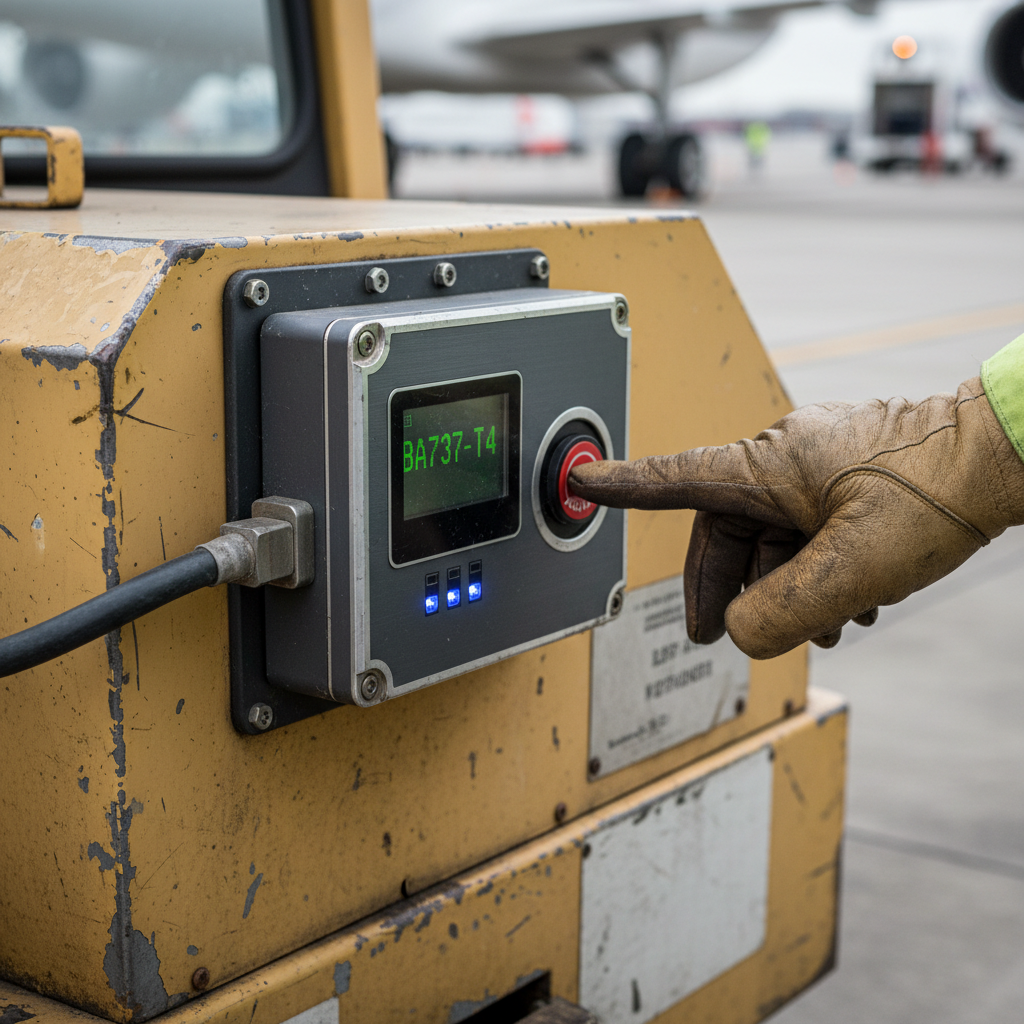
- Identification: every asset gets a unique physical tag (barcode, QR, RFID, BLE beacon, GPS tracker, or some combination).
- Software: a CMMS or fleet management platform that logs maintenance history, location, assignment, status, and utilization data.
- Intelligence: AI that reads the data to predict failures, optimize routing, flag underutilization, and prevent incidents before they happen.
Most airports I talk to have layer one partially deployed and layer two in fragmented form (spreadsheets, legacy CMMS, or nothing at all). Layer three barely exists outside a handful of tier-one hubs. The gap between “we know where our carts are” and “our system prevents failures” is where billions in avoidable cost sit.
The Technology Stack: No Single Protocol Covers Your Ramp
The persistent myth in airport equipment tracking is that GPS solves the problem. It doesn’t. GPS gives you outdoor location on vehicles, and it does that well. But the moment a tow bar rolls into a terminal, a calibrated tool enters a hangar, or a dolly sits in a covered staging area, GPS goes dark. This is where comprehensive geolocation tracking systems that layer multiple technologies become essential.
A properly architected deployment layers multiple technologies, each covering what the others can’t:
| Technology | Best for | Range | Accuracy | Battery life | Key limitation |
|---|---|---|---|---|---|
| GPS / GNSS | Outdoor vehicles, perimeter | Global | 3-10 m | Weeks to months | Indoor dead zones; spoofing risk |
| RFID | Inventory audits, staging zones | Short | Item-level | Passive (no battery) | No real-time continuous location |
| BLE beacons | Indoor proximity (terminals, hangars) | 10-50 m | Room-level | 1-3 years | Lower positional accuracy |
| UWB | Indoor precision, collision avoidance | 10-30 m | 10-30 cm | Months | Higher cost, complex installation |
| Cellular IoT (LTE-M / NB-IoT) | Intermittent reporting, wide-area | Wide | GPS-level | Years | Carrier subscription fees |
| LPWAN (LoRaWAN / Sigfox) | Long-life tags on low-data assets | 5-15 km | 10-100 m | 5-10 years | Low data throughput |
The engineering challenge that trips up most deployments is the indoor-outdoor handoff. When a tug exits a hangar (GPS picks up) and enters a terminal concourse (GPS drops, BLE takes over), the transition needs to be seamless. Systems that lose track of assets in this limbo zone create the exact blind spots that cause ramp damage and turnaround delays.
The GNSS risk most operators aren’t pricing in
GPS spoofing and jamming events affecting commercial aviation grew from a few dozen per day in February 2024 to more than 1,100 per day by August of that year. A single United Airlines flight from New Delhi to the New York area was spoofed for the entire journey. Position jumps of 50 to several hundred miles were reported.
This isn’t just an inflight concern. Ground vehicles that rely on GPS for geofencing, routing, and collision-avoidance logic share the same vulnerability. Insurance underwriters have started penalizing single-modality tracking setups. The baseline for any new deployment should be multi-modal positioning: GNSS plus at least one independent fallback (inertial sensors, BLE, or cellular triangulation).
Where the ROI Actually Lives
Nobody buys a tracking system because the technology is interesting. You buy it because it saves money or prevents loss. Here are the four financial vectors where airport equipment tracking pays for itself.
Turnaround time compression
Industry analysis estimates that eliminating one minute of average turnaround time would save the airline industry roughly $1 billion annually. At the single-hub level, if your airport handles 300 departures a day and visibility shaves even 30 seconds off average turnaround, the cascade effect on on-time performance, gate utilization, and crew scheduling shows up within a quarter.
Maintenance model shift
Delta moved its GSE maintenance from fixed six-month schedules to a 500-hour usage-based preventive model after deploying fleet tracking across 1,400 units in Atlanta. Equipment that’s heavily used gets serviced when it needs it. Equipment that barely moved stops getting pulled off the line for calendar inspections. Lower cost and higher readiness, simultaneously.
Ground damage avoidance
With aircraft ground damage projected to cross $8 billion by 2030, every proximity-alert layer justified by tracking data carries a clear dollar value. The three hazard patterns (equipment strikes, parts contact, towing collisions) all require one thing: knowing where every vehicle is relative to every parked aircraft, in real time.
Regulatory compliance and incentive capture
The LAX GSE Emissions Reduction Program mandates that airlines and ground handlers report equipment inventory and emissions through a dedicated portal. As electric GSE adoption scales, airports with structured utilization data qualify for clean-vehicle tax credits estimated at 18-22% of total cost of ownership. Without tracking data, there’s no proof of compliance and no pathway to those credits.
What Delta’s 400,000-Piece Fleet Proves at Scale
Delta operates over 400,000 individual pieces of GSE globally. That scale alone makes the case for tracking as infrastructure, not a nice-to-have feature.
Key data points from their deployment:
- 1,400 GSE units tracked in Atlanta via the Adveez FAMA platform, with interactive mapping, customized alerts, and utilization reporting.
- Maintenance shifted from calendar to 500-hour usage triggers, cutting maintenance spend while improving equipment availability.
- In-house “Baggage AI” routes 250 ramp agents using real-time flight data, bag locations, and connection-time windows, delivering a nearly 30% improvement in bag transfer rates.
- 15 autonomous tugs were targeted for operation by end of 2025, with zero aircraft damage incidents or injuries from autonomous jet bridges and tugs reported to date.
The lesson from Delta isn’t that you need a fortune in GSE. It’s that tracking data becomes the foundation for everything else: predictive maintenance, AI routing, autonomous operations, compliance reporting. Without tagged, connected assets, none of those upper layers have anything to work with.
The Third-Party Problem: Tracking Equipment You Don’t Own
Here’s a reality most tracking vendors sidestep: the majority of GSE on a busy ramp isn’t owned by the airport.
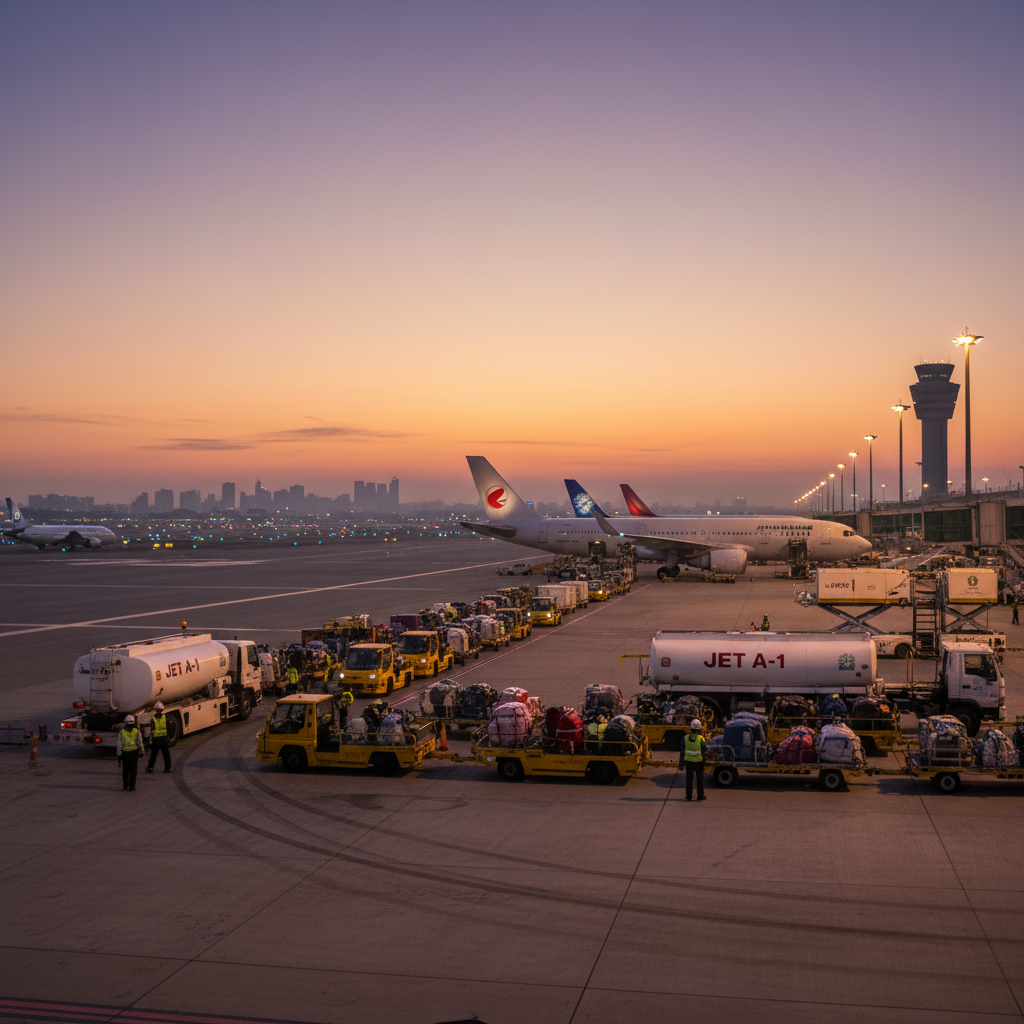
Airlines own some of it. Ground handlers (Swissport, dnata, Menzies, WFS) own more. Third-party contractors bring their own. All of it operates in the same airside environment, affecting the same turnaround times and the same safety scores.
This creates three problems:
- Fragmented visibility. The airport sees its own assets. The airline sees its own. The handler sees its own. Nobody has the full picture of what’s on the ramp at any given moment.
- Accountability gaps. When a dolly damages an aircraft, whose dolly was it? Without a shared tracking layer and timestamped evidence, the incident report turns into a negotiation.
- Interoperability pressure. Airport Collaborative Decision Making (A-CDM), now implemented across 29 European airports, depends on real-time data exchange between airlines, handlers, and airport operators. A tracking system that can’t share data across stakeholders solves half the problem at best.
When evaluating platforms, test for multi-tenant visibility. Can the airport see all tagged assets regardless of owner? Can each operator access only their own data while contributing to a shared operational layer? A “no” to either question means you’re buying a point solution, not infrastructure.
The Next 24 Months: Autonomous GSE and AI on the Ramp
Tracking is shifting from “where is it?” to “where is it going, what does it see, and should it be allowed to proceed?” Once the asset drives itself, the data requirements change fundamentally.
Autonomous deployment has left the pilot stage
dnata deployed Level-3 autonomous baggage tugs at Dubai World Central in July 2025, a $1.6 million project using TractEasy and EasyMile technology, with a Level-4 upgrade targeted for early 2026. Autonomous dolly-tug platforms are now being tested at multiple airports worldwide following initial validation at Amsterdam Schiphol. The autonomous electric GSE market is projected to grow from $1.8 billion in 2025 to $6.4 billion by 2034, a 15.2% CAGR.
AI is consuming tracking data for operational control
INFORM identifies five AI applications with the highest current value for ground handlers: predictive maintenance, decentralized task allocation, cargo staging optimization, weather and disruption forecasting, and autonomous ramp robotics. Every one of them feeds on the telemetry stream that tracking systems produce. Without tagged, connected assets, AI has no input layer. This is why tracking is no longer a standalone category. It’s the data fabric for the next-generation ramp.
Digital twins enter production
Digital twin deployments are moving from concept to production across major airports in 2026. They consume the same real-time telemetry as tracking platforms but add a simulation layer: test new gate configurations, rehearse emergency scenarios, validate autonomous-vehicle routes before going live. The tracking infrastructure you install today becomes the sensor network for the digital twin your airport will need by 2028.
Choosing the Right Architecture
The vendor landscape splits along two axes that matter at procurement time.
Aviation specialists (Adveez, Litum, Sensolus, Blumenbecker, Targa Telematics, and similar providers) build workflows tailored to airside operations: apron geofencing, A-CDM data hooks, turnaround dashboards, aviation-grade certifications. They win on operational context.
General telematics platforms (Geotab, Verizon Connect, and others) offer cross-fleet management at lower per-device cost. They win on breadth and price. If your fleet includes both airside GSE and landside vehicles, a general platform might serve both. If A-CDM compliance or turnaround optimization is the priority, you need a specialist.
Three questions to pressure-test any vendor during evaluation:
- Multi-modal positioning. Does the system combine GNSS with at least one independent fallback (BLE, inertial, cellular)? Single-modality GPS is a liability in 2026.
- Interoperability. Can the platform exchange data with airline CMMS systems, A-CDM networks, and third-party handler tools? If not, you’re buying a data silo.
- AI readiness. Is telemetry data timestamped, structured, and exportable in formats that feed predictive models? If the system only outputs PDFs and static dashboards, it won’t support the intelligence layer you’ll need in two years.
Frequently Asked Questions
What is airport equipment tracking?
Airport equipment tracking is the real-time monitoring and lifecycle management of ground support equipment (GSE) used on the ramp and apron: baggage carts, tugs, belt loaders, fuel trucks, mobile GPUs, stairs, de-icers, and similar assets. Modern systems combine physical identifiers (GPS, RFID, BLE, UWB), a fleet management or CMMS platform, and increasingly an AI layer for predictive maintenance and routing optimization.
What technologies are used for airport ground equipment tracking?
Common technologies include GPS/GNSS for outdoor vehicle location, RFID for inventory audits, BLE beacons for indoor proximity in terminals and hangars, UWB for centimeter-level indoor precision, and LPWAN protocols (LoRaWAN, Sigfox) for long-life tags on slower-moving assets. No single protocol covers the full airport envelope. Effective systems layer multiple technologies with seamless handoff between indoor and outdoor zones.
How much does airport equipment tracking cost to deploy?
Hardware tags typically range from a few hundred dollars per unit for cellular or LPWAN trackers, with SaaS platform fees added. Solar-powered trackers (like those from Blumenbecker) operate for multiple years without battery changes. At the high end, autonomous baggage tractors run $280,000 to $420,000 versus $80,000 to $120,000 for conventional units, though U.S. clean-vehicle tax credits can reduce TCO by 18-22%.
What ROI can airports expect from equipment tracking?
Documented returns include elimination of calendar-based maintenance waste (Delta’s 500-hour usage model), nearly 30% improvement in bag transfer rates (Delta’s Baggage AI), reduced ramp accidents (from a baseline of 27,000 incidents per year globally), and regulatory-incentive capture through fleet utilization data. Industry estimates suggest that each minute shaved off average turnaround could save roughly $1 billion annually across the airline sector.
How does GPS spoofing affect ground equipment tracking?
GPS spoofing can cause vehicles to report false positions, disrupting geofencing, proximity alerts, and apron routing logic. Daily spoofing events affecting commercial aviation grew from a few dozen in early 2024 to over 1,100 by mid-year. Mitigation requires multi-modal positioning: GNSS paired with inertial backup, BLE, or cellular triangulation. Insurance underwriters increasingly require this redundancy for new deployments.
What is A-CDM and why does it matter for equipment tracking?
Airport Collaborative Decision Making (A-CDM) is a protocol for real-time data sharing between airlines, ground handlers, and airport operators. Implemented at 29 European airports, it ties equipment availability, turnaround status, and handler coordination into a shared operational picture. Tracking platforms that integrate with A-CDM feed directly into airport-wide performance metrics. Without that compatibility, tracking data stays siloed.
If your GSE fleet feels invisible between hangar and gate, that’s the gap asset tracking closes. We build end-to-end tracking deployments for aviation operators. See our tracking hardware catalog, or reach out to our team at info@datanetiot.com.









 +1 508 292 2210

8 Responses