

A company raised over $700 million, built some of the most technically advanced indoor farms on the planet, and shut down in late 2024. That was Bowery. Not a scrappy startup that ran out of runway. A unicorn. Gone.
Around the same time, Plenty closed its Compton leafy-greens facility and pivoted hard toward strawberries. AeroFarms, fresh out of bankruptcy, started reporting profitable quarters for the first time. Oishii expanded a 237,500-square-foot premium strawberry facility in New Jersey.
Same sector, same macroeconomy, wildly different outcomes. The difference was not who had better LEDs or fancier aeroponics. It was who understood that vertical farming optimization is a financial discipline backed by biology, not the other way around.
I spend most of my time deploying IoT sensor systems across industrial operations: airlines, ports, supply chains. When I look at vertical farming, I see the same pattern that separates functional operations from expensive chaos. The companies that survive are the ones that close the loop between what they measure and what they change. The ones that fail collect data and admire it.
This piece breaks down what optimization actually means in a vertical farm, where the money leaks, which crops give you a fighting chance, and how the sensor-to-decision architecture either saves you or becomes an expensive decoration.
What Optimization Actually Means Inside a Vertical Farm
Most articles on vertical farming optimization default to the same framing: more yield per square meter. That framing is incomplete. Growing 35% more lettuce while your electricity bill eats the margin does not optimize anything. It accelerates losses.
A better definition: vertical farming optimization is the continuous reduction of cost per saleable kilogram, achieved by tuning energy, water, nutrients, labor, crop selection, and logistics as one integrated system.
Notice the word “saleable.” Not harvested. Not grown. What actually leaves the facility, meets buyer spec, and gets paid for. Shrinkage, quality rejects, and unsold inventory are invisible in yield-per-square-meter math. They are very visible on your P&L.
The table below reframes the optimization targets most operators track versus the ones that actually determine survival.
| Common metric | What it measures | What it misses |
|---|---|---|
| Yield per m² | Biological productivity | Energy cost, labor cost, sellability of the harvest |
| Grams per mole (light efficiency) | How well plants convert photons | Whether that conversion is economically worth the electricity |
| Water savings (%) | Reduction vs. field farming | Actual liters per saleable kg (boundary definitions vary wildly) |
| Uptime (%) | System availability | Whether uptime produced sellable product or just ran equipment |
| Cost per saleable kg | Total input cost against revenue-generating output | This is the metric. Everything else feeds into it. |
If your dashboard does not show cost per saleable kilogram, broken down by energy, water, nutrients, labor, and depreciation, you are not optimizing. You are monitoring.
Energy: The 80% Problem
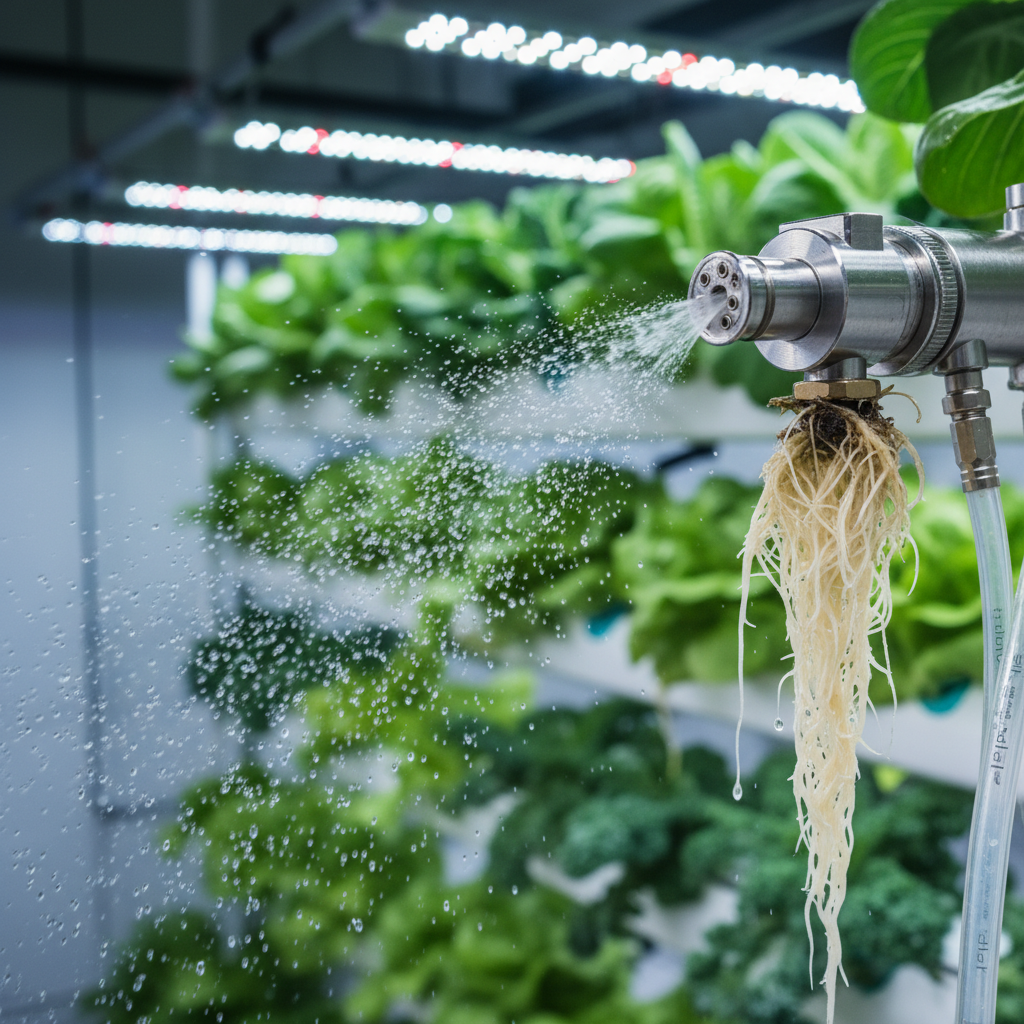
In a sealed indoor vertical farm, lighting accounts for roughly 80% of electricity consumption, air conditioning about 16%, and auxiliary equipment around 4%. That split makes your light recipe the single largest financial lever you have.
The optimization is not about buying the best LEDs. It is about matching photon delivery to crop demand, hour by hour, growth stage by growth stage. A study testing hydroponic basil under DLI targets of 12.5, 15, and 17.5 mol/m²/day found that adaptive LED control reduced energy use by at least 43% compared to a fixed-schedule approach. That is not a marginal gain. That is the difference between a viable business and a money furnace.
Three concrete moves that compound:
- Dynamic dimming tied to growth stage. Seedlings need less light than mature canopy. If your LEDs run at the same intensity from germination to harvest, you are paying for photons the plant cannot use.
- HVAC as a coupled system, not an afterthought. Every watt your LEDs emit becomes heat. Efficient heat pumps reportedly use 25% to 65% less energy than conventional heating and produce 56% to 79% lower CO₂ emissions. Recovering waste heat instead of venting it changes the equation.
- Demand response and time-of-use pricing. If your local grid charges less between midnight and 5 AM, your photoperiod should know that. Plants do not care what time the photons arrive. Your electricity bill does.
The metric to track is kWh per saleable kilogram. Not kWh per square meter, not kWh per grow cycle. Per saleable kilogram. That number connects your energy decisions to revenue.
Water, Nutrients, and the Measurement Trap
You will hear that vertical farms reduce water use by over 90% compared to open-field agriculture. The number is real, but it hides a measurement problem that trips up even experienced operators.
A review comparing hydroponic and aeroponic systems reported water-use efficiency values of 3.45 g/L, 9.3 g/L, and 77.07 g/L for the same aeroponic setup, depending on whether researchers measured leaf-area modeled consumption, total applied irrigation, or used nutrient solution. That is a 22x spread from the same data, just by changing the boundary definition. Similar measurement challenges appear in aquatic farming systems where water quality monitoring requires consistent sensor calibration and boundary definitions.
This matters because you cannot optimize what you cannot measure consistently. Two practical rules:
- Define your boundary. Are you measuring water applied to the system, water consumed by plants, or water recovered and recirculated? Pick one, document it, and stick to it across crop cycles. Otherwise, every “improvement” you measure might just be a change in how you are counting.
- Separate nutrient cost from water cost. In recirculating hydroponics, nutrients drift over time. EC and pH sensors catch gross drift, but ion-specific monitoring (potassium, nitrogen, calcium) catches the subtle imbalances that degrade quality before they kill yield.
The same review noted about 60% fertilizer reduction potential in hydroponic systems. That potential only becomes real if your nutrient dosing responds to actual sensor readings, not to a fixed schedule someone set up at commissioning.
Crop Selection Is Your First Optimization Decision
No amount of LED tuning or HVAC engineering will save a vertical farm growing the wrong crop for its cost structure.
USDA data show that tomatoes, lettuce, and cucumbers represented 60% to 70% of US controlled-environment agriculture crops in both 2009 and 2019. That concentration is a warning signal: commodity produce in a high-OPEX facility competes directly with field-grown supply, and consumers have shown limited willingness to pay a premium for “cleaner” produce. Bowery learned that the hard way.
The survivors are moving toward value density. Commercial crop guidance now emphasizes microgreens, herbs, specialty lettuce, strawberries, and other high-value crops because their selling price per kilogram can absorb the energy and labor overhead that indoor production demands.
Consider the contrast:
- AeroFarms narrowed to nutrient-dense microgreens after bankruptcy and reported two profitable quarters. Higher value density per tray, lower energy per plant through better throughput.
- Plenty closed its Compton leafy-greens farm and pivoted to vertically farmed strawberries, citing higher California farming costs. A crop pivot driven by unit economics, not agronomy preference.
- Oishii expanded a 237,500+ square-foot strawberry facility in New Jersey, complete with robotics, a multi-million-dollar water purification system, and adjacent solar. Premium fruit from day one.
A back-of-the-envelope analysis published in 2025 estimated a minimum of roughly $10/kg dry plant matter for vertical farming versus under $1/kg for conventional staple production. Wheat, rice, and corn are off the table. The optimization is in choosing crops where indoor production creates a defensible advantage: year-round availability, flavor consistency, food safety, or freshness that field farming cannot match.
The Sensor-to-Decision Architecture
Here is where I see the most waste in vertical farming operations, and where my background in industrial IoT makes me opinionated.
Most farms have sensors. Temperature probes, humidity monitors, CO₂ meters, EC and pH sensors in the nutrient solution, PAR sensors measuring light. The hardware is rarely the problem. The problem is what happens after the data is collected.
A comprehensive review of IoT and AI applications in vertical farming describes systems where environmental sensor data feeds machine-learning models for nutrient delivery, water flow, and light settings, with reported yield-prediction accuracy (R² of 0.94 for lettuce, 0.99 for tomatoes). Those numbers sound impressive. They are also lab results. The gap between a model that predicts well in a research paper and a control system that acts reliably in a commercial farm is where most optimization programs stall.
What separates a functional sensor architecture from an expensive data lake:
- Closed-loop actuation, not just monitoring. A temperature reading that triggers an alert a human must act on is monitoring. A temperature reading that automatically adjusts HVAC output and LED dimming within validated bounds is optimization. The difference is response time, consistency, and labor cost.
- Sensor reliability and calibration discipline. A CO₂ sensor that drifts 50 ppm over three months will silently degrade your crop recipe. Environmental sensors need scheduled calibration, redundancy for critical parameters, and alerts when readings fall outside plausible ranges.
- Edge processing for latency-sensitive decisions. Nutrient dosing adjustments and light dimming cannot wait for a round trip to a cloud server. The architecture should process time-critical decisions at the edge and send aggregated data to the cloud for trend analysis and recipe refinement.
- Interoperability across subsystems. Lighting, HVAC, irrigation, and nutrient dosing are often from different vendors with different protocols. If those systems cannot share data in real time, you are optimizing four independent systems instead of one farm.
Computer vision adds another layer. Cameras can monitor plant growth rate, detect disease symptoms, identify stress before it becomes visible to the human eye, and estimate yield. But vision systems generate enormous data volumes. Without clear decision rules (what action does a detected anomaly trigger?), they become surveillance cameras pointed at lettuce.
The operational principle I apply across every IoT deployment, whether it is tracking containers in a port or monitoring conditions in a vertical farm: the value of a sensor is not in the data it generates. It is in the decision it enables. If a reading does not change a behavior within a defined timeframe, question whether that sensor belongs in the architecture.
Winners, Losers, and What Separated Them
The last two years produced enough data to stop guessing about what works.
| Company | Model | Outcome | Optimization lesson |
|---|---|---|---|
| Bowery | Commodity leafy greens, heavy VC funding | Shut down after $700M+ raised | Capital cannot substitute for willingness-to-pay. Scaling losses faster does not create margin. |
| AeroFarms | Aeroponic microgreens, post-bankruptcy restructuring | Two profitable quarters reported (May 2025) | Narrow crop focus, higher value density, operational discipline over growth ambition. |
| Plenty | Indoor leafy greens, then strategic strawberry pivot | Closed Compton farm, filed Chapter 11, restructuring toward berries | Crop pivot can improve addressable margin. Technology and funding do not override unit economics. |
| Oishii | Premium indoor strawberries, robotics, water purification | Expanded 237,500 sq ft facility in 2024 | Premium product justifies deep automation. Flavor and consistency as competitive moat. |
| Gotham Greens | Hydroponic greenhouses, regional distribution | Operates climate-controlled greenhouses across multiple US regions | Sunlight is free. A greenhouse envelope with controlled climate can deliver CEA benefits at lower energy cost than a sealed warehouse. |
The pattern is consistent. Winners did three things:
- They chose crops where the selling price could absorb indoor production costs.
- They treated energy as a cost to minimize, not just a resource to manage.
- They proved contribution margin at small scale before committing to large facilities.
Losers shared a common trait: they raised capital as if capital were a substitute for customers willing to pay a premium.
Five Optimization Priorities for 2026
1. Value density over volume. The crop determines the ceiling. Every facility-level optimization (lighting, HVAC, labor automation) is a multiplier applied to crop margin. If the base margin is thin, the multiplier does not save you.
2. Energy as a co-designed system. One lighting study found that the reported carbon footprint of lettuce drops from 6.42 kg CO₂-eq/kg on the global electricity mix to 0.16 kg CO₂-eq/kg with 100% renewable electricity, compared to 0.35 for open-field farming. Co-locate with renewable generation where possible. Use battery storage and demand response to shift loads. Recover waste heat. A 2024 paper even explored feeding vertical-farm waste heat into local district heating networks.
3. Predictive control over reactive monitoring. The next competitive edge is not more sensors. It is models that trade a small yield reduction for a large energy or labor saving, validated against real facility data. A 2025 systematic review flagged that many optimization studies rely on simulations or short-term data with inconsistent reporting units. The farms that build longitudinal datasets and validate their models against actual seasons of production will outperform those running on vendor benchmarks.
4. Modular commissioning, not megafarm bets. Industry discussion now points toward smaller farms that can reach profitability faster, with expansion driven by secured buyer demand rather than investor enthusiasm. Plant a facility in modules. Prove sell-through and uptime in module one. Scale to module two with real data.
5. Standardized measurement. A 2024 modular-farm life cycle assessment reported 0.78 to 1.18 kg CO₂-eq/kg for lettuce and 1.45 to 2.12 for basil, but noted the results are sensitive to electricity and infrastructure assumptions. Until the industry agrees on common definitions for kWh/kg, liters/kg, CO₂-eq/kg, and saleable yield, benchmarking across facilities remains unreliable. Start by defining these boundaries for your own operation and holding to them consistently.
Frequently Asked Questions
What is the difference between vertical farming and hydroponics?
Vertical farming refers to growing crops in stacked layers inside a controlled environment. Hydroponics is one root-zone method used within that model. A vertical farm can be hydroponic, aeroponic, or aquaponic. Some greenhouse operations use hydroponics without any vertical stacking at all.
What should a new vertical farm optimize first?
Crop selection and buyer commitment. Then lighting (roughly 80% of electricity) and HVAC (roughly 16%). Your first dashboard should track saleable yield, kWh per saleable kg, labor hours per kg, water per kg, waste rate, and contribution margin. Prove economics at small scale before expanding.
Does vertical farming really use 90% less water?
Recirculating systems can achieve that reduction compared to field farming. But the number depends heavily on whether you measure water applied, water consumed by plants, or water recovered and recirculated. A single aeroponic study produced water-use efficiency values ranging from 3.45 g/L to 77.07 g/L depending on the measurement boundary.
Is vertical farming better for the climate than conventional agriculture?
It depends almost entirely on your electricity source. Reported carbon footprints for lettuce range from 6.42 kg CO₂-eq/kg on the global electricity mix to 0.16 on 100% renewables, versus 0.35 for open-field. Vertical farming reduces land and transport impact but substitutes purchased electricity and equipment. Without low-carbon energy, the climate case collapses.
Which crops are most profitable in vertical farms?
Fast-growing, compact, high-value crops: microgreens, herbs, specialty lettuce, strawberries. Commodity staples like wheat are economically unviable at current energy costs (estimated minimum $10/kg dry matter vs. under $1/kg for conventional). The winning strategy is choosing crops where indoor production offers a flavor, freshness, or availability advantage the customer will pay for.
Can vertical farms replace conventional farming?
No. They complement it. Indoor systems offer year-round local supply and resilience against weather variability for specific high-value crops. But energy conversion efficiency in vertical farms sits at roughly 1% to 2%, making staple-crop production economically impractical. Open-field farming will continue to feed the world’s calorie needs.
If you run a vertical farming operation and the environmental data driving your crop recipes feels fragmented, inconsistent, or disconnected from actual decisions, that is the gap where optimization breaks down. Reliable sensor infrastructure, from temperature and humidity monitoring to nutrient-solution tracking, is the foundation everything else sits on. If you want to talk about building that foundation, reach out to our team or drop a line at info@datanetiot.com.



 +1 508 292 2210

One Response