

Airbus wants to build 75 A320 Family aircraft per month by 2027. Boeing is studying a 70-jet monthly pace for the 737. Lockheed Martin delivered a record 191 F-35s in 2025. Behind numbers like these sits a planning function that rarely makes headlines, until it fails.
Four missing bolts on a door plug. A $9.66 billion machinist strike. A ransomware attack that dropped Collins Aerospace’s shop floor platform mid-production. Every one of those events traces back to aerospace production planning: the discipline that turns a backlog of aircraft orders into a synchronized, executable factory schedule.
In 2026, with production rates pushing toward historic peaks and the margin for error near zero, this discipline is under more pressure than at any point since commercial aviation began. Here’s what it takes to get it right.
What Aerospace Production Planning Actually Is
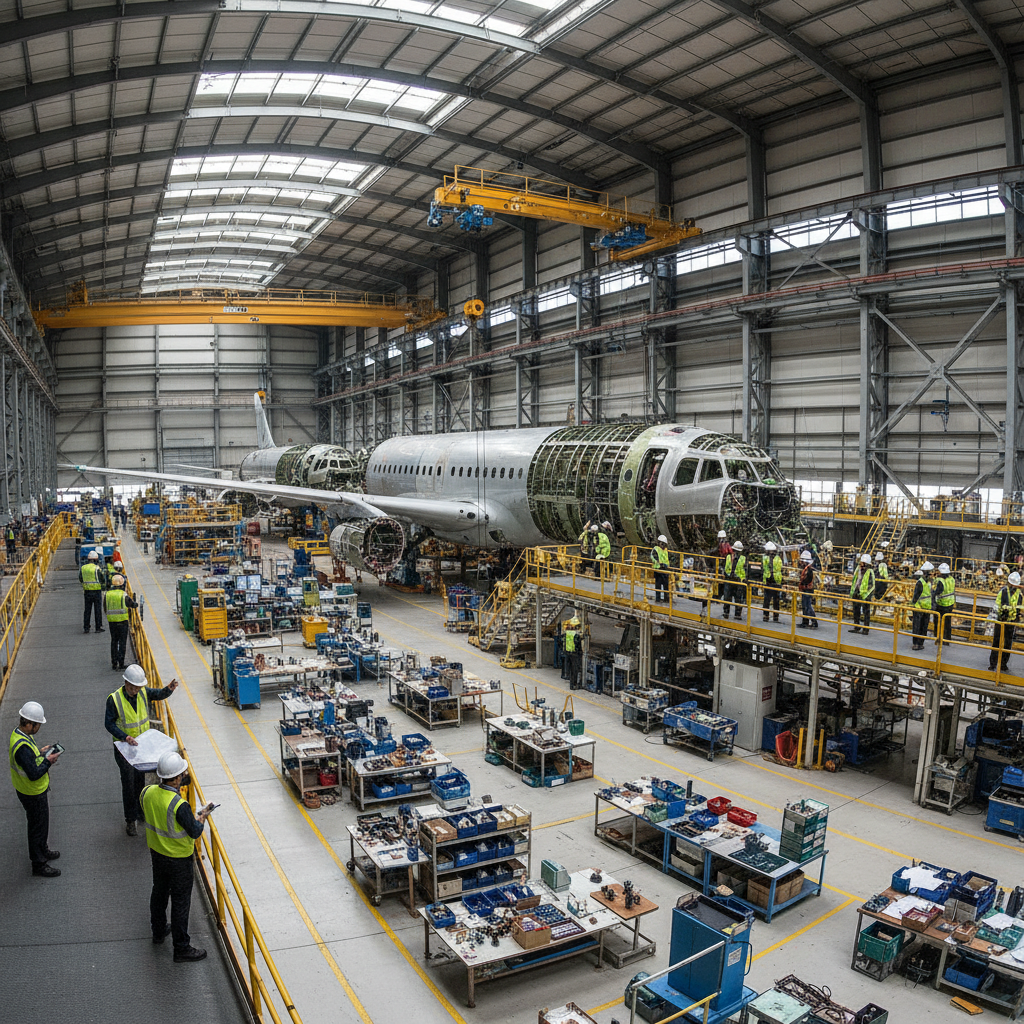
Aerospace production planning is the function that converts demand (firm orders, options, spare parts) into factory-executable plans. It coordinates materials, labor, tooling, machine capacity, and quality gates across every work center in a final assembly line (FAL) or component facility.
Four connected activities define the cycle:
- Routing defines the sequence of manufacturing operations for each assembly.
- Scheduling assigns those operations to specific time slots, work centers, and personnel.
- Dispatching releases work orders to the floor with the right materials staged at the right time.
- Follow-up tracks actual vs. planned execution and feeds deviations back into the next scheduling cycle.
What makes aerospace different from general manufacturing? Scale of complexity and consequences of error.
A single A320neo contains roughly four million parts sourced from hundreds of suppliers. Lead times for castings and forgings run 12 to 18 months, BOMs stack thousands of components across multi-level structures, and every part must comply with AS9100. Depending on the program, ITAR, DFARS, and EASA Part 21 requirements layer on top. Full serialization is mandatory. No two aircraft are truly identical once customer options are applied, so configuration management is constant.
Miss a single constraint in any of those layers, and you don’t just delay a delivery. You potentially ground a fleet.

The 2026 Rate Race in Numbers
Production rate targets across the industry today would have sounded delusional five years ago.
| OEM | Program | Current Rate | Target Rate | Timeline |
|---|---|---|---|---|
| Airbus | A320 Family | ~58/month | 75/month | 2027 |
| Boeing | 737 MAX | ~38/month | 53 to 70/month | 2026-2028 |
| Lockheed Martin | F-35 | ~16/month | Sustain/increase | Ongoing |
| Airbus | A350 | ~7/month | 10/month | 2026 |
Airbus describes rate 75 as civil aerospace’s highest-ever production level. Reaching it requires 10 FALs across Toulouse, Hamburg, Mobile, and Tianjin. The company opened a second FAL in Tianjin in October 2025, converted the former A380 line in Toulouse to A320 production, and acquired Spirit AeroSystems sites in Belfast, Prestwick, Casablanca, Saint-Nazaire, and Kinston for $439 million.
Boeing’s trajectory is different but converging on the same problem. After the FAA lifted the 737 MAX production cap in March 2026, Boeing is targeting 53 per month as a near-term milestone and studying a push to 70. The company delivered 600 commercial aircraft in 2025 (up 72.4% year-over-year) and outsold Airbus in net orders for the first time since 2018.
On the defense side, Lockheed Martin broke its F-35 delivery record with 191 aircraft in 2025, running at five times the pace of any other allied fighter in production. That record didn’t happen by adding floor space. It happened through planning maturity built over a decade of multi-site coordination.
The core tension: every additional aircraft per month doesn’t add complexity linearly. It compounds it. More supplier handoffs, more quality gates, more workforce shifts, more tooling changeovers. The planning system either keeps up or becomes the bottleneck.
Where Traditional MRP Hits the Wall
Most aerospace suppliers still run MRP (Material Requirements Planning) as their primary planning engine. MRP does one thing well: it explodes a BOM into time-phased material needs. Order this forging in month 1 so it arrives by month 14.
The problem: MRP assumes infinite capacity. It tells you what to build and when, but never asks whether your factory can actually do it with the people, machines, and tooling available.
At 20 aircraft per month, that gap is manageable. Experienced planners paper over the difference between MRP output and shop floor reality with tribal knowledge, spreadsheets, and daily stand-ups. At 75 per month across 10 FALs on four continents, tribal knowledge hits a wall.
Two additional layers fill the gap:
| System | What It Does | Capacity Model |
|---|---|---|
| MRP | Calculates material needs from BOMs | Infinite |
| APS (Advanced Planning and Scheduling) | Sequences work across machines, skills, and tools | Finite |
| MES (Manufacturing Execution System) | Tracks execution in real time on the floor | Real-time |
When APS and MES are integrated, the APS can schedule based on actual employee skills tracked by the MES, and the MES can trigger schedule adjustments based on real machine performance data. That feedback loop separates a plan that works from one that just looks good in a meeting.
The uncomfortable truth: plenty of tier 2 and tier 3 aerospace suppliers still run MRP on infinite-capacity assumptions with manual schedule patches. That worked at their old rates. It won’t survive the supply demands of rate 75.
The Software Stack Running a Modern Assembly Line
Five layers of software now define a mature aerospace production planning environment. Not every supplier needs all five, but understanding how they connect clarifies where the industry is heading.
PLM: where the aircraft definition lives
Product Lifecycle Management systems manage configuration, engineering BOMs, change orders, and documentation across the aircraft’s life. Dassault Systèmes leads this market with 16.5% share, followed by Siemens (Teamcenter) and PTC (Windchill). Dassault’s 3DEXPERIENCE platform runs Airbus programs from design through manufacturing instruction, so the same model that engineering approves is the model the shop floor builds to.
APS: finite-capacity scheduling
APS sequences production against real constraints: actual machines, actual labor pools, actual tool availability. Siemens Opcenter APS and Dassault DELMIA dominate the large OEM tier, while Accevo and other specialized vendors serve mid-tier A&D manufacturers with lower total cost of ownership. The difference between infinite-capacity MRP and finite-capacity APS is the difference between a wish list and a factory schedule.
MES: the shop floor in real time
MES tracks work order status, labor, quality non-conformances, and tool calibration as they happen. Vertical MES providers built specifically for A&D handle serialized parts, compliance documentation, and engineering change incorporation at the work order level. Generic MES tools from the food or automotive world don’t handle A&D regulatory depth.
Production digital twin
A virtual replica of the factory (not the aircraft) that simulates throughput, bottlenecks, and layout changes before they’re implemented. Production digital twins let manufacturers simulate an entire ramp-up weeks before real production starts, cutting engineering hours and surfacing bottlenecks early. This market is accelerating: the digital twin segment in aerospace manufacturing hit $5.82 billion in 2025 and is projected to reach $89.99 billion by 2035.
Agentic AI
The newest layer. AI copilots that don’t just report data but recommend scheduling changes, flag anomalies, and autonomously adjust parameters within defined guardrails. The MOM software market (which includes MES and APS) reached $23.13 billion in 2026, growing at 17.85% annually. That’s nearly 3x faster than PLM. The growth reflects the urgency of replacing static planning with systems that can keep up with rate 75 complexity.
The minimum stack for any supplier feeding an OEM at these rates: a finite-capacity scheduler (APS) connected to real-time floor data (MES). Running MRP in isolation at rate 75 supply volumes is navigating a 747 with a compass and a paper chart.
Four Missing Bolts: When Planning Breaks
On January 5, 2024, the left mid-exit door plug of Alaska Airlines Flight 1282 (a Boeing 737 MAX 9) separated in flight at 16,000 feet. Passengers in the adjacent row lost shirts, headrests, and personal items. One phone was recovered two months later in a Portland backyard.
The NTSB’s final report (AIR-25-04, June 2025) traced the failure to four missing bolts on the door plug. The root cause wasn’t a mechanic dropping a wrench. It was a systematic production planning breakdown.
Three findings stand out for anyone in this field:
- Boeing’s BPI (Bulletin of Procedure Instruction) for parts removal “lacked the clarity, conciseness, and ease of use necessary to be an effective tool for workers in the manufacturing process.” In plain terms: the routing document, the core artifact of production planning, was written in a way that made it easy to skip steps.
- The “short stamp” handoff process failed. When a mechanic leaves a task incomplete and passes it to the next shift, a short stamp flags the open work. Boeing’s system relied on paper and manual discipline. At production rates demanding dozens of shift handoffs per aircraft, manual discipline predictably failed.
- The NTSB recommended Boeing convene an independent panel for a comprehensive review of its safety culture. Culture isn’t separate from planning. A planning system that tolerates ambiguous work instructions and manual-only handoff controls will produce quality escapes. It’s a matter of when, not if.
The lesson is not “Boeing is bad at planning.” Boeing delivered 600 aircraft that same year. The lesson is that aerospace production planning cannot rely on institutional memory or manual processes at scale. When the rate goes up and the planning system doesn’t evolve, the errors that were always latent become catastrophic.
Boeing’s response included completing the $4.7 billion acquisition of Spirit AeroSystems in December 2025, bringing fuselage production for the 737, 767, 777, and 787 back in-house. Vertical integration is one response. But without fundamentally improving work instructions, MES-driven handoffs, and digital traceability, ownership alone doesn’t prevent the next quality escape.
Shop Floor Visibility: The Gap Most Planners Ignore
Here’s a question I ask every operations manager I meet: can your planning system tell you, right now, where every jig, tool cart, and parts container is on your shop floor?
The answer is usually an honest pause followed by “not really.”
The APS generates a schedule that assumes tooling is where it’s supposed to be, the parts container from the supplier arrived at staging on time, and the calibrated torque wrench for station 14 isn’t sitting in a cage at station 32. The MES tracks work orders. The ERP tracks purchase orders. The APS tracks capacity. But the physical location and status of movable assets (tooling, ground support equipment, reusable containers, parts kits) often lives in someone’s head or on a whiteboard.
At 20 aircraft per month, a technician walks around and finds the missing tool in ten minutes. At 75 per month across 10 FALs, that missing tool creates a cascading delay the APS never predicted because it had no data to predict it from. This is precisely why aerospace production asset monitoring has become critical for preventing these cascading delays before they impact the schedule.
This is where IoT-based asset tracking enters the production planning conversation. Not as a nice-to-have visibility dashboard, but as a data source that feeds the MES and APS with ground truth about physical asset positions. Cellular and GNSS-enabled trackers on tooling carts, jig frames, and reusable containers close the gap between what the schedule assumed and what’s actually happening on the floor.
The shift is subtle but consequential. Production planning moves from “we scheduled it, so it should be there” to “we can see it’s there, so we can schedule around it.” That inversion separates planners who react from planners who predict. Implementing aviation production line tracking enables this predictive capability by providing continuous visibility across all manufacturing stages.
What Comes Next: AI, Quantum, and Vertical Integration
Three trends are reshaping aerospace production planning over the next 24 to 36 months.
Agentic AI in scheduling
A 2025 TCS study estimates that only about 40% of aerospace operations will be fully automated within five to seven years, with 60% still depending significantly on human expertise. AI won’t replace aerospace planners. It will augment them. Agentic copilots that monitor APS outputs, flag conflicts, and propose re-sequencing in real time are the near-term application. Start with scheduling, not design. The ROI comes faster and the risk stays lower.
Quantum-inspired optimization
The Airbus Quantum Challenge enters its third iteration in 2026, partnering with Cleveland Clinic, HSBC, E.ON, and Volkswagen. PsiQuantum and Airbus are collaborating under the QuLAB project to evaluate quantum algorithms for complex production problems. Early benchmarks show quantum-inspired optimization cutting scheduling solve times by 10 to 20x on real workloads. That matters when you’re running a job-shop scheduling problem with hundreds of constraints across 10 assembly lines. The gains are still early-stage, but the trajectory is clear.
Vertical integration as a planning strategy
Boeing’s $4.7 billion Spirit acquisition and Airbus’s parallel $439 million pickup of Spirit’s A220, A320, and A350 sites mark a reversal of the outsourcing model that dominated aerospace since the early 2000s. The planning rationale: when your tier 1 supplier is also your biggest source of quality defects and delivery variance, bringing them in-house reduces the information lag between detection and correction. The risk: reduced flexibility to shift capacity during demand shocks, the exact lesson COVID taught the industry in 2020.
All three trends converge on the same principle. Aerospace production planning is becoming a real-time, data-intensive discipline that cannot function on weekly plan updates and static BOMs. The metric that matters most isn’t throughput or cycle time alone. It’s data latency: how fast information moves from the shop floor to the plan to a decision.
If your tooling, containers, or ground equipment go invisible the moment they leave the staging area, that latency is already too high. Closing that gap with real-time asset visibility is one of the fastest paths to a planning system that works at modern production rates. If that’s a conversation worth having, reach out to our team or explore how industrial asset trackers integrate into the production planning stack.
Frequently Asked Questions
What does an aerospace production planner do?
An aerospace production planner converts aircraft orders and engineering BOMs into executable factory schedules. The role includes sequencing work centers, scheduling labor and tooling, coordinating material arrivals with lead times of 12 to 18 months, managing AS9100/ITAR/EASA compliance, and adjusting plans based on real-time shop floor deviations.
How is aerospace production planning different from general manufacturing?
Three factors set it apart: regulatory intensity (every part serialized and traceable under AS9100, ITAR, or EASA), BOM complexity (millions of parts per aircraft with deep multi-level structures), and lead time length (castings and forgings routinely exceed 12 months). General MRP assumes infinite capacity, which fails at aerospace scale and production rates.
What software do aerospace production planners use?
The typical stack includes PLM for configuration and BOM management (Dassault 3DEXPERIENCE, Siemens Teamcenter, PTC Windchill), APS for finite-capacity scheduling (Siemens Opcenter, DELMIA, Synchrono), and MES for shop floor execution (iBASET, JobBOSS). Production digital twins and AI copilots are increasingly layered on top.
What is Airbus rate 75?
Rate 75 is Airbus’s target of producing 75 A320 Family aircraft per month by 2027, the highest production rate in civil aviation history. Achieving it requires 10 final assembly lines across four countries, conversion of legacy facilities, and integration of acquired Spirit AeroSystems sites.
How did the Boeing door plug incident affect production planning?
The NTSB’s investigation of Alaska Airlines Flight 1282 found that Boeing’s work instructions lacked clarity, the shift-handoff process failed, and quality culture gaps were systemic. The incident led to an FAA production cap on the 737 MAX (lifted March 2026), Boeing’s $4.7 billion re-acquisition of Spirit AeroSystems, and industry-wide scrutiny of planning system maturity.
How does real-time asset tracking support aerospace production planning?
IoT trackers on tooling, jigs, parts containers, and ground support equipment provide continuous location and status data to MES and APS systems. This closes the gap between where a schedule assumes assets are and where they actually are, reducing cascading delays caused by misplaced or missing equipment on the shop floor.






 +1 508 292 2210

6 Responses