

When the FAA capped Boeing’s 737 MAX production at 38 planes per month after a door plug detached mid-flight, it sent one message to every aircraft manufacturer: if your aviation production line tracking can’t prove compliance in real time, regulators will decide your output for you. (See also: aviation maintenance inventory tracking.) (See also: aviation asset tracking cost savings.) (See also: certified gps tracker for aviation assets.)
That cap wasn’t a quality suggestion. An FAA audit found 97 instances of noncompliance across 33 failed product checks. In a North American aircraft manufacturing market worth $247 billion, every capped month translates to hundreds of millions in delayed revenue.
Production line tracking has moved from efficiency play to regulatory gate. Here’s what that shift looks like in practice: the technologies, the hard numbers, and the outcomes that justify the spend.
What Aviation Production Line Tracking Actually Covers
Aviation production line tracking is the integrated system of technologies and processes that monitor, document, and control the movement and status of every part, tool, and assembly through an aircraft manufacturing line. From raw material receipt to final aircraft delivery, the objective is complete visibility and full regulatory traceability—similar principles that apply to tracking high-value aviation assets throughout their operational lifecycle.
The architecture works across five layers:
- Physical identification through RFID tags, barcodes, and QR codes attached to parts, tools, and containers
- Data acquisition via IoT sensors and edge devices collecting location, condition, and environmental data
- Execution management through MES (Manufacturing Execution System) software orchestrating work orders, sequencing, and compliance documentation
- Simulation and optimization using digital twins that model the production environment before and during physical assembly
- Regulatory compliance systems that satisfy AS9100, FAA, and EASA traceability and audit requirements
If you come from logistics or supply chain, think of this as asset tracking at a much higher resolution. Shipment tracking ends at delivery. Production line tracking follows every serialized component through every station, every inspection, every configuration change, into the aircraft’s flight readiness log. Then it keeps going. AS9100 Rev D requires identification and traceability beyond what ISO 9001 demands, including configuration management and full part genealogy that extends through the component’s entire service life.
A missing container on a logistics dock is an inventory problem. A missing fastener on a wing assembly is an airworthiness issue. The stakes dictate the granularity.
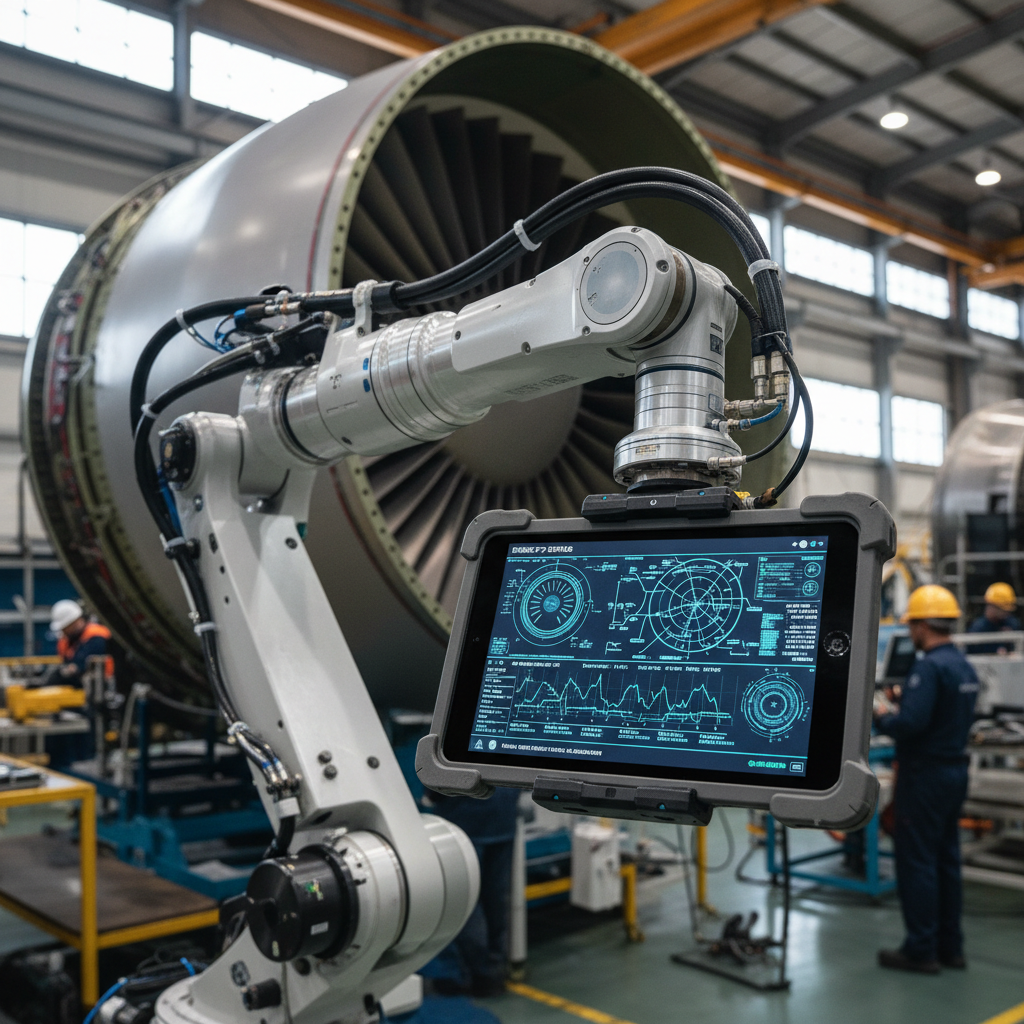
The Boeing Effect: What 97 Audit Failures Set in Motion
On January 5, 2024, a door plug detached mid-flight on Alaska Airlines Flight 1282. The FAA responded by capping MAX production and launching an audit that went “above and beyond” standard inspection protocols.
The results were severe. Of 89 product audits, Boeing passed 56 and failed 33, with 97 instances of alleged noncompliance. That’s not a documentation hiccup. That’s a systemic tracking failure across the production system.
Boeing’s response deployed multiple tracking technologies simultaneously. An RFID tool control pilot on the 737 and 787 programs tagged thousands of tools with unique identifiers. A digital Work-in-Process (WIP) system was deployed across all Commercial Airplanes final assembly areas to track and secure parts in real time. QR codes on composite shims improved component traceability. A photo-based AI tool replaced manual part-number entry, automatically recording data into aircraft readiness logs.
The measured results from March 2024 onward:
- 85% reduction in tool loss in targeted final assembly areas (RFID pilot on 737/787)
- 45% average defect reduction in 737 fuselage assembly at Spirit AeroSystems
- 75% reduction in traveled work (unfinished jobs moving down the line) on the 737 program
By October 2025, the FAA approved raising the production cap to 42 planes per month.
What gets lost in the Boeing narrative is the asymmetry. Deploying RFID, digital WIP, and AI inspection across a production line costs millions. A production cap on a program with hundreds of aircraft in backlog costs billions. Every aerospace operations leader I talk to understands this ratio intuitively. The question is whether they act on it before or after the audit.
Five Technologies Driving Production Visibility
No single product solves aviation production line tracking. It’s an integrated stack. Here’s what each layer looks like when it’s actually working.
RFID and Automatic Identification
RFID remains the most mature tracking technology in aircraft manufacturing. Passive UHF RFID tags compliant with SAE AS5678 are permanently affixed to aircraft parts, enabling identification without line-of-sight scanning. The global Aircraft Part Traceability RFID Tag market reached $1.37 billion in 2024 and continues to grow fast. Both Airbus and Boeing use RFID for tagging parts and components across their programs.
Boeing’s RFID pilot proved the payoff concretely: 85% reduction in tool loss. But the value goes beyond tools. Every serialized part with an RFID tag creates an automatic audit trail as it moves through assembly stations. No manual scanning. No handwritten logs. No data entry errors feeding bad information into the compliance record.
IoT Sensors and Real-Time Connectivity
IoT sensors monitor machinery condition, environmental factors (temperature, humidity, vibration), and asset location in real time. The challenge in aerospace assembly is connectivity. Aircraft manufacturing halls are massive metallic environments where standard Wi-Fi struggles with signal reflection and dead zones.
Airbus addressed this at its A321 Final Assembly Line by deploying a private 5G network across the facility, ensuring deterministic, low-latency data transmission for every sensor and mobile device on the floor. Other connectivity protocols, including LoRaWAN and Wi-Fi HaLow, serve specific use cases where cellular or 5G infrastructure isn’t practical. Edge computing processes data locally before transmitting to central systems, cutting latency for time-critical decisions on the line.
Manufacturing Execution Systems
MES is the software brain of the production line. It monitors, tracks, documents, and controls every step from raw material to finished product. In aerospace, MES must handle complex serialization, configuration management, nonconformance reporting, and AS9100 compliance requirements that generic manufacturing platforms were never designed for.
The global MES market is expected to grow from $15.95 billion in 2025 to $25.78 billion by 2030 at a 10.1% CAGR, with aerospace and defense among the fastest-growing verticals. That growth rate is roughly double the rate of overall aircraft manufacturing expansion. It tells you exactly where the capital is flowing.
Digital Twins
A digital twin is a dynamic virtual replica of a physical system that updates continuously with real-time sensor data. In production, it simulates assembly processes before physical execution, optimizes factory layouts, and validates assembly sequences virtually.
Lockheed Martin’s F-35 assembly line uses a virtual simulation system to validate geometry before the physical mating of major airframe sections. The result: near-production quality from the very first test aircraft. Siemens reports that production digital twin insights “stretch across the factory’s lifecycle,” enabling manufacturers to catch errors before they become physical defects.
The distinction from a static 3D model matters. A CAD file shows what should be. A digital twin shows what is, right now, on the factory floor.
AR and Computer Vision
Boeing installed approximately 40 projectors on the 777X wing assembly line to display work instructions directly onto wings as mechanics install over 5,000 fasteners per panel. That’s projected augmented reality replacing paper manuals, capturing cycle times and defect data while guiding each step.
Computer vision adds another layer. AI-powered cameras inspect parts automatically, detect surface defects, verify fastener installation, and confirm part placement. Boeing’s photo-based AI tool photographs part numbers instead of requiring manual entry. In an environment where a single missing fastener can ground an entire fleet, that automation is not a luxury.
Airbus Built What Boeing Had to Retrofit
While Boeing was deploying tracking technologies under regulatory pressure, Airbus inaugurated a new A321 Final Assembly Line in Toulouse in 2024. Housed in the former A380 Lagardère site, it spans 50 hectares with production halls the size of 500 tennis courts.
The facility operates in a completely paperless environment. Operators access real-time data via mobile devices. Automated guided vehicles move assemblies between stations. The CabinMarker robot handles seat installation. Automated drilling, titanium 3D printing, and a private 5G network provide the digital backbone. Airbus partnered with NI to develop smart tool families for drilling, measuring, and quality data logging that automatically capture and transmit production data without manual intervention.
The Airbus DDMS (Digital Design, Manufacturing and Services) program connects the entire product lifecycle through a continuous digital thread. Design data flows into manufacturing instructions. Manufacturing data flows into service records. Nothing is siloed.
The contrast is instructive. Boeing retrofitted tracking systems onto existing production lines after a crisis forced its hand. Airbus designed a greenfield facility where every process was digital-native from day one. Integrating tracking into an existing line is absolutely possible (Boeing’s results prove it). But designing it in from the start eliminates the legacy-system integration burden that slows and complicates every retrofit.
For Tier 1 and Tier 2 suppliers watching both paths, the takeaway is practical. Your OEM customers will eventually require the same level of digital traceability from your facility that they demand internally. The question is whether you build it proactively or scramble to retrofit when a purchase order depends on it.
The MES Decision: Horizontal, Vertical, or Hybrid
One of the most consequential technology choices in aviation production line tracking is MES platform selection. The debate breaks into three positions.
Horizontal MES platforms (Siemens Opcenter, SAP S/4HANA, Dassault DELMIA) offer broad integration with PLM, ERP, and enterprise IT systems. They’re powerful, widely supported, and built for multiple industries. The trade-off: aerospace-specific requirements like complex serialization, AS9100 compliance, lot traceability, and configuration management frequently require significant customization before they’re production-ready.
Vertical MES platforms built specifically for aerospace and defense (iBASEt Solumina, Manufacturo, Epsilon3) handle A&D workflows out of the box: deep serialization, nonconformance workflows, regulatory documentation. Vertical software in A&D is projected to grow at over 11% annually through 2030. The trade-off: they may lack the full PLM-to-ERP integration breadth of enterprise platforms.
In practice, most large OEMs run a hybrid architecture. An enterprise ERP backbone (typically SAP) serves as the business system of record, while a vertical MES layer handles shop-floor execution. That hybrid model works, but the integration cost is real. Middleware, custom APIs, data normalization between systems: none of it comes free, and none of it is fast.
For smaller manufacturers, the calculus is different. A full enterprise stack may be overkill. A vertical MES paired with the right IoT hardware for physical tracking (RFID readers, cellular asset trackers, condition-monitoring sensors) can deliver AS9100-compliant traceability without a six-figure integration project. The key is starting with the physical identification layer, getting real data flowing, and building software capability on top of that foundation.
Why Tier 2 Suppliers Can’t Sit This Out
Nearly every article on aviation production line tracking focuses on OEMs. Boeing, Airbus, Lockheed Martin. That’s understandable. They’re building the aircraft. But compliance pressure doesn’t stop at the OEM’s front door.
FAA Advisory Circular AC 20-154A specifies procedures for part segregation and documentation traceability. EASA addresses back-to-birth traceability for components fitted to European aircraft. These requirements flow down the supply chain. If your part goes on an aircraft, your traceability has to survive the same audit as the OEM’s.
The digital thread concept accelerates this. Aerospace companies now use digital threads to track every component from design through production and into service. If a turbine blade wears down faster than expected, engineers trace its entire history through that thread, and the thread doesn’t stop at the OEM. It reaches into every supplier who touched that component.
For Tier 2 and Tier 3 suppliers, production line tracking is shifting from nice-to-have to procurement prerequisite. OEMs will increasingly require digital traceability data from suppliers as a condition of doing business, especially as regulatory scrutiny intensifies.
The good news: you don’t need a Boeing-scale deployment to get there. Modular IoT tracking hardware, including RFID tags, cellular asset trackers like the Oyster Edge, and DO-160 approved devices like the Thingfox T2 for aerospace logistics, paired with a focused MES or traceability platform, can deliver compliant visibility at a fraction of enterprise cost. Start with the physical layer. Build up from there.
Three Outcomes That Justify the Investment
Enough efficiency language. Let’s talk specifics.
Defect reduction at the source. Boeing reported a 45% average reduction in defects in 737 fuselage assembly after deploying its tracking and inspection suite. Fewer defects mean less rework, fewer warranty claims, and fewer airworthiness directives to manage across the fleet. In a business where a single AD can cost millions to implement across operators, defect prevention at the production line is the highest-leverage quality investment available.
Cycle time compression. A 75% reduction in traveled work on Boeing’s 737 program means assemblies arrive at each station more complete, with fewer open jobs passed downstream. That directly compresses cycle time, which directly increases the number of aircraft exiting the line per month. At list prices north of $100 million per narrowbody, even a modest increase in monthly output is transformative revenue.
Regulatory confidence that unlocks production rate. The FAA capped Boeing’s production. Then partially un-capped it after verifiable improvements in tracking and quality. That’s the template: demonstrate robust production line tracking and you earn the right to produce at higher rates. Lack it, and regulators will constrain your output regardless of customer demand. With global passenger traffic projected to surpass 10 billion, demand for new aircraft is not the bottleneck. Production capability validated by tracking data is.
If your production floor has gaps between what your MES sees and what’s physically happening on the line, that’s where hardware-level asset tracking closes the loop. We work with aerospace manufacturers and their suppliers to integrate the physical tracking layer that feeds these systems. If that’s a conversation worth having, reach out to our team or drop us a line at info@datanetiot.com.

Frequently Asked Questions
What is aviation production line tracking?
It is the integrated system of technologies (RFID, IoT sensors, MES software, digital twins, AR) and processes used to monitor, document, and control the movement and status of every part, tool, and assembly through an aircraft manufacturing line. The goal is complete visibility and full regulatory traceability from raw material receipt through final delivery and into service life.
Why did the FAA cap Boeing’s 737 MAX production rate?
After a door plug detached mid-flight in January 2024, the FAA conducted an extensive production audit. It found 97 instances of noncompliance across 33 failed product checks out of 89 audits. The FAA capped production at 38 planes per month until Boeing demonstrated measurable improvements in quality and tracking systems.
How does RFID reduce tool loss in aviation manufacturing?
Each tool receives a unique RFID tag. Fixed or handheld readers at assembly stations automatically detect tagged tools, recording location and timestamps without manual scanning. Boeing’s RFID pilot on the 737 and 787 programs achieved an 85% reduction in tool loss in targeted final assembly areas, also helping prevent Foreign Object Damage (FOD).
What is the difference between horizontal and vertical MES?
Horizontal MES platforms are built for multiple industries and require customization for aerospace compliance, serialization, and configuration management. Vertical MES platforms are purpose-built for aerospace and defense, handling AS9100 requirements, complex work orders, and regulatory documentation out of the box. Most large OEMs use a hybrid of both.
Do Tier 2 and Tier 3 aerospace suppliers need production line tracking?
Increasingly, yes. AS9100, FAA, and EASA traceability requirements flow down the supply chain. OEMs are beginning to require digital traceability data from suppliers as a procurement condition. Smaller suppliers can start with modular IoT hardware and focused traceability software rather than deploying full enterprise MES platforms.
What role do digital twins play in aircraft production?
Digital twins are dynamic virtual replicas of the production environment, updated continuously with real-time sensor data. They simulate assembly processes before physical execution, validate component geometry, optimize factory layouts, and help manufacturers catch errors in virtual space rather than paying for them in rework on the physical line.







 +1 508 292 2210

5 Responses