

A hospital tags 800 assets with Bluetooth beacons. An airline invests $50 million in RFID readers across 344 airports. A manufacturer tracks thousands of returnable packaging units across its supply chain. In every case, the tags work. The readers read. And the project still underdelivers. (See also: geofencing for equipment tracking.)
Asset tracking system integration is not about hardware. It is about what happens to the observation after it leaves the antenna: which record updates, which workflow triggers, which person gets an alert that actually changes a decision. I have spent 15 years watching organizations confuse “we can see it on a map” with “we changed how we operate.” The distance between those two statements is where operational dollars disappear.
This piece walks through what real integration looks like in practice, where projects stall, how to select technology based on the decision you need to make (not the spec sheet you received), and how to build a business case that holds up under scrutiny.
Five Layers Between a Tag and a Business Decision
Most teams think about integration as “connecting the tracker to our software.” That framing is too narrow. A practical integration architecture has five layers, each with its own failure modes.
1. Identity. The tag must map to something authoritative. Not just a serial number, but the right serial number in the right system. ServiceNow’s Zebra RFID integration maps tag observations to assets by serial number, which sounds straightforward until you account for duplicate serials, replaced tags, and assets that should be excluded from tracking. Identity is a data governance problem before it is a hardware problem.
2. Capture. The reader (RFID gate, BLE gateway, GNSS module, cellular modem) records an observation with a timestamp, location estimate, and confidence level. It is not yet a fact about the business.
3. Transport. The observation moves from the edge to a platform. MQTT, REST APIs, batch imports: the mechanism matters less than reliability. Can you guarantee delivery order? Can you handle offline periods and replay? AWS’s reference architecture for asset tracking uses IoT Core, Lambda, EventBridge, and Amazon Location Service as composable building blocks. But the engineering work of defining schemas, retries, authorization, and monitoring at every boundary is yours.
4. Interpretation. This is where most projects stall. A raw observation says “Tag X was seen at Reader Y at time Z.” Interpretation turns that into “Container C-4471 arrived at Gate 3 in Brussels at 14:22 and has been idle for 6 hours, which exceeds the threshold for this route.” The gap between observation and interpretation requires business logic: thresholds, context, history, and rules about what matters. This is exactly how GPS geofencing for assets turns a location into an actionable event.
5. Action. The interpreted event updates a record, triggers a workflow, or alerts a person. SAP’s RFID integration can trigger notifications, display technical-object data, and release corresponding maintenance orders. That is integration. A dot moving on a dashboard is not.
The standard that formalizes this thinking across enterprises is GS1 EPCIS 2.0, which defines visibility events (what happened, where, when, why) in JSON/JSON-LD and REST interfaces. EPCIS does not require RFID or any specific radio. It is a semantic layer, and adopting its vocabulary reduces the cost of connecting new partners and systems later.
Where Projects Break: The Interpretation Gap
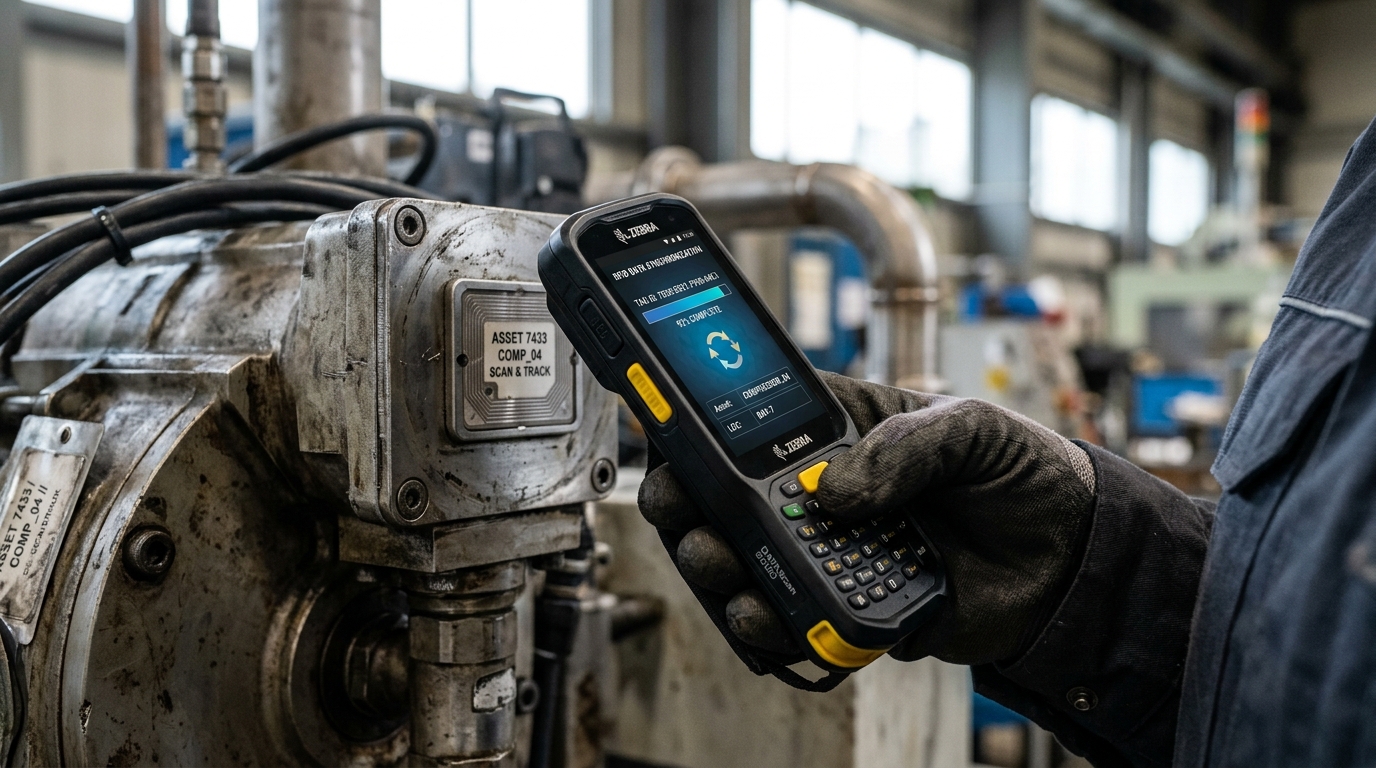
Layers 1 through 3 are infrastructure. They cost money, they require engineering, and vendors are generally good at selling them. Layer 5 is the destination everyone wants to reach. Layer 4 is where projects go to die quietly.
Here is the pattern I see repeatedly. A team pilots a tracking solution, and the pilot succeeds on its own terms. DHL and Intel tested an RFID sensor platform at a 120,000-square-meter facility in the Netherlands. One week. Nine end-to-end runs. Approximately 950 boxes. Read accuracy: 99.2% at two stations, 99.9% at another. Those numbers are strong. But they measure capture, not interpretation. The pilot ran in parallel with the existing system, generating internal purchase-order records for comparison. That parallel validation is the right approach. It is also where many teams declare victory and stop.
The harder question: what happens when those reads feed a live ERP? When exceptions arise (a tag read twice, a tag missed, an asset that moved but shouldn’t have), who owns the reconciliation? When the system of record and the tracking platform disagree, which one wins?
I have seen aerospace MRO teams deploy excellent RFID infrastructure on tooling, only to discover that their CMMS had no clean field to receive the data. The tools were visible. The maintenance records remained disconnected. Visibility without integration is an expensive screensaver.
The ERP and CMMS landscape makes this harder, not easier. IBM Maximo, SAP S/4HANA, Microsoft Dynamics 365, ServiceNow: each has its own connector model, data semantics, and version dependencies. Maximo’s IoT connector maps sensor data to asset and location meters, but the cited documentation is version 7.6.1. Your deployment may differ. Dynamics 365 Connected Field Service supports customizable Azure-based components, including alert debouncing (because without it, a single event generates hundreds of redundant notifications). Every connector promises interoperability. Interoperability is still integration work.
Choose Technology for the Decision, Not the Datasheet
I sit through vendor presentations where the first 30 slides are about radio specifications and the last slide says “integrates with your existing systems.” That ratio should be inverted. The radio exists to serve a decision. Start with the decision.
| Technology | Best-Fit Decision | Integration Reality |
|---|---|---|
| Passive RFID | Identity and presence at defined checkpoints (dock doors, tool cribs, gate transitions) | Reader observations must reconcile with inventory events. No continuous coordinates. |
| BLE | Indoor asset location, proximity alerts, low-power condition monitoring | Requires gateways or compatible detection networks. Coverage is infrastructure-dependent. |
| UWB RTLS | Precision location of moving assets in controlled environments (hangars, factories) | Dedicated infrastructure and location-engine integration. Validate installed performance, not spec-sheet claims. |
| GNSS/GPS | Outdoor position for vehicles, containers, mobile equipment | GPS gives you position, not the communications path back to your platform. Pair with cellular, satellite, or LoRaWAN. |
| LTE-M / NB-IoT | Wide-area mobile assets (LTE-M) or stationary deep-indoor sensors (NB-IoT) | Cellular subscription, coverage, and device configuration become integration dependencies. |
| LoRaWAN | High-volume, low-bandwidth messages across large areas | Unlicensed spectrum. Coverage planning is yours. |
| Cellular + Satellite hybrid | Remote routes, ocean transit, terrestrial coverage gaps | GSMA identifies hybrid modules costing roughly 25% more than standard cellular, with higher satellite power consumption. Match fallback coverage to asset value. |
The 2026 landscape adds options that blur these categories. Battery-free sensors (Wiliot’s Gen3 IoT Pixel broadcasts encrypted BLE signals powered by ambient energy), printable active BLE labels under 1 mm thick, and Bluetooth 6.0 Channel Sounding with sub-meter ranging all expand what “a tag” can be. None of them eliminate the integration work in layers 4 and 5. A thinner tag still needs an authoritative record and a workflow at the other end.
In aviation specifically, the constraints are more severe. Airfreight containers and ULDs need devices that are DO-160 certified, battery-safe for cargo compartments, and able to report across intercontinental routes. That is a narrow intersection of compliance, connectivity, and integration readiness. For ground support equipment on the ramp, you need outdoor GNSS combined with cellular, plus enough battery life to survive a GSE’s operational rhythm. For ocean containers in port logistics, you need devices that handle months of transit with periodic satellite or cellular check-ins.
The point is not to chase the newest radio. If you are evaluating industrial asset tracking hardware, start by defining the minimum actionable event, its permitted delay, and the system where the decision gets made.
Three Integration Strategies, Three Different Returns
Not all integration serves the same purpose. I find it useful to distinguish three strategies, each optimizing a different outcome.
Transaction-centered identification
The goal is to record that something happened at a defined point: a container passed through a gate, a tool was checked out, a shipment crossed a border. Value sits in the record, not in real-time coordinates.
DHL’s pilot is a clean example. RFID reads at specific stations generate purchase-order records, validated in parallel against the existing system. This approach plugs directly into transactional workflows (ERP, WMS, procurement) without requiring continuous location infrastructure. The ROI comes from eliminating manual scan errors, accelerating handoff documentation, and creating an auditable chain of custody.
Fortune Business Insights estimates the broad asset tracking market at $25.98 billion in 2025, growing to $71.55 billion by 2034. A significant share of that growth sits in exactly this layer: replacing manual, error-prone documentation with automated event capture. Meanwhile, MarketsandMarkets values the narrower IoT-based tracking and monitoring segment at $5.02 billion in 2024, projected at 12.8% CAGR through 2029. The denominators differ. Use the market definition that matches what you are buying.
Facility location intelligence
The goal is to know where assets are within a site, in near-real-time, to improve utilization, allocation, and response time.
The case I reference most comes from healthcare, but the mechanics translate directly to MRO hangars, airport ramps, and warehouses. GE Healthcare’s Encompass RTLS at OSMH tracks approximately 800 beacon-tagged assets. A clinician found a bladder scanner in 3 minutes instead of 40. More importantly, the team located 28 idle infusion pumps before a planned purchase of 40. That reduced the need for new equipment by 70%.
Sit with that number for a moment. The ROI was not faster search times. It was an avoided capital expenditure. The hospital did not need the equipment it was about to buy because the equipment it already owned was simply invisible.
Now translate that to an MRO facility. How many tooling sets, test rigs, or ground power units does your operation own that are “somewhere on site” right now? If you are planning a purchase because you cannot find them, you have the same problem OSMH solved.
Distributed visibility across organizational boundaries
The goal is to track assets that leave your facility and move through other organizations’ hands: returnable containers, ULDs, pallets, leased equipment.
Airbus tracks thousands of returnable transport packaging units across suppliers and sites, integrated into its IoT platform. The reported outcome is a 10% work-in-progress reduction. The mechanism is not GPS coordinates. It is visibility into where containers dwell, which suppliers hold them longest, and where the cycle slows down.
This is the strategy most relevant to airlines, ULD pool managers, and anyone operating reusable containers across a multi-party supply chain. It is also the hardest to integrate, because data crosses organizational boundaries, connectivity is intermittent, and the authoritative system of record may not be yours.
The non-obvious insight across all three strategies: more data does not equal better decisions. DHL validates transaction capture. OSMH avoids purchases. Airbus shortens cycle time. Their benefits arise at different operational boundaries. A single “tracking accuracy” KPI cannot compare them fai See also the article: How Asset Tracking Geofencing Works: From Signal to Action.rly.
Shipment Tracking Ends at Delivery. Asset Tracking Does Not.
This is the distinction I come back to in almost every conversation with logistics and aviation operators, and it shapes everything about how you design integration.
Shipment tracking answers: “Where is the cargo right now?” Its job ends when the goods arrive. The tracking ID retires. The device (if reusable) comes back, maybe.
Asset tracking answers: “Where is the container, ULD, pallet, or GSE unit across its entire lifecycle?” Its job never ends. The container delivers, empties, sits idle, returns (or doesn’t), gets inspected, goes back into rotation. The tracking ID persists through every cycle.
The integration implications are different at every layer:
- Identity: Shipment tracking can use disposable tags and temporary IDs. Asset tracking requires tags that survive hundreds of cycles and IDs linked to maintenance, utilization, and financial records that outlast any single shipment.
- Interpretation: In shipment tracking, the key event is “arrived.” In asset tracking, the key events are “idle too long,” “missing from the pool,” “due for maintenance,” and “cycle time exceeding threshold.” These are precisely the kinds of asset tracking alerts that should drive action, not noise, and the same logic applies to geofence alerts for equipment that too often fail silently.
- Action: Shipment tracking notifies the consignee. Asset tracking loops back to the owner: replenish the pool, trigger a return, schedule maintenance, adjust allocation.
If your container pool feels invisible after delivery, that is the gap asset tracking closes. The integration must be designed for the full cycle from the start, not bolted on after a shipment-tracking deployment proves insufficient. Defining the boundary where an asset enters or leaves a zone is the foundation of geofence asset monitoring, where the fence is the easy part and the workflow behind it is the real work.
For airfreight operators, this means devices like the Thingfox T2 (DO-160 approved for cargo compartments) need to report not just during transit, but through the return leg, the dwell at a foreign station, and the re-entry into the active pool. Battery life, reporting cadence, and connectivity strategy must account for the full asset cycle, not just the outbound shipment.
Security, Governance, and the Layer Nobody Wants to Talk About
Location data creates value and risk in equal measure. Both should be addressed in the integration architecture, not in a security review six months after go-live.
CISA’s advisory on Sewio RTLS Studio (versions 2.0.0 through 2.6.2) identified vulnerabilities enabling unauthorized access, information alteration, denial of service, and code execution. No known public exploits had targeted these specific vulnerabilities at the time of disclosure. CISA recommended upgrading to 3.0.0 or later, reducing network exposure, and changing database passwords. A vulnerability disclosure is not a breach. But it demonstrates that location systems are attack surfaces, and security does not stop at the radio layer.
The U.S. GAO’s review of DOD’s passive RFID implementation found that interoperable information systems, performance measures, milestones, and corrective evaluation were all needed. The technology was not the bottleneck. The organizational structure around it was.
And then there is the human layer that no vendor brochure covers: field adoption. The best-designed integration fails if your warehouse team ignores scan prompts, your ramp crew disables beacons they find annoying, or your MRO technicians work around the system because it adds friction to a process they have done by muscle memory for 20 years. Account for training, change management, and feedback loops in your integration plan. The technology you cannot get people to use consistently is the technology that produces garbage data.
One more dimension worth planning for. Apple and Google deployed cross-platform unwanted-tracker detection in 2024, alerting users when an unknown Bluetooth tracker moves with them. Enterprise tracking does not exempt you from these concerns. If your BLE-tagged asset is on a vehicle or carried by a person, your integration design must account for consent, data minimization, and legitimate-use policies.
Building a Business Case That Survives Scrutiny
Every integration project needs a financial defense. Here is how to build one that does not collapse under questioning.
Map the full cost. Tags, readers and gateways, installation, networking, platform subscriptions, integration development, commissioning, ongoing maintenance, tag replacement in harsh environments, and security operations. If your cost estimate stops at “tags plus software license,” your budget will be wrong by a factor that embarrasses everyone at the next review.
Separate the ROI sources. Mixing them weakens the case. There are at least three distinct categories:
- Avoided capital expenditure. The OSMH pattern: locating idle assets before buying replacements. Easiest to defend because the purchase order already exists. “We were about to spend $X. We found the equipment we already own.”
- Recurring labor savings. Reduced search time, automated documentation, fewer manual audits. Real, but requires honest measurement of current labor costs. Do not estimate “time saved” without measuring time currently spent.
- Utilization and cycle-time improvement. Shorter dwell times, faster container returns, better pool allocation. This is where asset tracking (not shipment tracking) pays for itself over multiple cycles. The value compounds, but it takes several cycles to measure.
Do not confuse pilot results with guaranteed outcomes. DHL’s 99.2% read accuracy was measured over one week with 950 boxes. OSMH’s 70% purchase reduction was one hospital’s experience with one equipment type. Sensolus reports Airbus’s 10% WIP reduction without disclosing the measurement baseline. Use these cases as evidence of what is achievable, not as promises you can replicate without doing the work.
Account for the cost of doing nothing. SITA’s 2026 baggage report estimates mishandled baggage costs the airline industry $6.3 billion, with a revised model putting the average at $260 per mishandled bag. That is a concrete, industry-specific cost of inadequate tracking and integration. Your industry has an equivalent number. Find it.
If you are assembling a business case for aviation, freight, or industrial asset tracking and want to pressure-test it against real deployment data, talk to our team. We have run enough of these to know where the estimates tend to be optimistic.
Frequently Asked Questions
What is asset tracking system integration?
It is the discipline of connecting physical observations (tag reads, GPS positions, sensor data) to authoritative business records and automated workflows. The tag captures an observation. Integration determines which business object it describes, which record it updates, and what action follows. A map pin without a workflow behind it is not integration.
Which tracking technology should I choose?
Start with the decision you need to support. Passive RFID excels at checkpoint-based identity. BLE covers indoor proximity and low-power conditions. UWB delivers precision indoor location. GPS provides outdoor coordinates but needs a separate communications path. Most industrial deployments combine two or more. The right question is not “which radio is best” but “what event must I detect, and where must I act on it?”
Can asset tracking integrate with my existing ERP or CMMS?
Yes, through vendor connectors, standard APIs (including EPCIS 2.0), or custom event integration. SAP, IBM Maximo, ServiceNow, and Dynamics 365 all offer documented paths. Compatibility depends on your specific software version, data model, and business process. Validate before committing, not after purchasing tags.
What is the difference between shipment tracking and asset tracking?
Shipment tracking follows cargo to delivery and stops. Asset tracking follows the container, ULD, pallet, or equipment through its full lifecycle: delivery, return, dwell, maintenance, and reuse. The integration architecture, identity model, and ROI calculation are fundamentally different. If your reusable containers disappear after delivery, you have a shipment tracker doing an asset tracker’s job.
How do I calculate ROI for an asset tracking integration?
Separate three sources: avoided capital purchases (finding idle equipment before ordering replacements), recurring labor savings (reduced search and documentation time), and utilization improvement (shorter cycle times, better pool allocation). Build total cost of ownership from hardware, installation, connectivity, platform fees, development, and maintenance. Compare against the measured cost of your current process, not an industry average.
How long does a typical integration project take?
A focused pilot covering one process at one site can run in weeks. Full production integration (ERP connection, exception handling, user training, security review) typically takes 3 to 6 months for mid-complexity deployments. The variable is not the hardware. It is data governance, workflow design, and getting field teams to actually use it consistently.








 +1 508 292 2210

One Response