

Quick clarification before anything else. If you searched “global airfreight tracking with Griffin Air,” you might be looking for Griffin & Company Logistics, an IATA-registered freight forwarder out of Minneapolis. This article covers the other Griffin Air: the airline-certified GPS tracker built by Digital Matter, purpose-built for cargo that moves by air.
The distinction matters because the hardware side of this conversation is where the operational dollars are moving. The smart air cargo tracking market reached $3.7 billion in 2025 and is projected to hit $6.9 billion by 2033 at a 15.4% CAGR. Global air cargo demand grew 11.3% in 2024 alone, exceeding the record volumes set in 2021. Shippers are done accepting the information black hole between departure scan and arrival scan. They want real-time position data, not milestone updates hours after the fact. The Griffin Air is one of the devices closing that gap.
What the Griffin Air Actually Is
The Griffin Air is a compact, battery-powered IoT tracker manufactured by Digital Matter, an Australian company with 2.5 million devices deployed across 130 countries. It tracks assets that move between ground transport and aircraft, automatically adjusting its behavior at each transition point without manual intervention.
The specs that matter operationally:
- 4G LTE Cat 1bis with 2G fallback for global cellular coverage. Wi-Fi AP scanning and cell tower positioning handle indoor environments where GNSS can’t reach.
- Three AA LiFeS2 user-replaceable batteries. Deploy-once life exceeds two years through intelligent power management that puts the device to sleep when assets are stationary.
- IP67 waterproof enclosure. Onboard sensors detect impact, tip, and rotation. A barometer monitors pressure changes relevant to altitude and environmental conditions.
- Automatic flight detection that silences all cellular transmissions when the device senses it’s airborne, then resumes reporting after landing.
- Certified by 46+ airlines: Delta, Emirates, Lufthansa Cargo, Qatar Airways, Singapore Airlines, United, American, British Airways, Southwest, FedEx, Cathay Pacific, Qantas, and more.
- Bluetooth connectivity for integration with BLE sensors and remote management via Digital Matter’s Device Manager platform, which integrates with 1,000+ third-party systems.
That flight detection feature is what separates this from every general-purpose tracker on the market. It’s the reason the device gets on aircraft. Without it, your tracker is a compliance violation sitting in a cargo hold.
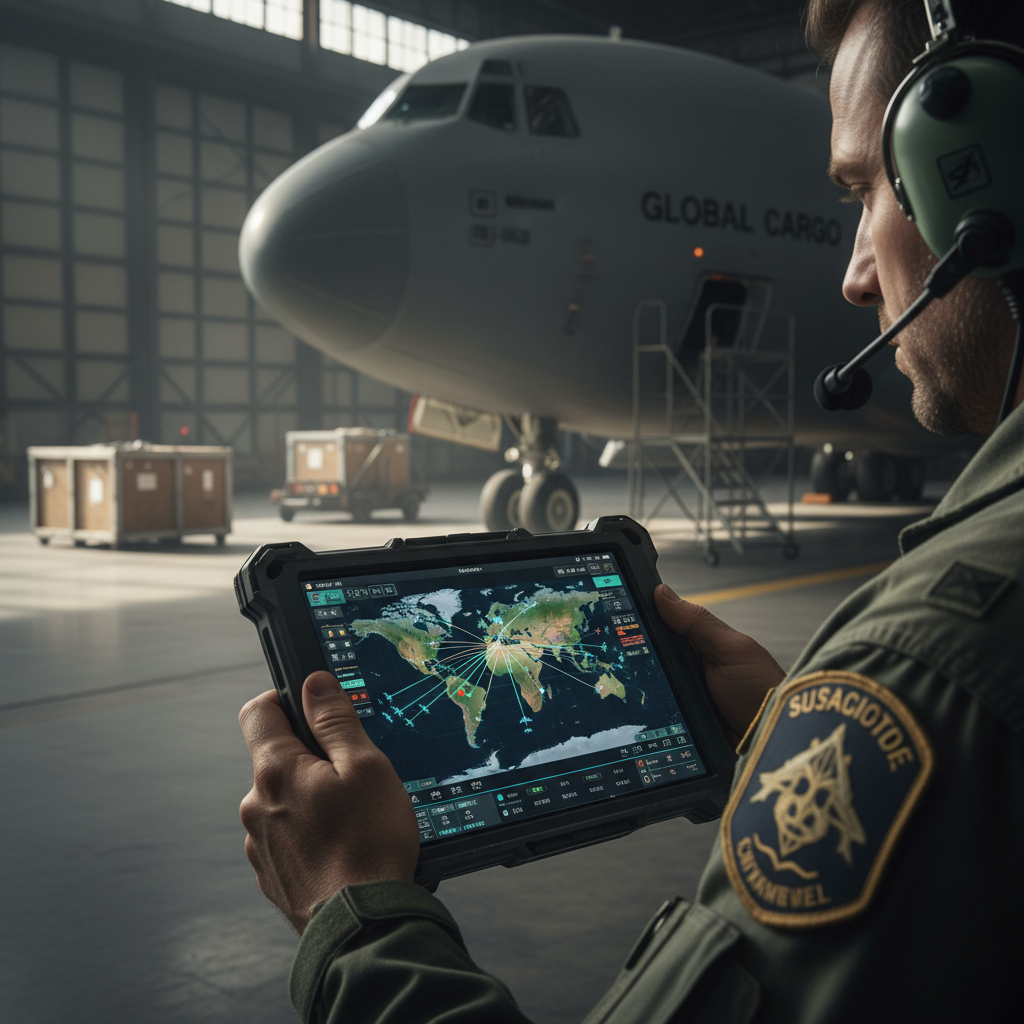
Why You Can’t Just Use Any GPS Tracker in Air Cargo
I hear this regularly from supply chain managers who come from road freight or ocean logistics: “We already have trackers. We’ll just include one in the shipment.” In trucking, that works. In air cargo, it can get your shipment pulled off the aircraft.
Airlines require every electronic tracking device in cargo to be pre-approved. Two concrete safety concerns drive that requirement.
The first is lithium battery safety. In 2022, the FAA documented 55 lithium battery air incidents, including a tracking device battery found burning inside a baggage cart at a cargo facility. A single thermal runaway event in a cargo hold at altitude, with limited fire suppression capability, is the scenario that keeps aviation safety regulators awake. Airlines take a zero-tolerance approach to unvetted lithium-powered devices, and for good reason.
The second is RF interference. A standard cellular tracker transmitting at cruising altitude violates ICAO regulations. The Griffin Air solves this with automatic flight detection: the cellular modem silences during flight and resumes only after landing. This isn’t a bonus feature. It’s the core compliance mechanism that makes airline certification possible.
IATA’s Lithium Battery Guidance Document spells it out plainly: unauthorized tracking devices may result in cargo hold, delay, or return to shipper. Southwest Airlines’ approved device list adds a hard technical threshold, requiring that batteries in approved devices stay under 100 watt-hours. The Griffin Air’s three AA cells don’t come close to that limit.
If you’re deploying trackers in air cargo today, the first question isn’t “which tracker.” It’s “is this tracker on my carrier’s approved list.”
Reusable vs. Disposable: The Math Most People Skip
The air cargo tracking market has split into two models. The Griffin Air is reusable: deploy it, track the shipment, retrieve it at the destination, replace batteries eventually, and deploy again. Competitors like Tive’s Solo 5G take the opposite approach: single-use, activate and discard.
Both models work. The question is which one makes sense on your specific lanes.
Run the numbers on a recurrent route. Say you’re moving pharmaceutical products from Frankfurt to Chicago three times a week. A disposable tracker at $25 per unit runs $3,900 per year on that single lane. A reusable Griffin Air, even at a higher upfront cost, amortized over hundreds of shipment cycles with its two-year battery life, drops the per-shipment tracking cost below $1. The device pays for itself within weeks.
Now consider a one-off shipment to a destination where you have no return logistics. Retrieving a reusable tracker costs coordination that may exceed the price of a disposable unit. On irregular or one-way lanes, disposable wins.
Most global shippers operate both types of lanes. The real decision isn’t “reusable or disposable” as a blanket policy. It’s mapping each lane’s frequency and return logistics to the device economics that actually pencil out. Roughly 70% of logistics firms are now investing in tracking technologies. The ones getting it right are matching the device model to the lane, not to a preference.
IATA ONE Source Is Rewriting the Approval Process
In December 2024, IATA launched its Air Cargo Device Assessment Program under Recommended Practice 1693. The program introduces standardized testing for electromagnetic compatibility and battery safety, with results centralized in a database called ONE Source.
This is a structural shift. Until now, getting a tracker approved meant navigating a separate process with each airline. The Griffin Air went through that grind to reach 46+ carriers. Tive claims 130+. Every approval required independent validation.
ONE Source collapses that fragmentation. One assessment, one database, visibility across carriers. For manufacturers, it cuts the cost of adding new approvals. For shippers and freight forwarders, it simplifies due diligence: check ONE Source, confirm the device is validated, deploy with confidence.
The competitive implication is worth flagging. Broad airline approval lists, currently a differentiator, will compress as the standardized process lowers barriers to entry. The advantage shifts from “how many airlines approve our device” to “what does the device actually do once it’s on your cargo.” Battery life, sensing capabilities, integration depth, and total cost of ownership become the primary criteria.
Building a Tracking Architecture That Scales
No single tracker covers every layer of air cargo visibility. That’s not a limitation of the Griffin Air. It’s a reality that should shape how you design your tracking strategy.
Think in layers.
At the container and pallet level, a reusable device like the Griffin Air sits on the ULD, providing continuous location and environmental data through both air and ground legs. Its IP67 rating, multi-constellation GNSS, and two-year battery make it the anchor for visibility on recurrent routes. This is where the air-to-ground transition visibility gap, the traditional “black hole” of air cargo, gets closed—especially critical when tracking high-value aviation assets that require documented chain of custody.
At the package level, cheaper label-format trackers monitor individual items during ground handling. Trackonomy’s SmartTape, which launched in September 2024 with cellular-enabled label tracking, is an example. These devices are thinner and lower-cost but can’t survive repeated air transport cycles.
Then there’s sensor coordination. The Griffin Air includes Bluetooth, which opens the door to a hub-and-spoke model. One Griffin Air on a ULD aggregates data from multiple BLE sensors attached to individual items inside the container. You get container-level location from the Griffin Air and package-level condition data (temperature, shock) from the BLE tags, all coordinated through a single hub. With e-commerce logistics growing over 20% annually, this layered approach is where the industry is heading.
How the Griffin Air compares
| Device | Type | Battery Life | Airline Approvals | Best For |
|---|---|---|---|---|
| Griffin Air (Digital Matter) | Reusable | 2+ years, 3x AA | 46+ | Recurrent lanes, ULD/pallet tracking |
| Solo 5G (Tive) | Disposable | Single use | 130+ | One-off shipments, broadest carrier access |
| Saga Logger (Controlant) | Reusable | Rechargeable | IATA/FAA/EASA | Pharma cold chain, GDP compliance |
| SmartTape (Trackonomy) | Disposable | Not disclosed | Limited | Package-level, label form factor |
| TRACK 1105 (Sensolus) | Reusable | 7 years | Not disclosed | Extreme industrial durability (IP69K) |
The Griffin Air’s sweet spot is clear: reusable, airline-certified, built for the air-to-ground transition on high-frequency international corridors. If your cargo cycles between the same origin-destination pairs and you need both location and environmental monitoring without per-shipment hardware cost, it belongs on your shortlist.
Choosing the right device is really choosing the right architecture. Lane frequency, cargo type, carrier mix, return logistics, integration requirements: all of these shape which devices go where. At Datanet, we work with Digital Matter’s full product range (including the Griffin Air) alongside airfreight-approved hardware like the Thingfox T2 with DO-160 certification. We also deploy tracking for the ground and ocean legs that happen before and after the aircraft. The point is never a single device. It’s the complete visibility layer your operation requires.
If your air cargo still goes dark between departure and arrival, or if you’re unsure whether your current trackers meet airline certification requirements, the gap is getting wider, not narrower. Browse our asset tracking device catalog or reach out directly to map the right setup for your lanes.

Frequently Asked Questions
What is the Griffin Air tracker?
The Griffin Air is a battery-powered, airline-certified GPS and IoT tracker manufactured by Digital Matter. It uses automatic flight detection to silence cellular transmissions while airborne, enabling compliant cargo tracking across 46+ approved airlines. It runs on three AA LiFeS2 batteries with a deploy-once life exceeding two years.
Which airlines have approved the Griffin Air?
As of 2026, approved carriers include Delta, Emirates, Lufthansa Cargo, Qatar Airways, Singapore Airlines, United Airlines, American Airlines, British Airways, Southwest Airlines, FedEx, Cathay Pacific, and Qantas. The full and current list is maintained on Digital Matter’s airline certifications page.
Can I use any GPS tracker inside air cargo?
No. Airlines require tracking devices in cargo to be specifically pre-approved. IATA warns that unauthorized devices may result in cargo hold, delay, or return to shipper. The concerns are lithium battery fire risk and RF interference with aircraft systems. Always verify your device against your carrier’s approved list or the IATA ONE Source database before deployment.
Is the Griffin Air reusable or disposable?
Reusable. It features user-replaceable AA batteries and is designed for repeated deployment across hundreds of shipment cycles. On high-frequency lanes, this reusable model delivers per-shipment tracking costs well below $1, compared to $20 or more for disposable alternatives on each shipment.
What is IATA ONE Source?
ONE Source is a centralized database launched by IATA in December 2024 as part of the Air Cargo Device Assessment Program under Recommended Practice 1693. It consolidates airline-approved tracking device information into a single registry, replacing the fragmented per-airline approval process that previously required separate validation with each carrier.
How does the Griffin Air handle the transition between air and ground?
The device uses automatic flight detection. When it senses airborne conditions (via barometric pressure and motion patterns), it silences cellular transmissions to comply with aviation regulations. Once it detects landing, it resumes tracking and transmits accumulated position and sensor data over 4G LTE. No manual mode switching required.








 +1 508 292 2210

6 Responses