

You have an 11-digit AWB number. You enter it into a carrier portal. You get a status: “Departed,” “Arrived,” maybe “Delivered.” And then… silence. The shipment reached its destination, but the ULD, the container, the reusable pallet? Those assets vanish from your visibility the moment the cargo is released.
That silence costs the air cargo industry approximately $1 billion annually in legacy messaging infrastructure alone. And it doesn’t even account for lost equipment, idle dwell time, or the insurance claims triggered when tracking stops at delivery.
If you searched “IATA cargo tracking,” you likely need one of two things: a practical way to trace a shipment right now, or a clear picture of how the system actually works (and where it breaks). I’ll cover both.
How IATA Cargo Tracking Works: The AWB Anatomy
Every air cargo shipment gets an Air Waybill number. It’s the DNA of IATA cargo tracking. The structure is 11 digits: a 3-digit airline prefix assigned by IATA (say, 160 for Air Canada), a 7-digit serial number, and a check digit calculated by dividing the serial by 7 and taking the remainder.
Format: 123-12345675
That prefix tells you which carrier issued the waybill. The check digit catches typos before you submit. If a tracking portal throws a “check digit error,” you likely transposed a number in the serial.
There are two types:
- MAWB (Master Air Waybill): issued by the airline or its agent, covers the full consignment from origin to destination airport.
- HAWB (House Air Waybill): issued by freight forwarders when consolidating multiple shippers into a single MAWB.
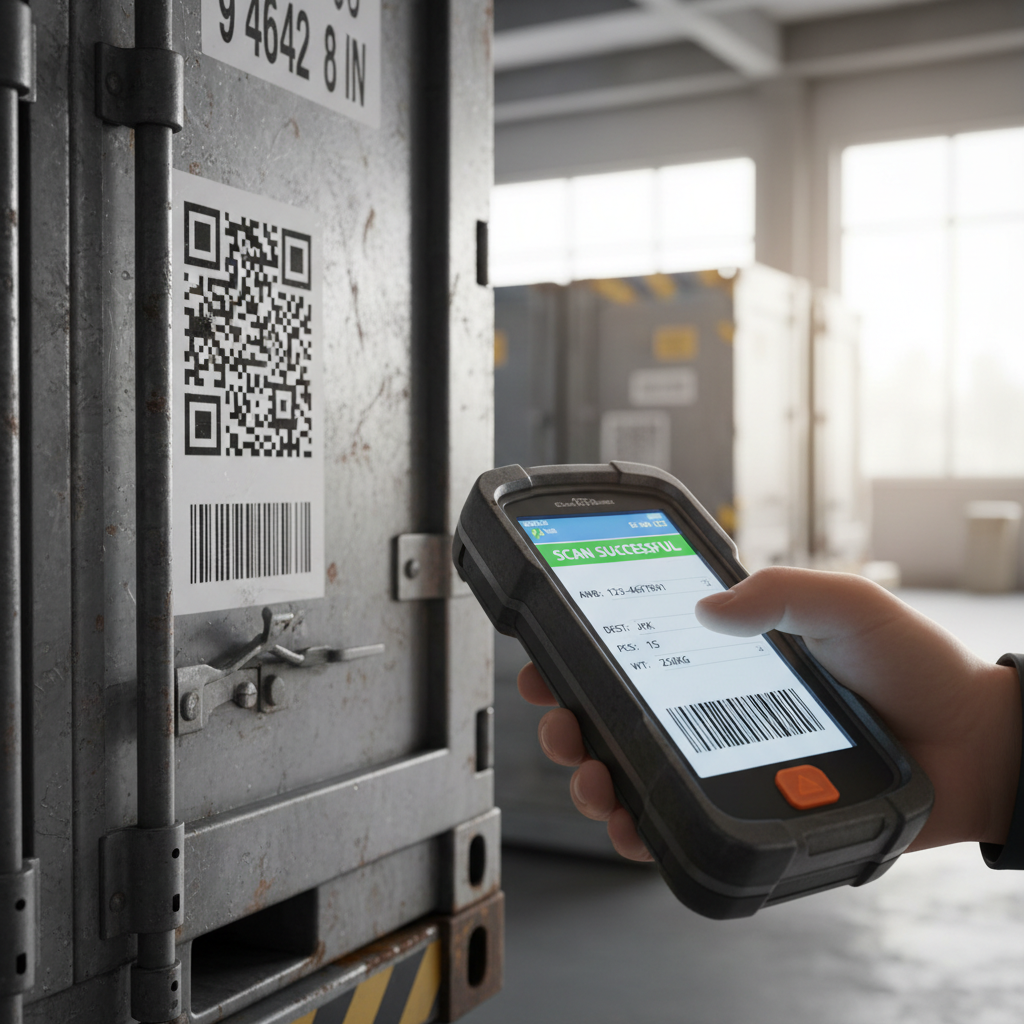
To track a shipment, you enter the AWB into the issuing carrier’s tracking portal. Services like track-trace.com cover 241 airlines and auto-detect the carrier from the prefix, saving you the step of finding the right portal. But here’s the catch: what you get back is milestone data. Departed. Arrived. Customs hold. Delivered. You’re reading a summary, not watching a live feed.
What Those Status Codes Actually Mean (And Don’t)
This is where most IATA tracking guides stop. They explain the AWB format but never decode what the milestones mean operationally. Here’s a practical breakdown:
| Status | What It Says | What It Doesn’t Tell You |
|---|---|---|
| BKD (Booked) | Space confirmed on a flight | Whether your cargo was physically received at the warehouse |
| RCS (Received from Shipper) | Cargo accepted at origin | Whether it passed security screening or is waiting in queue |
| MAN (Manifested) | Loaded onto a flight manifest | Physical location inside the aircraft or ULD assignment |
| DEP (Departed) | Flight has left | Whether your cargo actually made that flight (offloads happen) |
| RCF (Received from Flight) | Cargo confirmed at destination warehouse | How long it will sit before customs clearance |
| NFD (Notified for Delivery) | Consignee informed | Actual pickup window or dwell time before collection |
| DLV (Delivered) | Released to consignee | Condition on arrival, temperature excursions, or return of equipment |
Each milestone is a snapshot, not a stream. Between DEP and RCF, your cargo might sit on a tarmac for six hours during a connection. You won’t know. Between NFD and DLV, three days could pass. The AWB doesn’t distinguish “waiting for pickup” from “stuck in customs dispute.”
For a single Priority shipment, that ambiguity is manageable. For a freight forwarder managing 200 AWBs across 15 carriers simultaneously, those gaps compound into operational blind spots.
The Legacy Stack: Why IATA Tracking Is Still Catching Up
The messaging backbone behind most AWB updates is older than the internet. Type B teletype messaging has run for over 60 years, limited to 60 lines of 63 characters per message, transported over ARINC and SITA store-and-forward networks. Four kilobytes per message. No native encryption. No real-time push.
Cargo-IMP (the message format from 1975) and Cargo-XML (introduced in 2010) are the two protocols carrying your tracking data today. Both are batch-oriented. Both depend on each handler in the chain voluntarily updating the status when they process cargo. Miss one handler, miss one update.
The e-AWB program, which became the default contract of carriage on 1 January 2019, digitized the document itself. That was a milestone. But digitizing the paper didn’t change the underlying message architecture. You still get milestone pings, not continuous visibility. Industry-wide e-AWB adoption now exceeds 85% of shipments, but the original 100% target set for end-2022 was missed.
In April 2025, Brazil became the first Americas country to waive physical AWB requirements, removing a structural barrier. Progress is real, but incremental.
ONE Record: How IATA Is Rebuilding Cargo Tracking From Scratch
ONE Record is the answer IATA is building to replace the 1975 messaging layer. It’s an open, free, API-driven data-sharing standard that assigns a unique web address (URI) to each shipment and lets any authorized stakeholder pull live data through REST APIs, serialized in JSON-LD.
The IATA Cargo Services Conference endorsed ONE Record as the preferred data-sharing standard effective 1 January 2026, officially replacing the trajectory toward Cargo-IMP and Cargo-XML as the long-term backbone.
What this means in practice:
- Instead of batch status messages pushed at irregular intervals, stakeholders can query a shipment’s current state in real time through an API call.
- IoT sensor data (temperature, shock, location) integrates directly into the shipment record rather than living in a separate silo.
- Change requests (booking modifications, AWB corrections) flow through standardized workflows instead of back-and-forth emails.
As of IATA’s December 2025 survey: 70%+ awareness, approximately 50% readiness, and more than 30 active global pilots. The gap between “aware” and “ready” is where most of the industry sits right now.
Who’s already live?
Cathay Cargo went into production one year ahead of schedule, exchanging eAWB data with Sinotrans, WECAN, ALL-LINK, and Sinotrans Hong Kong starting December 2024. Lufthansa Cargo committed jointly with CHAMP Cargosystems to adopt the standard, and WFS (handling 95,000+ tonnes of Cathay Cargo annually) launched a ONE Record use case on the Hong Kong to Paris CDG lane, replacing the legacy Flight Booking List previously sent via Cargo-IMP over ARINC/SITA.
Korean Air, Turkish Cargo, Shandong Airlines, and Schenker are also running active pilots. The network effect is building, but slowly. 78% of survey respondents said they wanted more pilot examples before committing.
The Tracking Gap: Where AWB Visibility Ends and Asset Blindness Begins
Here’s the tension I see repeatedly in our client conversations. IATA cargo tracking, whether legacy or ONE Record, is designed around the shipment. The job ends at DLV (Delivered). The AWB closes. The record is archived.
But the physical assets that carried that shipment don’t disappear. ULDs cycle back. Reusable containers need to return. Ground support equipment moves between gates. Temperature-controlled packaging has a shelf life per cycle.
This is the distinction between shipment tracking and asset tracking, and where Griffin Air real-time cargo tracking bridges the operational gap:
- Shipment tracking answers: “Where is my cargo right now?” Job done at delivery.
- Asset tracking answers: “Where is my equipment across its entire lifecycle?” Job never ends.
Jettainer (a Lufthansa Cargo subsidiary managing 100,000+ ULDs at 500 global locations) just announced a next-generation IoT tracking solution at IATA WCS Lima in March 2026, using mobile and stationary readers rather than fixed scanners. Why? Because fixed scanners only catch assets at chokepoints. Between those chokepoints, the ULD is invisible.
Industry-wide, more than 1 million intermodal assets now carry telematics hardware, with Drewry forecasting nearly one-third of all containers telematics-equipped by 2027. The market has decided that milestone-based tracking is insufficient. Continuous visibility is the standard moving forward.
IoT Devices in IATA-Regulated Air Cargo: Compliance Matters
You can’t just strap any GPS tracker to air cargo and call it a day. IATA’s Interactive Cargo program governs which IoT devices are approved for use in aircraft cargo compartments. Battery safety (lithium-ion, lithium-metal), electromagnetic interference, and pressure/altitude tolerance are all regulated under the IATA Dangerous Goods Regulations (DGR). For a detailed overview of airfreight cargo tracking compliance and device selection, understanding these regulatory requirements is essential.
The IATA Air Cargo Device Assessment evaluates hardware against these criteria. Devices that pass get listed as “interactivity-ready,” meaning airlines can accept them without additional dangerous goods paperwork per shipment.
This is why DO-160 certification matters for airfreight trackers. DO-160 is the environmental testing standard for airborne equipment, covering altitude, temperature, vibration, humidity, and more. A device certified to DO-160 has been validated for the conditions inside an aircraft hold.
For ground support equipment and ULDs that stay on the tarmac or in warehouses, the bar is different. Cellular trackers with long battery life and rugged IP67-rated housings cover that use case without needing flight certification.
The practical question for operators: do you need tracking inside the aircraft (during flight), or around the aircraft (ground handling, warehousing, dwell)? The answer determines your compliance path and hardware choice.
The Security Angle: $27B in Cargo Theft Demands Better Tracking
CargoNet logged 884 cargo theft events in Q2 2025 in the U.S. and Canada alone, a 13% year-over-year increase. Full-year 2025 reached 3,594 supply-chain crime events. NICB reports dollar losses jumped 27% in 2024 with another 22% projected for 2025.
The EU’s ACC3 (Air Cargo or Mail Carrier operating into the Union from a Third Country Airport) designation requires carriers from non-EU airports to physically screen cargo to EU standards or validate the entire supply chain through Known Consignor and Regulated Agent schemes. The Consignment Security Declaration (CSD) provides the audit trail.
All of this is paperwork-intensive. ONE Record’s real-time shipment events aim to digitize the CSD chain. But until that’s universally adopted, physical IoT tracking provides the evidence layer that paper cannot: timestamped GPS coordinates, tamper alerts, temperature logs that prove chain of custody wasn’t broken.
For high-value cargo (pharma, electronics, aerospace parts), the calculus is simple. The cost of a tracking device per shipment is a fraction of a single insurance claim. The cost of a fleet-wide asset tracking deployment is a fraction of annual equipment loss.
The Market Context: Air Cargo in 2026
Airlines transport over 62 million cargo tonnes annually, representing more than 33% of global trade by value despite accounting for less than 1% by volume. That’s $8.3 trillion of goods per year, or roughly $22.7 billion per day moving through the air cargo system.
Full-year 2025 set another demand record: cargo tonne-kilometers rose 3.4% year-over-year (4.2% internationally), with capacity up 3.7%. Asia-Pacific grew 8.4%, and North America was the only region to contract (at -1.3%). IATA credited global e-commerce strength as the primary driver.
The air cargo optimization AI market alone is projected to grow from $3.2 billion in 2025 to $12.8 billion by 2034 at a 16.7% CAGR. CargoAi’s CargoCoPilot Agent is already processing 10,000+ monthly quotes at 94% automation. The trajectory is clear: manual milestone checks will be replaced by AI-driven, event-triggered visibility.
For operators and forwarders still relying on manual AWB portal checks across 10+ carrier websites, the question isn’t whether to digitize. It’s whether you digitize on someone else’s timeline or your own.
Practical Guidance: Choosing Between AWB Tracking and IoT-Based Tracking
Not every shipment needs an IoT device. Not every asset can survive on milestone-only AWB data. Here’s how to calibrate:
AWB tracking (milestone-based) is sufficient when:
- The cargo is general freight with standard transit times
- You need proof of delivery, not proof of condition
- The equipment is single-use (pallets, wrapping) and doesn’t cycle back
- Transit time is short (under 48 hours origin to destination)
IoT-based asset tracking is necessary when:
- Cargo is temperature-sensitive (pharma, biologics, perishables) and you need condition data, not just location
- Equipment is reusable and must be recovered (ULDs, containers, specialized packaging)
- High-value goods require tamper evidence for insurance or compliance
- Dwell time and cycle time are KPIs you’re managing (not just transit time)
- You operate across multiple handlers and need visibility between milestones
The cost comparison is often misframed. People compare the price of a tracker against the price of a single shipment. The real comparison is the tracker cost against the annual loss rate of untracked equipment, the insurance premium differential, and the operational hours spent manually chasing status updates.

Frequently Asked Questions
How do I track IATA cargo with an AWB number?
Enter your 11-digit AWB (format: 123-12345675) into the issuing airline’s cargo portal. The 3-digit prefix identifies the airline. Aggregator services like track-trace.com auto-detect the carrier and cover 241 airlines from a single interface. You’ll receive milestone updates (Booked, Departed, Arrived, Delivered) but not real-time location.
What is IATA ONE Record and how does it change cargo tracking?
ONE Record is IATA’s open API standard (endorsed January 2026) that replaces legacy batch messaging with real-time, event-driven data sharing. Each shipment gets a unique web URI that any authorized party can query. It enables IoT sensor integration, live status events, and standardized change-request workflows across the entire supply chain.
Is IoT tracking approved for use inside aircraft cargo holds?
Yes, but devices must pass the IATA Air Cargo Device Assessment and comply with Dangerous Goods Regulations for lithium batteries. DO-160 certified devices meet the environmental testing requirements for airborne equipment. Devices not certified for flight can still track ground handling, warehousing, and surface transport legs.
What’s the difference between MAWB and HAWB tracking?
A Master Air Waybill (MAWB) is issued by the airline and covers the full consignment between airports. A House Air Waybill (HAWB) is issued by the freight forwarder for individual shippers within a consolidated MAWB. Track the MAWB for airport-to-airport progress. Track the HAWB through your forwarder’s system for shipper-specific detail.
Why does my AWB tracking show no updates for hours?
The legacy Type B messaging system is batch-oriented, not real-time. Each handler updates status manually when they process cargo. Gaps between DEP and RCF (or between RCF and NFD) often reflect transit time, connection wait, customs processing, or simply that the next handler hasn’t scanned yet. It doesn’t necessarily mean a problem.
Can I track reusable air cargo equipment after delivery?
Standard AWB tracking ends at delivery (DLV status). To track ULDs, reusable containers, or specialized packaging through their return cycle, you need dedicated asset tracking hardware with independent power and connectivity. This is the domain of IoT-based solutions rather than IATA’s shipment-centric tracking system.
If your container pool goes dark after the DLV milestone, that’s the gap asset tracking closes. We deploy DO-160 certified airfreight trackers and long-life cellular devices for ground equipment across the aviation supply chain. See our asset tracking hardware or talk to us directly at info@datanetiot.com.








 +1 508 292 2210

3 Responses