

Improving aircraft maintenance efficiency with tracking sounds like a solved problem in 2026. The software platforms exist. The AI models are ready. The budgets are there, with global MRO demand reaching $136 billion in 2025 and climbing toward $193 billion by decade’s end. And yet, only 6% of MRO organizations have integrated digital tools at scale. That leaves 94% of the industry running maintenance operations where parts, tools, and equipment go dark the moment they leave a shelf or cross a facility boundary. (See also: aviation asset tracking regulatory compliance.) (See also: what is geolocation.) (See also: ip geolocation tracker.) (See also: reducing aircraft downtime with asset tracking.) (See also: aviation compliance tracking solutions.)
If you manage maintenance operations for an airline, MRO shop, or ground support organization, you’ve probably lived this gap firsthand. Your CMMS says a part is “in repair.” The part is actually sitting on a cart somewhere between receiving and the bench. Nobody knows for sure. The problem isn’t that you lack software. It’s that your software lacks the data it needs, because nobody is tracking the physical assets that feed it.
The Real Bottleneck Is Data, Not Software
McKinsey surveyed 45 MRO executives and found that over 80% cited data limitations as the biggest barrier to digital transformation. Not budget. Not executive buy-in. Data.
This makes sense when you look at how most MRO data actually gets created. A technician finishes a task, walks to a workstation, and logs it. Sometimes immediately, sometimes hours later. The entry captures what was done, but rarely where the part is right now, how long it sat in staging, or whether storage conditions stayed within spec during transit. It’s a record of action, not a picture of the asset’s current state.
That distinction matters because it’s the difference between shipment tracking and asset tracking. Shipment tracking tells you a rotable arrived at your facility. Asset tracking tells you which shelf it’s on, how long it’s been there, whether temperature held tolerance during transport, and that it’s actually ready for the next step in its repair cycle. Shipment tracking ends at the dock. Asset tracking follows the asset through its entire lifecycle: removal, transit, induction, repair, QA, return to service.
When 80% of executives say data is their top barrier, they’re describing a tracking problem. Not a software problem.
What Goes Invisible Between Maintenance Events
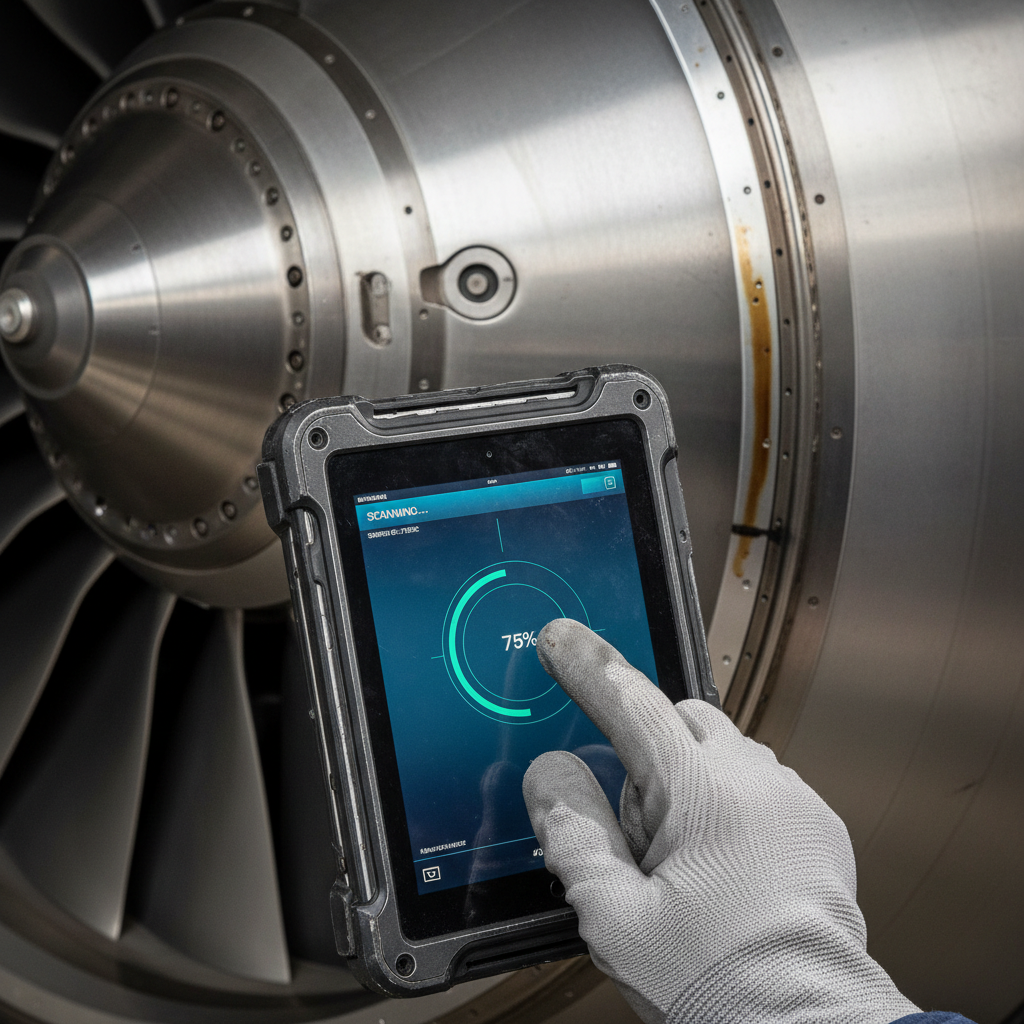
When people hear “aircraft maintenance tracking,” they think software: work orders, compliance calendars, AD/SB management. That layer is necessary. It’s not sufficient. Beneath the software, there’s a physical tracking layer that most operators barely have. It covers the assets themselves.
Rotable parts in the repair cycle are the clearest example. A wheel assembly gets removed in Atlanta, shipped to an overhaul facility in Miami, repaired, shipped back, and installed on a different aircraft. Without continuous tracking, you have visibility gaps at every handoff. Time disappears between stations, and nobody can pinpoint exactly where. Some operators see multi-week variances on identical inspection types because dwell time in staging is effectively unmeasured—challenges similar to those addressed through asset tracking in aircraft manufacturing environments.
Tools and calibrated equipment present a different blind spot. When mechanics spend time searching for a calibrated torque wrench that should be on a specific tool cart, that’s more than wasted minutes. Improper or missing tooling is a recognized human factor in maintenance incidents. RFID and BLE-based tool tracking eliminates the search entirely and creates an automatic audit trail for calibration compliance.
Ground support equipment adds another gap. Tugs, power units, air starters, de-icing trucks, and towbars: if you don’t know which units are serviceable, where they’re parked, or when they’re due for inspection, your turnaround schedule is built on assumptions rather than data. Aircraft towbar tracking is a prime example of a low-visibility asset that quietly disrupts turnarounds.
Environmental conditions matter more than most operators realize. Avionics components and composites degrade when stored outside specified temperature and humidity ranges. Sensors that log conditions continuously through storage and transit provide the compliance evidence that periodic manual spot-checks miss.
Then there’s the documentation bridge. IATA’s 2024 position paper on aircraft electronic records makes the case that configuration control and record integrity depend on connecting physical asset movements to digital records in real time. When tracking automates that connection, every movement becomes a data point without waiting for someone to type it in.
The Financial Case for Maintenance Tracking
The market dynamics make the math hard to ignore. Average fleet age rose to 13 years in 2025, the oldest in a generation, because aircraft production efficiency remains 24% below 2019 levels with 17,000+ unfilled orders in the backlog. Older fleets generate more maintenance events per aircraft. More maintenance events mean more parts cycling through repair loops, more tools in active use, more GSE deployed on ramps. Every one of those assets is a potential bottleneck when it’s invisible in real time.
The operators who have deployed tracking at scale are seeing measurable returns. McKinsey found that over 25% of digital MRO adopters report 10-20% reductions in maintenance spending, with front-runners delivering more than 5% revenue uplift and over 10% engineering productivity gains. Delta Air Lines invested $50 million in RFID tracking across 344 airports and achieved a 99.9% success rate for tagged items, proving that near-perfect tracking accuracy is technically achievable at airline scale.
Now flip the equation. Every AOG event that could have been prevented by knowing where a serviceable part was sitting costs the operator revenue, schedule integrity, and downstream maintenance disruption. When a mechanic spends shift time hunting for a tool instead of turning wrenches, that labor cost compounds across every shift, every station, every day. The financial case for tracking isn’t about one big win. It’s about eliminating hundreds of small, invisible losses that nobody counts because nobody can see them.
Predictive AI Needs Physical Tracking First
Predictive maintenance gets the headlines. 65% of maintenance teams plan AI adoption by end of 2026, and the results for early adopters are real: 25-35% reductions in unscheduled downtime, failure prediction windows extending up to six months, 35-40% fewer unscheduled maintenance events.
But here’s what the AI vendors rarely explain. Every one of those results depends on comprehensive, clean, real-time data. GE Aerospace monitors over 1,000 engines daily by processing more than 5 billion data points annually. Airbus Skywise aggregates data from over 11,000 aircraft. Rolls-Royce’s digital twin technology synchronizes virtual engine models with real-world sensor data transmitted via satellite.
Those systems work because the physical tracking layer (sensors on engines, transmitters on airframes, data links to ground stations) is already in place. The analytics are the last mile, not the first step.
For MRO operators who don’t build engines, the same principle applies at a different scale. Your rotable parts, your tooling, your GSE, your environment-sensitive components: if these assets aren’t continuously tracked, your analytics layer is doing math on incomplete data. Going straight to predictive AI without solving the tracking foundation is how you end up in the 94%.
Where to Start: The Practical Sequence
Most articles on this topic list technologies in order of impressiveness: digital twins first, blockchain second, drones third. That’s the wrong sequence. Here’s one that’s ordered by speed of impact.
In the first one to three months, focus on mobile digital workflows and physical asset tags. Replace paper-based task cards with mobile capture at point of work. Tag your highest-value rotables and most-used tools with RFID or cellular tracking devices. Cloud-based platforms can deploy in one to two weeks. For parts moving through airfreight, DO-160 certified trackers like the Thingfox T2 handle compliance requirements without regulatory friction. This phase alone delivers 40% faster planning cycles and kills the “where is it?” problem.
Between months three and twelve, add IoT sensor networks for condition monitoring. Environmental sensors log temperature and humidity for sensitive components through storage and transit. GPS and cellular trackers on GSE give you fleet status in real time, not after the shift report. Battery-powered devices like the Oyster Edge or Oyster3 work for assets without permanent power connections, which covers most equipment on the ramp.
From month six onward, layer predictive analytics on top of what is now clean, reliable data. Whether you use an OEM platform (Boeing Insight Accelerator, Airbus Skywise) or vendor-agnostic tools (Ramco, IFS, Veryon), the analytics produce meaningful output because the data beneath them is complete and current.
Digital twins and blockchain traceability come later, typically 12 to 36 months out. Both are systemic investments with longer payback periods. Both become dramatically more effective when built on the tracking infrastructure already in place. Skip to these without the physical layer, and you’re back to the 80% data-limitation barrier.
45,000 Mechanics Retiring. Their Knowledge Doesn’t Have To.
41% of US certified mechanics are over 60. Roughly 45,000 are expected to retire in the next decade. US airlines have already absorbed a 15% increase in maintenance costs over the past five years alongside a 14% increase in delayed flights. The experience walking out the door isn’t being replaced at the same rate.
When a senior mechanic retires, they take decades of operational intuition with them: which rotables tend to stall in staging, which tool carts run short, which GSE fails in cold weather. That knowledge was never in the CMMS. It lived in someone’s head.
Physical tracking encodes that knowledge into data. Every rotable movement logged. Every tool checkout recorded. Every GSE location and condition visible. New technicians don’t need 20 years of experience to find what they need or anticipate what’s missing. The system already knows.
This isn’t about replacing mechanics. It’s about making sure 45,000 careers’ worth of operational intelligence doesn’t disappear because it was never captured.
If your maintenance operation has more software than visibility, the physical tracking layer is where the gap closes. We build that layer for aviation and MRO operations. Talk to our team or browse our asset tracking solutions to see what fits your fleet.
Frequently Asked Questions
What is the difference between maintenance tracking software and asset tracking hardware?
Maintenance tracking software manages work orders, compliance calendars, and records digitally. Asset tracking hardware (RFID tags, GPS/cellular devices, IoT sensors) monitors the physical location and condition of parts, tools, and equipment in real time. Software tells you what maintenance is due. Hardware tells you where the asset is and what state it’s in. Both layers are needed for full operational visibility.
How much can tracking reduce aircraft maintenance costs?
McKinsey’s MRO survey found that over 25% of organizations with deployed digital solutions report 10-20% reductions in maintenance spending. Front-runners see more than 5% revenue uplift and over 10% engineering productivity gains. AI-driven predictive maintenance, which depends on clean tracking data, delivers 25-35% reductions in unscheduled downtime.
Can tracking devices be used on airfreight and parts in transit?
Yes. DO-160 certified trackers are built specifically for airfreight, meeting the vibration, temperature, and electromagnetic requirements for aircraft cargo environments. These devices follow rotable parts through the full repair cycle: removal, transit to MRO, induction, repair, return shipment, and reinstallation on a different aircraft.
How long does it take to see ROI from maintenance tracking?
Mobile digital workflows and physical asset tags typically deliver returns within one to three months. IoT sensor networks and condition monitoring show ROI in three to twelve months. Predictive analytics layered on clean data produce results in six to twelve months. Digital twins and blockchain traceability require twelve to thirty-six months.
Do I need to replace my existing CMMS to add physical tracking?
No. Physical tracking hardware integrates with existing CMMS and MRO platforms through APIs and standard data protocols. The tracking layer feeds real-time location and condition data into whatever system you already run, improving the quality of inputs your software relies on rather than replacing the software itself.
What types of assets can be tracked in MRO operations?
Rotable parts in the repair cycle, calibrated tools and tooling kits, ground support equipment (tugs, power units, air starters), containers and unit load devices, and environment-sensitive components requiring temperature or humidity monitoring. Any physical asset that moves between locations or stages in your maintenance workflow benefits from continuous tracking.








 +1 508 292 2210

5 Responses