

Unplanned downtime costs U.S. manufacturers roughly $50 billion a year. Equipment failure drives 42% of it. And predictive maintenance adoption, the technology built to prevent exactly this, actually dropped from 30% to 27% in the past year.
The software works. The dashboards are gorgeous. So why are plants still flying blind?
Because manufacturing asset visibility isn’t a software problem. It’s a data architecture problem that starts with the physical layer: the sensors, trackers, and connectivity that generate the signals everything else depends on. Get that layer wrong and the most sophisticated analytics platform in the world runs on garbage inputs.
I’ve spent over fifteen years deploying IoT tracking solutions across aviation, logistics, and industrial supply chains. The pattern holds across every vertical: visibility programs die not because the vendor underdelivered, but because the organization never built the foundation the vendor’s product needs to function.
This article breaks down what manufacturing asset visibility actually requires, why most programs stall, what the successful ones share, and where the field is heading.
What Manufacturing Asset Visibility Actually Means
Manufacturing asset visibility is the real-time ability to know where your physical production assets are, what condition they’re in, and whether they represent a risk to your operation. “Assets” here means machines, tooling, raw materials, work-in-progress, returnable containers, and finished goods.
The definition sounds simple, but it covers a lot of ground. Industrial Defender makes a useful distinction: asset visibility is the process of mapping every digital and physical device in your operation, while asset management is deciding what to do about each one. You can’t manage what you can’t see. But seeing and managing are separate disciplines, run by different teams, with different tools.
In practice, manufacturing asset visibility spans three overlapping domains.
The first is operational visibility: machine utilization, OEE, cycle times, and condition data like vibration, temperature, and pressure. This feeds predictive maintenance and throughput optimization. It’s what most people picture when they hear the term.
The second is cybersecurity visibility: a complete inventory of every PLC, HMI, engineering workstation, and IoT device on your OT network. With ransomware attacks on industrial organizations up 87% last year, this layer has moved from IT’s wish list to the boardroom.
The third is supply chain and logistics visibility: tracking raw materials inbound, WIP across the floor, returnable containers cycling between you and your suppliers, tooling moving between plants, and finished goods through distribution. This is where physical IoT trackers, RFID, and GPS-enabled devices close gaps that floor-level sensors can’t reach.
Most vendors specialize in one domain. The plants pulling the most value from asset visibility treat all three as a connected system.

The $50 Billion Paradox
The financial case for manufacturing asset visibility is not subtle. Across all manufacturing sectors, unplanned downtime averages $260,000 per hour. In automotive, that number exceeds $2.3 million. Fortune Global 500 manufacturers lose an estimated $1.4 trillion annually, roughly 11% of total revenue.
Root causes break down predictably: equipment failure (42%), human error (23%), process issues (15%), supply chain disruption (12%), IT and software failure (8%). The first four categories are exactly where asset visibility creates the most leverage.
So the ROI should be straightforward. The U.S. Department of Energy estimates a roughly 10x return on predictive maintenance investments. Condition-based monitoring programs reduce unplanned breakdowns by 70 to 75%. Digital twin deployments document 20 to 30% cost reductions within the first year, with payback typically under 18 months.
And yet. The 2026 MaintainX survey shows predictive maintenance adoption fell from 30% in 2024 to 27% in 2025. Seventy-one percent of manufacturers remain on preventive maintenance. Thirty-eight percent still run equipment to failure.
That gap between proven ROI and actual adoption is the most important number in this space. It tells you the problem isn’t technology. It’s organizational readiness.
The top three barriers from the same survey: budget constraints (25%), lack of in-house expertise (24%), and cybersecurity concerns (22%). Layer on an average plant asset age of 24 years, and the picture sharpens. Many of these machines were built before Ethernet existed, let alone IoT. Retrofitting them with sensors requires physical work, not just software licenses.
Five Layers That Make or Break Visibility
Manufacturing asset visibility isn’t one technology. It’s a stack. Skip a layer and the whole program underperforms. Here’s what the stack looks like, bottom to top.
Sensors and Physical Trackers
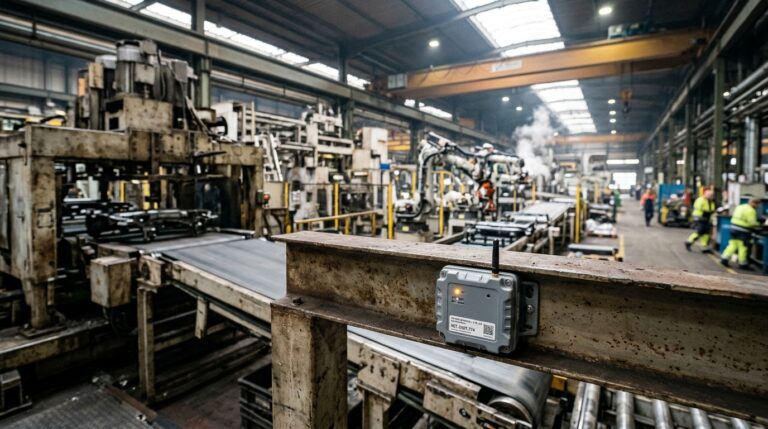
Everything starts here. Vibration sensors on rotating equipment. Thermal cameras on electrical panels. Pressure and temperature transducers on process lines. Acoustic monitors on compressors. RFID tags on tooling, containers, and WIP. For shorter-range indoor tracking, Bluetooth asset tracking provides cost-effective positioning for tools and mobile equipment within facility walls.
For assets that move between facilities (returnable packaging, field equipment, spare parts cycling through supplier networks) cellular GPS trackers provide continuous location and condition data outside the plant walls. This layer matters because many manufacturing supply chains go dark the moment an asset leaves the building.
This is also the layer most commonly underinvested. Organizations buy the analytics platform first and discover later that they have nothing meaningful to analyze.
Edge Computing
Raw sensor data is noisy and voluminous. Edge computing processes it on the factory floor: filtering, running inference models, detecting anomalies before anything ships to the cloud. This cuts latency, reduces bandwidth costs, and keeps the system functional during network outages.
Siemens’ Industrial Edge is the most cited commercial example, carrying UL Platinum and IEC 62443-4-2 certifications with connectors for ERP, MES, SCADA, and MQTT. But the principle applies regardless of vendor: if your visibility data has to round-trip to a cloud server before an operator can act on it, you’ve already lost the response window on high-speed lines.
IT-OT Connectivity
Industrial machines speak protocols (OPC UA, Modbus, EtherNet/IP, MQTT) that ERP and analytics systems don’t natively understand. Middleware translates between worlds.
PTC’s Kepware has been the default here for years, though its pending divestiture to TPG, announced November 2025, signals the connectivity layer is being treated as a standalone business rather than a feature. Private 5G networks are also emerging as a connectivity option, enabling continuous precise positioning so AGVs, forklifts, and high-value tooling can be tracked without Wi-Fi dead zones.
Analytics and Digital Twins
This is where most vendors want to start the conversation. Time-series databases, anomaly detection, ML models for remaining useful life, and digital twins that simulate failure modes and throughput changes.
The results, when the lower layers are solid, are real. PepsiCo deployed Siemens digital twins across its supply chain and found hidden capacity inside existing lines. Flowserve avoided roughly $16 million in downtime costs through PTC ThingWorx monitoring. Rockwell claims ThingWorx deployments deliver 20 to 30% reduction in unplanned downtime and 5 to 20% throughput improvement.
The caveat: all of those outcomes depend on the quality of the data feeding the platform. AI models trained on incomplete sensor coverage produce confident predictions about the wrong things.
OT Asset Inventory
This layer exists because manufacturers are now the number one target for ransomware. Dragos, Claroty, and Nozomi Networks perform deep packet inspection across 600+ industrial protocols to map every PLC, HMI, and controller on the OT network.
This is no longer optional. Dragos data shows 65% of assessed manufacturing sites had insecure remote access, and 70% of vulnerabilities sat at Purdue Level 3.5 and below, deep in the OT network where many organizations have zero visibility. Without an accurate asset inventory, security teams cannot prioritize patches or detect anomalous behavior.
Asset Tracking vs. Asset Visibility
These terms get used interchangeably. They shouldn’t.
Asset tracking answers one question: where is this thing? A GPS tracker on a returnable container tells you it’s at your supplier’s dock in Memphis. An RFID tag on a tooling kit tells you it’s in Building C, Bay 7. That’s tracking. Valuable, and for many use cases, sufficient.
Asset visibility answers a harder set of questions: where is this thing, what is it doing, what condition is it in, and is it creating risk? A tracked asset has a location. A visible asset has a location plus state plus context.
| Asset Tracking | Asset Visibility | |
|---|---|---|
| Core question | Where is this thing? | Where is it, what’s its condition, is it at risk? |
| Typical technology | GPS, RFID, BLE beacons | Sensors + edge + analytics + OT network monitoring |
| Output | Location over time | Location + state + context |
| Decision value | Locate and retrieve | Predict, prevent, prioritize |
The distinction costs money when organizations buy tracking and call it visibility. They know where the containers are but not how long they’ve been sitting idle. They know which machines are online but not which ones are three weeks from a bearing failure. They have a dot on a map but not a decision-ready signal.
The most capable programs layer both. Fixed sensors and OT monitoring feed the operational and cybersecurity picture inside the plant. Rugged IoT trackers with cellular connectivity extend that picture through the supply chain, across logistics partners, and back. One without the other leaves a gap that grows more expensive over time.
What Successful Deployments Actually Deliver
Vendor ROI claims are directional, not guaranteed. Pressure-test them against specifics. Here are four deployments with documented outcomes worth studying.
Flowserve instrumented its field pumps and valves with vibration and temperature sensors, correlated readings against failure models, and intervened before breakdowns. The result: approximately $16 million in avoided downtime costs through the PTC ThingWorx platform. The mechanism: catching a deteriorating bearing before it seizes, which in flow-control applications triggers both an SLA penalty and an emergency field dispatch.
Toyota’s engine plant at Deeside, UK, operating since 1992 and steeped in Lean methodology, partnered with Iter Digital to deploy a Machining Production Control Board tied to real-time machine station data. The outcome that mattered most: digital visibility surfaced production losses that paper Andon boards had missed. If a plant running the Toyota Production System can discover hidden losses through better asset visibility, most factories have considerably more to find.
Guidewheel’s FactoryOps platform, deployed across 400+ manufacturers with clip-on sensors installed in roughly 40 minutes per machine, reports an average productivity improvement of 1.4x and 15 to 30% hidden capacity on most lines. One specific facility cut machine downtime from 6.8 hours per day to 3.4 hours over five months. Across five machines, that’s 17 hours of recaptured production every day.
PepsiCo adopted AI-powered digital twins from Siemens to optimize its global supply chain. The reported outcome: reduced capital costs and discovery of hidden capacity inside existing production lines. This is asset visibility applied at the network level, linking plant-level data to demand and logistics signals across the organization.
The pattern across all four: the investment that mattered was instrumenting physical assets first. The software platform unlocked value from the data those instruments produced. Not the other way around.
Where Manufacturing Visibility Is Heading
Six forces are converging to reshape manufacturing asset visibility over the next 12 to 24 months. Each has measurable evidence today. Each also carries execution risk that buyers should price into their roadmaps.
AI is moving from hype to narrow utility. Sixty-five percent of maintenance teams expect to adopt AI by end of 2026, but only 32% have implemented any solution. The near-term deployment shape will be narrow, practical workflows: summarizing downtime patterns on a specific line, drafting work orders from anomaly alerts, prioritizing maintenance backlogs. The rate limiter isn’t the model. It’s data quality at the asset layer.
Digital twins are becoming default infrastructure. The digital twin market is projected to grow from $21 billion in 2025 to nearly $150 billion by 2030. Within five years, virtual replicas of production lines won’t be innovation pilots. They’ll be the standard way plant managers simulate changes, test maintenance strategies, and onboard new operators.
Private 5G is adding precision positioning. For manufacturers operating AGVs, high-value mobile tooling, or large indoor footprints with Wi-Fi gaps, private 5G networks transform asset visibility from “machine is on” to “machine is on, at work cell 4B, within 10 cm.” The tradeoff: real capex for a private core, with payback models still settling around 18 to 24 months.
OT cybersecurity is becoming a regulatory expectation. The Colonial Pipeline shutdown in 2021 was the watershed event. Five years later, the downstream effect is clear: insurers and regulators are asking for OT asset inventories, and manufacturers without one face higher premiums and compliance gaps. If your insurer hasn’t asked yet, they will.
Platform vendors are consolidating and narrowing focus. PTC selling its connectivity and IoT businesses to TPG signals that even large IIoT players are separating their portfolios. ServiceNow’s OTM module signals enterprise SaaS vendors absorbing OT as a new data domain. Buyers should expect more complexity in stitching visibility layers together, not less.
Workforce retirements are forcing the issue. Forty percent of the manufacturing workforce is set to retire by 2030, and 69% of current maintenance professionals are over 50. The tribal knowledge of how a particular line actually behaves walks out the door with every retirement. Asset visibility platforms are increasingly the only mechanism for retaining that knowledge in a form new hires can use.
Where to Start
The temptation is to start with the analytics platform. Resist it.
Plants that succeed with asset visibility tend to follow the same sequence. First, they identify the 20% of assets that cause 80% of their downtime, cost, or security exposure. Not everything needs a sensor. The machines with the worst failure history, the high-value tooling that disappears between shifts, the containers circulating through supplier networks, the legacy PLCs nobody can account for: those are the assets that justify the investment.
Second, they instrument those assets with the right physical technology. Industrial-grade sensors for machines that stay put. Rugged cellular trackers for assets that move between sites or through external supply chains. RFID for high-volume, short-range identification. The choice depends on where the asset lives, how it moves, and what data matters most.
Third, they choose analytics and visualization tools that match the data they’re actually collecting today, not aspirational data from a future phase. A predictive maintenance model fed by three sensors on one critical line produces better decisions than a digital twin platform fed by nothing.
If your visibility gap extends beyond your four walls (returnable containers going dark after shipment, tooling unaccounted for at partner sites, equipment cycling through MRO with no location data) that’s the gap IoT asset trackers close. If you want help matching the right device to the right asset class, reach out to our team or email info@datanetiot.com.

Frequently Asked Questions
What is manufacturing asset visibility?
Manufacturing asset visibility is the real-time ability to see where your production assets are, what condition they’re in, and whether they represent operational or security risk. It covers machines, tooling, containers, WIP, and finished goods across the factory floor, the OT network, and the supply chain. It’s the foundation for predictive maintenance, throughput optimization, and cybersecurity defense.
How is asset visibility different from asset tracking?
Asset tracking answers “where is this thing?” using GPS, RFID, or BLE. Asset visibility adds condition, utilization, and risk context to that location data. A tracked forklift has a dot on a map. A visible forklift has a dot plus engine hours, maintenance status, and a flag when it enters a restricted zone. Tracking is a component of visibility, not a synonym for it.
How much does unplanned downtime cost manufacturers?
U.S. manufacturing loses approximately $50 billion per year to unplanned downtime. The cross-sector average is $260,000 per hour. In automotive, that figure exceeds $2.3 million per hour. Equipment failure accounts for 42% of all incidents, making it the single largest downtime driver and the primary target for asset visibility investments.
What technologies are needed for manufacturing asset visibility?
At minimum: industrial sensors (vibration, temperature, pressure) for condition monitoring, edge computing for on-floor data processing, IT-OT connectivity middleware (OPC UA, MQTT), an analytics layer with time-series storage and anomaly detection, and OT network monitoring for cybersecurity. For mobile assets, cellular GPS trackers and RFID extend visibility beyond the plant.
Why is manufacturing the top target for ransomware?
Manufacturers run 24/7 operations with low downtime tolerance, retain legacy OT equipment that cannot be easily patched, and frequently pay ransoms because prolonged outages cost more. In 2024, 69% of industrial ransomware attacks targeted manufacturing entities across 26 subsectors. Twenty-five percent of those attacks caused a complete OT site shutdown.




 +1 508 292 2210

4 Responses