

The maritime logistics technology market hit $96.59 billion in 2024. Maritime AI alone is growing at 40.6% annually. Every major carrier has a digitalization roadmap and a transformation team. And yet, 25% of cargo owners still coordinate shipments over email.
That contrast defines the state of the industry more honestly than any conference keynote. The technology exists. Standards are maturing. Capital is flowing. But operational adoption below the tier-one carrier level lags by years. If you manage port equipment, run a freight forwarding operation, or oversee container pools, the question isn’t whether maritime logistics technology matters. It’s which pieces change your cost structure today versus which are still confined to pilot programs and vendor slide decks.
I’ve spent 15+ years deploying IoT and tracking solutions across aviation, maritime, and industrial supply chains. What I see from the field is a market where the top and the bottom barely recognize each other. The technology stack is real. The failures are instructive. And the single biggest gap most operators still ignore sits right between shipment tracking and asset tracking.
What Counts as Maritime Logistics Technology
Maritime logistics technology is the full stack of software, sensors, networks, and automation that coordinates the movement of goods across oceans, through ports, and into inland distribution. It covers the organization, shipping, and handling of products across seas and waterways, from a vessel’s bridge to a terminal yard to the last-mile truck.
In practice, the technology breaks into five functional layers:
- IoT and sensor networks. AIS transponders, container GPS/cellular trackers, environmental sensors (temperature, humidity, shock), engine telemetry.
- Real-time transportation visibility platforms (RTTVPs). Software aggregating sensor data into dashboards with predictive ETAs and bottleneck alerts.
- AI and machine learning. Route optimization, demand forecasting, predictive maintenance, emissions calculation.
- Digital twins and blockchain. Virtual fleet replicas for scenario planning. Distributed ledgers for documentation and smart contracts.
- Autonomous systems. Maritime Autonomous Surface Ships (MASS), automated cranes, autonomous port vehicles.
Each layer depends on the one below it. AI can’t optimize a route without sensor data. A digital twin is dead without real-time feeds. A visibility platform is only as reliable as the devices feeding it. When the bottom layer is spotty or missing entirely, everything above it degrades. That is why the sensor and tracking layer deserves more attention than it typically gets.
The Numbers Behind the Noise
Market sizing for maritime logistics technology depends on what the analyst includes, and the numbers diverge enough to mislead if you don’t read the methodology.
MarketResearchFuture sizes maritime logistics and services at $96.59 billion in 2024, projecting $220.71 billion by 2035 at a 7.8% CAGR. A broader definition from Cognitive Market Research puts the global maritime logistics market at $386.9 billion, growing at just 3.8% annually through 2031. The gap between those two estimates reflects the difference between “digital logistics technology” and “all maritime logistics including legacy, non-digital services.”
The digital sub-segments tell the sharper story:
| Segment | 2024 Value | Forecast | CAGR |
|---|---|---|---|
| Maritime AI | $4.3B | $32.7B by 2030 | 40.6% |
| Maritime Information Market | – | +$1.35B by 2030 | 10.3% |
| Marine IoT (Europe share) | 33.28% of global | Through 2034 | – |
Physical shipping services grow slowly. The digital layer on top grows at 10x to 40x that rate. The value is migrating from moving containers to moving data about containers.
But that spend concentrates at the top. MSC (19.9% market share), Maersk (14.6%), and CMA CGM (12.7%) dominate both container capacity and technology investment. Mid-tier carriers, regional forwarders, and independent terminal operators often run a generation behind. The result is a two-speed industry: a digital elite running AI-optimized fleets and a long tail still managing operations through spreadsheets and phone calls.
Five Layers of the Tech Stack in Practice
IoT and Sensor Networks
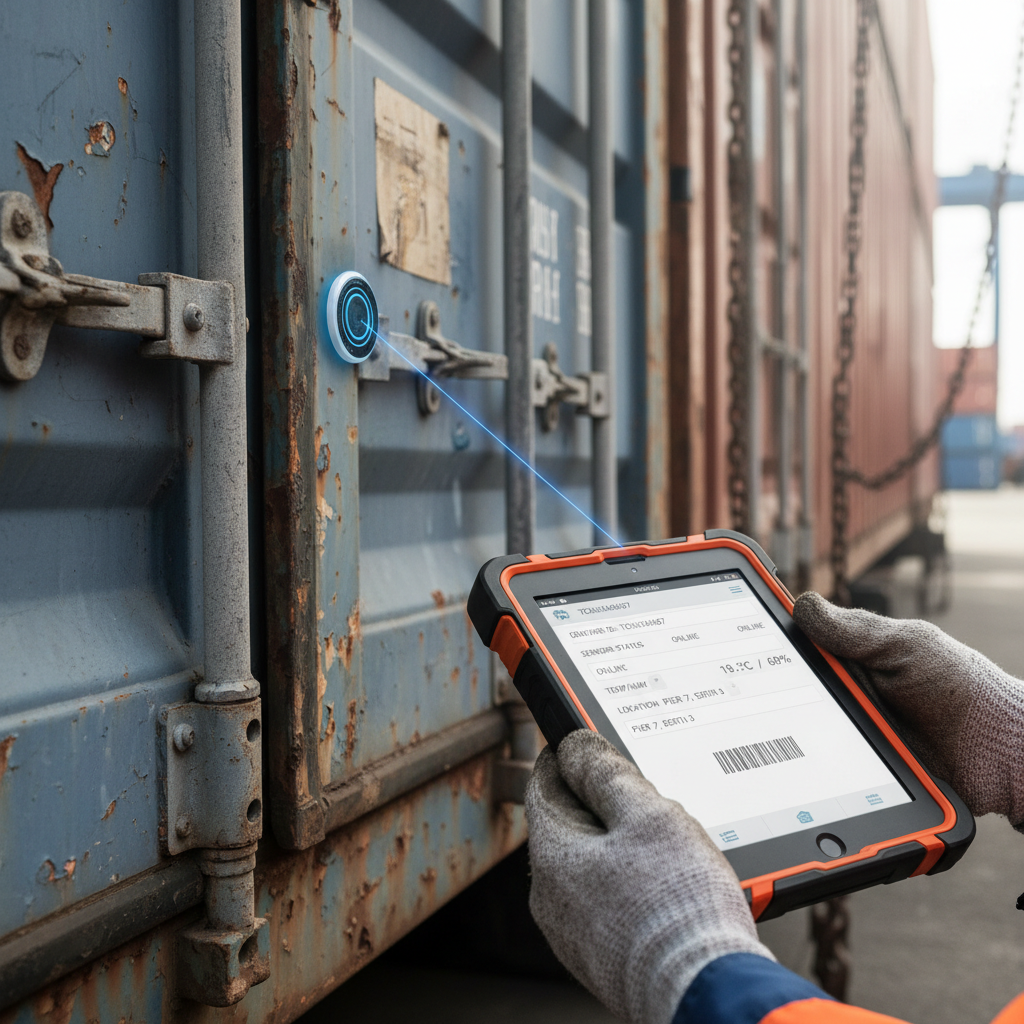
Everything starts here. AIS transponders track vessel position across the global fleet (they’ve been doing so for over two decades). Container-level IoT devices report GPS location, temperature, humidity, shock, and tilt via cellular or satellite networks. Engine sensors stream vibration and fuel data to cloud platforms for condition monitoring. Smart ports leverage interconnected sensors to reduce human error and improve asset tracking across terminal operations.
The IoT layer is the most mature. “Mature” does not mean “universal.” High-value reefer containers and pharmaceutical cargo get tracked consistently. Standard dry containers, ground support equipment, reusable transport packaging, and chassis often don’t. That blind spot cascades upward: no sensor data means no visibility, no predictive ETA, no AI optimization. The foundation matters more than the superstructure.
Visibility Platforms (RTTVPs)
Gartner defines RTTVPs as platforms providing real-time location and status insights into orders. In practice, they aggregate feeds from IoT devices, carrier APIs, and port systems into a single dashboard with predictive ETAs and exception alerts. A 2025 ResearchAndMarkets analysis confirmed project44, FourKites, and Shippeo as the leading platforms in this category.
RTTVPs solve a genuine problem: knowing where a shipment is now and when it will arrive. What they typically don’t solve is what happens to the container, pallet, or ULD after delivery. The platform marks “delivered” and moves on to the next order. The physical asset enters a black hole. More on that gap below.
AI and Machine Learning
DHL’s 2025 analysis found that AI improves route planning by optimizing freight capacity, reducing empty runs, cutting energy consumption, and lowering emissions. CMA CGM, the world’s third-largest carrier, uses AI-driven logistics to optimize cargo routing alongside investments in LNG-powered newbuilds.
Four core capabilities define maritime AI today: predictive analysis, pattern recognition, historical learning, and dynamic adaptation to disruption. When a conflict zone reroutes Red Sea traffic around the Cape of Good Hope, AI recalculates ETAs, fuel requirements, and emissions estimates in minutes. Manual planning takes days and misses second-order effects on downstream port scheduling.
Digital Twins and Blockchain
A digital twin is a real-time virtual representation of a physical entity used to simulate scenarios and optimize performance. For maritime fleets, that means modeling fuel consumption under different routing options before committing a vessel. For ports, it means testing terminal layout changes in simulation before moving a single crane.
Blockchain entered maritime with enormous expectations and delivered a hard lesson. The concept (a shared, transparent ledger for trade documentation and automated payment triggers) was sound. The execution required an entire industry to agree on a single platform. It didn’t. The TradeLens story below explains why that matters more than the technology itself.
Autonomous Ships
Maritime Autonomous Surface Ships (MASS) remain pre-commercial, but the regulatory trajectory is accelerating. The IMO held its dedicated MASS symposium in June 2025, co-organized with Norway, building toward a goal-based MASS Code. Lloyd’s Register’s MASS Volume 2 report, published May 2025, refined the Operational Envelope framework to address safety, regulation, and commercial trust barriers simultaneously.
One finding worth noting: even when autonomous navigation doesn’t reduce accident counts, safety at sea still increases because human exposure hours drop. Fewer crew on board means fewer person-hours exposed to risk, even if the failure rate per voyage stays flat. The safety argument may precede the economic one.
The Gap Nobody Talks About: Shipment Tracking vs Asset Tracking
Here’s what most maritime logistics technology coverage skips entirely.
Shipment tracking follows cargo from origin to destination. When the container delivers, the job is done. The RTTVP marks it complete and moves to the next order. This works well for customer-facing ETAs and supply chain coordination.
Asset tracking follows the physical equipment through its full lifecycle: loaded, in transit, delivered, emptied, returned, repositioned, maintained, redeployed. The container isn’t just a carrier for cargo. It’s a capital asset with a utilization rate, a maintenance schedule, and a depreciation curve.
The math isn’t abstract. A 20-foot shipping container costs $2,500 to $5,000. A fleet of 10,000 represents $25 to $50 million in mobile capital. If your visibility ends at delivery, you can’t measure dwell time, optimize repositioning, or even confirm how many containers you actually have in circulation. In my experience, companies discover that 3 to 8% of their container pool is functionally “missing” at any given time. Not stolen. Just invisible to their systems after the cargo comes out.
The same blind spot hits air freight ULDs, reusable packaging, chassis, and ground support equipment. If you only track the shipment, you lose sight of the asset the moment it stops carrying cargo.
Most RTTVP platforms are built for shipment visibility, and they’re good at it. But they leave a gap in the asset lifecycle that requires a different hardware and software approach: devices that stay with the equipment rather than the cargo, report on long intervals to conserve battery across months, survive salt spray and temperature extremes, and feed into pool management workflows rather than shipment dashboards.
This is where operational dollars leak quietly. Not in the AI layer. Not in the digital twin. In the gap between “delivered” and “where did that container go.”
What TradeLens and NotPetya Actually Taught the Industry
TradeLens: Technology Without Network Effect
Maersk and IBM launched TradeLens in 2018 as a blockchain platform to digitize global trade documentation. The vision was compelling: one neutral, transparent ledger for carriers, ports, customs, and shippers. Major players signed on. The technology worked.
By November 2022, both companies announced TradeLens would shut down. The platform went offline by Q1 2023. It never reached commercial viability because global industry collaboration didn’t materialize at scale. Competing carriers didn’t want to share operational data on a platform associated with Maersk, regardless of how “neutral” the branding was.
The Port of Barcelona’s post-mortem concluded that “technology alone is not enough”. The practical lesson for any operator evaluating maritime logistics technology: if a tool requires your entire competitive ecosystem to adopt it before it delivers value to you, the risk is structural. Start with technology that works on day one with the data you already control.
NotPetya: One Computer in Odessa, Global Supply Chain Down
In June 2017, NotPetya malware entered Maersk’s global network through tax accounting software installed on a single computer in Odessa, Ukraine. The attack wiped out roughly 150 domain controllers, knocked Maersk’s website offline for days, and forced the company to compensate customers for lost and damaged cargo.
The aftermath changed the entire industry’s posture. Maersk repositioned cybersecurity from an operating cost to a competitive advantage. Network segmentation and backup protocols became board-level priorities, not IT checklists. The IMO’s 2021 cyber risk management requirements made baseline practices mandatory.
For operators adding connected devices, API integrations, and cloud platforms today: every new node expands your attack surface. The question isn’t whether to digitize. It’s whether your security architecture can scale with your sensor count.
What’s Shifting in 2026
Five trends are reshaping maritime logistics technology right now, each with practical implications at every operator scale.
AI route optimization goes operational. DHL, CMA CGM, and COSCO are running AI-driven logistics at production scale. Carriers without dynamic route optimization pay more per TEU-mile than those who use it. The gap compounds every quarter as fuel costs and emissions regulations tighten simultaneously.
Green corridors take physical shape. Forty-four green shipping corridors have been proposed under the COP26 Clydebank Declaration, with eight having selected fuel pathways: 16% green ammonia, 16% green methanol, and a striking 41% still undetermined. These corridors have become central to shipping’s decarbonization strategy. For carriers on affected routes, emissions monitoring and fuel-pathway verification technology is becoming a compliance requirement, not optional infrastructure.
DCSA standards approach critical mass. The Digital Container Shipping Association’s Industry Blueprint maps standards across booking, equipment, and vessel journeys, developed with over 100 subject-matter experts. It’s the closest maritime has come to what IATA built for aviation: a shared reference framework that enables interoperability without forcing everyone onto one platform. That last part is the lesson TradeLens taught the hard way.
Autonomous ship regulation advances on schedule. The IMO’s 2025 MASS symposium and Lloyd’s Register’s Operational Envelope framework put goal-based MASS regulation on track for the late 2020s. Most operators won’t feel the impact this year. Within a decade, it will reshape crewing models, insurance structures, and port infrastructure requirements.
The 25% email cohort shrinks. Slowly. DCSA’s 2025 analysis found that a quarter of cargo owners still rely on legacy channels like email for shipping activities. Outdated infrastructure, lack of investment, and resistance to change are all cited. As DCSA standards lower integration barriers and IoT hardware costs keep dropping, the economic case for staying analog weakens. But “weakens” is doing a lot of work in that sentence. Cultural resistance in maritime outlasts every technology refresh cycle.
If You’re Not Maersk, Start Here
The digital transformation playbook for a mid-tier operator looks nothing like what a top-five carrier runs. No Chief Digital Officer. No $200M budget. Just a fleet of containers, a pool of equipment, and a team that needs better data without a multi-year integration project.
Three principles from what I’ve seen actually work in the field:
- Start with what you own, not what you ship. Shipment visibility platforms track someone else’s cargo through your system. Useful, but the ROI is indirect. Asset tracking devices on your own containers, chassis, and equipment give you data you control and outcomes you can measure directly: reduced dwell time, fewer lost assets, better pool utilization, tighter maintenance cycles.
- Choose hardware built for the environment. Maritime means salt, vibration, temperature extremes, and months between battery changes. Consumer-grade GPS trackers don’t survive. Industrial IoT devices with GNSS, cellular connectivity, and multi-year battery life are the minimum for ocean equipment tracking.
- Don’t wait for universal standards to deploy. TradeLens died waiting for industry-wide buy-in. DCSA standards are promising and progressing, but your container pool doesn’t need the entire industry to align before you can track it. Deploy what works now. Integrate with standards as they mature.
If your equipment fleet goes dark after delivery, that’s where operational dollars leak. At Datanet, we work with port operators, freight forwarders, and fleet managers to close exactly that gap, with end-to-end asset tracking solutions built for ocean and industrial environments. If that sounds like your situation, talk to our team.
Frequently Asked Questions
What is maritime logistics technology?
It’s the full stack of software, sensors, networks, and automation used to coordinate goods movement across oceans, ports, and inland waterways. This includes IoT tracking devices, real-time visibility platforms (RTTVPs), AI route optimization, digital twins, blockchain documentation systems, and autonomous ship technologies. The goal is better efficiency, lower costs, and continuous visibility across the maritime supply chain.
How large is the maritime logistics technology market?
Maritime logistics and services reached $96.59 billion in 2024, with projections of $220.71 billion by 2035 at a 7.8% CAGR. The digital sub-segments grow much faster: maritime AI is expanding at 40.6% CAGR (from $4.3 billion in 2024 to $32.7 billion by 2030), and the maritime information market at 10.3% CAGR through 2030.
What’s the difference between shipment tracking and asset tracking?
Shipment tracking follows cargo from origin to destination and ends at delivery. Asset tracking follows the physical equipment (containers, chassis, ULDs) through the entire lifecycle: transit, delivery, emptying, return, repositioning, maintenance, and redeployment. Most visibility platforms handle shipment tracking well. Asset tracking requires devices that stay with the equipment and report over longer horizons.
Why did TradeLens fail?
TradeLens, the Maersk/IBM blockchain platform launched in 2018, shut down in Q1 2023 because it couldn’t achieve the industry-wide adoption needed for commercial viability. Competing carriers resisted sharing data on a Maersk-associated platform. The lesson: technology that requires full ecosystem buy-in before delivering individual value carries structural risk that no amount of engineering can fix.
What are green shipping corridors?
Zero-emission maritime routes connecting two or more ports using zero-emission fuels. Forty-four have been proposed under the COP26 Clydebank Declaration. Eight have selected fuel pathways (green ammonia and green methanol lead at 16% each), while 41% remain undetermined. They represent the shipping industry’s most concrete step toward decarbonization.
Are autonomous cargo ships operational yet?
Not at commercial scale. The IMO held its MASS symposium in June 2025, and Lloyd’s Register published an updated Operational Envelope framework the same year. Goal-based autonomous ship regulation is expected by the late 2020s. Research shows autonomous operations can improve safety by reducing human exposure hours at sea, even before overall accident rates decrease.





 +1 508 292 2210

5 Responses