

A vertical farm today uses 10 to 18 kWh of electricity to produce one kilogram of lettuce. The achievable benchmark sits between 3.1 and 7.4 kWh/kg. That gap is not primarily an equipment problem. It is a measurement problem.
Most operators invest heavily in compressors, coils, and ductwork. Then they discover that a room-level thermostat cannot tell them what is happening between stacked growing tiers. Humidity pockets form. Tipburn appears on one shelf and not the next. CO2 enrichment dilutes before reaching the canopy. The compressor cycles correctly according to its own sensor. The crop tells a different story.
I work in industrial IoT, helping operations track physical assets and environmental conditions across supply chains, warehouses, and logistics networks. Vertical farming is the same problem wearing different clothes: a manufacturing environment where the product is alive and the process depends on continuous, accurate, tier-level environmental data. Here is what vertical farm climate control actually requires, where the energy goes, and how to close the loop between what your crop needs and what your equipment delivers.
What Climate Control Actually Means in a Vertical Farm
Climate control in a vertical farm is not a thermostat. It is the coordinated management of six interdependent variables: air temperature, humidity (expressed as vapor pressure deficit, not just relative humidity), CO2 concentration, airflow velocity and distribution, lighting (intensity, spectrum, photoperiod), and irrigation or nutrient delivery. Change one, and the others shift.
LEDs add sensible heat. Plants transpire moisture. CO2 enrichment interacts with ventilation rates. Irrigation changes the latent load. A controller that treats these as independent inputs will fight itself: cooling to remove LED heat while the dehumidifier reheats the air, or enriching CO2 while the ventilation system exhausts it.
The practical definition: climate control is a crop recipe executed by mechanical and software systems, validated by sensors at the point of growth. Danfoss describes the core requirement as coordinated control of temperature, humidity, CO2, and airflow, with dehumidification integrated into the HVAC loop rather than bolted on as an afterthought. That coordination is the difference between a building with air conditioning and a farm with climate control.
Where the Energy Goes
The numbers are blunt. HVAC can represent 30 to 40% of a vertical farm’s total electricity consumption. Artificial lighting accounts for most of the rest. Together, they dominate operating costs, which is why kWh per kilogram of saleable product matters more than any single equipment spec.
The 2025 benchmark study models what improvement looks like: raising LED efficiency from 0.5 to 0.9 could cut lighting consumption by up to 45%. Improving HVAC coefficient of performance (COP) from 2 to 6 could reduce climate-control energy by 66%. Those are modeled ceilings, not guaranteed outcomes. But they map exactly where the engineering leverage sits.
A separate systematic review suggests that smart, sensor-driven HVAC can lower total energy use by 15 to 25%, with a possible three-to-five-year payback on the automation and sensor investment for mid-sized facilities. The operating word is “sensor-driven.” An expensive compressor running on a fixed schedule, or responding only to a wall-mounted thermostat, will not deliver that reduction. The equipment does not know what it does not measure.
VPD: The Variable Your Thermostat Ignores
Relative humidity (RH) is the number most operators watch. It is also incomplete.
Vapor pressure deficit captures how temperature and humidity interact to drive plant transpiration. A higher VPD means the air can absorb more moisture from leaves, which accelerates water uptake through roots and nutrient transport. Too high, and the plant closes stomata to protect itself, slowing photosynthesis and growth. Too low, and moisture lingers on leaf surfaces, inviting mold and disease.
Here is why RH alone misleads. In a controlled lettuce study, researchers held relative humidity at 60% across three temperature treatments: 20, 23, and 26°C. The resulting VPD values were approximately 0.9, 1.1, and 1.3 kPa. Same humidity reading on the display. Different plant environments entirely. At 26°C, the crop experienced roughly 44% more evaporative demand than at 20°C, and the RH sensor reported the same number in both rooms.
The same study tested CO2 enrichment at 500, 800, and 1,200 micromol per mol. Raising CO2 from 500 to 800 increased shoot fresh mass by 33% for one cultivar and 16% for another. Pushing from 800 to 1,200 added zero biomass. That plateau is cultivar-specific. An operator who sets CO2 to 1,200 “because higher is better” wastes gas and money for no additional yield.
The takeaway: your climate recipe should specify VPD targets by crop and growth stage, validated against actual leaf quality and energy cost. Not a fixed RH setpoint borrowed from a forum post.
The Tier-Level Gap Most Farms Never Measure
This is where most vertical farms leak performance without knowing it.
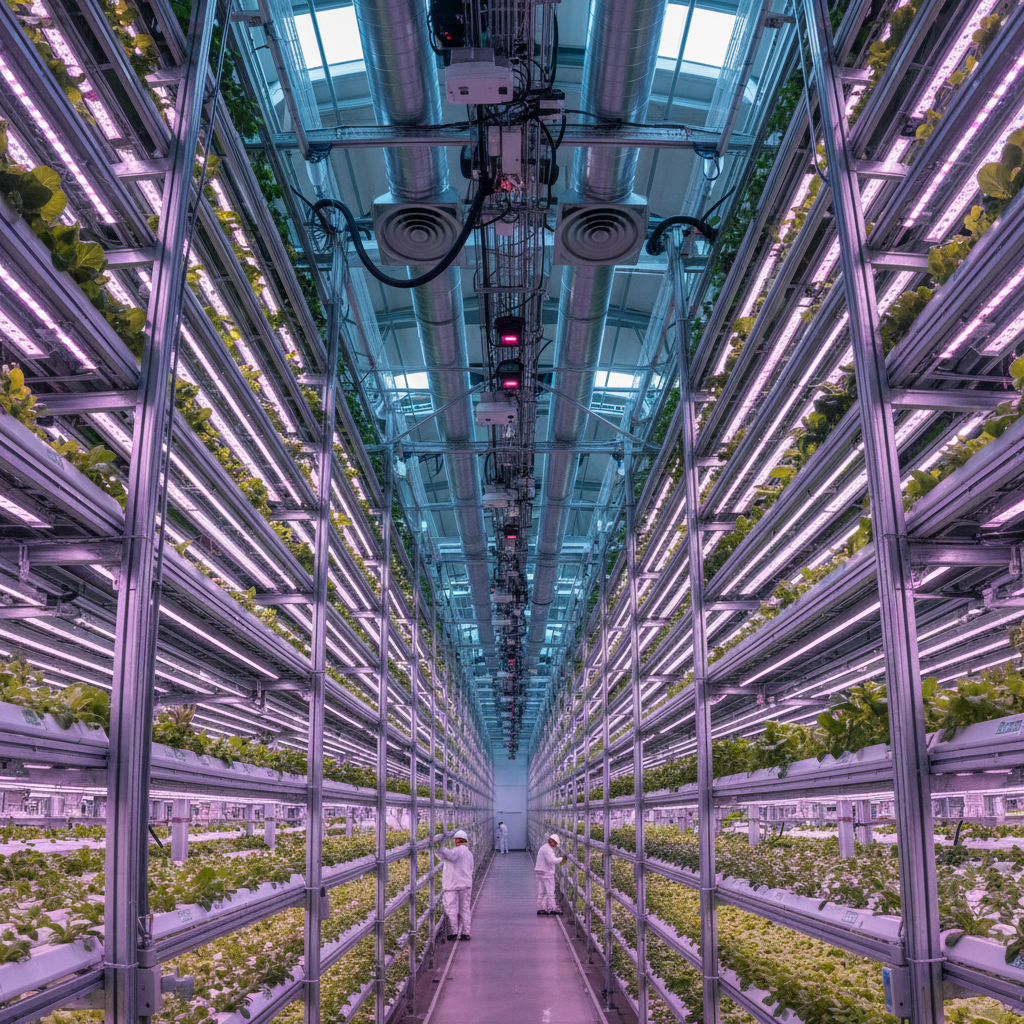
A conventional building puts one thermostat per zone. A vertical farm stacks growing trays five, ten, sometimes fifteen layers high. Air delivered from a central handler hits the top trays first. By the time it reaches lower tiers, it has absorbed heat from LEDs and moisture from transpiring plants above. The conditions at tier twelve are measurably different from tier two.
The lettuce study referenced above identified poor vertical airflow as the most likely cause of high tipburn incidence in its fastest-growing treatments. Not wrong temperature. Not wrong humidity at the room sensor. Insufficient air movement at the canopy level, creating stagnant boundary layers where local humidity spikes even while the room sensor reads a comfortable 60%.
A recent IoT vertical-horticulture system tackled this directly. Researchers deployed real-time multisensor monitoring of temperature, relative humidity, atmospheric pressure, and CO2 tied to automated lighting and ventilation. They reported narrow setpoint control and reduced microclimatic variability across tiers. The key was not more expensive HVAC. It was placing sensors where the crop lives, not where the duct terminates.
This is familiar territory for anyone who has tracked environmental conditions in logistics or cold-chain operations. A reefer container that reads the correct temperature at its sensor but runs 4°C warmer at the door end has the same problem. The fix is the same: measure at the point of impact, not at the point of convenience.
If your farm has one temperature and humidity sensor per room, you are not doing climate control. You are doing climate estimation.
HVAC Architecture: Centralized, Zoned, or Hybrid
The mechanical system has to remove both sensible heat (from LEDs and equipment) and latent heat (moisture from plants and irrigation). Cooling alone may lower temperature while leaving too much moisture in the air. Dehumidification alone may overcool the space and trigger a reheat cycle. The design challenge is integration.
| Architecture | Best for | Watch out for |
|---|---|---|
| Central recirculating air handler with integrated cooling and dehumidification | Large rooms, common crop recipes, heat-recovery opportunities | Duct balance across tiers. One crop recipe tends to dominate all zones unless carefully designed. |
| Zoned variable-refrigerant systems | Multiple rooms or zones with different crop loads | These systems adjust refrigerant flow to real-time demand, but they require strong commissioning and per-zone sensor coordination. |
| Refrigeration-based dehumidification | Standard moisture-removal duty | Can create a reheat problem if moisture removal and temperature control are not integrated in the same loop. |
| Desiccant dehumidification | High or persistent moisture loads | Energy source and regeneration strategy determine whether it beats cooling-based alternatives on a kWh basis. |
| Heat-recovery ventilator or energy wheel | Facilities needing outside air while conserving energy | Cross-contamination risk, maintenance burden, and seasonal performance variation need engineering, not just installation. |
Danfoss recommends integrating dehumidification with HVAC so that waste heat from the cooling process can be reused, and specifying high-COP compressors with variable-load control for compressors, pumps, and fans. That recommendation is equipment-agnostic and worth following regardless of vendor: design the thermal system as one loop, not as separate purchases that happen to share a building.
One often-missed opportunity: cooling creates waste heat. That heat can serve dehumidification, building heating, or adjacent facilities. Retrofitting heat recovery into an existing layout is expensive. Including it in the initial design costs a fraction of that. If you are still on the drawing board, this is the time.
What AeroFarms, Plenty, and Bowery Teach About Climate Control
Technology does not guarantee survival. Operating discipline does—and that discipline increasingly depends on vertical farming automation that coordinates climate control with crop cycles.
AeroFarms declared bankruptcy in 2023, then reported two consecutive profitable quarters by May 2025. The turnaround was not a hardware upgrade. Management shut R&D facilities in New Jersey and Abu Dhabi, consolidated into a 140,000-square-foot Virginia production facility, focused exclusively on microgreens, and hired people with deep food-production experience. Their automated system loads, monitors, harvests, and packs crops. Energy is cited as one of the biggest running costs, and the company says productivity improvements reduced energy per plant. Not a bigger compressor. Better operations.
Plenty filed for bankruptcy in March 2025 after raising nearly $1 billion. The company later announced it emerged from Chapter 11 in May 2025 to pursue year-round locally grown strawberries. The public record does not pin the failure on climate control hardware. It does illustrate what happens when a facility is sized for an optimistic volume forecast and the utilization never materializes. Climate control is a fixed cost. If the crop cycles, sales channel, and maintenance rhythms do not fill the building, the HVAC runs at partial load and the per-kilogram economics collapse.
Bowery Farming was reportedly closing in November 2024 after diminishing valuations and layoffs. Agriculture Dive connected the closure to a broader wave of indoor-farm shutdowns linked to cost challenges across the sector.
The pattern is consistent. Climate control creates the potential for reliable yield and quality. Operational excellence (crop selection, utilization rates, maintenance discipline, labor efficiency, and honest energy accounting) converts that potential into margin. A farm with perfect VPD recipes and a half-empty building is still losing money.
A Practical Design Sequence
If you are planning a vertical farm or retrofitting climate systems in an existing one, this sequence keeps the decisions in the right order.
- Start with the crop and the sales margin. A leafy green, a microgreen, and a strawberry have different temperature ranges, VPD targets, CO2 responses, light requirements, and price points. The crop dictates the load profile.
- Build a peak and annual load model. Separate the loads: LED sensible heat, plant transpiration (latent), outside-air infiltration, pump and fan heat, irrigation contribution. If you cannot quantify each one, you cannot size the equipment correctly.
- Specify tier-level sensing and calibration. Place temperature, humidity, and CO2 sensors at representative growing tiers, not just at air-handler returns. Define calibration intervals and drift tolerances. Plan for sensor replacement logistics. A sensor that reads 2°C high for three months costs more in lost yield than its replacement ever would.
- Compare HVAC alternatives on kWh per kilogram. Not nameplate efficiency. Not brochure COP. Modeled and then measured energy per kilogram of saleable product, accounting for lighting, climate control, pumps, fans, and parasitic loads. Ask vendors for reference-site energy data, not spec sheets alone.
- Design heat recovery into the first layout. Cooling creates waste heat that can serve dehumidification, building heating, or adjacent facilities. This is a day-one decision, not a retrofit project.
- Add software and automation last. A climate computer, AI-assisted monitoring, or recipe management platform only works if the mechanical system is correctly sized, the sensors are correctly placed, and the crop recipes are validated. Automate a working process, not a broken one.
This sequence is not theory. It mirrors what we see across industrial IoT deployments: the organizations that invest in accurate, continuous sensing before they invest in dashboards and AI consistently get better outcomes. The data layer is the foundation. Everything else is built on top of it.
Closing the Loop
Vertical farm climate control is not a product you buy. It is a capability you build, layer by layer: crop recipe, load model, tier-level sensing, integrated HVAC, heat recovery, and then software. Skip any layer, and the ones above it underperform.
The farms that survive the current shakeout will be the ones that measure energy per kilogram, validate VPD at the canopy, and treat their sensor network with the same seriousness as their compressor. That is where the 10 to 18 kWh/kg range compresses toward the 3.1 to 7.4 benchmark. Not through a bigger HVAC unit. Through better information at the point of growth.
At Datanet, we build environmental monitoring solutions for exactly this kind of challenge: continuous, calibrated, multi-point sensing in environments where conditions vary by location and shift by the hour. If your climate control feels like guesswork past the first tier, we should talk.
Frequently Asked Questions
What does vertical farm climate control include?
It covers the coordinated management of air temperature, humidity (ideally tracked as VPD), CO2 concentration, airflow distribution, lighting, and irrigation. The mechanical layer is HVAC, dehumidification, and heat recovery. The data layer is sensors, controllers, and recipe software. Both layers must work together for the system to function.
How much energy does climate control use in a vertical farm?
Danfoss estimates HVAC accounts for 30 to 40% of a vertical farm’s total electricity use. Combined with lighting, these two systems dominate operating costs. A 2025 benchmark puts total lettuce production at 10 to 18 kWh/kg, with a technical target of 3.1 to 7.4 kWh/kg. The exact split depends on facility insulation, lighting efficiency, and outside climate.
Why is VPD more useful than relative humidity?
VPD captures how temperature changes the plant’s evaporative environment even when relative humidity stays constant. At 60% RH, VPD ranges from approximately 0.9 kPa at 20°C to 1.3 kPa at 26°C. That is a 44% increase in evaporative demand that an RH-only controller cannot see. VPD gives you the plant’s perspective, not just the room’s.
Should I choose centralized or zoned HVAC for a vertical farm?
It depends on the number of crop zones, recipe diversity, and heat-recovery strategy. Centralized systems simplify heat recovery and maintenance. Zoned variable-refrigerant systems provide independent climate control per room. Most mid-to-large farms use a hybrid: centralized cooling and dehumidification with zoned air distribution tuned to each growing area.
Is vertical farming profitable?
It can be, but outcomes vary widely. AeroFarms reported two profitable quarters after restructuring around a single facility and microgreens in 2025. Plenty and Bowery Farming both went through bankruptcy or closure after significant capital raises. Profitability depends on crop choice, utilization rates, energy cost, maintenance discipline, and sales channel, not technology alone.
How many environmental sensors does a vertical farm need?
There is no universal number. The principle is to measure at representative growing tiers, not just at air-handler returns or wall mounts. At minimum, every distinct microclimate zone (a group of tiers with similar airflow patterns) needs its own temperature, humidity, and CO2 measurement point, calibrated on a documented schedule.





 +1 508 292 2210

3 Responses