

Most people think tracking shipping containers globally is a solved problem. Type a number into a carrier’s website, watch a pin creep across the ocean, done. That works fine. Until the pin disappears for four days. Until two platforms show the same box in two different places. Until the container arrives at port and drops off every dashboard entirely.
In 2024, 576 containers were reported lost at sea, up 161% from the record low of 221 the year before. By mid-2025, the count had already passed 1,478. Those are the extreme cases. The everyday version of “lost” is quieter: your container is somewhere between Shanghai and Rotterdam, the carrier portal says “in transit,” and your production line doesn’t need a status. It needs a date.
I’ve spent over 15 years deploying IoT across industrial and aviation supply chains, and the gap between “we track our containers” and “we know where our containers are” is wider than most logistics teams realize. The technology is there. Five distinct data layers feed container visibility right now. The problem is that most operators only see one or two of them, and none extends past the delivery point. That gap between tracking a shipment and tracking an asset is where operational dollars quietly disappear.
Five Data Layers Behind Every Container Track
Container tracking isn’t one system. It’s five overlapping layers, each with different refresh rates, coverage areas, and failure modes. Understanding which layer feeds your dashboard at any given moment explains why data quality varies so much between legs of a single voyage.
1. Carrier EDI and APIs. Every major line (MSC, Maersk, CMA CGM, Hapag-Lloyd, COSCO) publishes event data through its own portal and EDI feeds: bill-of-lading events, terminal gates, vessel departures and arrivals. This is the oldest and most common source. It’s also the most passive. You get what the carrier decides to push, when they decide to push it.
2. Vessel-level AIS. The Automatic Identification System is mandatory on most vessels over 300 gross tons. Kpler alone aggregates data from over 13,000 AIS receivers spanning terrestrial, satellite, and roaming networks. AIS tells you where the ship is, and it’s the foundation of how to track a boat at sea. It does not tell you which containers are aboard, what condition they’re in, or whether yours was offloaded at an intermediate port. Ship position is not container position, but most platforms treat them as interchangeable.
3. Terminal Operating Systems (TOS). Container terminals record gate-in, gate-out, yard moves, and every load/unload event, the backbone of modern port logistics. Increasingly, terminals use optical character recognition to capture container numbers at every crane move, cutting processing time by roughly 50%. This layer is highly accurate but limited to port boundaries. Once the container clears the gate, the terminal has no further visibility.
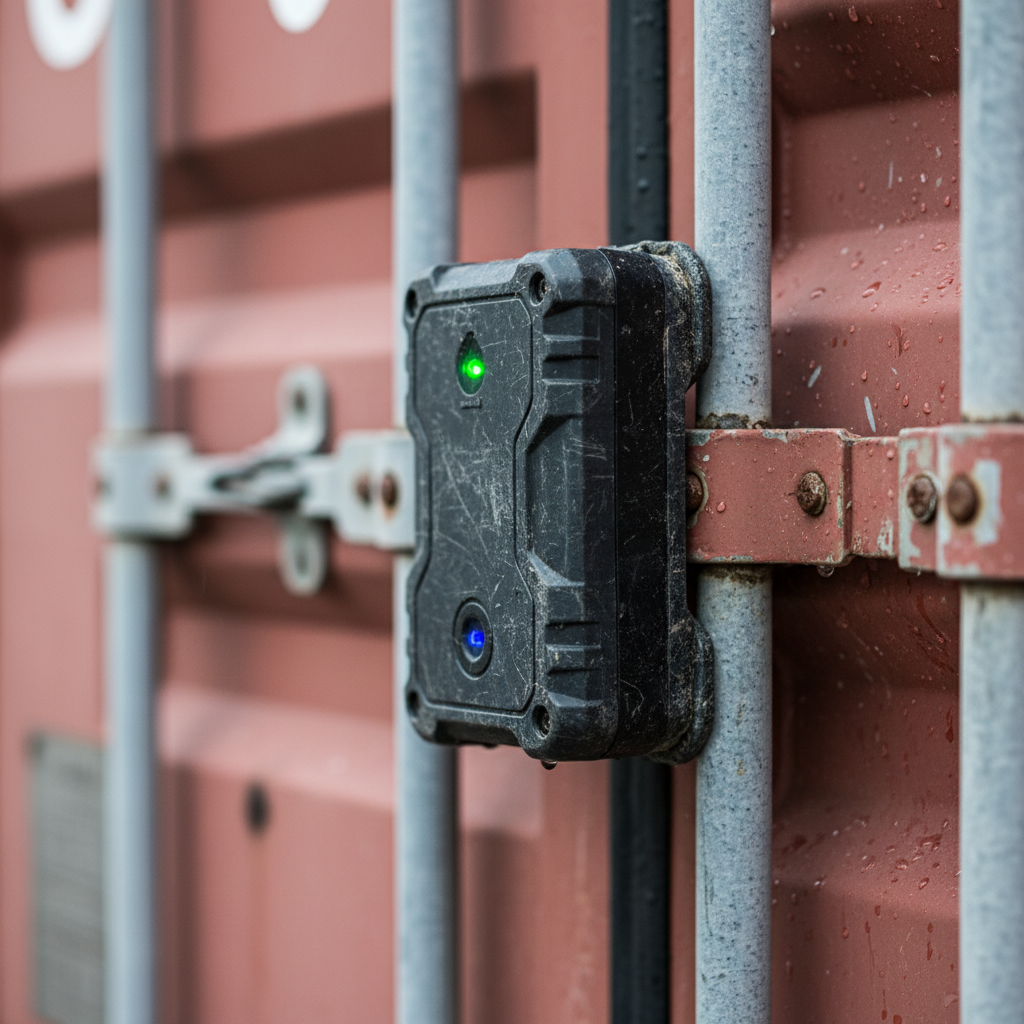
4. Container-level IoT. A sensor mounted on or inside the box transmits location and condition data over cellular (4G, LTE-M), NB-IoT, or satellite. This is the only layer that tracks the physical box itself, independent of the vessel, the terminal, or the carrier’s data pipeline. Maersk’s Remote Container Management system is the largest fleet-wide deployment, installed on every Maersk reefer to monitor temperature, humidity, atmosphere, and GPS location. Industry forecasts estimate one in four containers will carry a connected device by the end of 2026. That’s a massive jump, and three out of four still have no device at all.
5. Electronic documentation (eBL). Electronic Bills of Lading and trade document platforms add a documentary layer. GSBN, the Global Shipping Business Network, has processed over 700,000 eBLs across 26 ports involving more than 20,000 organizations. This doesn’t track physical location. It tracks ownership, title, and release status, which matters when the container is sitting at a terminal waiting for customs clearance and nobody can figure out why.
Most carrier portals and multi-carrier aggregators expose layers 1 and 2, with some integration of layer 3. Very few connect layer 4. Layer 5 runs on an entirely parallel track. So when someone says “I can track my containers globally,” the first question is: which layers are you actually seeing?
Container Number or Bill of Lading: Use the Right Key
Every intermodal container carries an 11-character identifier under ISO 6346: a four-letter prefix (three letters for the registered owner, one category letter), six numeric digits, and a check digit. MSCU1234565 is MSC. MAEU is Maersk. The fourth letter tells you the asset type: U for freight containers, J for detachable equipment, Z for trailers and chassis.
A Bill of Lading (B/L) number identifies the commercial contract under which cargo was loaded. One B/L can cover multiple containers. One container can appear across multiple B/Ls over its lifecycle.
For operational tracking, the container number wins almost every time. It follows one physical box across voyages, terminals, and carriers. The B/L follows one transaction, which ends when cargo is delivered. If you need to know where a specific box is right now, use the container number. If you need the commercial status of a shipment that spans multiple boxes, the B/L is the better input. Most platforms accept both, but the data returned for each is different, and confusing them leads to misaligned ETAs.
Carrier Portals, Aggregators, or Your Own Device
There are three tiers of container tracking tools, and each solves a fundamentally different problem.
Tier 1: Carrier portals. Maersk, MSC, CMA CGM, Hapag-Lloyd, and every major line offers a free web portal where you enter a container number or B/L and get event updates. The data comes straight from the carrier’s own systems (layers 1 and 2), so it’s authoritative for that carrier’s operations. The limitation: if your supply chain touches five carriers, you’re logging into five portals and manually reconciling five data formats and five different definitions of “in transit.”
Tier 2: Aggregator platforms. Visibility platforms like project44, FourKites, Shippeo, and ShipsGo pull data from hundreds or thousands of carrier APIs into a single dashboard. Project44 raised $320 million across 37 investors. Shippeo added $30 million led by Woven Capital. FourKites secured a $100 million Series D. These platforms compete on carrier integration breadth: the more APIs they connect, the harder they are to replace. For a logistics manager juggling hundreds of containers across a dozen carriers, the value is real. But the data is still carrier-sourced. If the carrier’s feed is delayed, the aggregator is delayed too.
Tier 3: Your own IoT hardware on the container. A GPS tracker mounted on or inside the box reports position and condition data directly to your platform, independent of every carrier system. This is where GPS tracking for containers gives you visibility after the carrier’s job ends. The container reaches its destination, the carrier marks it “delivered,” and it falls off every Tier 1 and Tier 2 dashboard. The physical asset keeps existing. It sits in a depot. Gets repositioned. Waits for its next load. With your own device, you still see it.
| Carrier Portal | Aggregator Platform | Container-Level IoT | |
|---|---|---|---|
| Cost | Free (carrier’s customers) | Per-shipment or monthly SaaS | $65-500+ per device + data fees |
| Carrier coverage | Single carrier | Hundreds to thousands | Your fleet only (carrier-agnostic) |
| Data source | Carrier EDI, AIS, terminal | Same sources, aggregated | GPS and sensors on the box |
| Visibility after delivery | No | No | Yes |
| Best for | Single-carrier shippers | Multi-carrier operations | Asset owners and container pools |
These three tiers aren’t competitors. They’re layers. Mature operations use Tier 1 or 2 for in-transit shipment visibility and Tier 3 for asset lifecycle management. The mistake is treating one as a substitute for the others.
Why Containers Vanish from the Map
If you’ve watched a container track update show the same “in transit” status for four straight days, you’ve hit a visibility gap. Here’s why it happens, and what you can do about each scenario.
Mid-ocean AIS gaps. Terrestrial AIS receivers only reach coastal waters. In open ocean, tracking shifts to satellite AIS, which refreshes on the order of minutes to hours, not seconds. After the Red Sea diversions that rerouted over 100 ships around the Cape of Good Hope, vessels spend longer in satellite-only coverage. The pin on the map jumps 200 nautical miles between updates. That’s not a tracking failure. It’s a refresh-rate limitation that most platforms never disclose.
Terminal data processing lags. Even with OCR-automated gates, terminal event data can take 30 to 60 minutes to propagate to carrier systems, and another cycle to reach aggregator platforms. For time-sensitive cargo, that lag turns a known position into a question mark at exactly the wrong moment.
Carrier-to-aggregator discrepancies. Carrier systems and aggregator platforms sometimes disagree. The carrier shows “loaded on vessel” while the aggregator still shows “at terminal.” Usually a sync issue. But “usually” doesn’t help when you’re committing trucks on the destination end based on an ETA that one platform shows and another contradicts.
Post-delivery blackout. This is the biggest gap, and the least discussed. The carrier’s tracking obligation ends at delivery. Once the container is unloaded and the B/L released, it stops appearing in Tier 1 and Tier 2 systems. If you own that container, lease it, or manage a reusable pool, it just entered the part of its lifecycle where cost accumulates fastest: dwell time, depot fees, repositioning delays, or outright disappearance from the system. And you’ve lost all visibility into it.
For the first three gaps, the fix is data triangulation: cross-check the carrier portal against vessel AIS against terminal events, the same layered approach behind how to track ocean shipment data. This is also the key to how to track ocean freight when carrier feeds fall silent. For the fourth, the fix is container-level IoT that doesn’t depend on the carrier’s infrastructure or the shipment’s lifecycle.
What Container Tracking Actually Costs
The range is wider than most operators expect when they first look into this.
Carrier portals: Free for the carrier’s customers. You enter the container number, you get status events. No subscription, no hardware. The trade-off is that you’re locked to a single carrier’s data, on their refresh schedule, with their definition of what constitutes an event worth reporting.
Aggregator platforms: Pricing varies by volume. Per-shipment, per-container, or monthly SaaS subscription. Enterprise agreements with the major RTTVPs run into five or six figures annually for large shippers. Mid-market tools are cheaper but connect fewer carriers.
Container-level IoT hardware: Devices range from roughly $100 to several hundred dollars per unit, depending on connectivity (cellular vs. satellite), power source (battery vs. solar), sensor suite (GPS-only vs. GPS plus temperature, humidity, door, shock), and certifications. Bulk pricing at scale can push unit costs toward the $65 mark. Monthly connectivity fees add $5 to $25 per device depending on network and data plan.
The cost question that matters isn’t “how much does a tracker cost?” It’s “how much does not knowing cost me?” If your container pool carries a 15% ghost rate (containers that appear in the system but are physically unlocatable), and each unit represents $3,000 to $5,000 in replacement value, the math favors hardware quickly. One recovered ghost container pays for the tracker on fifteen others. This ROI calculation follows the same framework detailed in our asset tracking ROI analysis.
The IMO 2026 Reporting Mandate Changes Everything
As of January 1, 2026, IMO amendments now require ship captains to report both the loss and the sighting of containers at sea, and to communicate those reports to nearby vessels, coastal states, and flag administrations. Before this year, reporting was inconsistent. Losses happened. Some got reported. The annual numbers were estimates built on voluntary disclosures.
The mandate doesn’t just affect carriers. It creates a formal data trail that insurers, port authorities, and cargo owners can reference. If your container goes overboard and the captain fails to report per the new protocol, the liability calculus shifts. If another vessel spots a floating container and logs the sighting, recovery gets more realistic and insurance claims gain evidence.
This regulation landed after two brutal years. The Red Sea crisis has persisted with more than 190 reported Houthi attacks since November 2023, forcing major shipping lines onto longer, rougher routes around the Cape of Good Hope. Container losses in 2024 jumped to 576 from 221 in 2023. The mid-2025 figure of 1,478 suggests the full-year number will be the worst in years.
For anyone tracking containers globally, the IMO mandate adds a new dimension: regulatory visibility. Tracking is no longer purely commercial. It is, for the first time, a compliance requirement tied to international maritime law. The infrastructure to support that must be in place now.
Shipment Tracking Ends at Delivery. Asset Tracking Doesn’t.
Here’s the distinction I bring up in every client conversation. Shipment tracking answers: where is my cargo right now? Asset tracking answers: where is my container across its entire lifecycle?
Shipment tracking follows a load from origin to destination. The moment the cargo is delivered and the B/L released, the job is done. The carrier’s portal updates to “delivered.” The aggregator platform archives the record. Everyone moves to the next shipment.
But the container doesn’t stop existing. It gets emptied. Returned to a depot (or not). Repositioned to a different port for the next load. Stored for weeks. If you own those containers, lease them, or manage a reusable pool, the post-delivery period is where cost quietly compounds. Dwell time. Idle assets. Containers sitting in the wrong depot on the wrong continent. Cycle time stretching from 45 days to 90 with nobody noticing, because the tracking ended when the shipment ended.
Container-level IoT closes this gap. A tracker mounted on the box doesn’t care whether a shipment is associated with it. It reports position and condition whether the container is loaded on a vessel, sitting empty in a yard, being repositioned on a rail car, or lost in a stack of 200 empties. The asset is always visible.
Operations that add container-level tracking to their fleet consistently report three outcomes: shorter cycle times (because idle containers get flagged and redeployed faster), reduced ghost inventory (containers in the system but physically missing drop dramatically), and lower replacement costs (because fewer units vanish permanently). This approach mirrors best practices in marine equipment tracking across the broader maritime industry.
This is where we focus at Datanet. Our ocean equipment tracking devices are built for the full asset cycle: solar and battery-powered, with satellite and cellular connectivity, designed to endure years of container life without maintenance. The same principles underpin offshore energy asset monitoring, where remote assets demand continuous visibility. We integrate with your existing platforms so the data doesn’t live in a silo. The goal isn’t to replace your carrier portal. It’s to extend visibility to the part of the container’s life that no carrier, aggregator, or terminal covers.
If your container pool feels invisible after the cargo’s been unloaded, that’s exactly the gap asset tracking closes. Reach out to our team or email info@datanetiot.com if you want to see what that looks like for your operation.
Frequently Asked Questions
How do I track a shipping container with just a number?
Enter the 11-character container number (for example, MSCU1234565) into the carrier’s website or a multi-carrier tracking platform. The carrier portal gives you data direct from the shipping line’s systems. Aggregator platforms pull from hundreds of carriers simultaneously. Both use the ISO 6346 container number as the primary lookup key. You can also track by Bill of Lading, but the container number gives box-level precision.
How accurate is real-time container tracking at sea?
It depends on the layer. Vessel-level AIS data refreshes within seconds in coastal waters and within minutes via satellite in open ocean. Container-level accuracy requires an IoT device on the box itself, which refreshes on configurable intervals (hours, geofence triggers). Without a device, you’re tracking the ship, not your specific container. Two very different things.
Can I track a container without a Bill of Lading?
Yes. The container number is sufficient. It’s printed on the box and included in your shipping confirmation or booking documents. Most carrier portals and aggregator platforms accept container numbers directly. A Bill of Lading adds commercial context (who shipped what, under what terms) but is not required for physical location tracking.
How much does a GPS tracker for a shipping container cost?
Hardware costs range from about $65 (bulk cellular units) to over $500 (satellite, multi-sensor, solar-powered devices). Monthly data fees typically run $5 to $25 per device. The ROI question isn’t the unit price. It’s how much idle time, dwell cost, and ghost inventory the tracker eliminates per container per cycle.
What changed with the IMO container reporting rules in 2026?
As of January 2026, ship captains must report both the loss and the sighting of containers at sea to nearby vessels, coastal states, and flag administrations. Previously, reporting was voluntary and inconsistent. The mandate creates a documented data trail for insurers and cargo owners, converting container tracking from a commercial value-add into a regulatory baseline.
What is the difference between shipment tracking and asset tracking?
Shipment tracking follows a cargo load from origin to delivery, then stops. Asset tracking follows the physical container through its full lifecycle: loaded, in transit, delivered, emptied, returned, repositioned, stored, and reloaded. If you manage a reusable container pool, shipment tracking gives you half the picture. Asset tracking gives you the whole thing.







 +1 508 292 2210

One Response