

If you manage a fleet or run an MRO shop, you already know the math. One aircraft-on-ground event costs between $10,000 and $150,000 per hour depending on the operator. Multiply that by delays caused not by mechanical failure itself, but by not knowing where a serviceable part sits, which engine is due back from the lessor, or whether your tooling kit cleared customs in Frankfurt three days ago. (See also: aviation asset tracking trends 2026.) (See also: how asset tracking works in aviation.) (See also: tracking aircraft components in real time.) (See also: aircraft ground support equipment tracking.) (See also: aircraft equipment location tracking.) (See also: aerospace asset tracking technology.)
That is the real function of an aircraft asset tracking system. Not flight surveillance (ADS-B handles that). Not shipment tracking that dies at the delivery dock. Full lifecycle visibility: from acquisition, through active service, across MRO events, during lease transitions, and all the way to disposition. The operators documenting 64% reductions in average delay time are not buying magic. They are closing information gaps that never should have existed.
I have spent 15 years deploying IoT tracking across industrial verticals, and aviation remains the one where the cost of NOT tracking is most brutally quantifiable. This piece covers what works, what the market actually looks like in 2025, and how to deploy without turning your operation upside down.
What an Aircraft Asset Tracking System Actually Covers
The term gets diluted. Vendors selling flight-following radar call it “aircraft tracking.” Courier companies slap a label on air waybill scans and call it “asset visibility.” Neither qualifies.
A proper aircraft asset tracking system provides continuous identity and location awareness for physical assets throughout their operational lifecycle. That includes:
- Rotable components (engines, APUs, landing gear assemblies) as they cycle between aircraft, MRO facilities, and storage
- Tooling and ground support equipment (GSE) across hangars, ramps, and outstations
- Airworthy spares inventory in warehouses, pooling agreements, and in-transit
- Documentation and compliance records tied to each physical item
- ULD containers and cargo pallets cycling between airlines, freight forwarders, and ground handlers
The distinction matters because shipment tracking ends at delivery. Asset tracking follows the item through its entire return loop: dwell time, reuse, maintenance, transfer, retirement. If your system loses sight of a $2M engine module the moment it leaves the wing, you have a shipment tracker wearing an asset tracker’s name.
Market Reality: $356M Today, $900M by 2032
The global aviation and airport asset tracking market hit $356.3 million in 2023 and is projected to reach $899.7 million by 2032 at a 14.8% CAGR. That growth is not speculative enthusiasm. It reflects three converging forces:
1. Traffic volume. Global international air traffic surged 13.7% year-over-year in 2024. More flights mean more component cycles, more GSE utilization, more pressure on MRO turnaround. Visibility gaps that were tolerable at lower volumes become hemorrhaging costs at scale.
2. Regulatory tightening. Traceability is required to comply with maintenance regulations and guarantee quality standards. Authorities are not relaxing. They are accelerating documentation requirements, especially around part provenance and counterfeit detection.
3. Fleet age. Older fleets require more maintenance events per year. Each event is a tracking challenge: components removed, shipped, repaired, certified, returned. Without systematic asset visibility, cycle times balloon and AOG risk compounds.
The broader aviation asset management market (valued at $273 billion in 2025) shows that commercial platforms alone capture roughly 60% of demand. Airlines and cargo operators are the primary buyers, not military or private aviation.
The Technology Stack: What Goes Where
No single technology covers every tracking scenario in aviation. The environment is too varied: RF-shielded hangars, open ramps, transcontinental cargo routes, climate-controlled warehouses. The systems that deliver ROI combine multiple layers.
Passive RFID for Parts Identity
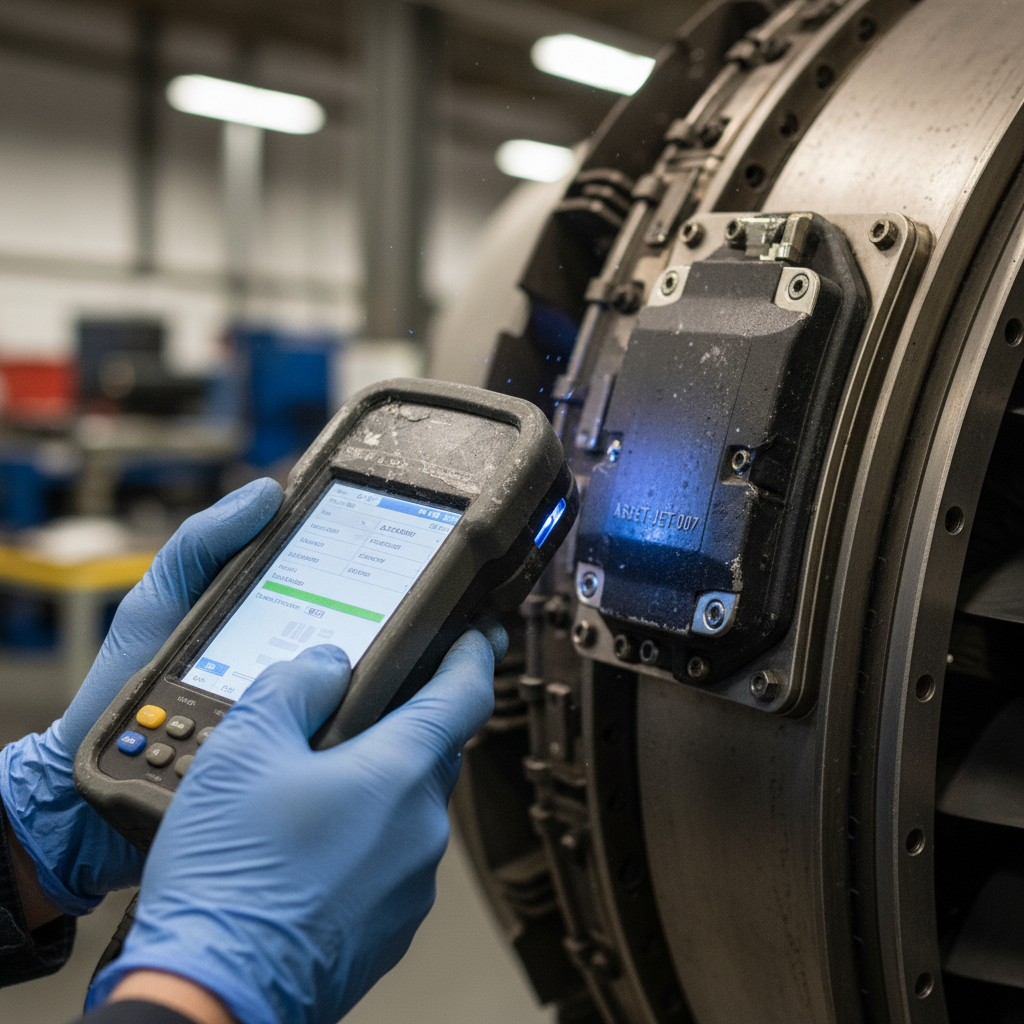
Passive RFID uses radio waves to transmit data from a tag to a reader without requiring a battery, making tags smaller, cheaper, and effectively permanent. In aviation, passive UHF RFID handles part-level identification: confirming that component X with serial number Y is physically present on aircraft Z.
The industry standard is ATA Spec 2000 Chapter 9, governing permanent identification of parts, shipping/receiving information, and traceability. Tags must be ISO 18000-6C and GS1/EPC Gen 2 UHF compliant per IATA OEM requirements.
Passive RFID excels at identity confirmation (is this the right part?) but does not provide continuous location. It reads only when within range of a fixed or handheld reader.
Cellular IoT for Supply Chain Visibility
When assets move between facilities, across borders, or sit in remote storage, cellular trackers fill the gap. Devices using LTE-M or NB-IoT networks report GPS position at configurable intervals, with battery lives measured in years rather than days.
A concrete example: a major engine manufacturer deployed the Oyster Edge tracker on jet engines in transit and storage, achieving 10+ years of battery life on three user-replaceable AA batteries. The trigger was COVID-era losses from engines corroding in uncontrolled environments because nobody knew exactly where they sat or under what conditions.
For assets that need to ride inside aircraft cargo holds, DO-160 certification is mandatory. This standard validates that electronic equipment can withstand the temperature extremes, vibration, humidity, and electromagnetic interference present in aircraft environments. Hardware without DO-160 approval simply cannot fly.
UWB for Precision Indoor Positioning
Inside hangars and MRO facilities, neither GPS (no signal indoors) nor passive RFID (limited range) provides real-time location. Ultra-Wideband delivers real-time location accuracy of 30 cm, making it viable for tracking high-value tooling carts, engine stands, and personnel within complex indoor environments.
UWB anchor costs have dropped to levels comparable with BLE and Wi-Fi positioning, but with significantly better accuracy and reliability. For an MRO facility managing hundreds of specialized tools across multiple bays, UWB eliminates the “where did we leave the borescope” problem that silently consumes technician hours.
Satellite for Airborne and Remote Assets
Engines on wing, aircraft in oceanic routes, assets positioned at remote outstations: satellite connectivity (Iridium, Globalstar) ensures pole-to-pole visibility regardless of cellular coverage. This layer is essential for operators with global route networks or assets positioned in regions without reliable terrestrial infrastructure.
Compliance Is the Floor, Not the Ceiling
I hear operators frame compliance as the reason to invest in tracking. That framing is backwards. Compliance is the minimum altitude. You will not get fined for exceeding it. But you will burn money every day you operate at merely compliant levels of visibility.
The regulatory framework sets clear mandates:
- ATA Spec 2000 Ch. 9: Part identification and traceability via RFID
- DO-160: Environmental qualification for any electronics operating onboard
- DO-326A: Cybersecurity standards to prevent malware from infecting avionics systems during development and flight operations
- EASA Part-145 / FAA 14 CFR Part 145: Maintenance organization requirements including tool calibration tracking and component traceability
Meeting these standards with manual processes (spreadsheets, paper logs, tribal knowledge) technically satisfies the auditor. But it does not satisfy the P&L. The gap between “compliant” and “operationally excellent” is where asset tracking systems generate their real return.
The Cybersecurity Angle Nobody in This Space Talks About
Here is something the typical tracking vendor pitch ignores entirely: your asset tracking data is a target.
EUROCONTROL reported that aviation sector cyber incidents tripled between 2021 and 2024, with a 400% increase in ransomware targeting aviation ground support and maintenance systems in that same period. An attacker who compromises your asset management platform knows exactly which engines are due for overhaul, which spares are in transit, and which aircraft are vulnerable to AOG if a single shipment is disrupted.
The FAA responded in 2024 with a Notice of Proposed Rulemaking outlining required cybersecurity measures for aircraft, engines, and propellers. This is not future speculation. It is active rulemaking.
When evaluating an aircraft asset tracking system, ask your vendor three questions most operators forget:
- Where does tracking data reside, and who controls encryption keys?
- How are device firmware updates authenticated to prevent supply-chain injection?
- What happens to operational continuity if the cloud platform goes offline for 48 hours?
If the answer to any of these is vague, your “visibility improvement” is simultaneously a new attack surface.
ROI That Shows Up in the First Quarter
The value case for aircraft asset tracking is not theoretical. Documented outcomes from operators who deployed systematically:
- $1.2 million saved in a single month by one major international airline using Boeing’s Airplane Health Management to predict component failures before they caused delays [source: Boeing AHM program data]
- 64% reduction in average delay time for a 777 fleet operator, and 80% reduction in pneumatics-related delays for a 737 operator, both through predictive alerting tied to asset condition data
- 70% reduction in part search times at Boeing MRO facilities after deploying RFID on components, and 60% streamlined compliance reporting at Airbus through automated tracking
These numbers come from operators with mature digital infrastructure. But even mid-market operators (regional airlines, independent MROs with 5 to 20 bays) see fast payback. The math is simple: if one prevented AOG event saves $50,000 and your tracking deployment costs $200,000, you need four saves to break even. Most operations exceed that threshold within 90 days.
What Most Operators Get Wrong
After deploying tracking solutions across aviation supply chains for years, I see the same three mistakes repeat.
Mistake 1: Tracking only what moves. The engine in transit gets a tracker. The engine sitting in long-term storage does not. Then corrosion happens, maintenance windows expire unnoticed, and a $15M asset loses airworthiness certification because nobody checked environmental conditions for six months. Static assets need monitoring too. Temperature, humidity, time-since-last-inspection: all trackable, all consequential.
Mistake 2: Confusing platform integration with vendor lock-in. Some operators avoid best-of-breed hardware because “it might not talk to our ERP.” Modern cellular trackers publish data via standard APIs. The integration question is not whether your tracker can send data to SAP or Ultramain. It is whether the platform you choose lets you switch hardware without rebuilding your entire data pipeline. Ask about data portability before you sign.
Mistake 3: Over-specifying accuracy when frequency matters more. A GSE tractor does not need 30cm UWB precision on the ramp. It needs a position report every 15 minutes confirming it is at the right gate. Operators who spec UWB for outdoor assets burn budget on infrastructure when a $50 cellular device reporting via LTE-M would deliver better outcomes. Match the technology to the actual operational question.
How to Deploy Without Disrupting Operations
The fastest path to value follows a predictable pattern. Not because every operation is identical, but because the physics of implementation reward a specific sequence:
Phase 1: High-value rotables (weeks 1 to 4). Tag engines, APUs, and landing gear assemblies with cellular trackers that report location and environmental conditions. These assets have the highest per-unit value and the longest cycle times. Immediate visibility into dwell time, storage conditions, and transit status. ROI materializes the first time you avoid an AOG by knowing exactly where your serviceable spare sits.
Phase 2: MRO tooling and GSE (weeks 4 to 8). Deploy RFID or UWB (depending on indoor/outdoor mix) on calibrated tooling, test equipment, and high-utilization ground support vehicles. Target: eliminate search time waste and prevent calibration expiry events that ground maintenance activity.
Phase 3: Full component and ULD tracking (weeks 8 to 16). Extend passive RFID to line-replaceable units and freight containers. Integrate with existing MRO software via API. At this stage, your system transitions from “tracking individual assets” to “providing fleet-wide operational intelligence.”
The key at every phase: choose hardware that matches the environment. For assets that enter aircraft cargo holds or ride on wing, DO-160 approved devices like the Thingfox T2 are not optional. They are regulatory requirements. For ground-side assets and warehouse inventory, rugged cellular trackers with multi-year battery life deliver visibility without creating a device-management burden.
The AI Layer: Predictive Maintenance Is Not Hype Anymore
AI can now analyze vast amounts of sensor data in near-real-time, predict when engine components are likely to fail, and enable technicians to act before serious issues arise. This is not a 2030 promise. It is a 2025 production capability.
The predictive airplane maintenance market reached $5.3 billion in 2024 and is growing at 13.1% CAGR. The reason is straightforward: machine learning models trained on sensor telemetry, OEM failure databases, and operational history can forecast component degradation with enough lead time to schedule maintenance proactively rather than reactively.
But here is the part vendors gloss over: predictive models are only as good as the data feeding them. If your asset tracking captures location but not environmental exposure (temperature cycling, humidity extremes, vibration events during transit), your predictive layer operates with incomplete inputs. The tracking system is the data foundation. AI is the analytical layer on top. One without the other underdelivers.
Operators integrating platforms like Airbus Skywise (connecting nearly 12,000 aircraft) or Lufthansa Technik’s AVIATAR are proving that fleet-wide predictive capability is achievable today, not in some hypothetical digital-twin future.
Choosing the Right System: Three Questions That Filter Fast
The vendor landscape is crowded. OEM platforms, enterprise software suites, standalone hardware vendors, and full-solution integrators all compete for the same budget line. Cut through the noise with three filtering questions:
Does it cover the full asset lifecycle, or just one phase? Systems that track only in-service assets miss the 30 to 40% of cycle time where components sit in MRO, storage, or transit. If the system goes dark when the asset leaves the aircraft, it is a usage monitor, not an asset tracker.
Is the hardware certified for your environment? DO-160 for airborne. IP67+ for ramp and outdoor. Intrinsically safe for fuel-adjacent areas. Battery life measured in years, not weeks. If you are replacing batteries quarterly on a fleet of 500 tracked assets, your maintenance burden just shifted from aircraft to tracking devices.
Can you own your data? Some platforms hold your tracking history hostage behind proprietary formats. If switching vendors means losing three years of location and condition data, your “digital transformation” just created a new form of dependency. Demand API access and standard export formats from day one.
Where This Goes Next
Private 5G networks in airports are already operational. Zagreb Airport deployed a private 5G network in May 2025 supporting drone-based inspections with UHD cameras. This infrastructure will enable sub-second location updates for every GSE vehicle and cargo container on the apron, replacing the 15-minute GPS intervals of today’s cellular trackers with near-continuous positioning.
Blockchain is entering parts traceability, providing immutable provenance records that address the persistent counterfeit-parts problem in used serviceable material (USM) markets. When combined with physical RFID identity, blockchain creates a digital thread from OEM manufacturing floor to final disposition that no paper logbook can match.
The IoT in aviation market is growing at 21.7% CAGR through 2034. The question for operators is not whether to adopt aircraft asset tracking. It is whether to deploy now at current costs or wait and deploy later at higher costs with less competitive advantage.
If Your Assets Go Dark After Delivery, That Is the Gap
Most aviation operators I talk to have some form of tracking. A maintenance software suite that logs component status. A freight forwarder providing shipment ETAs. An ADS-B feed showing where aircraft are in the sky.
None of that constitutes an aircraft asset tracking system. The system is what connects all those data points into lifecycle visibility: where every asset is, what condition it is in, when it needs attention, and whether it is generating value or burning money while it sits.
If you are evaluating options or trying to figure out where to start, talk to our team. We deploy end-to-end tracking solutions, from DO-160 approved airfreight devices to long-life cellular trackers for ground assets, with implementation timelines measured in weeks, not fiscal quarters.
info@datanetiot.com | +1 508 292 2210 | +32 499 44 52 95

Frequently Asked Questions
What is the difference between aircraft tracking and aircraft asset tracking?
Aircraft tracking (ADS-B, radar, satellite flight-following) monitors where the airplane itself is during flight. Aircraft asset tracking monitors the full inventory of physical assets associated with aviation operations: engines, rotable components, tooling, GSE, and containers across their entire lifecycle, including storage, transit, and MRO events.
What certifications does tracking hardware need to fly on aircraft?
Any electronic device operating inside or on a commercial aircraft must meet RTCA DO-160 environmental testing standards, which validate performance under temperature extremes, vibration, humidity, and electromagnetic interference. RFID tags must comply with ISO 18000-6C and GS1/EPC Gen 2 UHF per ATA Spec 2000 Chapter 9.
How quickly does an aircraft asset tracking system deliver ROI?
Most operators see payback within 90 days of deployment. A single prevented AOG event typically saves $50,000 to $150,000 depending on aircraft type and route. Boeing’s AHM program documented $1.2 million in savings in one month for a single airline, and 64% reductions in delay time for 777 operators.
Can asset trackers work inside aircraft cargo holds?
Yes, but only DO-160 certified devices are permitted. These trackers are specifically engineered to withstand the pressure, temperature, and EMI conditions inside cargo compartments without interfering with aircraft systems. Non-certified consumer or industrial trackers are prohibited from airborne use.
What role does AI play in aircraft asset tracking today?
AI analyzes sensor telemetry and maintenance history to predict component failures before symptoms appear. The predictive maintenance market reached $5.3 billion in 2024, with documented results including 35% fewer unscheduled AOG events within 12 months. The tracking system provides the data foundation that AI models require to generate accurate predictions.
How do cybersecurity concerns affect tracking system selection?
Aviation cyber incidents tripled between 2021 and 2024, with ransomware targeting MRO systems up 400%. Operators should verify data encryption, firmware authentication processes, and offline continuity capabilities before selecting any connected tracking platform. The FAA’s 2024 proposed rulemaking signals that cybersecurity requirements will become mandatory, not optional.








 +1 508 292 2210

7 Responses