

In 2024, aquaculture produced 103 million tonnes of aquatic animals, worth $371 billion at the farm gate. That number will keep climbing. Wild capture has plateaued near 92 million tonnes. The math is simple: every incremental tonne of seafood protein the world needs will come from farms, not boats.
And yet, the majority of those farms operate on gut feel. A pond manager checks color. A cage operator watches pellet drift. A hatchery technician dips a handheld probe twice a day and writes the number on a whiteboard. Smart aquaculture is supposed to change that. The market for it sits somewhere between $4.5 billion and $4.9 billion in 2025-2026, depending on whose definition you trust. Vendors pitch AI feeding, computer vision, blockchain traceability, digital twins.
Here’s the problem I keep seeing. After 15+ years deploying IoT monitoring across supply chains (aviation, ocean freight, industrial assets), the pattern repeats: organizations buy the application layer before they’ve solved the sensing layer. They want the dashboard before they have trustworthy data. In smart aquaculture, that means buying an AI feeding algorithm when you can’t reliably tell me your dissolved oxygen level from 30 minutes ago. That’s autopilot without an altimeter.
This piece is for the operator, farm manager, or technology lead trying to figure out where to start, what to prioritize, and what the actual returns look like. No hype. Lots of numbers.
What Smart Aquaculture Really Means
Smart aquaculture is not a species, a farming method, or an industry code. It is a technology and management layer applied on top of existing production: ponds, raceways, cages, hatcheries, RAS (recirculating aquaculture systems), shellfish beds, seaweed lines. The core architecture has three layers: perception, network, and application. Perception is sensors and cameras. Network is how data moves (wired, LoRa, NB-IoT, cellular, satellite). Application is where data becomes a decision.
That third layer gets all the attention. But the architecture is sequential, not parallel. Bad perception corrupts every layer above it. A fouled optical probe sends a plausible but wrong oxygen reading. The network transmits it faithfully. The application layer trends it confidently. The farmer trusts the number. The fish die.
The practical definition is a feedback loop: measure the water, the animals, and the equipment. Transmit. Clean the data. Interpret. Recommend. Act. Verify. Every step can fail. The organizations that succeed are the ones that budget for calibration, cleaning, redundancy, offline operation, and staff response before they promise an AI return.
One distinction worth making early: smart aquaculture is not the same as RAS. RAS is a production architecture that recirculates water. Smart aquaculture is a digital layer that can be deployed in RAS, ponds, raceways, or open-water cages. RAS benefits from sensors and automation, but its energy, biological, and capital risks are a separate conversation.
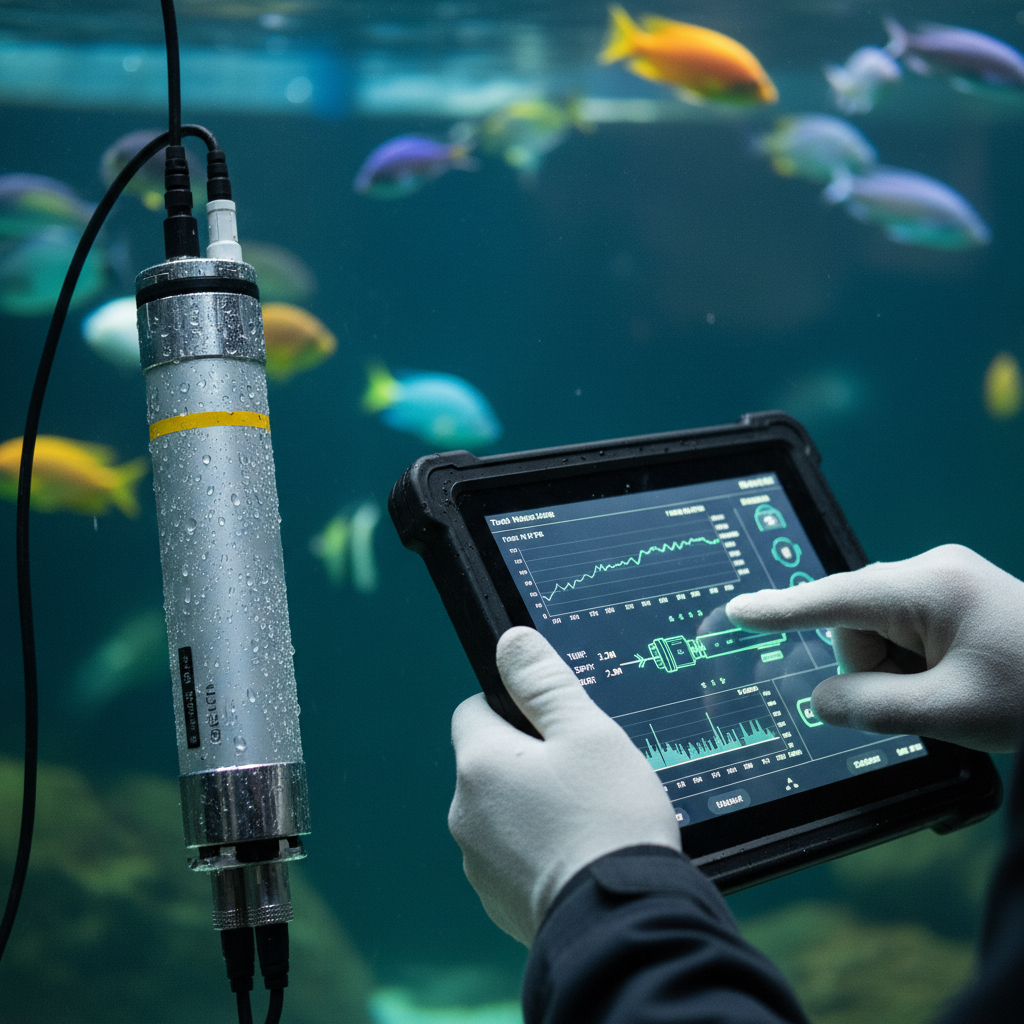
Water Quality Monitoring Is the Foundation
If you operate a farm and can only invest in one thing, invest in continuous water quality monitoring. Not a camera. Not a feeding algorithm. Not a dashboard. Sensors in the water, measuring the parameters that kill your animals.
Good water quality is essential for growth and survival, and the water source must match the requirements of the cultured species. That sounds obvious. But “match” means continuous measurement, not a twice-daily dip test. Dissolved oxygen can crash in hours during an algal bloom. Ammonia spikes overnight. Temperature stratification in a deep pond can create a lethal zone at the bottom while the surface reads fine.
The parameters that matter most depend on your species, but the core set for almost every operation includes:
- Dissolved oxygen (the single biggest killer in warm-water ponds)
- Temperature (drives metabolism, feeding rates, disease susceptibility)
- pH (affects ammonia toxicity, gill function, microbial balance)
- Salinity or conductivity (species-specific thresholds; changes stress animals)
- Ammonia and nitrite (toxic metabolic waste, especially in high-density systems)
YSI’s aquaculture monitoring portfolio extends to ORP, turbidity, nitrate, chlorophyll, blue-green algae, water velocity, and meteorological conditions, which matter for more advanced operations. But start with what correlates to mortality. A threshold alert is useful. A forecast (predicting a DO crash two hours before it happens) is more useful. A closed-loop response (an aerator that fires automatically when DO drops below 4 mg/L) is the endgame, but it requires safe actuator design and human override capability.
The monitoring priority should follow your farm’s risk register, not a vendor’s feature list. A tropical shrimp pond in Southeast Asia has different failure modes than a salmon cage in Norway or a tilapia raceway in Brazil. The technology is the same (sensors, connectivity, software). The configuration is not.
The Technology Stack Beyond Sensors
Once you have reliable water data flowing, the next layers add genuine value. Here’s what each does and where it actually stands in 2026.
AI-driven feeding
Feed typically represents around 50% of operating costs. Overfeeding wastes money, pollutes water, and accelerates disease. Underfeeding stunts growth. The premise of AI feeding is appetite detection: a camera or sensor observes the animals’ response, and software adjusts timing, speed, or quantity.
The clearest public data comes from Umitron’s trial with Dainichi Corporation on red sea bream. Over 67 days, AI-managed fish reached 1.90 kg average weight with a feed-conversion ratio of 1.86, versus 1.77 kg and FCR of 2.01 under manual feeding. Better weight, better conversion. Japan’s government has highlighted the Umitron CELL design (bottom camera, 400-liter tank, smartphone access) as a national technology example. The company reports potential feed-cost reductions of 10-20%, though that figure depends on local feed price, labor, mortality, and growth baseline.
The takeaway: AI feeding works best as a narrow, bounded loop with a clear biological KPI. It’s easier to validate than an all-purpose “AI platform.”
Computer vision
Cameras and machine learning can count, size, classify, segment, and infer behavior from underwater video. Published benchmarks look strong: one shrimp-larvae counter hit 98.72% accuracy; another detection system reported 98.8% precision. Aquabyte processes over one million salmon images per day for biomass, lice, welfare, and appetite.
But here’s the reality check: 45% of reviewed welfare-monitoring studies were still conducted in experimental tanks, roughly TRL 3-4. Commercial accuracy depends on turbidity, occlusion, lighting, stocking density, and species. A model trained on clear tank water can misclassify fish in a crowded, turbid cage. Before buying computer vision, ask for validation data from your intended species, life stage, and farm environment. Not a lab demo.
Digital twins
A digital twin combines a digital representation of a production unit with mathematical models and live sensor data. Descriptive twins show what’s happening. Predictive twins estimate what happens next. Autonomous twins would close the loop and act. Aquaculture twins remain in their infancy compared to terrestrial agriculture, because underwater observation, animal biology, and multi-species interactions are harder to model. The near-term value is scenario testing and decision support, not autonomous farming.
Edge computing and offline resilience
This is the least glamorous and most important infrastructure decision. Remote cages, rural ponds, and small farms cannot assume continuous broadband. Academic reviews highlight that electricity, communications, harsh environments, and sensor fouling remain persistent barriers. Low-power sensing, solar power, local gateways, and edge processing address these constraints. The critical design principle: local alarms must continue during cloud outages, devices must store data for later sync, and operators must be able to override a faulty model. If your system goes silent when the internet drops, it’s not smart. It’s fragile.
Real Numbers From Real Farms
The difference between a conference slide and an operational result is a farm that actually ran the technology under production conditions. Here are cases where the numbers are public.
Salmon: vision-driven welfare and lice
Aquabyte, founded in 2017, developed what Norwegian authorities approved as the first AI product for sea-lice assessment. The company’s HYDRA 360 combines camera, sonar, and environmental sensing. The operational question isn’t “can AI see lice?” (it can, under favorable visibility). It’s whether the lice count, biomass estimate, or feeding recommendation changes a real decision: earlier treatment, better harvest timing, reduced manual sampling. The lesson is to buy a measurable workflow, not the abstract promise of computer vision.
Shrimp: smartphone measurement for smallholders
XpertSea’s XperCount lets a farmer photograph shrimp, then uses AI to count, size, and weigh them. The Growth Platform predicts growth, FCR, stocking density, survival, and harvest timing. Customers operate in Ecuador, Mexico, the UK, and Vietnam. The entry cost is a smartphone, not a $50,000 camera rig. Aquaconnect takes a wider approach in India, serving over 60,000 fish and shrimp farmers with AI, satellite data, credit, insurance, and market access. Smart aquaculture for a smallholder can mean satellite monitoring and financial coordination, not cage-mounted cameras.
RAS: the sustainability paradox
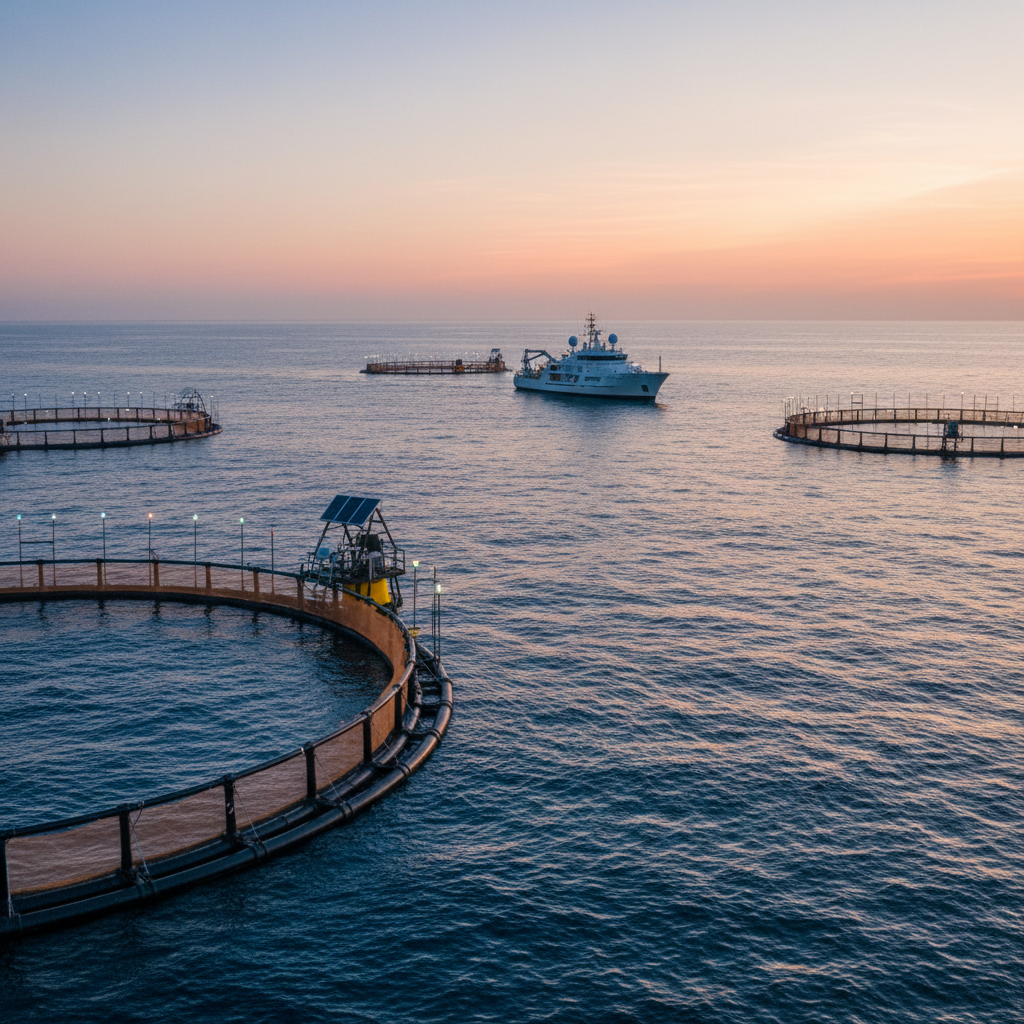
Recirculating aquaculture systems promise geographic flexibility and environmental containment. But the energy, capital, and biological complexity are severe. Land-based salmon energy demand can exceed sea-pen energy by more than three times, according to a 2025 review. Atlantic Sapphire’s experience illustrates both the potential and the risk: in 2024, the company reported 6.4% mortality, biomass gain improved to 5,500 tonnes from 3,700 the previous year, and inadequate cooling in Q3 2023 caused warm water, maturation, and poor harvest performance. By Q3 2025, survival exceeded 99% and FCR hit 1.3. Smart controls helped the recovery, but they didn’t prevent the original failure. Sensors can optimize oxygen demand and stabilize feeding. They can’t make electricity cheap or turn an immature biological process into a mature one.
What Goes Wrong (and Usually Does)
The smart aquaculture conversation is dominated by success stories. Here’s what the pitch decks leave out.
Sensor fouling destroys data quality
Optical DO sensors in marine cages accumulate biofouling within days. Turbidity probes in earthen ponds drift. Ammonia sensors in warm, nutrient-rich water require frequent calibration. If your maintenance budget doesn’t include cleaning schedules, calibration consumables, and redundant probes for critical parameters, your data degrades silently. The AI model built on top of that data degrades with it.
Lab accuracy does not transfer to production
A classification model that scores 98% in a controlled tank can drop to the 80s in a commercial cage with variable lighting, dense stocking, and turbid water. Fish that look distinct in training images look identical when they’re crowded, moving, and partially occluded. The responsible approach is to require site-specific validation, define confidence thresholds, and build human escalation into the workflow. If a vendor won’t share field accuracy data, that tells you something.
Connectivity is not a given
Many aquaculture operations sit in areas with weak or intermittent cellular coverage. Offshore cages may have no terrestrial signal at all. A system designed around cloud-first architecture fails when the connection drops. The best implementations use local edge processing for time-critical decisions (oxygen alerts, emergency aerator activation), store data locally during outages, and sync when connectivity returns. LoRa and NB-IoT offer low-power, long-range options for remote sites, but they have bandwidth limits that affect camera-heavy applications.
Governance gaps undermine everything
The eFishery case is instructive. The Indonesian startup served dispersed fish and shrimp farmers with AI feeding technology. In February 2025, new management appointed FTI Consulting after allegations of misconduct and fraud involving prior management. Sensors can record feeding events accurately. They cannot, by themselves, prove revenue, customer count, inventory levels, or loan quality. Operational intelligence needs institutional intelligence alongside it: immutable event logs, role-based access, model versioning, exception review, and independent financial controls.
A Practical Sequence for Getting Started
The vendors want you to buy a platform. What you need is a sequence.
- Instrument the highest-risk variable. For most farms, that’s dissolved oxygen, temperature, and pH. Continuous monitoring with automated alerts. Not twice-daily manual dips. This single step prevents the catastrophic loss events that wipe out an entire cycle.
- Prove one narrow intervention. Pick the largest cost or loss driver. If it’s feed waste, trial appetite-based feeding on a subset of cages or ponds. If it’s sampling labor, trial smartphone-based measurement. Measure the biological and economic KPI against your baseline. Not the vendor’s claimed average.
- Integrate data across the farm. Once you trust the sensing layer and have proven one intervention, connect water quality, feeding, biomass, mortality, and environmental data into a single view. This is where patterns emerge. Correlations between temperature spikes and mortality. Feed conversion shifts tied to dissolved oxygen levels.
- Add predictive models. With clean, integrated data, forecasting becomes viable. DO crash prediction. Growth trajectory. Disease risk windows. These models earn their keep by giving you hours or days of lead time instead of reactive crisis management.
- Automate bounded actions. Only after the previous four steps are stable. Aerator activation on DO threshold. Feed pause on appetite detection. Pump adjustment on temperature. Every automated action needs a human override, a fallback mode, and a failure alarm.
The timeline varies. A well-resourced salmon operation might move through steps 1-3 in 12 months. A smallholder shrimp farmer might spend a full season on step 1. That’s fine. The point is that each step validates the next. Skip ahead, and you’re building on assumptions instead of evidence.
If your operation needs environmental monitoring as the starting point (and for most farms, it is), our environmental tracking devices are built for exactly this kind of deployment: continuous measurement of temperature, humidity, and water parameters in harsh conditions. No platform lock-in, no AI upsell required. Sensor data you can trust. If that conversation is relevant to where you are in the sequence, reach out to our team.
Frequently Asked Questions
What is smart aquaculture?
Smart aquaculture is the application of connected sensors, automation, analytics, and AI to aquatic farming. It works as a feedback loop: measure water and animal conditions, transmit data, analyze it, recommend or execute an action, then verify the result. It applies to ponds, cages, hatcheries, RAS, and shellfish operations.
What water parameters should a farm monitor first?
Start with the parameters that correlate to immediate mortality risk: dissolved oxygen, temperature, and pH. Add ammonia/nitrite for high-density systems and salinity for brackish or marine species. Monitoring priorities should follow your species requirements and risk register, not a generic list.
Can AI actually reduce feed costs in aquaculture?
Published trials suggest yes, within specific conditions. Umitron’s red sea bream trial showed improved feed-conversion ratio (1.86 vs. 2.01 manual) and the company reports 10-20% feed cost reduction potential. Results depend on species, feed price, stocking density, and baseline practices. Measure against your own operation, not an industry average.
Is smart aquaculture only viable for large operations?
No. Smartphone-based tools like XpertSea’s shrimp measurement app and Aquaconnect’s farmer platform serve tens of thousands of smallholders. Continuous water quality monitoring with low-power sensors and LoRa connectivity can work on a single pond. The investment sequence should match the operation’s scale and risk profile.
How accurate are computer vision systems for fish monitoring?
Lab benchmarks reach 98-99% for specific tasks (counting, species identification, lice detection). Field accuracy is lower and depends on water clarity, lighting, stocking density, and species. Nearly half of reviewed welfare studies were conducted in experimental tanks, not commercial farms. Always request validation data from conditions comparable to yours.
Does smart aquaculture guarantee sustainability?
No. Better monitoring can reduce feed waste, water use, and mortality. But equipment requires energy and maintenance. RAS can contain environmental risk while consuming three times the energy of sea pens. Sustainability requires a measured, farm-level life-cycle analysis, not a technology label.





 +1 508 292 2210

4 Responses