
Your sensors are collecting data. Oxygen, temperature, pH, maybe a camera feed. The readings look fine on the dashboard at 5 PM. But when dissolved oxygen crashes at 3 AM because an aerator tripped and nobody saw the alert, you still lose stock. (See also: aquaculture environmental monitoring.)
That gap between collecting data and acting on it is where most remote aquaculture monitoring setups break down. Not because the technology is bad, but because the system was never designed to close the loop.
I spend most of my time deploying IoT tracking and monitoring systems in aerospace and industrial supply chains, environments where a missed signal means a grounded aircraft or a lost container. Aquaculture shares the same fundamental challenge: remote assets in harsh conditions, intermittent connectivity, and decisions that can’t wait for someone to check a screen. The technology stack is similar. The stakes, when you’re talking about living biomass, are often higher.
Similar challenges apply to cargo monitoring at sea, where harsh marine conditions demand reliable IoT systems.
This article breaks down what remote aquaculture monitoring actually involves in practice, which parameters to prioritize, how the technology layers connect, where AI earns its keep, and the failure modes that don’t show up in product brochures.
What “Remote” Actually Means in Aquaculture
Remote aquaculture monitoring carries two distinct meanings, and conflating them causes expensive mistakes.
The first is operational: monitoring a farm from a control room, office, or phone rather than walking every cage, pond, or tank. Sensors measure water conditions, cameras observe fish behavior, and software sends alerts when something deviates. The operator is remote. The instruments are local.
The second is environmental: satellites, buoys, and autonomous platforms observe conditions around and beyond the farm. Sea-surface temperature, chlorophyll concentration, water clarity, wave height, harmful algal blooms. This data provides regional context that no in-water probe can offer.
The most effective systems combine both. Local instruments supply high-frequency ground truth. Remote sensing supplies geographic context. But neither produces value unless the farm has defined what happens when a threshold is breached, which is why strong aquaculture data management matters as much as the sensors themselves.
The scale reinforces why getting this right matters now. Global aquaculture produced 130.9 million tonnes in 2022, with farmed aquatic animals crossing 50% of total aquatic-animal production for the first time. A narrow market estimate puts the precision aquaculture technology sector at USD 847.9 million in 2025, reaching USD 1.43 billion by 2030. That’s significant capital flowing into monitoring and control systems. The question is whether it flows into the right layers.
The precision fish farming framework from the Global Seafood Alliance puts the design challenge simply: observe, interpret, decide, act. Most farms invest heavily in “observe.” Some reach “interpret.” Very few have automated or even documented the “decide” and “act” steps. That’s not a sensor problem. It’s a systems design problem, and it explains why smart aquaculture depends on more than instrumentation alone.
The Parameters That Protect Your Stock
Not all measurements are equal. Some parameters shift from safe to lethal in hours. Others change slowly enough that weekly sampling works fine. The priority list depends on species and system type, but the hierarchy of risk is consistent. The same principles apply to shrimp farm monitoring, where rapid parameter shifts can wipe out a crop.
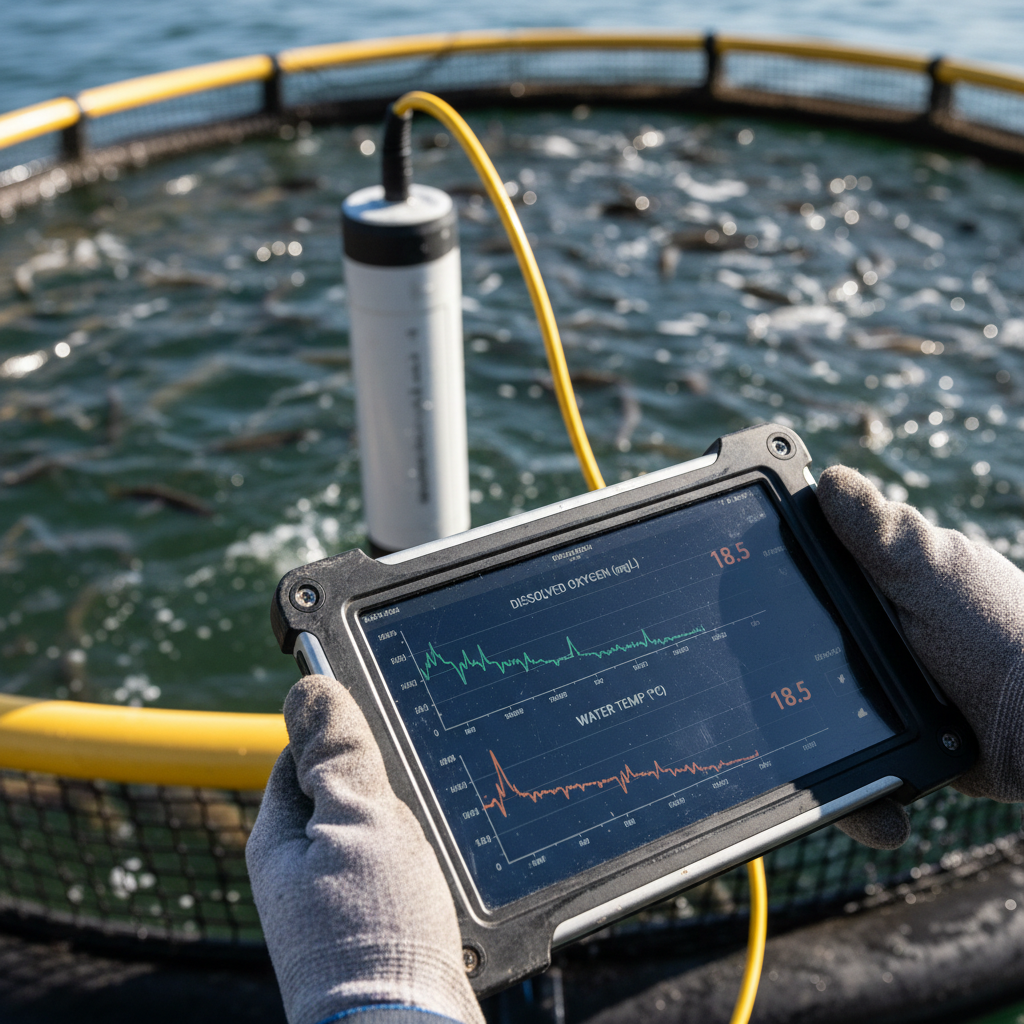
Start with dissolved oxygen and temperature. These two drive metabolism, stress response, feeding behavior, and disease susceptibility. Reliable aquaculture temperature monitoring is essential because a pond or cage that holds 8 mg/L of dissolved oxygen at dawn can drop below 3 mg/L by midnight if algae crash, an aerator fails, or stocking density is too high. By the time a morning check reveals the problem, mortality is already underway.
After oxygen and temperature, add pH, salinity (or conductivity), turbidity, ammonia, water level, and weather inputs. Effective salinity monitoring in aquaculture is especially critical for species sensitive to osmotic stress. The ITU reference architecture for IoT-based smart aquaculture includes all of these, with sensor-to-cloud pathways that trigger alerts or activate equipment like aerators and heaters automatically.
For fish specifically, feeding response, biomass estimation, and behavioral indicators matter once you have visual or acoustic instrumentation validated for your species. But those are second-tier. I’ve seen operations that invested in camera-based biomass estimation while their dissolved oxygen alerts went to an email inbox nobody checked at night. Sequencing matters. If the parameter that kills stock fastest isn’t covered by a reliable, real-time alert with a documented response protocol, adding cameras or AI won’t save your operation.
Building the Technology Stack
A complete remote aquaculture monitoring system is five layers deep. Most purchasing conversations focus on one or two. That’s where integration gaps form.
| Layer | What It Does | Common Components |
|---|---|---|
| Sensing | Measures water chemistry and physical conditions | Dissolved oxygen, temperature, pH, salinity, turbidity, ammonia probes; weather station |
| Observation | Captures visual and acoustic data on fish and infrastructure | Underwater cameras, aerial imaging, hydroacoustic echosounders, sonar, ROV |
| Edge and connectivity | Moves data from site to operator; keeps local controls running during outages | Gateway, controller, cellular/LoRaWAN/satellite modem, solar or battery power |
| Analytics | Turns raw data into predictions, recommendations, and alerts | Cloud platform, rules engine, ML models, dashboards, mobile app |
| Action | Changes the physical system in response to a detected condition | Aerator, oxygenator, feeder, heater, valve, or a human task with a defined SLA |
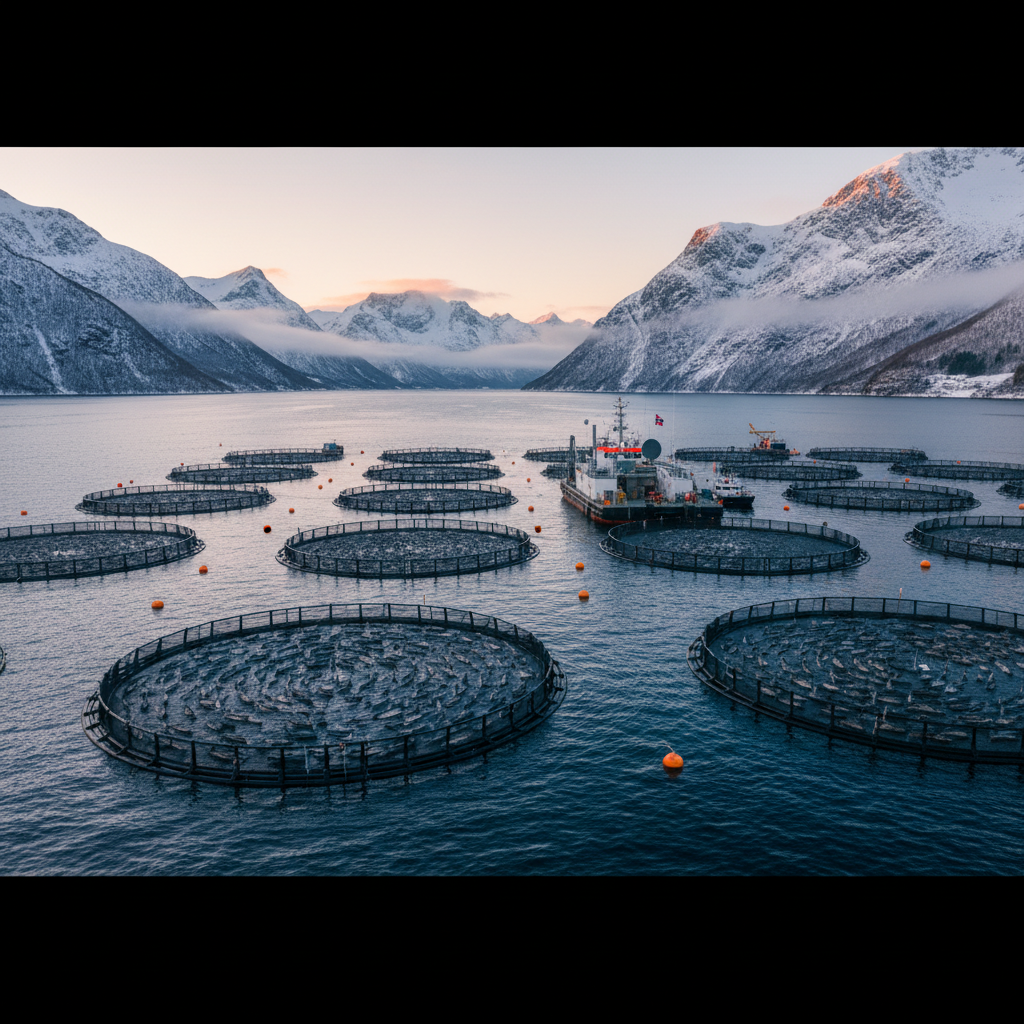
The connectivity layer deserves extra attention for remote sites. Ponds in rural Southeast Asia, cages off the Norwegian coast, and recirculating systems in West Virginia have very different backhaul options. Wireless environmental monitoring enables flexible deployment across these diverse locations—cellular works where coverage exists, LoRaWAN extends reach for low-bandwidth sensor data, and satellite fills the gaps for truly remote operations. The right choice depends on data volume, latency requirements, and power budget.
One design principle I enforce on every IoT deployment, aquaculture or otherwise: edge devices must retain local alarm logic and safety controls. If cloud connectivity drops (and at some point, it will), the aerator should still turn on when oxygen falls below threshold. A system that depends entirely on a cloud round-trip for emergency actions is a liability, not an asset.
Where AI Delivers and Where It Fails
Computer vision and machine learning have legitimate use cases in aquaculture. They also have limitations that vendor marketing tends to blur.
USDA researchers achieved more than 85% precision for AI-based fish detection in a recirculating aquaculture system in West Virginia. The system used underwater imagery to count and size fish without handling them, reducing stress and labor. In a controlled tank environment with stable lighting and water clarity, that performance is operationally useful.
Open-water cages are harder. A commercial salmon study using multi-depth camera arrays generated behavior and abundance indicators validated against expert review. The study revealed statistically significant differences in winter depth behavior between farms, information a water probe alone could never provide. But it also documented gaps: no infrared capability, no night coverage, reduced performance during low visibility, and partial cage observation. Sonar covers more volume but offers less visual detail.
The pattern is consistent. AI performs best in constrained environments: controlled flow, stable light, known species, consistent stocking density. Performance degrades when any of those variables shift. A model trained on Atlantic salmon at 12°C in Norwegian daylight may not generalize to the same species at 4°C in winter darkness.
My recommendation for farms evaluating AI: start in recommendation mode, not closed-loop. Let the system suggest feeding adjustments or flag anomalies, but keep a human in the decision chain until you have validated accuracy across seasons, stocking cycles, and edge cases at your site. Enforce hard safety limits (minimum oxygen, maximum temperature) independently of any machine learning model. Automation earns trust through evidence, not vendor claims.
Satellite Data Is Context, Not Control
Satellite-based environmental intelligence gives you something no probe can: a view of conditions beyond your farm’s instrumented footprint.
UMITRON’s PULSE service illustrates the approach well. Its Copernicus-based platform combines more than 30 satellite and open-data sources with buoy observations to deliver daily environmental layers and 48-hour forecasts. That’s useful for site selection, feeding strategy, harvest timing, and harmful algal bloom risk assessment.
NOAA has applied satellite measurements of sea-surface temperature, plankton abundance, and water clarity to study conditions affecting oyster growth and support site-scouting decisions. NASA’s harmful algal bloom detection work combines remote sensing with machine learning to improve early warning for events that can devastate an entire farming region.
But satellites do not replace local probes. Satellite measurements are indirect (inferred from reflectance or emission, not sampled in the water column), spatially averaged (one pixel may cover your entire site), and temporally constrained by orbit and cloud cover. They tell you “conditions around the farm look risky.” They don’t tell you the dissolved oxygen in cage 7 dropped below 4 mg/L twelve minutes ago.
The right architecture uses satellite intelligence as a screening and planning layer, then confirms every management action with in-water measurements. Two different tools, two different jobs.
Three Failure Modes the Brochure Skips
Every remote monitoring vendor shows you the dashboard. Clean data, smooth graphs, timely alerts. Here are three ways the real world diverges.
Physical infrastructure outlives its monitoring
The 2017 Cooke net-pen failure near Cypress Island, Washington, released approximately 250,000 Atlantic salmon into Puget Sound. The investigation found the operator had failed to clean and maintain the facility. No amount of water-quality telemetry would have prevented a structural collapse. A monitoring system that tracks dissolved oxygen every minute but can’t flag net fatigue, anchor movement, or overdue maintenance inspections is operationally incomplete. Physical asset condition belongs in the same monitoring architecture as biological parameters.
Sensor data degrades silently
Biofouling, calibration drift, power intermittency, and connector corrosion don’t trigger dramatic alarms. They produce readings that look plausible but are wrong. A low-cost IoT water-quality study documented 76% to 97% accuracy across parameters during a controlled three-month validation, with relative errors from 0.27% to 4%. That’s a proof of concept. Over twelve months in saltwater, without rigorous maintenance schedules, those numbers erode. Farms should log every calibration event, flag stale or missing data visually on the dashboard, and define explicit behavior for data gaps rather than silently interpolating them.
Governance failures can be worse than technical ones
The eFishery case shows that impressive hardware and growth metrics can coexist with alleged financial misconduct. Bloomberg reporting described revenue growth from USD 185,000 in 2018 to roughly USD 10 million in 2019, followed by allegations of manipulated financial reports and a founder detention in 2025. Remote monitoring is a trust system, and sound aquaculture risk management begins before you sign a contract. If you can’t independently verify a vendor’s financials, uptime history, data handling practices, and support commitments, you may be adding risk instead of reducing it.
Compliance Is Becoming Non-Negotiable
Environmental monitoring in aquaculture is shifting from voluntary best practice to market access requirement.
In the US, EPA effluent guidelines cover concentrated aquatic-animal production facilities producing 100,000 pounds per year or more, incorporating monitoring requirements into NPDES permitting. NOAA’s marine aquaculture monitoring guidance calls for site-specific measurement plans before, during, and after production, with standardized protocols and public engagement expectations.
Certification programs like ASC and BAP increasingly expect documented environmental data, not just periodic inspections. If your monitoring system can’t export auditable records with timestamps, calibration logs, and chain-of-custody metadata, you’re building compliance debt that compounds over time.
The practical implication: treat data retention, access controls, and export formats as product requirements from day one. A dashboard that shows real-time conditions but can’t generate a regulatory submission package solves only half the problem.
How to Evaluate a Vendor Before You Sign
The remote aquaculture monitoring market is fragmented. Some vendors sell instruments. Some sell analytics. Some sell integrated platforms. AKVA group’s 2024 acquisition of the remaining shares of Observe Technologies (after holding 33.7%) to serve over 100 farm sites illustrates the consolidation trend toward multi-layer platforms. But comparing options still requires a framework broader than a spec sheet.
Here’s what I ask when evaluating any IoT monitoring vendor, aquaculture or otherwise:
- Parameter coverage vs. your actual risk profile. Does the system measure the variables that cause the fastest, most expensive losses at your specific site?
- End-to-end latency. From event to alert to human response, including notification failures and off-hours, what’s the real timeline?
- Accuracy by site and season. Has the system been validated in conditions matching yours, or only in a lab or a different geography?
- Local fallback behavior. What happens to safety controls and alarms when cloud connectivity drops?
- Data ownership and export. Can you extract raw data via API? Can you switch vendors without losing your operational history?
- Calibration and maintenance burden. Who does it, how often, and what does it cost annually?
- Cybersecurity and access controls. Who can access your production data? How are firmware updates authenticated?
- Total cost of ownership over 3 to 5 years, including hardware, connectivity, cloud services, sensor replacement, calibration, and support.
The staged investment approach works best. Instrument the failure modes that can kill stock fastest. Prove data quality and human-response discipline with that baseline. Then add cameras, AI, satellite layers, and predictive models where they answer a defined economic or welfare question, all of which contribute to aquaculture productivity improvement. Automation comes last, with independent safety limits that no algorithm can override.
At Datanet, we approach aquaculture and marine monitoring the same way we approach any industrial IoT deployment: start with the decision the operator needs to make, then work backward to the sensor, connectivity, and analytics architecture that supports it. If you’re evaluating remote monitoring for aquaculture, marine operations, or environmental compliance, our environmental tracking solutions are built for exactly this kind of deployment. Talk to our team or reach us at info@datanetiot.com.
Frequently Asked Questions
What is remote aquaculture monitoring?
It is the use of sensors, cameras, sonar, buoys, satellites, and software to observe farm conditions and support operational decisions without requiring staff to be physically present at every site. A complete system covers the full loop: observe conditions, interpret what they mean, decide on a response, and act on it.
Which water parameters should a farm monitor first?
Dissolved oxygen and temperature. These change fastest and have the most direct impact on fish survival, feeding efficiency, and disease risk. Add pH, salinity, turbidity, and ammonia based on your species and production system. Visual and acoustic tools (cameras, sonar) are second-tier additions once the chemistry that kills stock is reliably covered.
Can satellite data replace in-water sensors?
No. Satellites provide broad regional context: temperature gradients, plankton density, bloom risk, wave conditions. But their measurements are indirect and spatially averaged. In-water probes deliver high-frequency, cage-level readings required for real-time control decisions. The strongest architectures use both as complementary layers.
How reliable is AI for fish counting and health assessment?
Reliability depends on the environment. USDA research reported over 85% precision in a controlled recirculating system. Open-water conditions introduce challenges: variable lighting, night blindness, turbidity, biofouling, and model drift across species and seasons. Ask vendors for validation data specific to your conditions before committing budget.
Does remote monitoring eliminate the need for on-site staff?
It changes their work, not eliminates it. Automation reduces routine inspection and helps prioritize exceptions. But staff still calibrate instruments, inspect physical infrastructure, manage disease events, and respond to emergencies that sensors can’t anticipate. The 2017 Cooke net-pen escape is a clear example of why structural inspection can’t be replaced by a biological dashboard.
What should I ask a vendor before signing a monitoring contract?
Focus on accuracy validated at your site, end-to-end latency from event to human response, local fallback during connectivity loss, data ownership and API access, calibration costs, cybersecurity controls, and total cost of ownership over 3 to 5 years. A lab calibration certificate is not a field performance guarantee.





 +1 508 292 2210

3 Responses