

Aquaculture crossed 100 million tonnes of farmed aquatic animals in 2024. Farm-gate value hit $371 billion, making it the majority source of aquatic animal food worldwide. That makes aquaculture data management production infrastructure for the planet’s fastest-growing food sector. Not an IT project. Not a nice-to-have.
And yet, most conversations about aquaculture technology start in the wrong place. AI models. Digital twins. Blockchain traceability. Those are outputs. The input, the layer that determines whether any of those outputs are trustworthy, is the data architecture underneath. Get that wrong, and everything built on top becomes expensive noise dressed as insight.
I’ve spent over 15 years deploying IoT systems across aviation, logistics, and maritime operations. The pattern repeats everywhere: organizations invest in the analytics layer before fixing the collection layer. Aquaculture is following the same trajectory. This piece is about what actually works when you’re managing data from living systems in harsh environments with unreliable connectivity.
What Aquaculture Data Management Actually Covers
Aquaculture data management is the full lifecycle of collecting, validating, storing, integrating, analyzing, securing, and acting on information generated by aquatic production systems. It spans water chemistry, fish and shellfish biology, feed records, health events, welfare indicators, energy consumption, equipment telemetry, environmental conditions, traceability events, and commercial transactions.
The Precision Fish Farming framework, published by Føre et al., organizes this around a control-engineering loop: Observe, Interpret, Decide, Act. Instead of relying only on operator experience, a farm continuously measures biological and environmental state, interprets signals, chooses an intervention, acts, and records the result. That cycle, repeated across every tank, cage, and processing step, is what aquaculture data management enables.
It is not the same thing as precision aquaculture. Precision aquaculture is the narrower automation and analytics layer built on top of managed data. A farm can manage data without AI. No AI system can produce reliable recommendations without managed data. The distinction matters because the precision aquaculture market is estimated at $665 million in 2024, projected to reach $2.3 billion by 2034. Much of that spending will be wasted if the data underneath is unreliable.
The search phrase “aquaculture data management” attracts at least four distinct needs: farm-management software (production records, inventory, tasks), water-quality and IoT monitoring (sensors, alarms, connectivity), AI and computer vision (feeding optimization, disease detection, biomass estimation), and supply-chain traceability (GDST compliance, FDA records, chain of custody). If you’re evaluating solutions, specify which problem you’re solving before comparing products. A feeding optimizer and a traceability platform solve fundamentally different problems, even when both call themselves “data management.”
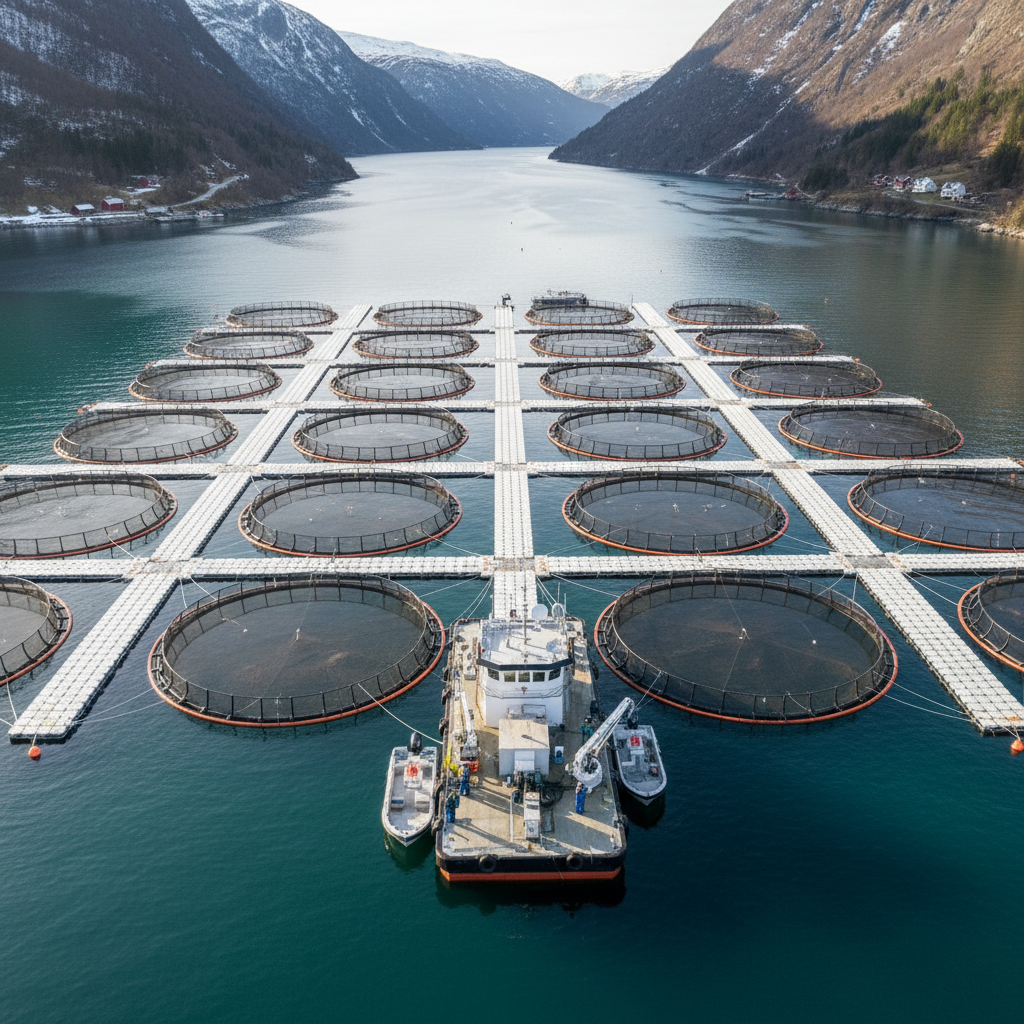
In the United States, the stakes are concentrated. NOAA reports $1.6 billion in US aquaculture production from 688 million pounds in 2023: just 9% of domestic seafood volume, but 25% of its value. High-value species demand compliance-grade operational data even before volume scales.
The Architecture That Works: Five Layers, One Loop
Every functional aquaculture data system, regardless of species, scale, or geography, needs five linked layers. Skip one and the loop breaks.
1. Observe
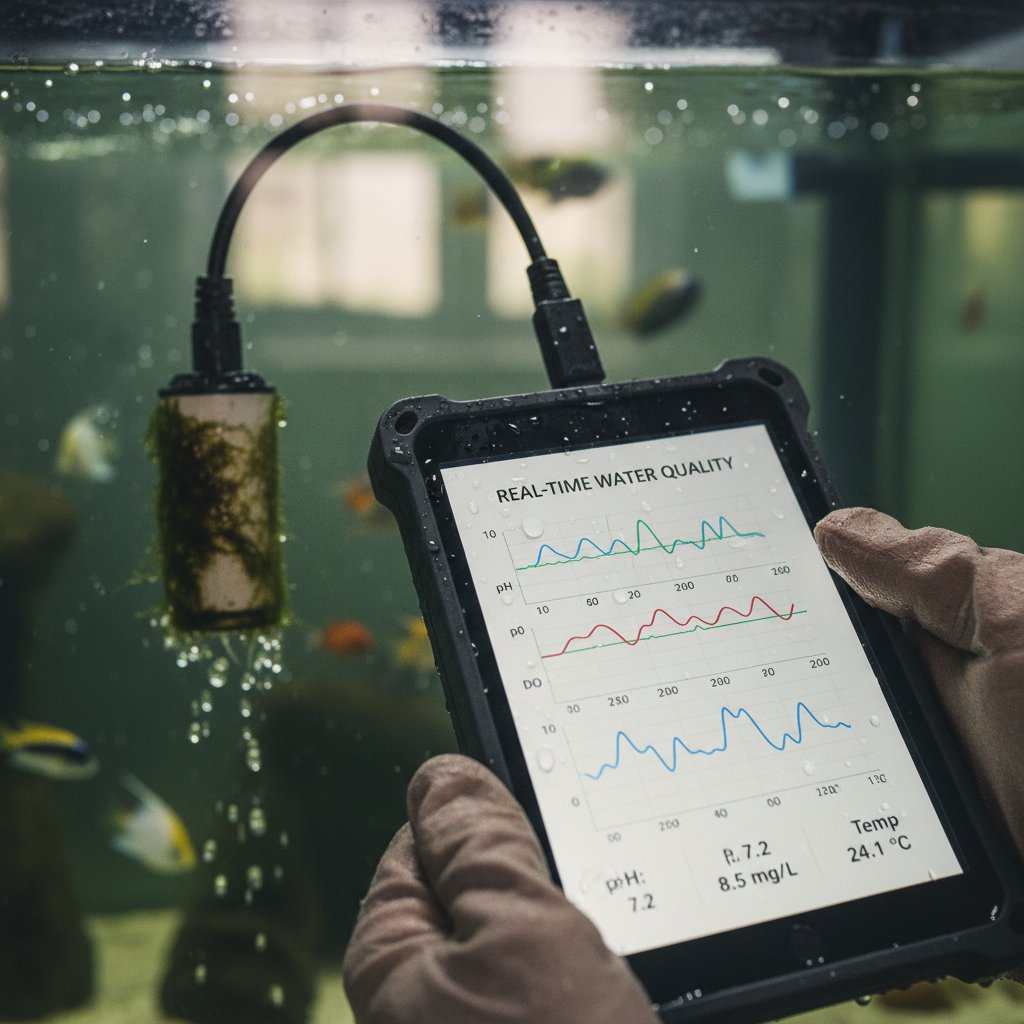
Probes, cameras, meters, buoys, weather feeds, laboratory tests, manual records, and equipment telemetry. ITU guidance for IoT-based smart aquaculture lists feeding sensors, water-level monitors, and water-quality probes covering temperature, pH, turbidity, carbonates, bicarbonates, and ammonia. Broader stacks add dissolved oxygen, salinity, fish behavior, biomass estimation, chlorophyll, nitrate, ammonium, and oxidation-reduction potential. YSI’s aquaculture monitoring systems demonstrate the range: portable, continuous, buoyed, and cloud-connected instruments measuring parameters from DO and conductivity to algae and nutrients.
The critical detail at this layer is not which parameter you measure. It is whether you retain the raw reading, the timestamp, the device identity, the calibration state, the location, the units, and a quality flag. Dashboards that display a final number without context are hiding the information you will need when something goes wrong.
2. Connect and ingest
Getting data off the farm and into a system that can use it. Wi-Fi, LoRaWAN, cellular, low-power wide-area networks, and satellite links each trade bandwidth against power, range, and latency. MQTT is the dominant lightweight protocol for device-to-platform communication in most reviewed IoT architectures.
The engineering rule: design for the outage, not the demo. Store-and-forward at the edge, health checks on gateways, and an offline operating mode are not nice-to-haves. In a marine or pond environment, they are the difference between usable data and gaps that corrupt every model downstream.
3. Store and standardize
ITU’s guidance is explicit: farm data should be stored in a common format regardless of device manufacturer, with redundancy, regular backups, and secure archiving. Time-series databases handle sensor streams well. Relational databases manage batches, lots, treatments, inventory, labor, and financial records. Object storage handles images, video, and lab files.
The decision that matters here is not which database engine to use. It is whether you can export your data, maintain its lineage, and move to another platform without starting over. Vendor lock-in at the storage layer is the most expensive mistake in IoT. I’ve seen it across aviation and logistics. Aquaculture is no different.
4. Interpret and decide
Simple thresholds and statistical process control handle basic alarms. Machine learning detects anomalies, forecasts harmful events, estimates biomass, classifies behavior, and recommends feed or oxygen interventions. Models should expose confidence levels, data freshness, missingness, and the reason an alert fired.
A farmer needs to distinguish a true biological event from a dirty lens, a drifting probe, a network outage, or unusual but harmless behavior. An opaque model that says “alert” without showing its evidence is a liability, not a tool.
5. Act and learn
The output: an operator alert, a feed adjustment, aeration activation, water exchange, dosing command, harvest decision, or a traceability record. ITU describes a system that predicts oxygen decline from rising temperature and automatically activates aeration. This type of closed-loop intervention represents the operational goal of aquaculture automation, where data triggers action without manual intervention.
Start with human approval for irreversible or high-risk actions. And every intervention should return an outcome to the data store. Did the aeration work? Did feed conversion improve? Did mortality drop? Without that feedback, the system learns nothing and the farm is paying for automation that cannot improve itself.
Data Quality Beats Algorithmic Sophistication
Here is where I see the same mistake across industries. A company buys the AI. The AI needs clean, labeled, continuous data. The sensors are fouled, the labels are inconsistent, the connectivity drops, and the model outputs garbage that looks credible because it lives inside a polished dashboard.
A bibliometric review of aquaculture IoT and machine learning research identifies limited annotated datasets, poor generalization across species and regions, sensor failures, lack of unified data standards, weak cloud integration, and few large-scale field-validated deployments as the dominant constraints. Not algorithm design. Data quality.
A model trained on one Norwegian salmon site can fail when turbidity changes, when the species is different, when the camera angle shifts, when genetics vary, when stocking density changes, or when operator practice differs. The algorithm didn’t get worse. The data context changed.
Practical implications:
- Establish calibration schedules and sensor replacement criteria before connecting to any analytics platform.
- Define how missing data is handled. Interpolation? Flagging? Exclusion? The choice changes every downstream result.
- Version your models. Know which data trained them. Know when they were last validated against field outcomes.
- Set a local benchmark before accepting a vendor’s accuracy claim. If a vendor reports 95% accuracy on their test set, measure what happens on your site, your species, your season.
Calibration, metadata, and data hygiene are more valuable than a new algorithm. They are also harder to sell, which is why you hear about them less.
AI in Aquaculture: What the Numbers Actually Say
A 2025 review of IoT, AI, and blockchain in aquaculture cites studies reporting more than 90% accuracy for early behavioral disease signs in salmon, 20% lower feed waste in controlled shrimp studies, and 95% predictive accuracy for adverse water conditions. Those numbers are real. They are also context-dependent.
“More than 90% accuracy” means different things depending on whether the metric is precision, recall, or F1. It matters whether the test set came from the same site and season as the training data. And it matters whether the 10% miss rate includes the type of event (a missed disease outbreak, for instance) whose cost dwarfs the savings from the 90% correct detections.
This is not a case against AI in aquaculture. It is a case for honest deployment:
- Run in shadow mode first. Let the AI score observations while staff continue existing checks. Measure false alarms, missed events, and labor impact over weeks, not days.
- Compare against the counterfactual. What mortality, feed waste, or energy cost would have occurred without the system?
- Expand automation only where field validation supports it. Edge decisions for oxygen and pump safety make sense when connectivity is intermittent. Automated feeding adjustments need more history and more caution.
The USDA Agricultural Research Service offers a concrete example. In 2024, ARS described MortCam, an AI-aided computer-vision system for real-time monitoring of fish health, size, and number in recirculating aquaculture systems. The system can reduce mortality events and improve production. But the published description reports capabilities and intended benefits, not controlled mortality percentages across species and sites. That honest framing is exactly how a farm should evaluate any vendor claim.
Digital twins: high potential, early innings
A 2025 review of digital twin technology in aquaculture finds adoption nascent, with current applications centered on real-time monitoring and system optimization. Proposed uses include feeding management, water-quality control, waste removal, energy management, and predictive disease intervention. The barriers are practical: synchronization with live systems, data quality, security, high initial and maintenance costs, legacy interoperability, and operator training.
Digital twins work best in controlled RAS systems with dense instrumentation and repeatable production cycles. If your sensor coverage is sparse and your identifiers change between batches, the twin is a visualization exercise, not a decision tool.
Edge vs. cloud: not either/or
Comparative studies report up to 50% lower latency and 70% less transmitted data with cloud-edge hybrids versus cloud-only designs. The practical split: edge processing for urgent safety decisions (oxygen collapse, pump failure, temperature alarms) when connectivity drops; cloud processing for fleet benchmarking, model training, long-term storage, and cross-site pattern recognition.
For farms in remote locations, edge capability is not optional. It is the difference between an automated response and a notification that arrives after the stock is dead.
Traceability, Security, and the Governance Gap
Traceability is becoming operational
Aquaculture traceability covers far more than a barcode on a finished box. GDST’s aquaculture guidance identifies feed sources, antibiotic use, water quality, and farm-management practices as part of the multidimensional record, following farmed seafood from hatchery to harvest. The standard uses GS1 Digital Link, JSON-LD, and alignment with EPCIS for interoperable machine-to-machine exchange.
In the US, FDA FSMA 204 requires covered persons handling Food Traceability List foods to maintain Key Data Elements tied to Critical Tracking Events: harvesting, cooling, initial packing, shipping, receiving, and transformation. Records must be available within 24 hours of an FDA request. The original January 2026 compliance date has a proposed extension to July 2028, but the regulatory direction is clear.
The operational opportunity: capture hatchery, feed, treatment, harvest, and shipping events at source. Forensic reconstruction after a recall is always more expensive and less reliable than continuous event recording. Companies that build traceability into production data (rather than bolting it on for compliance) gain recall speed, customer trust, sustainability evidence, and benchmarking capability at the same time. This overlaps closely with sustainability data management, where reliable operational records turn reporting into measurable improvement.
Security is a biological risk
A 2026 cybersecurity review identifies integrity attacks, network disruption, authentication failures, ransomware, and supply-chain compromise across sensor, cloud, blockchain, and digital-twin layers in aquaculture. The biological consequence sets this apart from a typical IT breach: a manipulated oxygen reading or a disabled pump can kill stock before anyone notices the data was wrong.
Controls that actually matter in the field: network segmentation, gateway-mediated sensor protection, mutual authentication, lightweight encryption adapted to low-power devices, secure remote access, intrusion detection, regular backups, incident response plans, and a safe manual operating mode. That last one is the most important. If your entire operation depends on a connected system with no manual fallback, you have built a single point of failure into a biological process.
What AquaCloud and eFishery teach about governance
AquaCloud represented the cooperative model: shared production, health, welfare, and environmental data from Norwegian fish farmers, standardized for collective learning. In January 2026, AquaCloud announced it was filing for bankruptcy, citing insufficient financing and industry support. Two months later, DNV entered an agreement to acquire the platform and integrate it into its Veracity cloud infrastructure.
The lesson is not that shared data platforms fail. It is that shared data infrastructure needs durable financing, clear participation commitments, data-owner controls, and an institutional home with the capital and security capacity to sustain operations. Technology was never AquaCloud’s problem. Governance was.
The eFishery episode adds another dimension. Reuters reported allegations of misconduct and the board’s appointment of FTI Consulting for an independent review. The data management lesson is direct: a connected operation can generate impressive volumes of operational data while presenting financial or impact claims that lack independent reconciliation. Audit trails, separation of duties, and controls linking device activity to reported outcomes are not optional features. They are the difference between data and theater.
What to Build First
If you are a farm operator scaling production, an enterprise consolidating sites, or a policy maker structuring regional data systems, the temptation is to start with the most advanced capability. Resist it.
Common identifiers first. Every batch, lot, tank, cage, device, treatment, and shipment needs a stable, unique ID that persists across systems. Without this, nothing integrates. GDST’s alignment with GS1 Digital Link exists precisely for this reason.
Offline and edge operation second. Design for the outage. Store-and-forward at the gateway. Manual fallback for safety-critical systems. If your data management breaks when the internet drops, it was not designed for aquaculture environments.
Explainable recommendations third. Any alert, feeding adjustment, or intervention recommendation must show its evidence: confidence score, data source, freshness, and the threshold that triggered it. A 2026 review of human-centered AI in aquaculture places explainability and meaningful human oversight alongside model performance as success criteria.
Secure data ownership fourth. Know where your data lives, who can access it, and whether you can export it. Contract terms should specify export formats, API access, data retention, and what happens to your data if the vendor is acquired or ceases operations.
A validated economic metric fifth. Pick the decision your data system will change. Feed conversion ratio? Mortality rate? Recall response time? Energy cost per kilogram? Measure it before deployment and after. If you cannot prove the change was caused by the data system, you are running on faith.
These five capabilities connect the physical farm to the commercial and regulatory supply chain. They also happen to be the capabilities that survive a sensor failure, a species change, a network outage, a recall, and an audit.
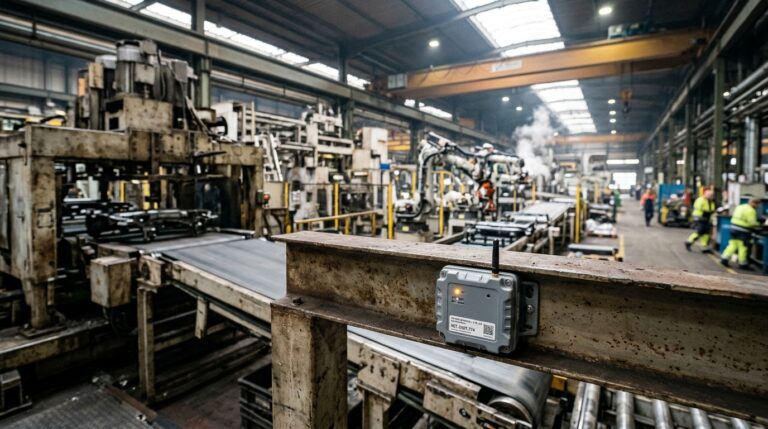
The hardware layer (sensors, trackers, and connectivity devices) is where this entire architecture begins. Whether you are tracking water quality across ponds, monitoring environmental conditions in transit, or keeping tabs on equipment that moves between sites, the device at the edge determines the quality of everything downstream. That is the work we do at Datanet IoT Solutions: deploying reliable, field-proven environmental monitoring hardware and asset tracking devices across industries where harsh conditions and unreliable connectivity are the norm. If your aquaculture data management starts with a gap at the sensor layer, let’s talk.
Frequently Asked Questions
What is aquaculture data management?
It is the full lifecycle of collecting, validating, storing, integrating, analyzing, securing, and acting on data from aquatic production and its supply chain. The Precision Fish Farming framework organizes it as Observe, Interpret, Decide, Act. It covers water quality, biology, feed, health, welfare, traceability, assets, energy, and commercial operations.
Is aquaculture data management the same as precision aquaculture?
No. Precision aquaculture is the narrower decision and automation layer (sensors, analytics, feeding control) built on managed data. Data management also covers schemas, identifiers, storage, backups, security, lineage, and governance. A farm can manage data without AI, but AI cannot function without managed data.
Which data should an aquaculture farm collect first?
Start with the variables tied to your highest-cost or highest-risk decision: dissolved oxygen, temperature, pH, feed amounts, mortality counts, and health events. Add biomass estimation, cameras, and laboratory data once you can define the specific action each measurement will change.
Does AI reliably reduce mortality or feed waste?
It can, under the right conditions. A 2025 review cites over 90% accuracy for early disease detection and 20% lower feed waste in controlled shrimp studies. Results depend on species, site, sensor quality, and study design. Validate locally, measure false positives and missed events, and compare against your baseline before expanding automation.
What does FDA FSMA 204 require for seafood traceability?
For foods on the Food Traceability List, covered persons must maintain Key Data Elements tied to Critical Tracking Events (harvesting, cooling, packing, shipping, receiving, transformation) and supply records to FDA within 24 hours. The proposed enforcement date is July 2028. Verify current rule status and your product scope before planning compliance.
What is the biggest implementation risk?
Poor data quality combined with weak governance. Research reviews consistently identify sensor failures, limited labeled data, poor cross-species generalization, missing standards, cyber threats, and skills gaps as the recurring constraints. A phased deployment with calibration, human oversight, security controls, and measurable outcomes is safer than a farm-wide automation launch.




 +1 508 292 2210

4 Responses